
Personal Finance
“The greatest economic boom in history”
I often feel like Archie Bunker.
The “All in the Family” TV character greeted Walter Cronkite’s news with raspberry snorts, frustration and contempt. I do the same thing when I hear politicians and commentators glumly bewail the end of the United States.
Many of the doomsayers are what I call “Flat-Earthers.” They deny human evolution, ignore scientific evidence and rail against technology with religious fervor. Most are angry men who long for the good old days and would rather live in a bubble than face the real world.
While this frustrates me sometimes, I take comfort in knowing that these people will sink into political, social and economic irrelevance in the next decade or two.
In other words, they cannot stop the accelerating pace of scientific discovery and technological innovation sweeping across our great nation.
Across the United States, in kids’ bedrooms, garages, dens, dorm rooms and classrooms, in every part of the country, American genius is building the foundation for the next great leap.
They will create the greatest economic boom in history, making us more-prosperous than any civilization in human history.
Mini-Supercomputers
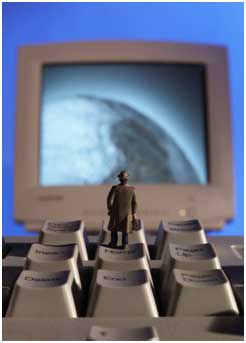 The revolution’s next chapter is beginning right now. Processing power that was unfathomable just a few years ago is now commonplace. The newest supercomputers in the laps of America’s brightest children and teens will become the catalyst for trillions of dollars of new wealth.
Last week Apple (AAPL) unveiled a desktop Mini-Supercomputer that is EXPONENTIALLY faster and more powerful than you can imagine.
For decades, these “supercomputers” were available only to a few governments, universities and large pharmaceutical and technology companies. In fact, the United States still enforces export restrictions to keep them from the hands of many foreign governments.
Now you can buy these powerful supercomputers via hundreds of websites and thousands of retail stores from Hoboken to Anchorage. The genie of computer power and processing speed is out of the bottle and in the imaginative hands of American kids and young adults.
The newest Apple supercomputers will be the first generation of faster, more powerful and eventual sentient computers that will accelerate science and innovation in giant leaps.
The great leap of computing power will create entire new industries, amazing economic efficiencies, and expand the limits of science.
Get Ready For Future Shock!
Change that would once take a century will soon unfold in a decade or less. Armed with supercomputers, a new and larger generation of geniuses will replace Steve Jobs, Bill Gates and Elon Musk. Utopian science fiction will become reality.
• Nanotechnologies will alter our minds, our intelligence, our memories, our metabolisms, our personalities and even extend our lifespans.
• Creative medical technology will vanquish illness, disease, starvation and poverty.
• New fuel technologies make the United States 100% energy-independent.
America’s next great leap will also help investors — like you and me — retire with security and wealth.
When I share my belief in America’s coming leap, friends ask how I can still be a gold bug. They ask me,
“James, don’t you preach buying gold and precious metals as a hedge against economic crisis and social chaos?”
Yes, buying precious metals to hedge against economic crisis and social chaos makes sense — but I recommend precious metals as only 10%-15% of any investment portfolio.
I also recommend gold because $150 trillion will flow into the world’s financial markets by the end of the next decade — while the supply of gold and precious metals grows just incrementally.
This vast new wealth will chase essentially the same amount of gold, silver and platinum. I buy gold and precious metals as a hedge but also as a long-term play on worldwide wealth creation.
I believe the bulk of your investment dollars should be solid technology, biotechnology, science and energy stocks.
Every Investor Should Read This Book …
My wife says I must have recommended Ray Kurzweil’s 2005 New York Times bestselling book, “The Singularity is Near,” to every person I’ve met since reading it.
Ray Kurzweil is America’s leading futurist. He is an author, inventor, and a director of engineering at Google (GOOG). Kurzweil is involved in fields like optical character recognition, text-to-speech synthesis, and speech recognition technology like Apple’s Siri.
 The Singularity is Near isn’t an investment book or even an economics book — but I consider it essential reading for every investor. Kurzweil describes the world to come and America’s next great leap.
As you read this book written eight years ago, you will see how some of Ray Kurzweil’s uncannily accurate predictions are already coming true. You will better understand his predictions for the next 40+ years.
Kurzweil describes “The Singularity,” a future utterly different from anything we can imagine. Supercomputers will accelerate change, making centuries of progress happen in only a few years. The remarkably rapid innovation Kurzweil predicts will change the world and enrich our country.
Kurzweil’s “The Singularity is Near” gives investors a broad outline of what is coming. Apple is a counterweight to the skeptics who dominate the stuff of our news media and political discourse.
Artificial intelligence, fantastic innovation, new wealth and much healthier, longer lives are right around the corner. Those who invest in this bright future now will be the ones who prosper.
Read Kurzweil’s book — then reflect and invest accordingly. Your life will never be the same.
James DiGeorgia
P.S. In just 12 hours, you will have missed out on 3 huge opportunities:
1. First, Tony Sagami is taking his new video, “How to Build a Bullet-Proof Portfolio,” offline, where you can learn how a simple scientific-investing formula can generate remarkable returns.
2. Second, this indicator just uncovered 2 new exciting opportunities … and he just released these newest recommendations a few hours ago.
3. Third, this is your last chance to claim your $1,105 gift just for watching my new video.
Here’s the thing — you only have until TONIGHT at 11:59 p.m. Eastern to take advantage of these profit-boosting opportunities.
There’s no guarantee that they will be available again anytime soon. So don’t wait — click this link to get in on Tony’s newest recommendations Today!

 Thirteen months ago in a Currency Currents I wrote a long piece titled, “Ben Bernanke – The Shadow Dancer.” I explained why QE3 would fail. If we look at the numbers globally since the advent of central bank QE over the past five years, we can see just how dramatically it failed.
Editor Note: Many stats in this issue come via Leto Research (not referenced in the piece). Thank you.

U.S. stocks rose, with the Standard & Poor’s 500 Index reaching a third straight record, as earnings from Pfizer Inc. to Xylem Inc. beat estimates and data indicating slower growth fueled bets the Federal Reserve will maintain stimulus.
“It still seems that the Fed has created this good news is bad news, bad news is good news scenario,” Randy Bateman, who oversees $15 billion as chief investment officer of Huntington Asset Advisors in Columbus, Ohio, said by telephone. “The anticipation is that the Fed will retain its purchasing of $85 billion in monthly Treasury and mortgage securities, which is going to continue to help the housing market. That will be taken fairly well by the market.”
The S&P 500 climbed in 12 of the past 14 sessions through yesterday, as companies beat estimates in the current earnings reporting season and signs of slower economic growth fueled bets the Fed will maintain stimulus measures after its two-day meeting that started today. The rally has pushed the index up 24 percent this year, leaving it poised for the best annual gain in a decade.

Let’s call it an energy shopping spree of sorts.
Last year, more than $10 billion poured from the pockets of Chinese investors seeking a stake in the U.S. energy sector.
And yet, for every cent they put toward U.S. shale projects, there was another patch of land attracting even greater attention…
Although it may be hard for some people to believe, given the fact that the media spotlight has been focused solely on the United States, the Chinese shelled out roughly $23 billion in Western Canada alone.
And that’s because for China, it’s all about natural gas right now.
More and More and More Gas
It’s easy to see where all this spending is taking us…
We can follow the money right to the Canadian frontier.
And China’s lust for North American energy is even more evident in the steps they’re taking at home.
A few weeks ago, I mentioned the ongoing war on smog being waged in Beijing. Perhaps the only way to turn the tide is to reduce the country’s dependence on coal. In order to cut their coal addiction, the Middle Kingdom is turning to natural gas.
This move is more serious than pledges and press releases. As it stands now, China can only import less than 26 billion cubic meters of LNG per year. However, within the next two years, that amount is expected to more than double — to nearly 65 billion cubic meters.
There is, of course, a major obstacle in China’s plans to implement natural gas on a grand scale, and that’s their serious inability to kick-start their own shale gas boom.
Here in the United States, we’ve been spoiled by the supply glut created from the dramatic ramp-up of shale gas production. On the other side of the globe, the Chinese are having problems producing their resources…
Even though they are sitting on a larger deposit of shale gas than Uncle Sam is (more than one quadrillion cubic feet of technically recoverable gas, according to the EIA), that doesn’t necessarily mean they can extract it.
(Don’t forget, it took George Mitchell nearly 20 years to get it right in the Barnett Shale.)
When it comes to drilling shale wells, cost is king. In the U.S., for example, wells in the Marcellus can run about $5 million apiece. So far, the handful of shale wells drilled in China has come with a price tag of almost $15 million per well.
Add to the fact that it’s taking more than three months to drill and complete each one, and that translates to the Chinese spending five times more andtaking four times longer than companies operating in the Marcellus Shale!
Barring a miracle, China will be forced to import a good deal of the natural gas it needs if it’s to meet the 230 billion cubic meters it expects to consume in 2015.
Follow the Money… Straight to Canada
It’s no coincidence China is quickly expanding its LNG import infrastructure. And I’ll give you one guess where the country will look to meet its supply shortfall…
British Columbia is home to the Horn River Basin, one of the largest shale gas deposits in North America. At last count, this area contains over 500 trillion cubic feet of natural gas underground.
While this figure doesn’t seem all that impressive when stacked against the 1,116 trillion cubic feet on the Asian continent, let me assure you that looks can be deceiving in this situation…
Because unlike China, where shale production is still a well of hopeful optimism right now, companies in British Columbia have 94 trillion cubic feet of recoverable gas on hand.
And we can take these potential investments in Canada’s burgeoning LNG industry a step further…
One of the biggest names right now in Canadian LNG is none other than Chevron. Back in February, Chevron became a 50% owner in the Kitimat LNG project in British Columbia.
Now, Chevron is great if you also happen to have a multi-decade time frame in mind.
Had you decided to invest in the source responsible for supplying Chevron with its natural gas, the results would have been drastically different.
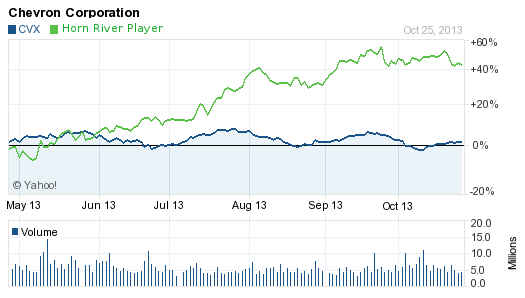
Then again, you wouldn’t be shelling out over $120 per share, either…
Not only is this company trading for ten times less than major oil companies like Chevron, but it’s also exploiting Big Oil’s biggest weakness: the crucial need for more gas to export.
The Horn River player above is doing precisely that, and it’s actually one of a handful of companies that will practically monopolize the entire LNG trade with Asia.
I suggest you take a few minutes to learn the details of this opportunity.
Until next time,

Keith Kohl
A true insider in the energy markets, Keith is one of few financial reporters to have visited the Alberta oil sands. His research has helped thousands of investors capitalize from the rapidly changing face of energy. Keith connects with hundreds of thousands of readers as the Managing Editor of Energy & Capital as well as Investment Director of Angel Publishing’s Energy Investor.For years, Keith has been providing in-depth coverage of the Bakken, the Haynesville Shale, and the Marcellus natural gas formations — all ahead of the mainstream media. For more on Keith, go to his editor’s page.


-
I know Mike is a very solid investor and respect his opinions very much. So if he says pay attention to this or that - I will.
~ Dale G.
-
I've started managing my own investments so view Michael's site as a one-stop shop from which to get information and perspectives.
~ Dave E.
-
Michael offers easy reading, honest, common sense information that anyone can use in a practical manner.
~ der_al.
-
A sane voice in a scrambled investment world.
~ Ed R.
Inside Edge Pro Contributors

Greg Weldon

Josef Schachter

Tyler Bollhorn

Ryan Irvine

Paul Beattie

Martin Straith

Patrick Ceresna

Mark Leibovit

James Thorne

Victor Adair