
Currency
Pension funds and US institutions are upping their wager on the US dollar as the funds bought the most dollar denominated assets since January of 2009.
Click here to read more.
Robert Levy
Border Gold Corp.
www.bordergold.com | 1.888.312.2288


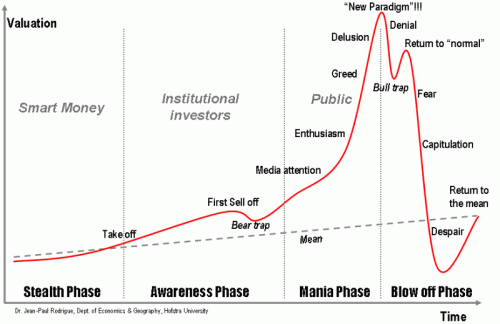
Richard Russell: “My thoughts go back to 1957. I wrote my first article for Barron’s in December of 1957, in which I noted that we’d never had a third speculative phase in that bull market. Soon a vicious recession was on, and everybody was bearish. I predicted that despite the recession, we would see a speculative third phase in the secular bull market. The third phase did come, and my forecast proved correct.
I’m wondering whether the same situation exists today, with the speculative third phase somewhere in our future. Despite the sluggish GDP, I believe you will see a third phase speculative blow-off in this bull market. Often in a bull market’s third phase, profits are larger than anything seen during the first and second phases of the bull market. For this reason, my current thinking is that subscribers should hold gold and DIAs. The last thing investors are expecting now is a profitable third phase explosion in stocks, and perhaps something close to hyperinflation in the money market.
I believe you see a phenomenon where increasingly bullish retail buyers are coming into this market, while at the same time institutional money is taking profits and moving to the sidelines. I expect this action to accelerate in the coming months, leading to an upside boom in stocks, along with a good deal of churning action. It is now recognized that the forces of deflation are pressing down on the US economy, and that more QE will be needed. This will halt deflation and gradually lead to inflation, finally being expressed as a boom in the stock market.
Thus the great bull market will end as all bull markets do: with a massive entrance of the retail public and subtle distribution by institutional money. Our subscribers’ choice: going into what appears to be a growing stock market bubble, or remaining in the universe of gold, which is acting as though it is at a bear market bottom.
As for gold, China is accumulating all it can at these attractive prices. It seems to me that China is intent on creating the world’s largest hoard of gold. The Golden Rule: “He who owns the gold makes the rules,” and owns the reserve currency … I think the present system has, in effect, been destroyed by more debt than we can handle. I think a new system will be required, a system based on gold, which will automatically put a brake on debt.”
To subscribe to Richard Russell’s Dow Theory Letters CLICK HERE.
About Richard Russell
Russell began publishing Dow Theory Letters in 1958, and he has been writing the Letters ever since (never once having skipped a Letter). Dow Theory Letters is the oldest service continuously written by one person in the business.
Russell gained wide recognition via a series of over 30 Dow Theory and technical articles that he wrote for Barron’s during the late-’50s through the ’90s. Through Barron’s and via word of mouth, he gained a wide following. Russell was the first (in 1960) to recommend gold stocks. He called the top of the 1949-’66 bull market. And almost to the day he called the bottom of the great 1972-’74 bear market, and the beginning of the great bull market which started in December 1974.
Letters are published and mailed every three weeks. We offer a TRIAL (two consecutive up-to-date issues) for $1.00 (same price that was originally charged in 1958). Trials, please one time only. Mail your $1.00 check to: Dow Theory Letters, PO Box 1759, La Jolla, CA 92038 (annual cost of a subscription is $300, tax deductible if ordered through your business).

The Indian government has restricted the importation of gold. So Indians have switched to silver:
“Starved of gold, Indians may import record volumes of silver
(Reuters) – Indian silver imports are on pace to hit a record high this year as the wedding and festival season drives up buying of the precious metal instead of the traditional gold, made scarcer and dearer by official measures aimed at cutting the trade gap.
Higher silver demand in the world’s biggest buyer may help support prices, which have fallen almost 30 percent this year on the international market and are on track for their biggest annual drop in almost three decades.
The increase in buying is unlikely to spark a fresh policy response from authorities, as in the case of gold, since the value of silver that is imported is far lower than that of gold and therefore not critical to the trade balance.
“There has been a massive improvement in silver imports and we will continue to see more. Investors are taking advantage of lower prices and the lack of restrictions on silver imports as of now,” said Harmesh Arora, director with the Bombay Bullion Association.
According to the GFMS metals consultancy, India imported 4,073 tonnes of silver from January to August, more than double the 1,921 tonnes in the whole of 2012, when a jump in prices in the peak season hurt demand. The record high was 5,048 tonnes in 2008.
India, also the world’s biggest buyer of gold, has raised the import duty on bullion three times this year, taking it to 10 percent, and in July the government told importers that a fifth of their purchases would have to be turned around for export, leaving only 80 percent for domestic use.
SECOND CHOICE
The import duty on silver was also raised to 10 percent in August from 6 percent, but prices remain far apart: gold is about 60 times more expensive than silver in dollar terms.Gold has a special place in Indian culture, bought as a hedge against inflation and traditionally used for gifts at weddings and festivals. Silver does not enjoy the same status.
The value of silver imports in 2012 was $1.8 billion, whereas gold imports cost $52 billion. Even record shipments of silver are therefore unlikely to put any strain on the trade deficit, in contrast to the impact of gold, which is India’s second-biggest import item after oil.
For now, much of the silver flooding in is finding its way to rural areas, where industry officials expect a surge in disposable incomes after a bountiful monsoon boosted agricultural harvests.
Some thoughts
Here’s a chart showing Indian silver imports since 2008. Note how they plunged in 2012, which might have had a bit to do with silver falling by over half from its $50 high.
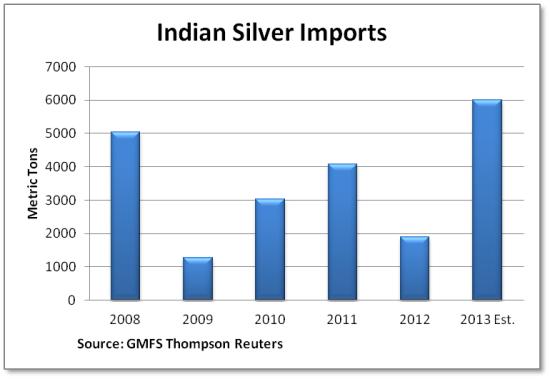
There are about 32,000 ounces in a ton, so India’s projected 2013 imports of 6,000 tons is nearly 200 million ounces. The total annual supply of silver is a billion ounces (750 million ounces from mines, 250 million from recycling). So 200 million ounces is 20% of total global supply – a lot of silver for just one country.
According to the Silver Institute, industrial users (including jewelry makers) absorb about 850 million ounces of silver each year, which leaves 150 million ounces for investors. But by importing 132 million more ounces this year than last, India is taking almost all of that surplus for itself, leaving the rest of the world’s silver bugs to scramble for what little is left.
Also interesting is the fact that silver is so cheap that a doubling of imports has a negligible impact on India’s balance of trade and therefore probably won’t attract the ire of regulators. So from a policy standpoint, restricting gold imports is working and will likely continue. That means the current level of silver demand might be sustained. Wonder where all the extra silver will come from?
ALSO ON DOLLARCOLLAPSE.COM
-
Another Reason to Worry About China 10 comments
-
Mass Delusion and the Myth of Deleveraging 22 comments
-
China Enjoying Gold Clearance Sale 23 comments
-
China’s Appetite for Gold: “Waning” or Surging? 4 comments

I want to give you an update on the commodity sector today. That way you will see the big picture as I do.
Most are saying the commodity super cycle — a rise in demand and prices — is over, that commodities are headed down for years to come. Not just gold, silver or other commodities like copper and foods, but the entire commodity complex is now going into hibernation.
The fact of the matter is nothing could be further from the truth. Not only are precious metals now in the timeframe for a major bottom — and the beginning of their next leg up — so are most other commodities.
The reasons are simple:
First, my war cycles and the turmoil the world is headed toward, especially Western governments and societies. Historically when the war cycles are ramping up — as they are now — commodities do well. Investors seek hard tangible assets, others scramble to secure as much supply as possible, and regional natural-resource wars break out. All of that is bullish for commodities.
Second, the crashing monetary system. As I’ve been telling you now for quite some time, the U.S. dollar will lose its reserve status. By 2016. As the monetary system crashes along with the dollar and a new monetary system is born, the uncertainty and volatility that will be seen during the evolutionary process will be very bullish for most commodities.
Third, inflation. Inflation will inevitably rise as well. And though I am not in the hyperinflation camp, faster inflation will be bullish for commodities.
 Fourth, the dismal state of supplies. The interim bear market of the past three years has crimped supplies in almost every commodity. Producers, not just miners, have had to shut down operations all over the world. Many have gone out of business, in every commodity. Miners, food producers, oil and gas exploration companies, and more have been shuttered by the dozens.
The big commodity firms that remain will not be able to pick up the slack or increase production all that much even as prices rise in the future. That means shrinking supplies, which is, of course, bullish for commodities.
Fifth, the ongoing rise of China and southeast Asia. Three billion of the world’s 7 billion people live in Asia. More than 40 percent of the world’s population. Anyone who thinks that their newly awakened souls are going to stop desiring better lives for themselves, their children and grandchildren, must be smoking something.
Asian demand is here now and it will accelerate higher in the months and years ahead. And Asian demand will remain a very strong force driving commodity prices higher in the future, even if the Western economies of Europe and the United States go down the toilet.
So what about commodity prices right now? Why are they mostly weak and falling? Oil is trading below $100. Grain prices are slipping and sliding. Base metal prices are weak. What gives?
Like gold and silver, we are in the tail end of disinflation. There will likely be further declines in the immediate future. Some will even be steep and startling, like oil, where I expect the price of crude to fall to near $60 before the energy market bottoms.
But the tail end of disinflation is what it is: a bottoming process. There’s still money to be made on the bearish side of commodities. But the really big money will be made getting in on the long side soon, in just about every commodity under the sun.
The thing is, unfortunately, most investors won’t profit from the next big move up in commodities. They will see the price declines of the next few weeks and call it a day — just when commodities are about to turn up again.
Or they will believe that any rise in interest rates will spell the death of commodities. Or they will see a rally in the dollar and believe that commodities themselves can’t rally.
I’m here to tell you again that nothing could be further from the truth. Instead …
 Rising interest rates should be music to your ears when it comes to commodities. Why? Because it means inflation will be ticking higher. Because it means the velocity or turnover of money is starting to increase. Because it means a heartbeat is coming back to the artificially depressed monetary environment, leading to increased demand, increased hoarding of commodities and more.
A stronger dollar will also be bullish for commodities. Exactly the opposite of what most believe is possible.
As I’ve told you previously, a stronger dollar means that Europe is going down the tubes. As Europe cracks at the seams, hundreds of billions of dollars will find its way back into commodity hedges.
A stronger dollar also means Washington will be going down the tubes as well. How so? When Washington is in trouble, hundreds of billions of dollars go into cash, and since the dollar — as flawed as it is — is still the world’s reserve currency, a flight of capital into cash means the dollar will strengthen. Naïve investors will interpret that as bearish for commodities. But what they won’t understand is that in addition to the hundreds of billions going into cash — there will be hundreds of billions more being invested by savvy money into commodities like gold, silver and other tangible assets.
Those savvy investors know that a rise in the value of the dollar at this point in the big macro-economic cycles also means that Washington is having trouble paying its bills, that Washington is about to collapse and that to preserve capital, alternative assets must be sought out. Not just cash but also tangible assets: commodities.
We are entering a period not seen since the middle of the Great Depression, between 1932 and 1937. It’s a period when what was once safe, becomes risky, and what was once risky, becomes safe. A period when the old rules of investing and trading are turned upside down, and inside out.
Keep that in the front of your mind, and not only will you survive it, but you will also become one of those savvy investors who thrives.
Best wishes,
Larry


-
I know Mike is a very solid investor and respect his opinions very much. So if he says pay attention to this or that - I will.
~ Dale G.
-
I've started managing my own investments so view Michael's site as a one-stop shop from which to get information and perspectives.
~ Dave E.
-
Michael offers easy reading, honest, common sense information that anyone can use in a practical manner.
~ der_al.
-
A sane voice in a scrambled investment world.
~ Ed R.
Inside Edge Pro Contributors

Greg Weldon

Josef Schachter

Tyler Bollhorn

Ryan Irvine

Paul Beattie

Martin Straith

Patrick Ceresna

Mark Leibovit

James Thorne

Victor Adair