
Stocks & Equities
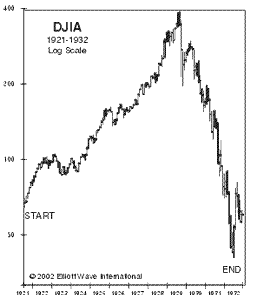 Since everyone is talking about stock market crashes this week, let’s add some context here…
Since the invention of the Dow Jones Industrial Average at the turn of the last century, there have been eleven instances in which stocks declined by more than 35% from peak to trough, or what you would term a market crash. We’ll talk about how the Dow Jones Industrial Average behaved during these crashes as it is ouR oldest index; there was no such thing as the S&P 500 until 1957 and the Nasdaq didn’t come along until later.
The most benign of these eleven crashes took place between January of 2000 and October of 2002. It lasted for 999 days and lopped off 37.8% of the Dow’s price, ending that fall at around 7286. The damage in the tech-heavy Nasdaq was obviously much worse but, unless you had abandoned all of your blue chips to chase dot com stocks exclusively, it wasn’t the end of the world. It should be noted that the tech crash was augmented by the uncovering of massive frauds at both Enron and WorldCom and punctuated with the September 11th attacks.
….read more HERE


“We went on a bond-buying spree that was supposed to help Main Street. Instead, it was a feast for Wall Street.”
By ANDREW HUSZAR, in charge of the Federal Reserve’s $1.25 trillion agency mortgage-backed security purchase program (QE 1) in 2009-2010.
 I can only say: I’m sorry, America. As a former Federal Reserve official, I was responsible for executing the centerpiece program of the Fed’s first plunge into the bond-buying experiment known as quantitative easing. The central bank continues to spin QE as a tool for helping Main Street. But I’ve come to recognize the program for what it really is: the greatest backdoor Wall Street bailout of all time.
Five years ago this month, on Black Friday, the Fed launched an unprecedented shopping spree. By that point in the financial crisis, Congress had already passed legislation, the Troubled Asset Relief Program, to halt the U.S. banking system’s free fall. Beyond Wall Street, though, the economic pain was still soaring. In the last three months of 2008 alone, almost two million Americans would lose their jobs.
The Fed said it wanted to help—through a new program of massive bond purchases. There were secondary goals, but Chairman Ben Bernanke made clear that the Fed’s central motivation was to “affect credit conditions for households and businesses”: to drive down the cost of credit so that more Americans hurting from the tanking economy could use it to weather the downturn. For this reason, he originally called the initiative “credit easing.”
My part of the story began a few months later. Having been at the Fed for seven years, until early 2008, I was working on Wall Street in spring 2009 when I got an unexpected phone call. Would I come back to work on the Fed’s trading floor? The job: managing what was at the heart of QE’s bond-buying spree—a wild attempt to buy $1.25 trillion in mortgage bonds in 12 months. Incredibly, the Fed was calling to ask if I wanted to quarterback the largest economic stimulus in U.S. history.
This was a dream job, but I hesitated. And it wasn’t just nervousness about taking on such responsibility. I had left the Fed out of frustration, having witnessed the institution deferring more and more to Wall Street. Independence is at the heart of any central bank’s credibility, and I had come to believe that the Fed’s independence was eroding. Senior Fed officials, though, were publicly acknowledging mistakes and several of those officials emphasized to me how committed they were to a major Wall Street revamp. I could also see that they desperately needed reinforcements. I took a leap of faith.
In its almost 100-year history, the Fed had never bought one mortgage bond. Now my program was buying so many each day through active, unscripted trading that we constantly risked driving bond prices too high and crashing global confidence in key financial markets. We were working feverishly to preserve the impression that the Fed knew what it was doing.
It wasn’t long before my old doubts resurfaced. Despite the Fed’s rhetoric, my program wasn’t helping to make credit any more accessible for the average American. The banks were only issuing fewer and fewer loans. More insidiously, whatever credit they were extending wasn’t getting much cheaper. QE may have been driving down the wholesale cost for banks to make loans, but Wall Street was pocketing most of the extra cash.
From the trenches, several other Fed managers also began voicing the concern that QE wasn’t working as planned. Our warnings fell on deaf ears. In the past, Fed leaders—even if they ultimately erred—would have worried obsessively about the costs versus the benefits of any major initiative. Now the only obsession seemed to be with the newest survey of financial-market expectations or the latest in-person feedback from Wall Street’s leading bankers and hedge-fund managers. Sorry, U.S. taxpayer.
Trading for the first round of QE ended on March 31, 2010. The final results confirmed that, while there had been only trivial relief for Main Street, the U.S. central bank’s bond purchases had been an absolute coup for Wall Street. The banks hadn’t just benefited from the lower cost of making loans. They’d also enjoyed huge capital gains on the rising values of their securities holdings and fat commissions from brokering most of the Fed’s QE transactions. Wall Street had experienced its most profitable year ever in 2009, and 2010 was starting off in much the same way.
You’d think the Fed would have finally stopped to question the wisdom of QE. Think again. Only a few months later—after a 14% drop in the U.S. stock market and renewed weakening in the banking sector—the Fed announced a new round of bond buying: QE2. Germany’s finance minister, Wolfgang Schäuble, immediately called the decision “clueless.”
That was when I realized the Fed had lost any remaining ability to think independently from Wall Street. Demoralized, I returned to the private sector.
Where are we today? The Fed keeps buying roughly $85 billion in bonds a month, chronically delaying so much as a minor QE taper. Over five years, its bond purchases have come to more than $4 trillion. Amazingly, in a supposedly free-market nation, QE has become the largest financial-markets intervention by any government in world history.
And the impact? Even by the Fed’s sunniest calculations, aggressive QE over five years has generated only a few percentage points of U.S. growth. By contrast, experts outside the Fed, such as Mohammed El Erian at the Pimco investment firm, suggest that the Fed may have created and spent over $4 trillion for a total return of as little as 0.25% of GDP (i.e., a mere $40 billion bump in U.S. economic output). Both of those estimates indicate that QE isn’t really working.
Unless you’re Wall Street. Having racked up hundreds of billions of dollars in opaque Fed subsidies, U.S. banks have seen their collective stock price triple since March 2009. The biggest ones have only become more of a cartel: 0.2% of them now control more than 70% of the U.S. bank assets.
As for the rest of America, good luck. Because QE was relentlessly pumping money into the financial markets during the past five years, it killed the urgency for Washington to confront a real crisis: that of a structurally unsound U.S. economy. Yes, those financial markets have rallied spectacularly, breathing much-needed life back into 401(k)s, but for how long? Experts like Larry Fink at the BlackRock investment firm are suggesting that conditions are again “bubble-like.” Meanwhile, the country remains overly dependent on Wall Street to drive economic growth.
Even when acknowledging QE’s shortcomings, Chairman Bernanke argues that some action by the Fed is better than none (a position that his likely successor, Fed Vice Chairwoman Janet Yellen, also embraces). The implication is that the Fed is dutifully compensating for the rest of Washington’s dysfunction. But the Fed is at the center of that dysfunction. Case in point: It has allowed QE to become Wall Street’s new “too big to fail” policy.
This column appeared in the Wall Street Journal on November 11, 2013.”

 “It will end badly” Look at China, its credit as a percent of the economy has increased by 50 percent in the last 4-1/2 years. This is the fastest credit growth you can imagine in the whole of Asia,”
“It will end badly and the question is whether we will have a minor economic crisis and then huge money printing or get into an inflationary spiral first,”
“Why are so many product prices in Singapore and Hong Kong more expensive than in the U.S.? It’s because when you have asset inflation and high property prices, shops have to pay higher rents, so they charge more for their products. So asset inflation can flow into consumer inflation,”
“Today there are “bio printers” that print a layer of a patient’s own cells onto a 3-D-printed “scaffold” of inert material. Once the cells are in place, they can grow into an organ, with bladders and kidneys already demonstrated in the lab. Print with stem cells, and the tissue will form its own blood vessels and internal structure.”
The Transformative Tech Of 2015-2025 & Your Chance To Invest Today.
- The Alchemist’s Dream — “indistinguishable from magic”
- Desktop factories… desktop hospitals… and more!
“Tea. Earl Grey. Hot.”
When Capital Jean-Luc Picard wants a steaming beverage in his ready room aboard the Starship Enterprise, he just utters those words. The ship’s “replicator” then assembles the necessary atoms — including those for the cup — and produces it, ready for the drinking. Picard thinks nothing of it — it’s hardly more remarkable to him than a microwave oven is to us today. Just as we now use radio waves to excite atoms and generate heat in our own kitchens (which would have been mind-blowing in the 1950s), his replicator uses some fancy energy technology that is never quite specified in Star Trek: The Next Generation to get atoms to self-assemble into food and drink.
 That’s science fiction, but it’s actually not impossible. When you see an industrial 3-D printer working today, with a little poetic license you can glimpse the beginnings of something similar. A bath of liquid resin lies inert, a primordial soup. A laser begins tracing patterns in it, like lightning. Shapes form and emerge from the nutrient bath, conjured as if by magic from nothing.
Okay, poetic license revoked — we’re still a long way from molecular self-assembly, or at least in any useful way. A 3-D printer can only work with one material at a time, and if you want to combine materials you need to have multiple print heads or switch from one to another, like the different color cartridges in your desktop inkjet printer. We can only work at a resolution of about 50 micrometers (the thickness of a fine hair), while nature works at a thousand times finer detail, of a few tens of nanometers. And there’s nothing self-assembling about the way a 3-D printer works: it does all the assembling itself, with the brute force of a laser solidifying a powder or liquid resin, or melting plastic and spreading it down in a fine line.
But you get the point. We can imagine something, draw it on a computer, and a machine can make it real. We can push a button and an object will appear (eventually). As Arthur C. Clarke put it, “any sufficiently advanced technology is indistinguishable from magic.” This is getting close.
You may think of 3-D printing as bleeding-edge technology today, the stuff of high-end design workshops and geeks. But you may have encountered a 3-D printer already, in ways so prosaic you didn’t even notice.
Take custom dental fittings, such as those that change the alignment of the teeth over months with a series of slightly different mouth guards, each of which shifts the teeth imperceptibly into a new position, In that case, a dental technician scans the current position of your teeth, then software mathematically models all the intermediate positions to the desired endpoint. Finally, those positions are 3-D printed plastic as a series of mouthguards that you wear, each for two or three weeks, until your teeth are in the new position.
Likewise for the prototypes of practically every gadget you’ve ever bought, and the architectural models for the newer buildings around you. Custom prosthetics are 3-D printed, if you’re lucky enough to have a dentist who can replace a crown in a single sitting, that’s probably 3-D printed (they sprayed with enamel) in the office. Doctors have printed and replaced an entire human jaw from titanium.
Today, you can buy a custom 3-D printed action figure of your World of Warcraft character or your Xbox Live avatar. And if you go to Tokyo, you can have your head scanned and you can buy a photorealistic action figure of yourself (try not to get too creeped out).
Commercial 3-D printing only works with a few dozen types of materials, mostly metals and plastics of various sorts, but more are in the works. Researchers are experimenting with more-exotic materials, from wood pulp to carbon nanotubes, which give a sense of the scope of this technology. Some 3-D printers can print electrical circuits, making complex electronics from scratch. Yet others print icing onto cupcakes and extrude other liquid foods, including melted chocolate.
At the huge scale, there are already 3-D printers that can make a multistory building by “printing” concrete. Right now that requires a 3-D printer the size of the building, but it may someday be built into the cement truck itself with a concrete that uses positional awareness to decide where to put down concrete and how much, directly reading and following the architect’s CAD plans.
Meanwhile, researchers are working just as hard at moving in the other direction: 3-D printing at the molecular scale. Today there are “bio printers” that print a layer of a patient’s own cells onto a 3-D-printed “scaffold” of inert material. Once the cells are in place, they can grow into an organ, with bladders and kidneys already demonstrated in the lab. Print with stem cells, and the tissue will form its own blood vessels and internal structure.
Today’s vision for 3-D printing is grand in ambition. Carl Bass, the CEO of Autodesk, one of the leading companies making 3-D authoring CAD software, sees the rise of computer-controlled fabrication as a transformative change on the order of the original mass production. Not only can it change the way traditional consumer goods are made, but 3-D printing can also work on scales as small as biology and as large as houses and bridges.
In an essay he published in the Washington Post, Bass explained what’s so different about this way of making things:
The ability to produce a small number high quality items and sell them at reasonable prices is causing an enormous economic disruption. In it, you can see the future of American manufacturing.
In a computerized manufacturing process like 3-D printing, complexity and quality come at no cost… A traditional paper printer can print a circle or a copy of the Mona Lisa with equal ease. The same rule applies to a 3-D printer.
From a design perspective, this is revolutionary. It is no longer necessary for the designer to care or know about the manufacturing process, because the computer-controlled machines figure that stuff out for themselves. The same design can be fabricated in metal, plastic, cardboard, or cake icing (it might not be very useful in all those materials, but it would exist.). “We can separate the design of a product from its manufacture for the first time in history, because all of the information necessary to print that object is built into the design.” Bass explained.
Even better, as 3-D printers proliferate and become used for small-scale bespoke or custom-made manufacturing, they can provide a more sustainable way of making things. There are little or no transportation costs, because the product is made locally. There is little or no waste, because you use no more raw material than you need. And because the product is custom-made just for you, you’re more likely to value it and keep it longer. Personalized products are less disposable; you simply care about them more.
Rich Karlgaard, the publisher of Forbes magazine, thinks that 3-D printing “could be the transformative technology of the 2015-2025 period.” He writes:
This has the potential to remake the economics of manufacturing from a large scale industry back to an artisan model of small design shops with access to 3-D printers. In other words, making stuff, real stuff, could move from being a capital intensive industry into something that looks more like art and software. This should favor the American skill set of creativity.
But also remember what 3-D printing and any other digital production technique cannot do. They offer no economies of scale. it is no cheaper on a per-unit basis to make a thousand than one. Instead, they offer exactly the opposite advantage: there is no penalty for changing each individual unit or making just a few of a kind.
It is the reverse of mass production, which favors repetition and standardization. Instead, 3-D printing favors individualization and customization. The big win of the digital manufacturing age is that we can have our choice between the two without having to fall back on expensive handcrafting: both mass and custom are now viable automated manufacturing methods.
Regards,
Chris Anderson
for Tomorrow in Review
(This essay was excerpted from Chris Anderson’s book, Makers: The New Industrial Revolution.)
Ed. Note: We believe that 3-D printing not only has a chance to materially improve peoples’ day-to-day lives… but also make gobs of cash for investors who have the foresight to put their money into certain industry pioneers. If you’re curious, our in-house expert has estimated you stand to make upwards of $50,000 from this technology.
He’s listed his analysis for you, right here.
Thank you for reading Tomorrow in Review. We greatly value your questions and comments. Click here to send us feedback.


-
I know Mike is a very solid investor and respect his opinions very much. So if he says pay attention to this or that - I will.
~ Dale G.
-
I've started managing my own investments so view Michael's site as a one-stop shop from which to get information and perspectives.
~ Dave E.
-
Michael offers easy reading, honest, common sense information that anyone can use in a practical manner.
~ der_al.
-
A sane voice in a scrambled investment world.
~ Ed R.
Inside Edge Pro Contributors

Greg Weldon

Josef Schachter

Tyler Bollhorn

Ryan Irvine

Paul Beattie

Martin Straith

Patrick Ceresna

Mark Leibovit

James Thorne

Victor Adair