Asset protection

Investor Implications Scottish Independence YES Vote Panic

scotland-trojan-horse-bank-of-englandThere is PANIC in the air as the NO Campaigns 20% opinion poll lead at the start of 2014 has now completely evaporated as the YES campaign edges into the lead with just 12 days to go.

“Whether the 300 year old United Kingdom lives or dies will be determined by as few as 4.5% of the British electorate on September 18th as only the people of Scotland, some 9% of the UK electorate have been afforded the luxury of deciding what happens to the United Island of Great Britain, and that if the tunnel visional nationalist have their way they would succeed in setting in motion its termination starting the morning of 19th of September when the world that Brit’s have know for centuries starts to unravel.”

“90% of North Sea oil revenues come from Scottish waters”

….continue reading more from the Market Oracle  Scottish Independence YES Vote Panic – Scotland Committing Suicide and Terminating the UK?


Scottish Independence Vote: Investor Implications

By: Axel G. Merk, Merk Investments

Is your portfolio’s fate dependent on Scotland’s? Why is it that when a place known for haggis, kilts and bagpipes indicates it might want to be independent, the markets pay attention?

The usually rather boring pound sterling jumped to life in recent days, becoming one of the world’s most volatile currencies. The trigger was a poll that suggested that the pro-independence camp in Scotland might hold the upper hand in the September 18, 2014 vote. Until recently, that event risk had not been priced in. All else equal, greater volatility warrants a lower price for an instrument (a security or currency). Prudent risk management takes into account the riskiness of the instrument.

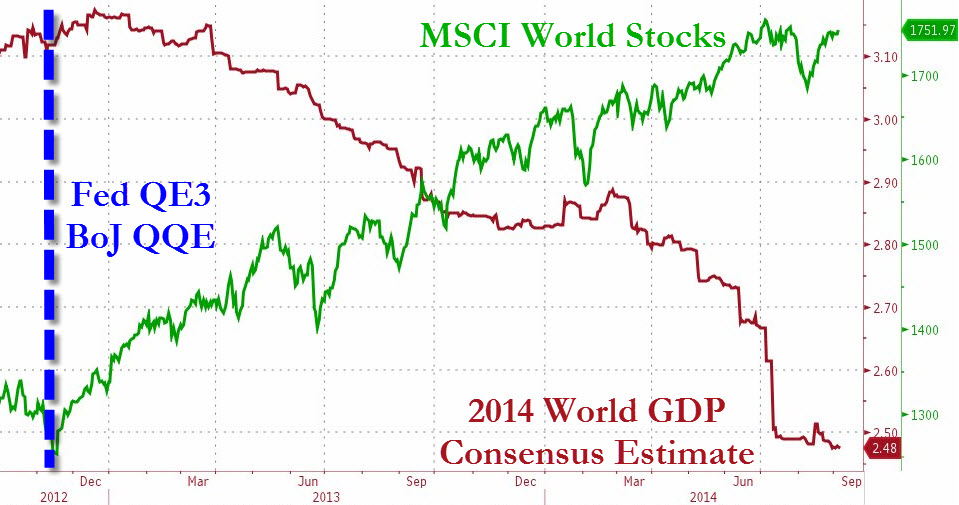
Before we discuss specifics for Scotland, I would like to remind everyone that we are literally asking to be surprised by event risks of this sort in general as markets have been rather sleepy- evidenced by low volatility. In our assessment, this lull is a direct result of quantitative easing and related efforts by central bankers around the world that make risky assets appear less risky. Except, of course, the world is a risky place. So when something does pop up, the markets are taken by “surprise.” Just as the sterling fell sharply, the same could happen to the S&P 500 or any other investment. After all, keep in mind that the independence vote is not news; neither is the fact that the yes-vote has been gathering steam. In this complacent market environment risks are being suppressed until they can’t be ignored any longer – then they break out with a vengeance. It’s in this context that investors may want to stress test their portfolios in general- the lack of volatility in your portfolio may be deceiving.

Event risk means that once the event is over, reality ought to settle in. If the vote is NO, i.e. Scotland remains part of the UK, it might cause a relief rally in the sterling. However, if the vote is YES, the outcome isn’t all that obvious. Notably, while everyone is now glued to watching each poll, is Scottish independence, in the short-run might mean more uncertainty as it could trigger, amongst others, a challenge to Prime Minister David Cameron’s government; there’s also a lot of uncertainty around what might happen to the North Sea oil assets. But let’s not forget that Scotland comprises less than 10% of Britain’s GDP. Let’s also not forget that when a country splits up, there may be a flight of mobile capital to the stronger. While Scots rightfully show that that they do quite well based on numerous economic measures, the vulnerability remains with Scotland, as it has to play catch-up with institutions building: what happens if depositors move their deposits from Edinburgh to London? An asset-liability mismatch for the financial sector could be rather precarious as the Scottish financial system is about thirteen times Scotland’s GDP. If there is no access to a lender of last resort, it could destabilize Scotland.

The European Union, in our assessment, will initially play tough, arguing that Scotland will have to apply (and fulfill all criteria) to become an EU member, but ultimately would like an independent Scotland to become a member. Conversely, Scotland may try to take hostage some oil assets. In short, it will be haggling over haggis – a solution to many issues will be negotiated. This would take time.

There’s a silver lining in all of this:


  • Greater volatility is good. It’s not good for asset prices, but it’s good for the price discovery process and, as such, the long-term health of one’s portfolio. It’s not healthy that risky assets appear almost risk free, as it encourages capital misallocation, thus inducing bubbles and subsequent crashes.
  • Greater volatility is good for currency investors. You may argue you don’t care about those currently speculators, but you should, as 30% to 50% of international equity returns are due to currency moves. If you hedge out currency risk you are missing opportunities. If you ignore currency risk, you are taken for a ride. Active management of currency risk is something prudent investors may want to consider – and the latest flare-up may be the canary in the coal-mine that it’s about time investors take currency risk seriously.
  • Opportunities are being created. The same poll that suggested Scots will vote for independence also suggested 44% of Scots believe Scotland would be worse off economically as an independent country (vs 35% thinking Scotland would be better off); similarly, 41% of Scots thought they would be personally worse off with Scotland as an independent country (21% thought they would be better off). To me this suggests a proud Scot may well indicate in a poll that they favor independence, but it doesn’t mean they’ll vote that way. In a world where asset prices are expensive, it’s refreshing to see value opportunities in the markets. And if there’s a ‘YES’ vote, the opportunity may get even better.


On Tuesday, September 16, 2014, please join me for a “fireside chat.” We will make most of the hour available for you to ask questions. Please register to participate. We no longer record our webinars (the regulatory overhead is too much hassle), so join live to get answers to the questions you always wanted to ask.

If you haven’t done so, also make sure you sign up for Merk Insights. If you believe this analysis might be of value to your friends, please share it on your favorite social media site.

Axel Merk

Axel Merk is President and Chief Investment Officer, Merk Investments, 
Manager of the Merk Funds.


Single Most Bullish Precious Metals Factor Imaginable

Since my sophomore year in college what I’ve loved most is analyzing economics, finance and corporate fundamentals.  The 1987 crash occurred when I was still a clueless high school senior, but by the time I started my first internship in 1989 – at Paine Webber, cold calling certificates of deposit yielding 6% – I was reading the Wall Street Journal daily and daydreaming of working at Goldman Sachs.  My first decade in the business was highly optimistic, but by the time Goldman actually offered me a job in May 1998, I already disliked them so much, no amount of money could have sealed the deal.  Instead, I worked for Salomon Smith Barney – owned by none other than what has turned out to be the nation’s most destructive financial force outside JP Morgan and Citigroup.

In the ensuing 16 years, the business I once loved was utterly destroyed by the “1%” running such firms; with Citigroup’s own Sandy Weill spearheading the 1999 repeal of Glass-Steagall; which, in hindsight, was the single most destructive economic act of our lifetimes.  By the time I left Wall Street in 2005, equity research had been long discredited; and by the time I left mining investor relations to join Miles Franklin in 2011, the Wall Street institution was permanently lost to corruption.  More ominously, its traditional economic roles of capital formation and allocation were no longer necessary; as following two decades of offshoring “productivity” gains and the emergence of Eastern hemisphere powers like China, America’s economic empire was in irreversible decline.  This is when TPTB realized the only way to maintain the status quo – or more appropriately, “kick the can” that last mile – was exponential growth of money printing, market manipulation and propaganda.  This is how dying empires collapse; and oh yeah, fiat currency Ponzi schemes in their terminal stage.

Today, 25 years from that Paine Webber internship with CD yields at 0% and in danger of turning negative, I still love financial analysis more than anything.  However, now that markets are rigged, my finance degree, CFA degree and 15 years of buy- and sell side experience have been rendered moot.  Thus, I’ve been forced to build an “alternative” analytical mosaic; which fortunately, is not immune to the forces of “Economic Mother Nature.”  Using it, as well as common sense, I have been consistently correct in my expectations of global economic growth; and via this mosaic, I have never been more negative about the world’s short- and intermediate-term outlooks.  As for the long-term, I have not the slightest idea when prosperity will return.  However, what I do know is that until today’s global fiat Ponzi scheme inevitably implodes, prosperity is not possible.  This is why I hold 90% of my liquid net worth in physical gold and silver; as when the dollar, Euro, yen and other fiat trash are dramatically devalued in the coming years, they are theonly assets guaranteed to maintain purchasing power.

Which brings me to today’s very important topic.  Not that we haven’t spoken of it countless times before; but as a new world-threatening “episode” has emerged, with the prospect of violently expanding in the coming months it appears to be a good time to speak of it.  Which is the economically catastrophic impact of fiat currency volatility, particularly relative to the dying universally despised “dollar.”

Yesterday, I read an article titled “Germany loses the battle for the ECB, as QE goes global.”  Essentially, it was referring to the virulent “final currency war” we have been writing of for years.  In other words, in the final cancerous stage of the fiat Ponzi scheme, global economic growth has been so badly crippled, politicians and Central bankers are resorting to dramatic currency devaluations in the hope of gaining all-important manufacturing market share – and thus, “jobs.”  The fact that inflation erodes the value of such gains and prompts draconian retaliation by other nations – in the form of “competitive currency devaluations” – bothers them not, so long as said jobs are produced.

Unfortunately, this deadly “zero sum” game is infamous for not only destroying capital, but prompting economic – and often military – wars.  This is why global unrest has not been this ubiquitous in generations, and why World War III is just one “black swan” event away.  Currency volatility makes it nearly impossible to build a long-term corporate strategy and wreaks havoc with earnings – particularly, at companies whose financial departments are too “cute” with hedging strategies, which by and large fail miserably.  This is the legacy of a world gone mad in which not a single currency is backed by anything but the “full faith and credit” of corrupt, uncaring, financially unsophisticated governments which cede unlimited money printing authorization to bankers incentivized to generate inflation for their own interests.

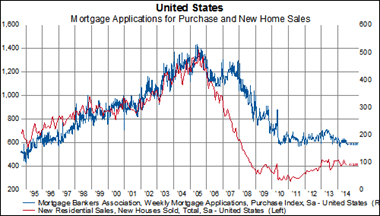
Regarding economic activity, what more damning statement can be made than the below chart, of the supposedly strongest sector of the supposedly strongest nation; let alone,this fantastic article by David Stockman of the true state of U.S. employment decay?  Meanwhile, Europe’s widely watched Sentix Investor Confidence Index plunged this morning from 2.7 in August to -9.8 in September, whilst Japanese capital spending was reported to have experienced its largest decline since the “deer in headlights” economic trough of 1Q09.  In other words, “it” appears to be starting – which is why you mustconsider protecting your assets as soon as possible!

US-Chart

In our view, the “single most bullish PM factor imaginable” is the catastrophic economic dislocation, political and social tension and inflation caused by the currency volatility inherent in all fiat currency regimes.  Such volatility increases as their inevitable end approaches; and the current “emerging market” currency plunge – catalyzed by Draghi doing “whatever it takes,” and the Bank of Japan on the verge of same – is the fourth such episode in the past five years.  In last year’s “Inflation and Arab Spring,” we wrote of how such volatility – which always effects lesser “non-reserve” currencies first – creates massive inflation surges, nearly always followed by social unrest.  This time around with sovereign balance sheets and economies in dramatically worse shape, we shudder to think how inflationary – and potentially, hyperinflationary – the coming round of massive Central bank money printing will be.  And yes, that goes for the “tapering” Federal Reserve as well.

Is this week’s U.S. rate surge (albeit, quite modest in absolute terms) due to better economic prospects (NO!), Fed manipulation or otherwise?  Who knows; but as is becoming quite evident, next week’s Scottish independence referendum has emerged as quite the “black swan” candidate.  Amidst such a capricious global economic situation, such an event could send shock waves through financial markets – particularly the other “supposedly” strong nation, England.  Of course, in reality, England’s economy is in the same sorry shape as ours – with its only “bright spot” being the same high-end real estate bubble as the one the Fed has created here; which, by the way, was deflatingbefore the potentially catastrophic “Yes Scotland” movement gained steam.  More importantly, the inevitable secession – and expulsion – movements I first wrote of in 2011’s “unprecedented” are clearly gaining momentum; which is probably why Spanish bond yields had their biggest spike in 15 years this week – and why nations like Italy, states like California and various other municipalities are in danger of monstrous yield spikes in the coming months.

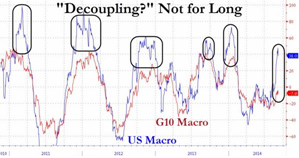
In the past month, the “dollar index” has risen modestly from 81 to just over 84; in other words, solidly within the 70-90 range it has traded within for the past decade.  However, the inflationary impact of such a move cannot be underestimated.  In the case of Europe, the euro’s recent plunge will likely generate the inflation Draghi so desperately wants, even before ECB QE starts in October.  In Japan, which not only broke through long-term support at 105/dollar this week, but 106/dollar as well, it may well be that the “real Yen bomb starts now.”  And as for U.S., said dollar “surge” will cause dramatically weaker earnings for the multi-national corporations dominating the economic landscape; which, given unparalleled equity overvaluation and economic data “decoupling” could prove catastrophic to TPTB’s “recovery” illusion,” no matter how hard their “PPT teams” huff and puff.

Such dramatic economic shifts, in turn, will warrant retaliation by the Fed – in the form of further monetary easing, yielding increased money printing by the countless nations “pegged” to the dollar – such as China; and so on and so on.  In other words, the latest round of “emerging market” currency collapses – which cumulatively, have shaved nearly 40% of purchasing power versus the dollar in the past three years – has the potential of catalyzing the “big one”; from which, when it commences, there will be no possibility of reversal or escape from regional hyperinflation.

20140905 moneyfornothing

Decoupling-Not-For-Long

And when the “big one” inevitably occurs, there will no longer be even the slightest doubt of what the true definition of “inflation” is.  Or, for that matter, that the “dollar index” is not how one should measure the dollar’s strength – but instead, the real items of value it buys or won’t buy – such as history’s only real money, physical gold and silver.  To that end, we hope you will consider protecting yourself before it’s too late; and if you do, that you’ll give Miles Franklin celebrating our 25th year of business the opportunity to earnyour business.

Andrew C. Hoffman, CFA

Marketing Director

Miles Franklin Ltd.

goldsilverdealer-1

ahoffman@milesfranklin.com

www.milesfranklin.com


Craig Burrows on Private Equity

craigburrows

For many people, the past decade has been a time of anxiety, fear, and frustration. My personal emotion was one of frustration. I was frustrated with the lack of accountability, transparency, and astuteness of the financial industry. The idea of a financial adviser not having any accountability for the welfare of my investments and more importantly, the astuteness to warn me of possible dangers in my portfolio mix was a constant bother. It bothered me so much that I stopped investing in the public markets.

I came across the private equity market due to some of my wealthy friends who seemed to have that “inside track” or being invited to participate in “President’s Lists”. The problem with this market, I found it shrouded in secrecy and had no or little transparency. For the unsophisticated investor, you took your chances with little recourse or liquidity if things went bad.

No wonder people have had to be contented with low returning products like GICs or term deposits. We saw our nest eggs shrink and our retirement line moved farther ahead. We should be embracing our retirement years instead of thinking that being a greeter in a large retail chain seems like a sad reality. There must be a balance between private and public markets.

I believe that many people are like me; hard-working, honest, and want a fair return on their savings. I have also learned that there are great investments to be had if you’re willing to look and are financially savvy. The question is what if you don’t know where to look? What if someone could provide a service that could manage investments and were committed to being astute, accountable, and transparent?

Creating TriView has been a labour of love. We found the right partners that share the same vision but bring different strengths to the table. From an experienced portfolio manager and Investment Bankers that ensure we offer the right product to the right client. These partners have combined to raise over $6 billion in the private market space, have reviewed hundreds of opportunities and have the discipline when to invest and when to walk. All of our investments opportunities are vetted before they are ever offered to our clients.

We have a former Securities Commission Enforcement Officer dedicated to compliance and ensuring that our clients have a well-balanced, diversified portfolio that is personally designed for their needs. Lastly, we want to share our knowledge with our clients. We don’t want you to simply trust us with your money; we want to educate you so we earn your trust through providing solid returns while protecting your principal. This is about being transparent and accountable.

We see a tremendous opportunity to invest in private and alternative investments over the next five years. We want to offer you another option to your current financial portfolio. Contact us today at www.triviewcapital.com to learn more about why the most astute and conservative investors, pension & endowment funds, are increasingly moving assets into this financial sector.

Craig Burrows

Co-Founder, President & CEO, TriView Capital Ltd

TriView Capital Ltd. is a registered EMD across Western Canada

CDN Real Estate: Another Step Down

764087 orig

The Canadian Real Estate
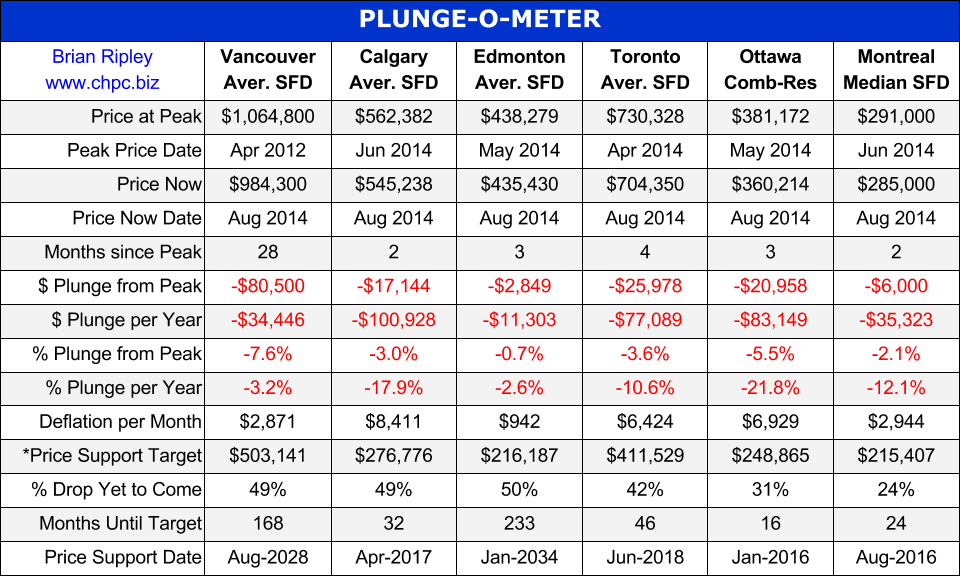
PLUNGE-O-METER

1680109 orig

The Plunge-O-Meter tracks the dollar and percentage losses from the peak and projects when prices might findsupport. On the price chart in the spring of 2005 there was a 4-6 month plateau period while buyers and sellers twitched like a herd. When the credit spreads narrowed and the yield curve began its journey towards inversion, the commodity stampede began.
 
Ottawa data are Combined Residential (not SFD) and Montreal data are Median (not Average) *The Price Support target represents prices at March 2005; the start of a 40 month period of ardent speculation in all commodities; then a full blown crash into the pit of gloom (March 2009); and then another 39 month rocket ship to the moon but then the crowd suddenly thinned out in April 2012. The revival of spirits erupted in 2013 as globalmoney went short cash and long real estate on an inflation bet. See Whale Watching.

Plunge-O-Nomics

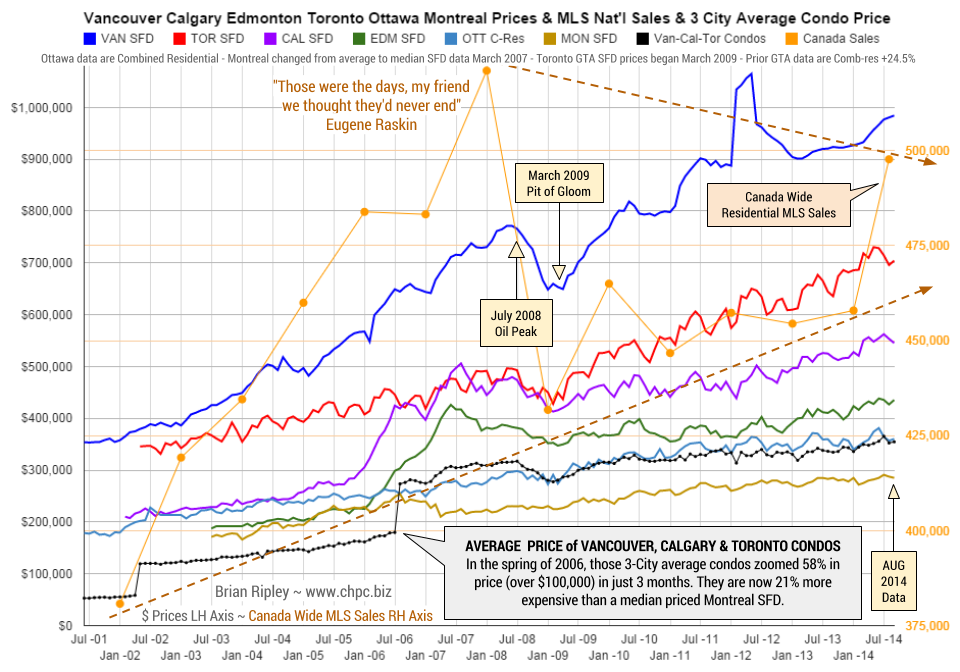
In case you have forgotten the depth and velocity of the previous market reversal when Canadian real estate prices plunged in 2007-2008 (chart); householder equity vanished as follows:

  • ’07-’08 Average Vancouver SFD lost $122,900, or 15.9% in 8 months (2%/mo drop)
  • ’07-’08 Average Calgary SFD lost $92,499, or 18.3% in 18 months (1%/mo drop)
  • ’07-’08 Average Edmonton SFD lost $78,719, or 18.5% in 21 months (0.9%/mo drop)
  • ’07-’08 Average Toronto SFD lost $63,867, or 13% in 13 months (1%/mo drop)
  • ’07-’08 Average Ottawa Residence lost $25,664, or 8.6% in 6 months (1.4%/mo drop)
  • ’07-’08 Median Montreal SFD lost $6,000, down 2.6% in 6 months (0.4%/mo drop)

Another Observation: oil spikes and real estate (TSX Chart)

  • 2008 Vancouver down 16% in 8 mos
  • 2008 Calgary down 14% in 8 mos
  • 2008 Toronto down 14% in 9 mos
  • 2008 TSX RE down 51% in 10 mos
  • 2011 Vancouver down 2% in 6 mos
  • 2011 Calgary down 10% in 8 mos
  • 2011 Toronto down 7% in 3 mos
  • 2011 TSX RE down 6% in 4 mos

The Tech Bubble Blowout…

…occurred in March of 2000 and since then we have had serial bubbles globally (Financial Assets, Commodities & Real Estate). Prior to 2000, Japan and the USSR blew out in the late 1980’s and the Asian crisis occurred in the late 1990’s. More recently Argentina defaulted in 2001-02 and now European taxpayers are on the hook for public and private mal-investment. Commodities peaked July 2008 and the U.S. 7-10 year Treasury Bond prices peaked in May 2013.

Real estate has boomed and plunged in select markets with awesome volatility since the early 2000’s atop a huge edifice of debt that is only being propped up by the willingness of fewer and fewer buyers who think that prices will never collapse despite recent history being full of examples of the opposite (California, Florida, Detroit, Japan, Dubai, Greece, Ireland, Spain, etal). 

Rising prices allow both the private and public sectors to over-leverage and with it comes speculative fervor that leads to prices rising further. But when prices decline then market sentiment changes and real estate becomes a slow moving asset class as debt revulsion sets in and fundamental illiquidity leads to asset re-pricing. At that point there is only one viable solution and that is for debt to be transformed into equity, and that occurs either by the debt being repaid slowly, or written off quickly.

In the sell-off phase, governments (who do not issue their own non-convertible currency eg: Greece, Spain and Italy, ie: members of the Eurozone) and corporations and individuals who defer repayment with more leverage (bailouts, bond issuance, secondary financing) are simply delaying the date of foreclosure, increasing the amount of potential asset destruction or lengthening the time and amount of repayment with valuable income streams that could have been used for productive investment (Canadians are producing more weapony and less infrastructure). Increasing debt leverage only works when prices are rising.

With respect to housing, there are much better mortgage models to follow than CMHC’s tax payer “insurance”. See the Danish Mortgage Finance Model where the combined loss ratio for all Danish mortgage credit institutions (MCIs) has never exceeded 1% in any one year – a number most other countries can only dream of.

A change in taxation policy is also needed. The way that government collects tax is highly inequitable. For an elegant solution see the APT (Automatic Payment Transaction) which would eliminate the tax complex. Gone would be personal, corporate, property, estate, capital gain, income, sales, excise and all manner of taxes or levies disguised as fees as well as the elimination of tax returns, deductions and special interest exemptions.

Implementation of this simple idea in Canada would allow Canadians to create an original, authentic social organization that would eventually be copied by all other nations. Let’s apply the power of the internet to build better housing, financing and taxation institutions. Canadians, write your Member of Parliament.


Sprott’s Charles Oliver: Gold at $1,500 by Christmas?

Charles Oliver rev 10-23-12Gold and silver prices are being repressed by central banks, but Sprott Asset Management’s Charles Oliver argues that demand pressure will cause this dam to burst sooner rather than later. As a result, he expects big increases in the prices of gold and especially silver, with a corresponding recovery of small- and mid-cap precious metal equities. In this interview with The Gold Report, Oliver discusses companies likely to prosper thereby, most of which will be profitable now, even at current bullion prices.

COMPANIES MENTIONEDASANKO GOLD : DALRADIAN RESOURCES : GUYANA GOLDFIELDS : OSISKO GOLD ROYALTIES : PRETIUM RESOURCES :SILVER WHEATON : TAHOE RESOURCES : UNIGOLD

The Gold Report: Gold continues to languish under $1,300 per ounce ($1,300/oz), even as full economic recoveries in the U.S. and the European Union (EU) have yet to occur, despite trillions in new debt and stimulus. Meanwhile, we have two wars in the Middle East that could escalate, as well as reports that Russian troops are in Ukraine. With all that in mind, do you think that gold’s fundamentals are less important than they once were, or is the price of gold being held back by other factors?

Charles Oliver: Gold is just as valuable today as it was 100 years ago. There was an orchestrated takedown of gold in April 2013. It has since traded between $1,200/oz and $1,400/oz, and this flies in the face of the conditions you mentioned.

We’re going to have to be patient. We have gone through a bottoming process. We’ve had similar conditions before. In 1974, after the oil embargo, U.S. inflation was increasing dramatically, yet gold fell from about $200/oz to about $100/oz in 1976. Then over the next four years gold subsequently rallied to over $800/oz. In this decade, gold has fallen from $1,921/oz to $1,180/oz, but the fundamentals remain intact, and gold will regain its reputation as a unique store of value.

TGR: You used the phrase “orchestrated takedown.” Do you agree with the thesis advanced by the Gold Anti-Trust Action Committee (GATA) that gold and silver prices are manipulated downward by central banks?

CO: A decade ago I was on the sidelines. Then, after 2008, when the Federal Reserve gave us quantitative easing (QE) 1, 2 and 3 and increased its balance sheet by $4 trillion, effectively fixing the bond market and price, I became convinced that GATA was correct. All the price-fixing scandals we’ve seen are not isolated incidents. The gold market is a relatively small one. When 400 tons of gold rapidly came onto the market in April 2013, I was persuaded that this was definitely an orchestrated takedown.

TGR: Can this gold repression be maintained, or is it a dam about to burst?

CO: I like that metaphor. Eric Sprott did an analysis that suggested that a fair amount of the gold putatively held by the Federal Reserve may not actually be in its vaults. Footnotes in the Fed’s records indicate possession of about 8,000 tons but also suggest that some of that might have been loaned out. We don’t know how much, but supply-and-demand numbers suggest it could be a very significant amount. I believe that the gold exchange-trade funds (ETFs) were raided because gold could not be found where it was supposedly held, so it was taken from the ETFs instead.

Much of the gold sold out of Western vaults has found its way into Asia, China in particular. To run a trading platform requires a certain amount of physical bullion to meet delivery demands. If deliveries cannot be met, confidence in the system will fail, and paper trading will dry up. I must say I was quite surprised that after Germany asked for its gold back from the U.S. and it was informed that delivery would take seven years, the market did not suddenly unravel. Nevertheless, I believe the central banks are running out of bullets, and when they do, we could see a very significant rise in the gold price.

TGR: Is control of the gold bullion market shifting from London to Shanghai?

CO: The amount of trading in Shanghai is increasing, and I would imagine that the gold bullion repositories in London are diminishing. Over time, control of many components of the world economic system will shift to Asia as it becomes a more powerful entity on the global stage.

TGR: As mentioned earlier, central banks continue their attempts to force demand, yet economic recoveries remain elusive. How will this play out?

CO: QE was a dirty word five years ago, but today governments tout it as a triumph, even though the economies are still not that healthy, while record-low interest rates and record-high stimulus will continue. The U.S. is currently winding down QE, but the EU looks as if it may start up. I do believe that the U.S. may once again ramp up QE because its interest rate policy hasn’t worked.

Countries are debasing their currencies, which leads to investors moving into hard assets, as confirmed by U.S. stock indexes reaching record levels. We saw this in the Weimar Republic in Germany, when stocks soared because they were inflation hedges. A collapse in confidence in paper money is not something I want to see. If that happens, all bets are off. In the meantime, currency debasement should lead to a recovery in the values of gold, silver and other precious metals.

TGR: Do you anticipate higher gold and silver prices following the historic return of market interest in September?

CO: I think there is a very real chance that gold might hit $1,500/oz by the end of the year.

TGR: It is has been reported that higher tariffs on gold buying in India have resulted in the substitution of silver for gold there. Do you think this will spur a higher silver price and that the current gold/silver ratio of 1:66 will fall as a result?

CO: We have seen in India an increase in silver purchases. That said, the gold purchase figures from India do not include smuggling, which soared in the 1990s and is rising again.

At Sprott, we believe very strongly that the next decade will see the gold/silver ratio move toward its historic rate of 1:16. The last time this happened was in 1980, when the gold price was $800/oz and the silver price was $50/oz. Under this scenario when the gold prices rise to $1,600/oz, I could expect silver to hit $100/oz. That would be a 500% increase in the silver price, versus a 30% increase in the gold price. I have taken a fairly significant weighting in the silver sector.

TGR: Gold equities outperformed bullion by a significant margin earlier this year. Can we expect more of this, or is the value of gold equities now constrained by the current gold price?

CO: The gold price bottomed out in December 2013, and as a result, gold equity valuations were destroyed. To some extent, the outperformance we’ve seen in 2014 is a return to more normal valuations, but a continuation of this trend will require higher bullion prices.

TGR: When the Sprott Gold & Precious Minerals Fund considers the companies it holds, which qualities are paramount?


CO: We look first to management. We want management teams with track records of performance, teams with share ownership of their companies. A deposit’s geology is just as important. Without the geology there is no mine, there is no cash flow, there are no profits. We evaluate ore bodies by all the various parameters: quality, strip ratios, underground versus open pit, access to water and power, ease of permitting and local taxation regimes. Finally, we examine a company’s valuation and how it compares to its peer groups. That includes dividends, cash flow, cash-flow growth and many other aspects.

TGR: Which gold and silver companies are your favorites?

CO: Within my top 10, I have Osisko Gold Royalties Ltd. (OR:TSX) and Tahoe Resources Inc. (THO:TSX; TAHO:NYSE). They both have great management. Tahoe is run by Kevin McArthur, the ex-CEO ofGoldcorp Inc. (G:TSX; GG:NYSE) and Glamis. Osisko is run by Sean Roosen, who discovered and built the Canadian Malartic mine in Québec.

Among explorers, other companies in my top 10 include Guyana Goldfields Inc. (GUY:TSX), run by Scott Caldwell, whose CV includes Kinross Gold Corp. (K:TSX; KGC:NYSE) and Freeport-McMoRan Copper & Gold Inc. (FCX:NYSE), and Dalradian Resources Inc. (DNA:TSX), run by Patrick Anderson, who built up Aurelian Resources, which was sold to Kinross.

TGR: Why do you like Tahoe and its Escobal silver mine in Guatemala?

CO: I visited the mine in March and was very impressed. The company has ramped it up over the last year, and the process has been almost flawless. Tahoe has delivered what it promised and is exceeding guidance. It looks to produce 20 million ounces (20 Moz) silver equivalent at below $5/oz for over a decade. This is one of the largest producing silver mines on the planet, and to accomplish that in the first year of operations is outstanding.

TGR: How does Tahoe’s balance sheet look?

CO: Tahoe is going to be paying down the debt it took on to build Escobal. It should announce a dividend sometime this year.

TGR: Does operating in Guatemala negatively affect Tahoe’s valuation?

CO: There is a discount, no question about it. There was local opposition to Escobal, and there are still holdouts, but I think the company has done a good job with community relations and brought most of the population to its side.

TGR: Guyana is another burgeoning mining jurisdiction. What impresses you about Guyana Goldfields and its Aurora gold project?

CO: I’ve been a shareholder for many years. The management and board of directors are large shareholders and have participated in the most recent round of financing to a large degree. Guyana Goldfields has a nice asset in Aurora: 6.54 Moz Measured and Indicated, and 1.8 Moz Inferred. The after-tax internal rate of return (IRR) is great at 31%, as is the net present value (NPV) at $735 million ($735M). Aurora is fully funded, and the engineering, procurement and construction management contracts are complete. Guyana Goldfields is building the mine.

TGR: When will mining begin, and how much gold will be produced annually?

CO: Commercial production is scheduled for mid-2015. The number of ounces per year will depend to a certain extent on whether they go underground or not, but first-year production is estimated at 126,000 oz (126 Koz), ramping up to about 300 Koz by year six or seven. Aurora has a 17-year mine life, and all-in sustaining costs will be lower than $700/oz.

TGR: If Guatemala and Guyana are burgeoning jurisdictions, then Northern Ireland is virgin territory. What impresses you about Dalradian’s Curraghinalt gold project there?

CO: The management has been buying into the company, and Curraghinalt is an exceptionally high-grade underground deposit. The after-tax IRR and NPV are exceptional as well. Based on $1,378/oz gold, they are 41.9% and $467M, respectively. There is some concern about opening a mine in Northern Ireland, but they are gaining the goodwill of the people, and permitting is moving forward.

TGR: The company closed a $27M financing at the end of July. How does it stand for cash?

CO: That placement gives Dalradian the cash and permits it needs to fund its current underground exploration bulk sample program. I think this stock is extremely undervalued.

TGR: Let’s talk about some of your fund’s other holdings.

CO: Asanko Gold Inc. (AKG:TSX; AKG:NYSE.MKT) is in my top 15 companies. It features top-notch management, including much of the ex-team of LionOre Mining International Ltd., which was bought out by Norilsk Nickel (GMKN:RTS; NILSY:NASDAQ; MNOD:LSE) after a bidding war with Xstrata Plc (XTA:LSE). Asanko’s team paid about $30M to take over Keegan Resources, which merged with PMI Ventures and now owns two Ghana deposits within 10 kilometers of each other. They can be processed by the same plant. The company has begun construction of its first phase of the Asanko gold mine at Obotan.

This is a very cheap stock. In fact, before the merger with PMI, Keegan was trading very close to cash. It has great assets, and I have a big position in it.

TGR: Asanko announced Aug. 27 it has eliminated a 2% net smelter royalty (NSR) on the Asanko gold mine. Is this good news?

CO: I am always happy when companies can buy back royalties at a reasonable price, because NSRs skim the cream off the top.

TGR: Your fund holds Pretium Resources Inc. (PVG:TSX; PVG:NYSE). In June, the Supreme Court of Canada awarded substantial, yet undefined, rights to native Indians on British Columbia’s Crown Lands. This was followed in August by the tailings spill at Imperial Metals Corp.’s (III:TSX) Mount Polley mine. What implications do these two events have for mining in British Columbia?

CO: They are very negative. It will be more costly, time consuming and challenging to build mines in British Columbia. That said, Pretium’s Brucejack has a great many positive attributes. It is a very small, very high-grade gold-silver mine with a very small environmental footprint. So tailings will be a relatively smaller issue for Pretium. Indeed, it is so high grade that dry-stack tailings may be possible.

On permitting, Brucejack was a historic mine as recently as the 1980s, which will make approvals easier to get. The project is going underground, so Brucejack will not have one of those big open pits that some people do not like.

TGR: Pretium’s gold and silver assays have been spectacular for several years, but many people point to this resource as being nuggety. Could you speak to this issue?

CO: They’re absolutely correct, but many nuggety gold deposits have been produced successfully in the past, and they will continue to be produced successfully in the future. Brucejack has the advantage that it has seen a surprisingly large number of high-grade nugget hits. The resources are there. Mining this project may result in some lumpy quarters, but I do believe that the mine will be permitted and will be very profitable.

TGR: Let’s discuss gold explorers in your portfolio.

CO: Unigold Inc. (UGD:TSX.V) is one of them. The company is drilling a very prospective land package, the Neita concession, in the Dominican Republic. Unfortunately, there is not much financing available to the small-cap sector. For companies like this to recover, we’ll need higher gold and silver prices.

TGR: The company announced in November 2013 an initial Inferred resource of 2 Moz. Yet shares are trading at $0.04. Can this be attributed to the specifics of Neita?

CO: No, it’s the market, which currently is paying nothing for ounces in the ground.

TGR: This bear market in junior precious metals companies is now 3.5 years old. How long will it continue?

CO: As I said at the beginning, we could have $1,500/oz gold by Christmas. Should gold reach that price, interest in juniors will revive, and valuations will come up quite dramatically.

TGR: Do you see any potential takeover targets among the companies we’ve discussed so far?

CO: Dalradian, Guyana and Asanko could all be targets.

TGR: The gold and silver royalty/streaming sector has done quite well compared to the general market. Will this continue?

CO: This sector will continue to grow and prosper but is somewhat countercyclical. The best time for such companies is when the general market dries up, when companies cannot access capital and are forced to sell royalties or streams. And so the last two to three years have been very good for royalty streaming companies. Higher gold prices will result in higher profits for this sector, but I expect the mid- and small-cap mining companies will do better in relative terms.

TGR: Pierre Lassonde of the World Gold Council told The Gold Report in May he believes that the relatively small size of its market will compel silver streamers to move into gold contracts. Do you agree?

CO: I do. I have long thought that limiting a company to gold or silver is not completely logical, although I don’t believe it’s in the interest of gold and silver companies to move into base metals. I would expect that over time we will see companies such as Silver Wheaton Corp. (SLW:TSX; SLW:NYSE) take on more gold transactions.

TGR: What’s your opinion of Silver Wheaton?

CO: It has been one of the best performers over the last few years. Silver streamers do not run much risk of operating overruns and higher costs. It’s a nice business when you know you’re going to get a profit, and the only question is how big it will be.

TGR: Are you bullish on Silver Wheaton going into the future?

CO: I am, but given the higher bullion prices I’m expecting, my preference is for increasing my weights in some of the midtiers.

TGR: Osisko Gold Royalties is a newcomer to the streaming sector. It has a 5% NSR on the Canadian Malartic mine and 2% NSRs on the Upper Beaver and Kirkland Lake properties and on the Hammond Reef project. Will it aggressively seek further streams?

CO: The management team has significantly invested in the company, and I think they will take their time and do what they think is appropriate. I do expect, however, that significant assets will be acquired in the next year.

TGR: Even before the takedown of the gold price, precious metals valuations collapsed, and the last few years have been dire for many investors in gold and silver companies. What are the reasons for investors to feel positive?

CO: We’ve seen an awful lot of capitulation. Barrick Gold Corp. (ABX:TSX; ABX:NYSE) just announced it will eliminate its entire corporate development team. I’ve lost a lot of good friends and analysts who have left the industry. These are all signs of a bottom.

I look around the world and see European Central Bank President Mario Draghi talking about rolling out QE. I see the continual debasement of currencies. And I see China buying gold left, right and center. I am convinced that gold and silver and precious metals equities will recover in the not-too-distant future.

TGR: Charles, thank you for your time and your insights.

Charles Oliver joined Sprott Asset Management in 2008. He is lead portfolio manager of the Sprott Gold and Precious Minerals Fund. Previously, he was at AGF Management Limited, where his team was awarded the Canadian Investment Awards Best Precious Metals Fund in 2004, 2006 and 2007. His accolades also include Lipper Awards’ best five-year return in the Precious Metals category (AGF Precious Metals Fund, 2007) and the Lipper Award for best one-year return in the Precious Metals category 2010.

Want to read more Gold Report interviews like this? Sign up for our free e-newsletter, and you’ll learn when new articles have been published. To see recent interviews with industry analysts and commentators, visit our Streetwise Interviews page.

Related Articles


DISCLOSURE: 
1) Kevin Michael Grace conducted this interview for Streetwise Reports LLC, publisher of The Gold Report, The Energy Report, The Life Sciences Report and The Mining Report, and provides services to Streetwise Reports as an independent contractor. He owns, or his family owns, shares of the following companies mentioned in this interview: None. 
2) The following companies mentioned in the interview are sponsors of Streetwise Reports: Tahoe Resources Inc., Guyana Goldfields Inc., Asanko Gold Inc., Pretium Resources Inc., Unigold Inc. and Silver Wheaton Corp. Goldcorp Inc. is not associated with Streetwise Reports. Streetwise Reports does not accept stock in exchange for its services.
3) Charles Oliver: I own, or my family owns, shares of the following companies mentioned in this interview: None. I personally am, or my family is, paid by the following companies mentioned in this interview: None. My company has a financial relationship with the following companies mentioned in this interview: None. Sprott funds hold all of the companies mentioned. I was not paid by Streetwise Reports for participating in this interview. Comments and opinions expressed are my own comments and opinions. I had the opportunity to review the interview for accuracy as of the date of the interview and am responsible for the content of the interview. 
4) Interviews are edited for clarity. Streetwise Reports does not make editorial comments or change experts’ statements without their consent. 
5) The interview does not constitute investment advice. Each reader is encouraged to consult with his or her individual financial professional and any action a reader takes as a result of information presented here is his or her own responsibility. By opening this page, each reader accepts and agrees to Streetwise Reports’ terms of use and full legal disclaimer.
6) From time to time, Streetwise Reports LLC and its directors, officers, employees or members of their families, as well as persons interviewed for articles and interviews on the site, may have a long or short position in securities mentioned. Directors, officers, employees or members of their families are prohibited from making purchases and/or sales of those securities in the open market or otherwise during the up-to-four-week interval from the time of the interview until after it publishes.




test-php-789