
Timing & trends
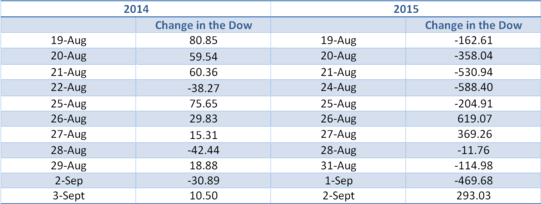
Twelve months ago the world was happily sailing along in the Great Moderation, with financial markets that moved gracefully higher most of the time but even in their rare negative moments didn’t cause too much angst. The eleven trading days leading up to September 3 saw not a single triple-digit move on the Dow, and only three down sessions.
What a difference a year makes. During the same eleven days in 2015 the Dow had exactly one single-digit close — and eight 200+ point sessions. Stomach-churning descents into the abyss are followed the next day by epic recoveries. The only thing moving in a straight line is volatility.
This is what the world looks like when things stop working. China’s well-oiled, top-down export machine turned out to be the mother of all Ponzi schemes. The Fed is tipping into the next crisis without reloading its interest rate bazooka. The US political process is suddenly interesting in the bad sense of that word. Brazil is not well-run after all. Japan’s Abenomics is appearing in headlines with the word “failure”.
The markets can’t figure out whom to trust — or indeed if anyone can be trusted. So money is sloshing around looking for a place to hide. One day it’s Treasuries, the next day blue chips or tech. But none turn out to be warm, dry and quiet, so the search continues.
If this sounds a lot like 2008 heading into the “one day away from martial law” Wall Street coup, that’s because in many respects that time and this one match up perfectly. All that’s missing from the present is a stock market crash.

 While business cycles are a normal part of life (there have been 22 recessions in the U.S. since 1900), many businesses are woefully unprepared for shocks and will pay the ultimate price in the months and years ahead. As Milton Friedman articulated, they will become victims to “the tyranny of the status quo” by thinking it was safer to stay the course, rather than adapt… CLICK HERE for the complete article

 When I was a lad studying economics in between bouts of playing blues guitar, surfing, and drinking fine Namibian lager, professors taught my classmates and me the origins of paper money. Like the beginners we were, we Economics 101 students trusted and believed them.
Years later, when I was a postgrad in Economic History, I learned that my professors were wrong. Their account of the origins of paper money was based on theoretical wishful thinking rather than real world history. When you studied actual events, you found that things weren’t so simple.
My professors believed what they were teaching to be true because it was an elegant and logical explanation, and because their professors had taught it to them. That same trust in elegance and logic characterizes many people today when it comes to owning gold.
That’s a big mistake.
Paper Isn’t Metal
The standard explanation of the origins of paper money sounds plausible, but it isn’t the whole — or even the main — story.
In the old days, the wise greybeards explained, money always took the form of a precious metal, usually gold. People would exchange gold coins for goods and services. That meant they had to carry those coins around with them, which was dangerous. So goldsmiths started offering secure storage services for a small fee.
It was a hassle to go to the goldsmith every time you needed to transact, so the smiths started issuing paper certificates of deposit in various denominations. In theory, every piece of this paper was fully backed by gold stored with a smith somewhere, and you could go get it if you wanted. The certificates derived their value from the underlying value of gold.
People used these certificates to transact — and voila, paper money (and banking) was born.
This scenario may have played out in some places, but the historical record suggests that paper money actually rose independently at various times around the world through quite a different mechanism. Paper money (and other forms like cowrie shells and tally sticks) came into being as a way to measure and trade in debt. For long periods of human history, people understood that money was a claim on someone else’s obligation to provide goods or services, not on their gold. They accepted it because they knew that everybody else did the same thing … especially the taxman.
The ETF Scam
Fast forward thousands of years, and people still confuse paper and metal. This is especially true when it comes to exchange-traded gold funds (ETFs) like GLD.
Like the goldsmiths of old, gold ETFs claim to have gold in secure storage, and sell pieces of paper that they say represent them. These pieces of paper can be traded and vary in price with the underlying price of gold.
At first blush, this seems like a cheap and convenient way to “own” gold. The problem is that in an ETF you don’t own any gold at all.
Most ETFs are organized as trusts. If you read the GLD prospectus carefully, you’ll note that your investment is actually in “fractional, undivided beneficial ownership interests in the trust, the sole assets of which are gold bullion, and, from time to time, cash.” In other words, you own a piece of debt issued by the trust that runs GLD, not gold itself. And some of that debt may represent “cash,” not gold.
Now, you can’t convert that piece of trust-issued debt into physical gold except with the permission of the trust … and that permission is only given if you want to cash out at least 100,000 shares, which are worth about $13 million at the moment. And even then, you don’t have the right to any actual gold; the trust retains the right to substitute “cash” — once again.
Of course, since your interest in the GLD ETF is a “fractional” financial interest in the trusts’ assets, not your own gold, it’s fully reportable to the IRS as a financial account, even if you own GLD shares via an overseas vehicle like an LLC or trust of your own.
And since the GLD trust is structured as a “grantor” trust, you pay taxes on its underlying assets — the gold you don’t actually own — at a long-term holding at a rate of 28%, instead of the 15% capital gains tax you would pay on an equity holding alone, like your share in the GLD trust.
A Golden No-Brainer
Nobody really knows whether the gold underlying the GLD ETF is all there. They say it is, but it’s stored in a HSBC vault in London along with HSBC’s own gold, as well as metal belonging to others. Who knows how it gets moved around?
“Owning” gold via an ETF is a lot like paper money. It’s basically just a claim on someone else’s debt, just like those ancient forms of money. And just like any other debt claim, you have to take it on trust that it can be fulfilled.
If you’re not in the mood to trust someone you don’t even know, I’d suggest you invest in some real, actual gold.
Kind regards,
Ted Bauman
Offshore and Asset Protection Editor

Is it over? Will the stock market now make a beeline back to the highs, then on to new record highs?
Not yet! The long-awaited correction, according to my models, is far from over. Yes, we may see the dust settle for a few more days. We may even see more strong spikes higher.
But my work tells me there is much danger on the horizon, and the Dow Industrials have not yet bottomed. Not even close. Nor have the other major indices such as the Dow Transports, the S&P 500, the Nasdaq.
Nor has Europe bottomed. Or Asia.
So don’t be deceived if you see some rallies. Don’t let your stockbroker load you up on stocks, of any kind.
Instead, mark my words: The time to buy is not yet here. In the weeks ahead, you will see …
– The Dow Industrials plummet as low as 13,937
– The NASDAQ as low as 3,162
– The S&P 500 as low as 1,710
How sure am I? In this business, it’s a rare exception when someone can be 100% sure.
But if I had to rate the odds of new lows ahead for stocks, I’d say they’re better than 90%.
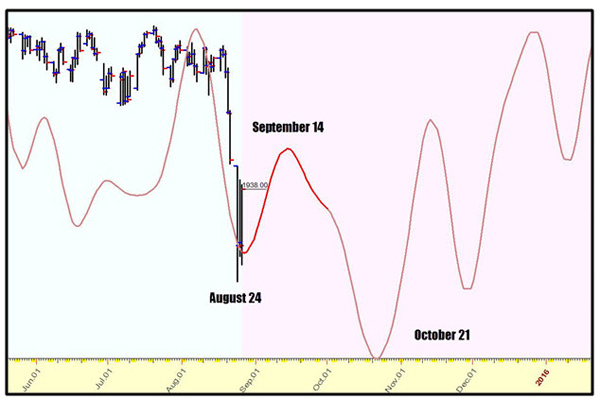
FIRST, is this cycle forecast chart for the Dow Industrials. It’s the type of cycle forecast I frequently show members of my Supercycle Trader, who actively speculate in the markets per my specifically chosen and timed recommendations.
And who also just bagged a sweet 121% gain on a bearish position in stocks, more than doubling their money, in just one week!
As you can see from this chart, which is based on billions of calculations of stock market data via an artificial intelligence model or neural net …
After a brief stabilizing period and bounce (red line) into the middle of this month, the stock market is likely to nosedive into the third week of October.
That low can come in as low as 13,937 in the Dow.
SECOND, is Europe. My models show similar patterns for virtually all stock markets in Europe. Some stabilization and a possible bounce into the middle of this month, then a collapse.
Moreover, Europe’s economic data is far worse than the lackluster data on the U.S. economy. Deflation is worsening in Europe. Industrial production is sliding. Consumer confidence is near lows.
And all the policies that have made Europe such a basket case in the first place — including a hair brained single currency experiment — continue to squeeze the European Union as if it were in a vice with a one way screw that can only be further tightened by insane leaders.
THIRD, is Asia. Long-term, Asia, including China, is fine. But my work tells me the markets there too have not yet bottomed. But keep an eye on them, for when they do bottom — especially China — they will likely bottom ahead of Western markets.
Why? Because in a very real sense today, Asia — especially China — leads the world.
They used to say when the U.S. sneezed, the rest of the world caught a cold. Now it’s the other way around: When China sneezes, the rest of the world gets pneumonia.
There are many more reasons why I believe stock markets have not yet bottomed.
So here’s what I strongly suggest:
A. If you own any stocks, with the exception of specifically selected ones you plan to own longer-term, just get out. If you cannot get out, then hedge your holdings via an inverse ETF such as the ProShares Short Dow30, symbol DOG.
B. Do not — I repeat — do not go bottom fishing. In any sector. It makes no sense to bottom fish stocks that have already lost, say 30% or more, when they can easily lose another 30% or more.
Instead …
C. Build your cash so that you can deploy it at the right time, near or at the bottom of the correction …
Fully keeping in mind that the long-term bull market in stocks is still intact — and that over the next couple of years the Dow Industrials can easily stage a slingshot move back up and more than double to over 31,000. Ditto for other major U.S. broad market indices.
And all on the backbone of frightened capital rushing out of the collapsing cancerous debts of the doomed-to-fail Western socialist-style economies of Europe and Japan.
Washington will collapse too, but not for a couple of years. So make hay of it while you can, just like my Supercycle Trader members are starting to do.
Best wishes,
Larry
The photo you see below was snapped recently in Beijing. It might not be that special to some readers, but in my 25 years of visiting the Chinese capital, I’ve never seen a blue sky because it’s always been blotted out by yellow smog. Beijing is clearly undergoing a transformation right now. This might please proponents of the green movement, but it’s ultimately harmful to the health of the manufacturing sector.

On the other hand, blue skies could be ahead for China’s service industries!
Misconception and exaggeration are circling China’s economy right now like a flock of hungry buzzards. If you listen only to the popular media, you might believe that the Asian giant is teetering on the brink of economic disaster, with the Shanghai Composite Index’s recent correction and devaluation of the renminbi held up as “proof.”
Don’t get me wrong. These events are indeed significant and have real consequences. They also make for some great, sensational headlines, as I discussed earlier this month.
But what gets hardly any coverage is that China’s economy is not weakening so much as it’s changing, like Beijing’s skies. Take a look at the following two charts, courtesy of BCA Research:


-
I know Mike is a very solid investor and respect his opinions very much. So if he says pay attention to this or that - I will.
~ Dale G.
-
I've started managing my own investments so view Michael's site as a one-stop shop from which to get information and perspectives.
~ Dave E.
-
Michael offers easy reading, honest, common sense information that anyone can use in a practical manner.
~ der_al.
-
A sane voice in a scrambled investment world.
~ Ed R.
Inside Edge Pro Contributors

Greg Weldon

Josef Schachter

Tyler Bollhorn

Ryan Irvine

Paul Beattie

Martin Straith

Patrick Ceresna

Mark Leibovit

James Thorne

Victor Adair