
Bonds & Interest Rates
 Central banks have been dumping US Treasury bonds because of the debt ceiling problem and the Tea Party will shut down the funding if they have their way. This is illustrating the entire problem. The debt ceiling only ever rises. We will see a rise in taxation and this will help to collapse the US economy and thus the world. These people we call “representative” only represent themselves and they have no solution to this Sovereign Debt Crisis. It certainly looks like we will be seeing that blast to new highs next year. So hold on tight. This may even hurt a bit.
….more from Martin:
Money & Politics: The Corrupt System is Starting to Come to a Head

USDCAD Overnight Range 1.2990-1.3050
USDCAD tracked the other commodity currencies lower on the back of a surge in oil prices which touched $49.71/barrel overnight. Kiwi also continued yesterday’s New York rally following the higher than expected GlobalDairyAuction results.
Kermit the Frog complained about how it “Wasn’t easy being green” and today some traders are whining about how hard it is to be bullish. It seems like someone shouted “Risk on” and all that was bad about the world economy, disappeared. It hasn’t.
China, the source of much of the global economic angst, didn’t suddenly recovery. They went on holidays and are still not back. Out of sight, out of mind. Oil prices have risen on hot air and a drop in crude inventories reported by API.
San Francisco Fed president Williams repeated his call for a 2015 rate hike but it was a case of seen that, heard that and it was ignored.
In Japan, the BoJ left rates and policy unchanged but didn’t say enough to close the door on additional stimulus this year.
This morning’s worse-than-expected Canadian Building Permits data (Actual -3.7% vs. forecast of a gain of 0.8%) didn’t have much of an impact on the Loonie. USDCAD will continue to track WTI prices today and remains vulnerable as long as the risk-on sentiment prevails. Tomorrows’ return of China from holidays and the release of the FOMC minutes may dampen trading enthusiasm today.
USDCAD technical outlook
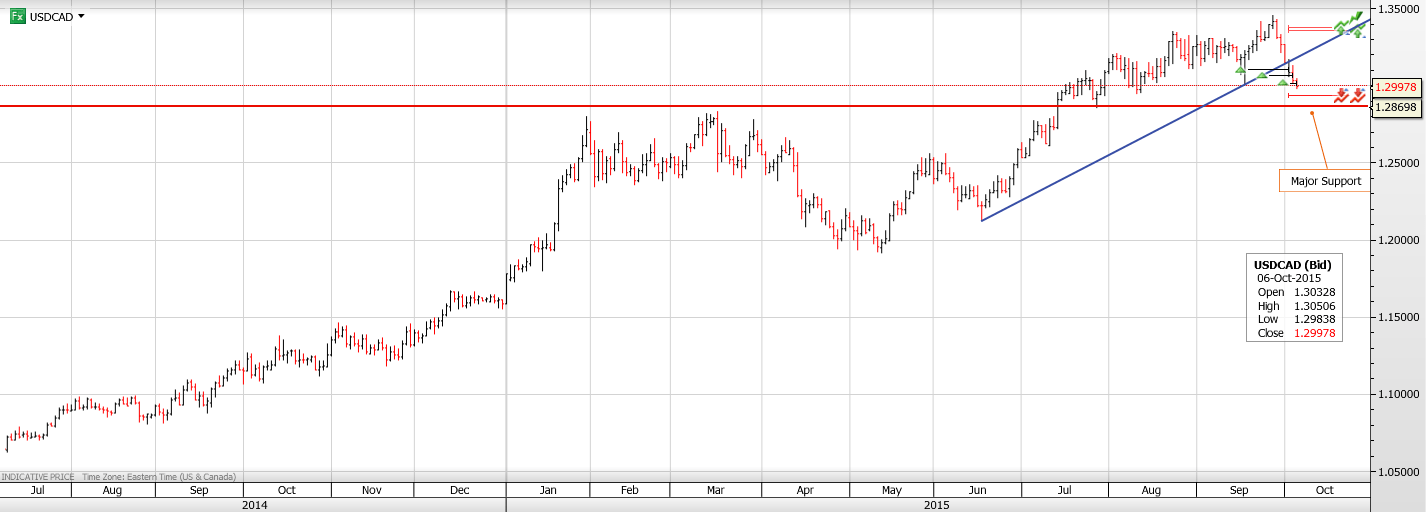
The intraday USDCAD technicals are bearish following the break of the uptrend from June which came into play at 1.3130. The steep drop has made short work of support in the 1.3020-60 area and now has the major 1.2950-1.3000 resistance area in its sights. A break of this level opens up a drop to 1.2850. A move above 1.3060 would negate the downward pressure. For today, USD support is at 1.2990, 1.2970 and 1.2950. Resistance is at 1.3030 and 1.3060.
Today’s Range 1.2980-1.3050
Chart USDCAD daily with broken uptrend Larger Chart
I’ve long maintained that the final quarter of this year, starting with the historically volatile month of October, would be the start of a roller coaster ride through hell.
And if you haven’t already noticed, it’s shaping up to be precisely that.
Global equity markets are teetering on the edge of a cliff. For some, like Europe’s markets, it will be the beginning of a long, drawn out bear market.
For others, like our markets, it will be a severe sharp pullback that gets the majority bearish, but then sets the stage for yet another bull leg higher.
You can see the blood starting to spill almost everywhere. Europe’s markets are cratering, with Germany’s DAX, the bulwark of the European Union, starting to rollover to the downside.
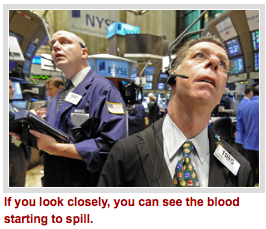 You can see it — if you look closely — with our equity markets:
Where more than half of all publicly traded U.S. stocks are now down more than 20% from their record highs.
Where the Dow Transports are now down 15.43% from the record high Nov. 14.
Where the Dow Utilities have slid as much as 18.8% since their January record high.
And where many U.S. stocks are down even more, many losing more than half their value since their record highs over the past year.
Thing is, it’s going to get much worse this month for stocks, all over the world. Germany’s DAX is set to crash. The Dow Jones Industrials will plummet to 15,000 then possibly to 13,900 before recovering.
And stocks aren’t the only asset class where holy hell is breaking loose.
Bubbles are bursting in the biggest markets of all, sovereign debt. That’s true no matter what Janet Yellen and the Federal Reserve do with their official interest rates.
In Europe, German bunds are starting to look like they will implode any day now. Same for Japan, where the Japanese government continues to print money with reckless abandon and Japanese government bonds have nowhere to go but down.
Here in the U.S., hardly anyone realized it, but interest rates started moving up way back in July 2012, when the 10-year U.S. Treasury note yield bottomed at 1.394%.
Slowly, but surely, investors worldwide are starting to shun sovereign debt, realizing that there are no returns to be had there and that the safety of government debt today is nothing but a mirage.
Short-term interest rates, on the other hand, are indeed falling, with
three-month Treasury bill yields now negative at -0.02%. They could get even more negative as investors flee the stock markets and park capital in money markets, pushing short-term yields even further into negative territory.
But don’t be deceived: Even in the short end of the yield curve, a government debt bubble bursting looms high.
Then there is the commodity sector, in one of its worse deflations ever. So bad that the world’s largest and most sophisticated commodity company, Glencore, has seen its share price plummet more than 70% this year, with half that loss occurring on Sept. 28.
Gold, which has fallen more than 40% since its high in September 2011. Silver getting clobbered. Copper annihilated. Other base metals prices shedding 70% or more.
Grain markets reeling. Soft commodity prices such as coffee, cocoa and sugar cut in half or more.
Right now, a bounce is overdue, especially in gold and silver. But here too, don’t be deceived. We have not yet seen the final lows in gold or silver and any bounce is nothing but a fake out. So don’t — I repeat, DO NOT — get caught now in any commodity bounce. It will merely rob you blind.
And what about the geo-political scene, where I warned way back in 2012 that the war cycles were ramping up, and where Martin Armstrong, one of the foremost economists alive today, also agrees? Consider the refugee crisis in Europe — while I am for humanitarian efforts, the strain of the crisis will be the final nail in the coffin for indebted European governments. And where cultural conflict is sure to rise.
Or here, in the rise of Donald Trump, who is anti-establishment. No, I don’t like the economic policies he has revealed.
But that’s not the point. His popularity is threatening the status-quo in Washington, showing you that the people are finally rising up against harebrained politicians who want nothing more than to save their butts at your expense.
Or how about ISIS and Syria — where for the second time since the Cold War, Russia and the U.S. are polar opposites, just like they are regarding Ukraine?
Potential for a future international war? Very possible. Leaders in Washington, Brussels and Moscow need to divert their peoples’ attention away from the lousy state of domestic economic affairs.
And more, now all coming together on the world stage, starting to turn nearly all markets upside down and inside out.
No problem — if you are prepared. In fact, it’s exactly the opposite of a problem — if you know what to do. It’s an opportunity to better protect your wealth and build enormous profits to boot.
Already, as I pen this column, my Real Wealth Report is up 18.8% year-to-date. And members of my Supercycle Trader are enjoying gains of as much as 121% in less than a week, with several open trading positions on now and more coming that could offer even better profit potential.
Stay safe and best wishes,
Larry

 Interview with Gary Dorsch, a noted commodity analyst and market strategist who worked on the trading floor of the Chicago Mercantile Exchange for nine years as the Chief Financial Futures Analyst for three clearing firms. Written summary HERE

Canada is no stranger in dealing with oil price collapses. The sharp fall in the price of crude in 2014 is not unprecedented. Over the past 30 years, there have been five major declines in the price of crude that have hit world markets—starting dates: June 1986, October, 1990, October 1997, May 2002 and June 2008. The plunge in prices has ranged from 25% to 60%. In all cases, Canada, as an oil-exporting country has had to bear the brunt of these precipitous and severe price declines, in terms of loss production, loss income and downward adjustments in its exchange rate and balance of trade.
Parallels with 1985-86
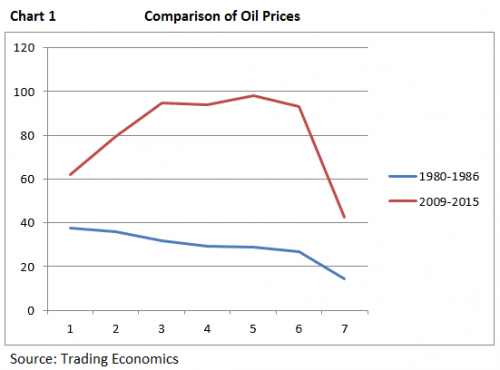
The current price collapse has significant parallels with that of 1985-86 (see Chart 1). In terms of the magnitude of the collapse, from peak to trough, prices fell by 59% in 1985-86 and by 56% in 2014-15. Both periods featured similar causes:
* A rapid and significant increase in supply; 1986 featured the full expansion from new fields in the Gulf of Mexico and in the North Sea; in 2014 the glut was caused by huge surge in production from unconventional sources such as oil shale in the U.S.
[Read: Canada Joins the Currency Wars]
* A major shift in OPEC policy. In 1985, OPEC abandoned price targets and stepped up production by about 30%, the resulting low price remained in effect for nearly two decades; OPEC took a similar position in November 2014 by increasing supply and dropping prices to stem further losses in its market share; no longer will OPEC abide by price targets.
* Worldwide a fall off in demand; in the early 1980s, the recession reduced demand and this contributed to lower oil prices. Today, oil demand has been slowing steadily since 2012, especially in the larger emerging markets.
…continue reading HERE

-
I know Mike is a very solid investor and respect his opinions very much. So if he says pay attention to this or that - I will.
~ Dale G.
-
I've started managing my own investments so view Michael's site as a one-stop shop from which to get information and perspectives.
~ Dave E.
-
Michael offers easy reading, honest, common sense information that anyone can use in a practical manner.
~ der_al.
-
A sane voice in a scrambled investment world.
~ Ed R.
Inside Edge Pro Contributors

Greg Weldon

Josef Schachter

Tyler Bollhorn

Ryan Irvine

Paul Beattie

Martin Straith

Patrick Ceresna

Mark Leibovit

James Thorne

Victor Adair