
Timing & trends
 This is starting to become very concerning.
The momentum to “ban cash”, and in particular high denomination notes like the 500 euro and $100 bills, is seriously picking up steam.
On Monday the European Central Bank President emphatically disclosed that he is strongly considering phasing out the 500 euro note.
Yesterday, former US Treasury Secretary Larry Summers published an op-ed in the Washington Post about getting rid of the $100 bill.
Prominent economists and banks have joined the refrain and called for an end to cash in recent months.
The reasoning is almost always the same: cash is something that only criminals, terrorists, and tax cheats use.
In his op-ed, Summers refers to a new Harvard research paper entitled: “Making it Harder for the Bad Guys: The Case for Eliminating High Denomination Notes”.
That title pretty much sums up the conventional thinking. And the paper goes on to propose abolishing, among others, 500 euro and $100 bills.
The authors claim that “without being able to use high denomination notes, those engaged in illicit activities – the ‘bad guys’ of our title – would face higher costs and greater risks of detection. Eliminating high denomination notes would disrupt their ‘business models’.”
Personally I find this comical.
I can just imagine a bunch of bureaucrats and policy wonks sitting in a room pretending to know anything about criminal activity.
It’s total nonsense. As long as there has been human civilization there has been crime. Crime pre-dates cash. And it will exist long after they attempt to ban it.
Perhaps even more hilarious is that many of these bankrupt governments have become so desperate for economic growth that they now count illegal drug activity and prostitution in their GDP calculations, both of which are typically transacted in cash.
So, ironically, by banning cash these governments will end up reducing their own GDP figures.
What’s really behind this? Why is there such a big movement to ban something that is used for felonious purposes by just a fraction of a percent of the population?
Cash, it turns out, is the Achilles’ Heel of the financial system.
Central banks around the world have kept interest rates at near-zero levels for nearly eight years now.
And despite having created massive bubbles and enabled extraordinary amounts of debt, their policies aren’t working.
Especially in Europe, the hope of stoking economic growth (and even the sickening goal of inflation) has failed.
So naturally, since what they’ve been trying hasn’t worked, their response is to continue trying the same thing… and more of it.
Interest rates across the European continent are now negative.
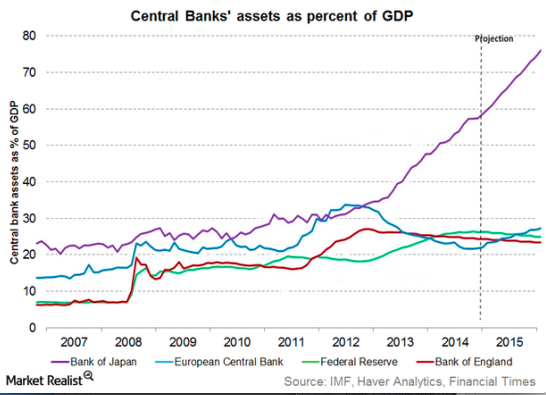
Japanese interest rates are now negative.
And even in the United States, the Federal Reserve has acknowledged that negative interest rates are being considered.
They have no other choice; raising rates will bankrupt the governments they support and derail any fledgling economic growth.
Look at how low interest rates are in the US– and yet 4th quarter GDP practically ground to a halt. They simply cannot afford to raise rates.
As global economic weakness continues to play out, central banks will have no other option but to take interest rates even further into negative territory.
That said, negative interest rates will be the destruction of the financial system.
Because sooner or later, if banks have to pay negative wholesale interest rates to each other and to the central bank, then eventually they’ll have to pass those negative rates on to their customers.
Many banks have already started doing this, especially on larger depositors.
We’ve seen this in Europe where some banks charge their customers negative interest to save money, and in some extraordinary circumstances, pay other customers to borrow money.
It’s total madness.
There’s a certain point, however, when interest rates become so negative that no rational person would hold money in the banking system.
Eventually people will realize that they’re better off withdrawing their money and holding physical cash.
Sure, cash doesn’t pay any interest. But it doesn’t cost any either.
If you have a $200,000 in your savings account at negative 1%, you’d have to pay the bank $2,000 each year.
Clearly it would make more sense to buy a safe and hold most of that money in cash.
Problem is, the banks don’t have the money.
For starters, there’s literally not enough cash in the entire financial system to pay out more than a fraction of all bank deposits.
More importantly, banks (especially in the US and Europe) are extremely illiquid.
They invest the vast majority of your deposit in illiquid loans or securities of dubious long-term value, whatever the latest stupid investment fad happens to be.
And many banks have been engaging in a substantial balance sheet shift, rotating bonds from what’s called “Available for Sale” to “Hold to Maturity”.
This is an accounting trick used to hide losses in their bond portfolios. But it also means they have less liquidity available to support bank customer withdrawal requests.
The natural side effect of negative interest rates is pushing people to hold money outside of the banking system.
Yet it’s clear that a surge of withdrawal requests would bring down that system.
Banks don’t want that to happen. Governments don’t want that to happen.
But since central banks have no other choice than to continue imposing negative interest rates, the only logical option is to ban cash and force consumers to hold their money within the banking system.
Make no mistake, this is absolutely a form of capital controls. And it’s coming soon to a banking system near you.
Until tomorrow,
Simon Black
Founder, SovereignMan.com
PS. Clearly a trend with this much momentum requires some deliberate and measured action if you don’t want your savings trapped.

Some analysts seem to think there’s an inflation scare in the air. That Europe’s economy is looking a tad better and so is Japan’s.
Therefore, they claim, the dollar is going to continue to fall while the euro and yen rally, hence, setting off inflation in the U.S. as a result of a falling dollar.
But the fact of the matter is that nothing could be further from the truth! Let’s take a closer look at their argument to see how ridiculous it is. It’s also a good lesson on how pointless it is to use fundamentals to make forecasts.
I ask you, where is the improvement in Europe’s economy?
Fact: The region’s economy grew by 0.3% in the last quarter of 2015. Meager at best.
Fact: Stock market losses in the euro region have left the Stoxx Europe 600 Index down 9.9% this year, its worst start since 2008.
Fact: Dismal bank earnings have pushed the cost of insuring the financial credit risk of European banks and insurers to the highest levels in more than two years.
Fact: Europe is stuck in a nightmarish depression of no economic growth in the strongest European economies and sinking growth in the weakest.
Fact: Prices are falling throughout the euro region. Unemployment is hovering at record highs. Debt-to-GDP levels are going virtually straight up.
Then there’s the Syrian refugee crisis that is wreaking havoc on government budgets everywhere in Europe and causing even further unrest among citizens who are already having a tough economic time.
Furthermore, Europe’s leaders are still committed to even more austerity, sacrificing the jobs and livelihoods of tens of millions of people!
Anyone with a clue of what’s going on in Europe would recognize that Europe is still headed down the tubes, and with it the euro. Its recent rally being nothing more than a bounce, with a still huge letdown coming, and soon.
 Now, let’s look at Japan.
Fact: For the third quarter of 2015, Japan’s economy shrank by 0.4% versus expectations of a quarterly contraction of 0.3%.
Fact: On an annualized basis, the economy contracted 1.4% in 2015!
Fact: Weaker domestic demand, together with slower investment in housing, contributed to the disappointing numbers. Private consumption plunged 0.8%, a huge drop.
Japan’s economy is picking up? Based on what? I don’t see it. Wrongly, pundits are taking the recent strength in Japan’s currency as a sign investors are willing to own the Japanese economy and hence even Japanese stocks.
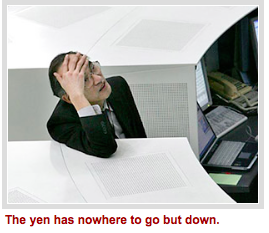
But that’s a recipe for financial disaster. Savvy money will soon realize that the yen has nowhere to go but down as the Bank of Japan puts the pedal to the metal with more yen printing.
Contrast Europe and Japan with the United States …
A. The U.S. economy, growing modestly as it is, is still the strongest of the developed nations, much stronger than Europe’s or Japan’s economy.
B. The U.S. economy has the deepest, most liquid capital markets on the planet, making them the easiest place to invest and with the most opportunities.
C. U.S. markets remain the last bastion of capitalism in the world, and certainly in the Western world.
Bottom line: Arguments that Europe and Japan are recovering are complete nonsense and based on fundamentals that are full of holes. Anyone with half a brain can see through such arguments.
In addition, …
FIRST, the euro’s bounce is near ending, and a renewed downtrend is about to take root.
SECOND, conversely, the dollar’s recent pullback is near ending, and a new leg up is about to begin.
THIRD, inflation is nowhere to be seen in Europe, Asia, Latin America, or even in the U.S.
So then, you ask, why the huge rally in gold? I warned you it was coming. I have also warned you all along that gold’s next rally would coincide more with the breakdown and collapse of Western economies than anything else, especially inflation.
And so it is. Gold is rallying with no inflation in sight. And instead, with collapsing economies all around it.
Gold has now taken out a weekly buy signal at $1,187.50 — the first step in confirming a new bull market in precious metals.
Best wishes, as always …
Larry
P.S. As the Dow doubles, some stocks will see explosive gains of 300%, 400%, 500% and more. To help you get ready to take full advantage of the bull market of a lifetime, I want to send you a complete Dow 31,000 Preparedness Kit — five distinct free reports! The first free report spells out step-by-step what you must do now to position yourself for amazing profits (and protection) over the next two years. Click here to download now!

Over the weekend, the following happened: China’s exports and imports fell by 11.2% and 18.8%, respectively, numbers which, for a trading power, are nothing short of apocalyptic. Japan’s Q4 GDP shrank at an annualized rate of 1.4% which, for a country that had spent the previous three years borrowing and printing record amounts of new currency, is an extraordinary admission of failure. And US allies Turkey and Saudi Arabia appeared to be invading Syria, putting them — and by implication the US — in direct confrontation with Russia.

The majority of the world’s stock indices topped out this month on Monday, February 1st, 2016 after a strong oversold technical bounce in price. Several indexes are now in the process of their first re-test of those multi-month lows which should act as support.
My belief is that the FED will abandon its plan to raise short-term rates in March 2016, given the “economic global contraction” in economic data including the Baltic Dry Index and troubled banking systems in the European Union.
The Baltic Dry Index below displays the major global contraction is now in process, it has now broken support at the 300 level and heading much lower. The Baltic Dry Index tracks the price of shipping raw materials across trade routes which makes it a good indicator of global economic activity. It is the pulse of World trade. The demand for goods is currently collapsing.
The BDI is one of the key indicators that experts look at when they are trying to determine where the global economy is heading. And right now, it is telling us that we are heading into a major worldwide economic downturn. In fact this trader warned of this happening on Nov 2015 in his report: The Collapsing Global Trade

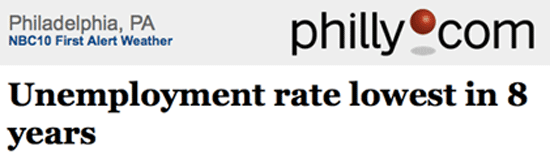
Washington, DC is pretty proud of the employment numbers it has been pumping out. Most recently, the Labor Department reported that the US unemployment rate dropped to 4.9% in January.
That’s an eight-year low going back to the 2008–2009 Financial Crisis.
The actual number of new jobs was a little on the light side, at 151,000 versus the expected 190,000, but most of the Wall Street crowd was impressed with the +0.4% monthly increase in wages.

-
I know Mike is a very solid investor and respect his opinions very much. So if he says pay attention to this or that - I will.
~ Dale G.
-
I've started managing my own investments so view Michael's site as a one-stop shop from which to get information and perspectives.
~ Dave E.
-
Michael offers easy reading, honest, common sense information that anyone can use in a practical manner.
~ der_al.
-
A sane voice in a scrambled investment world.
~ Ed R.
Inside Edge Pro Contributors

Greg Weldon

Josef Schachter

Tyler Bollhorn

Ryan Irvine

Paul Beattie

Martin Straith

Patrick Ceresna

Mark Leibovit

James Thorne

Victor Adair