
Daily Updates
Click on Image or HERE for Larger Image
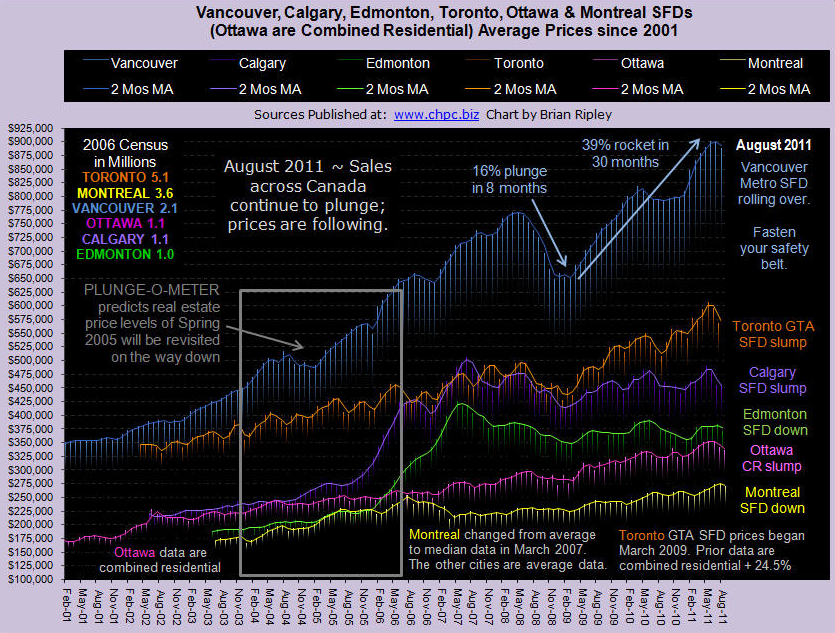
REAL ESTATE: In August 2011, the once hot markets across Canada dished up more declining sales and price data (scorecard) as the cash buyers represented by the TSX Real Estate Index hit the sell button.
All 6 cities covered here have had their SFD prices stall in the last 3 months and in Alberta house prices have fallen back to the levels of the spring of 2007 with Calgary andEdmonton being off 10% and 13% below their highs.
The Plunge-O-Meter is glowing red while gold continues to outperform real estate and all other commodities by a wide margin.
In case you have forgotten the depth and velocity of the previous market reversal when Canadian real estate prices plunged in 2007-2008 (chart); householder equity vanished as follows:
-
Average Vancouver SFD lost $122,900, or 15.9% in 8 months (2%/mo drop)
-
Average Calgary SFD lost $92,499, or 18.3% in 18 months (1%/mo drop)
-
Average Edmonton SFD lost $78,719, or 18.5% in 21 months (0.9%/mo drop)
-
Average Toronto SFD lost $63,867, or 13% in 13 months (1%/mo drop)
-
Average Ottawa Residence lost $25,664, or 8.6% in 6 months (1.4%/mo drop)
-
Median Montreal SFD lost $6,000, down 2.6% in 6 months (0.4%/mo drop)
-
THE PLUNGE-O-METER TODAY
When prices are rising, new buyers can always be found to cover leveraged positions. But when prices fall and equity shrivels up, debt and those who lend take over the headlines. You can figure out if that big mortgage is worth the risk with this $5 spreadsheet.
Perspective
Signs Of The Times
– Bill Gross to the Dow Jones, August 29, 2011
“Confidence Drops to Lowest Levels Since April 2009”
– Conference Board, August 30, 2011
In one month, the number plunged from 59.2 to 44.5 (no typo). The consensus estimate was 52.0.
“US Dept. of Energy devises security system to thwart rampant copper thefts.”
We don’t admire thieves, but in respect of market calls we hope they sold the copper forward. It may soon be too late.
“There is a good chance that the August 11th low was the final selling climax.”
– Business Insider, August 31, 2011
On September 9th, Prime Minister Harper addressed the Canadian troops that helped out in Libya with:
“A handful of soldiers is better than a mouthful of arguments. The Gadhafis of the world pay no attention to the force of argument. The only thing they get is the argument of force.”
INSTITUTIONAL ADVISORS
WEDNESDAY, SEPTEMBER 14, 2011
BOB HOYE
PUBLISHED BY INSTITUTIONAL ADVISORS
The above is part of Pivotal Events that was
published for our subscribers September 7, 2011.
As I said months ago, one of the safest investments you can hold right now is cash. Good old, US dollars. The gold bugs will hate that but when markets are in turmoil, big investors seek a safe haven. If you think you are smarter than the market and can invest wisely with gold up $70 one day and down $70 the next day, good luck with that program.
As I said months ago, one of the safest investments you can hold right now is cash. Good old, US dollars. The gold bugs will hate that but when markets are in turmoil, big investors seek a safe haven. If you think you are smarter than the market and can invest wisely with gold up $70 one day and down $70 the next day, good luck with that program.
Notable commodity and market news regarding crude oil, metals, agriculture, and China … and Jack and JR’s reaction:
-
I know Mike is a very solid investor and respect his opinions very much. So if he says pay attention to this or that - I will.
~ Dale G.
-
I've started managing my own investments so view Michael's site as a one-stop shop from which to get information and perspectives.
~ Dave E.
-
Michael offers easy reading, honest, common sense information that anyone can use in a practical manner.
~ der_al.
-
A sane voice in a scrambled investment world.
~ Ed R.
Inside Edge Pro Contributors

Greg Weldon

Josef Schachter

Tyler Bollhorn

Ryan Irvine

Paul Beattie

Martin Straith

Patrick Ceresna

Mark Leibovit

James Thorne

Victor Adair