
Daily Updates
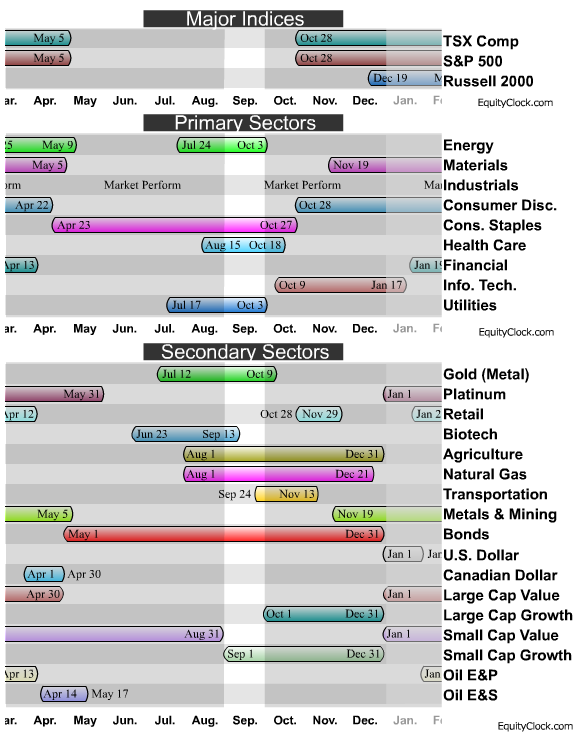
Seasonality refers to particular time frames when stocks/sectors/indices are subjected to and influenced by recurring tendencies that produce patterns that are apparent in the investment valuation:
There have been few catalysts driving uranium stocks this summer. But Mickey Fulp, the “Mercenary Geologist,” believes that this market funk resembles the period that preceded one of the best junior resource bull markets ever seen. In this exclusive interview with The Energy Report, Fulp tells us why he’s “hopefully optimistic” about the coming months.
Mickey Fulp: Although the bid was 40% over its current market price, higher than the pro forma 30% for a takeover, Hathor’s board of directors rejected the bid and put out a statement urging shareholders to reject the offer and “wait and see” until Hathor releases assays from this summer’s drilling at Far East and publishes a scoping study in the fall.
I certainly think that a bidding war could ensue. Players that could possibly be involved are AREVA SA (CEI:PAR), Denison Mines Corp. (DML:TSX; DNN:NYSE.A), Rio Tinto plc (RIO:NYSE; RIO:ASX), BHP Billiton Limited (BHP:NYSE; BHPLF:OTCPK), Vale S.A. (VALE:NYSE), or perhaps sovereign companies and governments. The market obviously thinks the bid is too low, with speculators pushing HAT’s recent trading to the $4.15 range.
TER: How long do you think it will be before this is flushed out?
MF: It usually takes a few months for these things to settle. Rest assured, I’m not selling my Hathor stock now.
TER: Are you making any other changes in your uranium portfolio based on what’s going on right now?
MF: Yes. I have been buying Fission Energy Corp. (FIS:TSX.V; FSSIF:OTCQX) via stink bids during the summer and added to that position upon the takeover bid announcement. It controls the ground adjacent to Hathor’s flagship Roughrider Property. Fission Energy must be taken out, too, if Roughrider is developed into an open-pit mine, which is the likely scenario. If you draw an open-pit outline around the main Roughrider zone, it severely encroaches upon Fission’s ground. Its ground also contains a significant uranium deposit, the J Zone.
TER: Fission’s stock is up 10% and it’s traded as high as $0.73. Is that on news of the takeover bid?
MF: Absolutely. It’s been trading tremendous volumes over the last few sessions.
TER: Let’s look at some of the fundamentals for uranium. When we spoke in March, you said that you didn’t think demand would diminish much in the short- to mid-term after Fukushima because fundamentals had not changed. Is that still your position?
MF: Yes. We’re presently seeing a weak spot market, which has been reduced to discretionary buying and consumers looking for bargains. Some traders and speculators have moved out of this market. We have seen more demand destruction than we did originally because Japan has taken many reactors offline temporarily. Their use is only one-third of pre-Fukushima capacity. At last count, 18 of 54 reactors were operating.
TER: Do you think that is going to keep the price down for longer than you had forecast in March?
MF: No. We’re still dealing with a +$50/pound (lb.) spot price and a long-term contract price of $65/lb. The spot price is down from a yearly high of $73/lb., so that’s very significant. But the long-term contract price is down much less. It was $72/lb. pre-Fukushima.
There has been a significant decrease in the spot price, but this is the slow season for uranium. Uranium goes through the summer doldrums just as the stock market does. The fall buying season is still ahead of us. I don’t expect uranium to drop much below $50/lb. in the near term.
TER: Have the U.S. Department of Energy’s stockpile sales impacted either the spot price or the long-term contract price?
MF: No. That actually stabilized a few months ago. Of the 5 million pounds (Mlb.) in scheduled sales per year, the Dept. of Energy forward sold 3.5 Mlb. and took it off the open market for 2011 to 2013. If anything, this agreement has stabilized the market—it is a significant positive factor.
TER: Has concern about finding a reliable domestic supply of uranium in both the U.S. and Europe been a catalyst for companies that could fulfill that demand?
MF: Western Europe is the only part of the world that seems to be trying to move en masse away from nuclear power. The U.S. will produce a bit more than 4 Mlb. this year. It uses 55 Mlb., so do the math: We produce only 7% internally at our own mines. We need a viable domestic industry and I’m still bullish on uranium mine development in the U.S.
TER: What are some companies in the U.S. that might be able to meet domestic demand?
MF: Uranium Energy Corp (UEC:NYSE.A) is a new producer with its in-situ recovery project in South Texas. It recently announced another key permit for its Goliad satellite facility. That well field could be in production within the next year. UEC is the one company that I am most bullish on.
I have been a long-term supporter of Strathmore Minerals Corp. (STM:TSX; STHJF:OTCQX), which has an on-going feasibility study at Roca Honda in New Mexico with joint venture partner Sumitomo Corp. (8053:TYK; SUMF:OTCPK). It also has the largest play in the Gas Hills of Wyoming with a partner in an announced, but not completed, deal with Korea Electric Power Corp., or KEPCO. The memorandum of agreement was announced about a month ago.
TER: Has that been a catalyst for the stock price?
MF: There are no catalysts for stock price in the uranium business at this juncture, except for Hathor, with the hostile takeover bid, and Fission as the next-door neighbor that has to be invited along for the ride. The uranium business continues to muddle along, which is to be expected during the summer doldrums. I wouldn’t expect any catalysts this time of year, especially given world economic uncertainty.
TER: In March, you talked about placing stink bids below a stock’s normal range to get bargains. Have any of those contrarian opportunities in energy paid off?
MF: I have continually bought Uranium Energy Corp. post-Fukushima. Has it paid off? No, because I haven’t sold. I have a profit on paper, but it’s not a profit until it is sold. Certainly, my stink bids that were filled for Uranium Energy Corp. and Fission Energy are looking good now.
TER: Regarding natural gas, another domestic energy source that you talked about in your July Musings, you said that “we import 9.4 Mbl. of oil a day, and we have a treasure trove of cleaner-burning and cheap natural gas in the ground, but we lack the infrastructure and political will to develop it.” What is limiting our will to utilize our own natural gas resources?
MF: I think a good portion of it is the NIMBY (not in my backyard) and the BANANA (build absolutely nothing anywhere near anything) crowd. We see environmental opposition to horizontal drilling and hydro-fracking, especially in the northeast U.S. where the Marcellus Shale is located. It has by far the largest shale gas potential in the U.S.
We have many plays in various parts of the U.S. that look good, but there is a lack of pipeline infrastructure and a lack of separating capacity where we need it. There is a very cheap natural gas price, which does not stimulate exploration or development. Lots of wells have been drilled that are now shut-in, either because of low price or lack of transport infrastructure.
The natural gas use that makes the most sense—and I will say that T. Boone Pickens has it absolutely right—is for small, mass transit and fleet and cargo vehicles, all are very easily converted to natural gas. We actually should be building natural gas-burning vehicles at the factory, but lack of fueling infrastructure is hindering that market. You can’t drive down the interstate, get off at every exit and fill your car or truck with natural gas. Until we are able to do that, the gas industry is not going to reach its full potential in the U.S.
TER: Do you think that those new natural gas fueling stations will be government driven or market driven?
MF: I hope they are market driven because I do not support government subsidies in any way, shape or form. I’m a strong proponent of free markets with little regulation, credits or stimulus.
TER: How long do you think it will take the market to get that installed?
MF: Well, that’s the $64,000 question. We must have the will to do it, and I don’t see the will to do it now.
TER: Any natural gas companies you’re following?
MF: I follow some natural gas companies, but the market has not been conducive to entering them. I’ve been watching the natural gas market for over three years now and haven’t made a move into it. I’m a contrarian, and try to be patient, but in retrospect, I’m glad that I didn’t go into natural gas exploration or development companies three years ago.
The oil and gas business is much different from mineral resources in that development and production companies must have a substantial revolving line of credit; they must continually have cash calls to grow and there can be hell to pay if the market is not good during these periods. They can end up going bankrupt. If mineral exploration companies have a significant cash kitty from equity financings, they can sit on their thumbs during bad market times.
TER: Do you have some companies you’re following in potash?
MF: I’m bullish on all agricultural minerals, especially potash, and on future prices. We see increased demand as the world’s middle-class grows, especially in eastern Asia. The three largest consumers in the world are China, India and the U.S.
TER: Does that relate to the growing middle class and its changing diet, or is it just pure population demand?
MF: It’s largely the former, the growing middle class and its changing diet from carbohydrate-rich to one higher in protein. It takes about 7 kilograms (kg.) of vegetable protein to produce 1 kg. of animal protein. On the other hand, there are also 75 million more people walking the planet every year, and they have to be fed.
TER: The macro picture on potash and agriculture depends a lot on geography, and potash is expensive to transport. Are some countries going to drive demand more than others?
MF: It’s an agricultural mineral that sells by the ton, so it’s a bulk mineral product. It is very location-sensitive. We know where the world’s potash deposits are. We know where they are likely to be developed. Are there new areas on the horizon? Yes, but time and time again, we’ll go back to the established producing areas, one of which is my home state of New Mexico, but most potash is produced in Saskatchewan, Russia and Belarus.
TER: Any final thoughts?
MF: We’re approaching the end of the summer doldrums. I see many things that happened during this summer that are analogous to the summer of 2010. Last year Labor Day launched arguably one of the best bull markets for seven months that the junior resource sector has ever seen. I am hopefully optimistic that we will see a boisterous fall, winter and spring for all the speculators in the junior resource sector.
TER: Great. It is always a pleasure chatting with you. Thank you so much for taking the time, Mickey.
Michael S. “Mickey” Fulp is the author of The Mercenary Geologist. He is a certified professional geologist with a B.S. in earth sciences with honors from the University of Tulsa and M.S. in geology from the University of New Mexico. Mickey has more than 30 years experience as an exploration geologist searching for economic deposits of base and precious metals, industrial minerals, coal, uranium, oil and gas and water in North and South America, Europe and Asia. Mickey has worked for junior explorers, major mining companies, private companies and investors as a consulting economic geologist for the past 24 years, specializing in geological mapping, property evaluation and business development.
Want to read more exclusive Energy Report interviews like this? Sign up for our free e-newsletter, and you’ll learn when new articles have been published. To see a list of recent interviews with industry analysts and commentators, visit our Exclusive Interviews page.
DISCLOSURE:
1) JT Long of The Energy Report conducted this interview. She personally and/or her family owns the following companies mentioned in this interview: None.
2) The following companies mentioned in the interview are sponsors of The Energy Report: Strathmore Minerals Corp., Fission Energy Corp., Uranium Energy Corp.
3) Mickey Fulp: I own shares of the following companies mentioned in this interview: Fission Energy Corp., Hathor Exploration Ltd., Strathmore Minerals Corp. and Uranium Energy Corp. Strathmore Minerals is a sponsor of my website.
Richard Russell has been busy penning his 12 Commandments for surviving the upcoming “bad times”

What’s wrong with gold stocks?
For the last several months, they’ve been trading a lot like stocks…but nothing like gold. Such is the occasional curse of the gold stock investor. In some market phases, gold stock investors failed to “get paid,” even when gold is soaring.
One of your editor’s friends, a gold stock expert, used to joke, “Gold stocks are the most empathetic of all investments. They fall when the stock market is falling, and also fall when the gold price is falling.”
While not entirely true, this observation is not entirely false either. For long periods of time, gold stocks can produce far more frustration than satisfaction. The last three-and-a-half years illustrate the point. Since the day the gold price first jumped above $1,000 an ounce on March 13, 2008, the yellow metal has soared 83%. But over the same time frame, gold stocks, as represented by the Philadelphia Gold and Silver Index, have gained a meager 9%.
While it’s true that plus-9% is better than the minus-3% the S&P 500 Index has delivered since mid-March 2008, no investor buys a gold stock to make 9% while the gold price is soaring 83%.
Furthermore, there may never have been a more difficult “plus 9” in the history of financial markets. Between March 2008 and late October of the same year, the XAU Index plummeted 67%. An investor would have had to stay put during that entire, sickening decline — and resist the temptation to cut his losses during the ensuing rebound — in order to eke out his “plus 9.”
On paper, therefore, riding the bull market in gold during the last few years has been “easy money.” In the real world, it has been anything but. Gold and gold stocks both recovered throughout 2009. Even so, during most of the ensuing two years — from October 2009 to the present — owning gold stocks has remained an exercise in frustration.
On October 2, 2009, gold traded below $1,000 an ounce for the very last time (at least so far) and ended the New York trading session at $1,002.80. Since then, the gold price has soared 82%. But again, gold stocks have lagged far behind. Over the last few months, gold stocks have delivered even less glittering results. While gold is up 30%, the XAU Index has gone nowhere. Perhaps gold stocks are due for a change of fortune.

As the chart below illustrates, the XAU Index has spent most of the last 20 years selling for about 20% to 25% of the level of the gold price. During the depths of the 2008 crisis, the XAU plummeted to 11.1% of the gold price. This ratio subsequently rebounded somewhat, but has been rolling back over during the last few months and has almost returned to the crisis lows of 2008. At today’s quote, the XAU sells for 11.9% of the gold price.
In other words, gold stocks are very lowly priced, relative to gold. This looks like a buying opportunity, not simply because gold stocks are cheap relative to gold, but also because gold stocks are cheap from almost every fundamental perspective. (We will examine that theme more closely in tomorrow’s Daily Reckoning).
No “Absolute Law of Mean-Regression” can guarantee that gold stocks will begin outperforming gold itself. Furthermore, no absolute law of any kind can guarantee that outperformance would be synonymous with positive performance.
Thus, the only absolute law that pertains is this one: Cheap is better than expensive, all else being equal.
Gold stocks are cheap.
Eric Fry
for The Daily Reckoning
Eric J. Fry, Agora Financial’s Editorial Director, has been a specialist in international equities for nearly two decades. He was a professional portfolio manager for more than 10 years, specializing in international investment strategies and short-selling. Following his successes in professional money management, Mr. Fry joined the Wall Street-based publishing operations of James Grant, editor of the prestigious Grant’s Interest Rate Observer. Working alongside Grant, Mr. Fry produced Grant’s International and Apogee Research — institutional research products dedicated to international investment opportunities and short selling.
Mr. Fry subsequently joined Agora Inc., as Editorial Director. In this role, Mr. Fry supervises the editorial and research processes of numerous investment letters and services. Mr. Fry also publishes investment insights and commentary under his own byline as Editor of The Daily Reckoning. Mr. Fry authored the first comprehensive guide to investing internationally with American Depository Receipts. His views and investment insights have appeared in numerous publications including Time, Barron’s, Wall Street Journal, International Herald Tribune, Business Week, USA Today, Los Angeles Times and Money.
You Could Build FIVE GENERATIONS of Wealth! The full power and promise of science’s next decade could create vast fortunes. Wealth opportunities are already piling up. Watch this urgent new presentation for full details on how to start your own wealth. Epic wealth revelations – Right Here…
Traveling this AM from beautiful St. John’s to Toronto and look forward to meeting many readers at show tomorrow
U.S. Stock Market– The fact that the Fed expanded its meeting from one-day to two next week and that there’s been recent descension in votes, I suspect Bernanke is going to try to get approval for some sort of QE 3. Meanwhile, the U.S. stock market is groping for a bottom and Europe is oversold.

U.S. Bonds– If we do get some sort of more funny money from the Fed next week and rates drop sharply off of that and continuing weak economic numbers, yours truly is all but certain to finally go short. The fact that Pimco’s Gross is long again could be an emotional signal not seen in years. Stay tuned.

Gold – Mother of all gold bull markets continues!!!

U.S. Dollar Index – Blip up in a terminally ill decline.

Oil and Natural Gas – I like oil around $75 and gas the more its under $4

….read much more on individual stocks and Market Interviews at Grandich.com HERE
-
I know Mike is a very solid investor and respect his opinions very much. So if he says pay attention to this or that - I will.
~ Dale G.
-
I've started managing my own investments so view Michael's site as a one-stop shop from which to get information and perspectives.
~ Dave E.
-
Michael offers easy reading, honest, common sense information that anyone can use in a practical manner.
~ der_al.
-
A sane voice in a scrambled investment world.
~ Ed R.
Inside Edge Pro Contributors

Greg Weldon

Josef Schachter

Tyler Bollhorn

Ryan Irvine

Paul Beattie

Martin Straith

Patrick Ceresna

Mark Leibovit

James Thorne

Victor Adair