
Daily Updates
Tune into CNBC or click onto any of the dozens of mainstream financial news sites, and you’ll find an endless array of opinions on the latest wiggle in equity, bond and commodities markets. As often as not
Like all previous stimuli, this round of borrowing and spending will act as an economic sedative rather than a stimulant. Running up the deficit in the short-run will not grow the economy, but will merely dig it into a deeper hole. A year from now there will be even more unemployed Americans than there are today, likely resulting in additional deficit financed stimulus that will again make the situation worse.
The President asserted that the spending in the plan will be “paid for” and will not add to the deficit. Conveniently, he offered no details about how this will be achieved. Most likely he will make non-binding suggestions to future congresses to “pay” for this spending by cutting budgets five to ten years in the future. History is absolutely clear on one point: politicians never pass cuts promised by prior politicians. In other words…the check is in the mail. So I will make the fairly riskless assumption that the plan will be financed by deficit spending. If so, the negatives associated with greater deficits will overwhelm any perceived benefit the spending will generate.
President Obama claims he wants to put money into the pockets of American consumers. The problem is the government’s own pockets are empty. In order to put money in the pocket of one American, it must first pick the pocket of another. The problem is that it takes more from the pockets it picks than it puts into the pockets it fills.
In the meantime money to fund the stimulus has to come from somewhere. Either the government will borrow it legitimately, or the Federal Reserve will print. Either way, the adverse consequences will damage economic growth and job creation, and lower the living standards of Americans.
There can be no doubt that some jobs will in fact be created by this plan. However, it is much more difficult to identify the jobs that it destroys or prevents from coming into existence. Here’s a case in point: the $4,000 tax credit for hiring new workers who have been unemployed for six months or more.
The subsidy may make little difference in effecting the high end of the job market. An employer will not pay a worker $50,000 per year simply to qualify for a one-time $4,000 credit. But the effects will be felt on minimum wage jobs where rather than expanding employment it will merely increase turnover.
Since an employer need only hire a worker for 6 months to get the credit, for a full time employee, the credit effectively reduces the $7.25 minimum wage (from the employer’s perspective) to only $3.40 per hour for a six month hire. While minimum wage jobs would certainly offer no enticement to those collecting unemployment benefits, the lower effective rate may create some opportunities for teenagers and some low skilled individuals whose unemployment benefits have expired. However, most of these jobs will end after six months so employers can replace those workers with others to get an additional tax credit.
Of course the numbers get even more compelling for employers to provide returning veterans with temporary minimum wage jobs, as the higher $5,600 tax credit effectively reduces the minimum wage to only $1.87 per hour. If an employer hires a “wounded warrior” the tax credit is $9,600 which effectively reduces the six month minimum wage by $9.23 to negative $1.98 per hour. This will encourage employers to hire a “wounded warrior” even if there is nothing for the employee to do. Such an incentive may even encourage such individuals to acquire multiple no-show jobs from numerous employers. History has shown that when government creates incentives, the public will twist themselves into pretzels to qualify for the benefits.
The plan creates incentives for employers to replace current minimum wage workers with new workers just to get the tax credit. Low skill workers are the easiest to replace as training costs are minimal. The laid off workers can collect unemployment for six months and then be hired back in a manner that allows the employer to claim the credit. The only problem is that the former worker may prefer collecting extended unemployment benefits to working for the minimum wage!
The $4,000 credit for hiring the unemployed as well as the explicit penalties for discriminating against the long term unemployed will result in a situation where employers will be far more likely to interview and hire applicants who have been unemployed for just under six months. Under the law, employers would be wise to decline interviews with anyone who has been unemployed for more than six months, as any subsequent decision not to hire could be met with a lawsuit. However, to get the tax credit they would be incentivized to interview applicants who have been unemployed for just under six months. If they are never hired there can be no risk of a lawsuit, but if they are hired, the start date can be planned to qualify for the credit.
The result will simply create classes of winners (those unemployed for four or five months) and losers (the newly unemployed and the long term unemployed). Ironically, the law banning discrimination against long-term unemployed will make it much harder for those people to find jobs.
Another problem is the President’s intention to help under-water homeowners refinance their mortgages with lower rates. While this will certainly be good for the borrowers, it will be horrific for the banks holding the loans. The borrower’s gain is simultaneously offset by the bank’s loss. This will further impair the solvency of our banking sector, exacerbating the losses and failures when rates rise, thereby increasing the costs to taxpayers of the next round of bailouts.
Moving from the sublime to the ridiculous, the President claims his payroll tax cuts will not endanger the Social Security Trust Fund, as the government will replace the lost “contributions” with transfers from general revenue. In other words, the government will borrow money, put it in a phony trust fund, then borrow the same money back from the trust funds and spend it on the stimulus. It is amazing the theatrics the government will go through to maintain the illusion that trust funds actually exist. The tragedy is that Americans continue to buy the charade and even heap scorn on those, like Rick Perry, who has the temerity to point out that the emperor is naked.
The truth of course is that no real economic growth or job creation is going to occur until the failed policies of both Obama and Bush are reversed. In his speech the President mourned the death of the American dream. Obama should stop killing it. To revive that dream we need to revive the American spirit that produced it in the first place. That means returning to our traditional values of limited government and sound money. Unfortunately we are still headed in the wrong direction.
Subscribe to Euro Pacific’s Weekly Digest: Receive all commentaries by Peter Schiff and other Euro Pacific commentators delivered to your inbox every Monday.
Click here for free access to Euro Pacific’s latest special report: What’s Ahead for Canadian Energy Trusts?
For a great primer on economics, be sure to pick up a copy of Peter Schiff’s hit economic parable, How an Economy Grows and Why It Crashes.
Whether or not gold prices will continue their upward trajectory is the “million dollar question” being assessed by the investment community.
The Bottom Line
Technical, fundamental and seasonal influences point to another volatile period for equity markets around the world this week. Support was established by major equity indices on August 8th including 1,105.54 for the S&P 500 Index, 10.604.07 by the Dow Jones Industrial Average and 11,617.81 by the TSX Composite Index. Support is about to be tested due to a series of four negative annual recurring events. Preferred strategy is to wait for weakness to purchase sectors that benefit from favourable seasonal influences at this time of year (e.g. gold equities, agriculture, “gassy” equities) and to watch for entry points on weakness in other economically sensitive sector in October.
The S&P 500 Index fell 19.74 points (1.68%) last week. Intermediate trend is down. Support is at its low on August 8th at 1,101.54. Resistance is forming at 1,230.71. The Index trades below its 50 and 200 day moving averages. RSI and MACD have recovered from oversold to neutral levels. Stochastics have retreated from overbought to neutral levels. Downside risk is to its August 8th low.

The TSX Composite Index fell 214.87 points (1.70%) last week. Intermediate trend is down. The Index trades below its 50 and 200 day moving average. Support is at 11,617.81. Resistance may be forming near its 50 day moving average at 12,808.75 and 12,798.53. RSI and MACD have recovered from oversold levels. Stochastics already are overbought and showing early signs of rolling over. Strength relative to the S&P 500 Index remains positive.

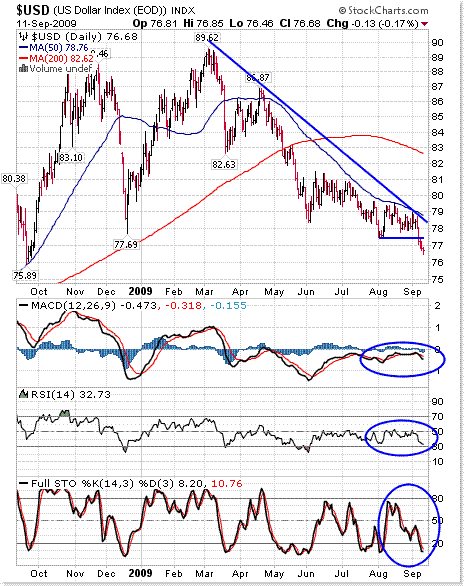
The U.S. Dollar Index gained 2.43 last week. It broke above resistance at 76.72 on Friday. Intermediate trend changed from down to up. The Index broke also above its 200 day moving average on Friday. Short term momentum indicators are overbought, but have yet to show signs of peaking.
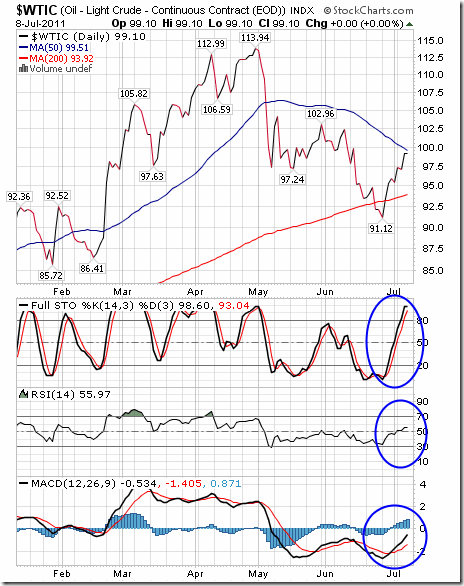
Crude oil added $0.34 per barrel last week. Intermediate trend is down. Short term momentum indicators are trending higher from oversold levels. Stochastics already are overbought. Resistance is likely near its 50 day moving average currently at $91.14.
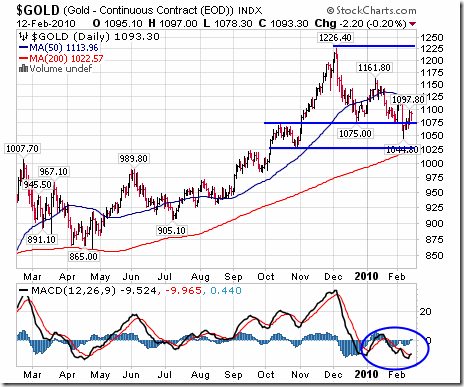
Gold slipped $26.80 U.S. per ounce last week. Gold remains in a volatile trading range following a “blow off” three weeks ago. Short term momentum indicators have rolled over from overbought levels. Gold equities are outperforming gold. Seasonal influences are positive until the end of September, followed by weakness in October.
…view 50 more charts including Gold Stocks Indices HERE
Not for nothing, but in my view all this talk about a double-dip recession in the U.S. is a bunch of baloney that misses the real issue …
A. The United States economy never even came out of its recession in the first place. And …
B. Our economy is already in a depression, one that’s about to get a whole lot worse.
Don’t believe me? Just ask anyone on Main Street if the U.S. economy ever came out of a recession. I doubt you’ll find more than one out of every five Americans you talk to who believes the economy recovered.
Yes, the economy did avoid a total meltdown in 2008 and 2009. But get out of a recession? Give me a break!
First, the true unemployment rate in this country is at least 22%. Not the 9.1% mythical figure Washington is reporting.
You see, Washington plays with the unemployment number. The figure they report every month is what they call the “official” unemployment rate. But it includes only those ages 16 or older who are not currently employed, but are able and available to work and “actively seeking work.”
Plus, Washington conveniently leaves out people who are working part-time, people whose hours have been dramatically cut, and “discouraged” workers — those who are ready, willing and able to work — but have given up looking for a job because they can’t find one.
Add these workers into the mix and you have an actual unemployment rate of 22% — more than double the so-called official number and almost as bad as the Great Depression of the 1930s.
Plus, of the unemployed, a full 45.1% have been out of work for six months (27 weeks), also rivaling the Great Depression.
President Obama’s just announced job plan will help a bit, but not much in the grand scheme of things.
Second, from its 1925 peak, the median home price in the U.S. fell 12.57% into a bottom in 1932. Compare that to the 32% decline since the property peak in 2007.
Third, in 1929, total U.S. debt as a percent of GDP stood at roughly 290%. Today, it’s approaching 1,000%, and growing. That’s equal to 10 times our country’s economic output!
Put another way, it now takes $10 of debt to produce $1 of GDP, compared to $2.90 during the Great Depression.
I don’t know about you, but to me, that’s not real economic growth. It’s debt-riddled growth. It’s treading water at best, before drowning.
Fourth, U.S. high-yield corporate bond default rates last year hit their highest level since the Great Depression. And although they’ve come down a bit since then, there’s no doubt in my mind that corporate bond default rates are going to surge again in the months ahead.
Fifth, there are at least half a dozen more stats I can cite that are already worse than those seen in the Great Depression. From durable goods production and sales, things like autos, etc., to the number of families requiring public assistance, to the number and rate of children that are now homeless.
So no matter how I look at it, our country is not heading into another recession. It’s already in a depression. In fact …
In real terms, the U.S. economy has
already contracted more than it did
during the Great Depression.
In today’s world of floating fiat currencies, it’s very difficult to measure changes in the value of anything without a benchmark, since the dollar itself floats in value.
That’s why I often prefer to use honest money — the price of gold — as a value-measuring yardstick, because over time, gold always holds its purchasing power.
For instance, back in the 1930s — and all the way through 1971 — the U.S. monetary system was on a gold standard. In 1932, for instance, just before President Roosevelt devalued the dollar, $1 was equal to roughly 1/20 of an ounce of gold.
In 1971, it was equal to about 1/42 of an ounce of gold. Then, Richard Nixon severed the link between the dollar.
And today, one dollar is worth roughly 1/1865 an ounce of gold.
So now, let’s take a look at our country’s GDP in terms of the amount of gold it can buy.
And let’s do a simple comparison of 1932, the depths of the Great Depression …
With 1971, just before the gold standard was abolished …
And then with the year 2000, the peak of the tech bubble … the year 2007, the real estate peak … and the latest GDP data.
That way we can see what’s really happening to the value of our country’s GDP in terms of how much gold it can purchase at those different points in time.
In 1932, our country’s GDP was worth 2.8 billion ounces of gold.
In 1971, it was worth 27.74 billion ounces of gold. Put another way, our country’s GDP was almost 10 times what it was in 1932. So over that 39-year period, the purchasing power equivalent of our country’s GDP grew almost 1,000%.
In 2000, the purchasing power of our country’s GDP continued to appreciate and would purchase 34.54 billion ounces of gold, a 24.5% increase.
But at year-end 2007, it was worth only 16.87 billion ounces of gold. A whopping 51% CONTRACTION in the purchasing power of our country’s GDP!
Think that’s bad? As of July 31, 2011 — latest GDP data — our country’s GDP would purchase a mere 7.72 billion ounces of gold.
That’s a 54.2% decline since the peak of the housing bubble in 2007 …
And a whopping 77.65% decline in GDP since the end of the year 2000.
If that’s not a contraction, if that’s not a depression in real honest money terms, I don’t know what is.
Of course, almost everyone will argue with me about the above analysis, the main objection being that I’m viewing the economy in terms of gold only, and that the contraction I speak of is merely because the price of gold has gone through the roof.
But I ask you the following questions …
If 5,000 years of gold holding its purchasing power doesn’t give it the right to be a measuring tool, then what tool would you use? Paper money?
And if you think paper money can be used to measure real values, then why does paper money — in almost all cases — buy you less than it did a couple of years ago … five years ago … 10 years ago … 50 years ago?
Moreover, for the economy’s current GDP to equal the same gold purchasing power it had in the year 2000 — 34.54 billion ounces of gold — the price of gold would have to plummet by more than 77.65% to roughly $417.
What are the chances that’s going to happen?
Especially since the Federal Reserve — I have absolutely no doubt about it — will soon be forced to start printing money again?
Folks, the U.S. economy is already in a depression. Deep in a depression. Problem is, almost no one realizes it.
Hopefully, you do. And hopefully, you’re taking the steps necessary to protect your wealth so that it does not suffer the same devastating losses in real terms.
Best wishes,
Larry
P.S. Stay ahead of the curve with all my analysis, all of my recommendations, flash alerts, strategies to protect and grow your money, and more! Become a Real Wealth Report member today.
It’s the best money you will ever spend for your investments. I guarantee it! Click here now to join.
-
I know Mike is a very solid investor and respect his opinions very much. So if he says pay attention to this or that - I will.
~ Dale G.
-
I've started managing my own investments so view Michael's site as a one-stop shop from which to get information and perspectives.
~ Dave E.
-
Michael offers easy reading, honest, common sense information that anyone can use in a practical manner.
~ der_al.
-
A sane voice in a scrambled investment world.
~ Ed R.
Inside Edge Pro Contributors

Greg Weldon

Josef Schachter

Tyler Bollhorn

Ryan Irvine

Paul Beattie

Martin Straith

Patrick Ceresna

Mark Leibovit

James Thorne

Victor Adair