Daily Updates

With gold and silver consolidating and continued uncertainty surrounding the stock market, today King World News interviewed Peter Schiff, CEO of Europacific Capital.  When asked about the ongoing banking crisis and where how it will impact gold, Schiff responded, “Clearly when banks fail, people that loaned money to those banks lose.  So there are repercussions when dominos start to fall, you just don’t know how many there are.  I prefer to let the dominos fall rather than to try to prevent it from happening with government bailouts that wind up doing even more damage.”

Peter Schiff continues:


“Gold is down a little bit today and I think the reason was the Europeans through cold water on the idea that there is going be a rapid solution to the problems.  So they have backpedaled and diminished expectations.  So the euro is falling and it’s taking the stock market down with it along with gold as money still foolishly flows into Treasuries.”


I’m bullish in general and think the dips are a good opportunity to buy.  This recent dip is a good example.  I think we are going to make new highs in the gold market, maybe even before the end of the calendar year, which would imply a pretty big move to the upside for gold.  We would be talking about a move of more than $250 to hit new highs.

….read more HERE

Fear Gauge Sounds Alarm

Chart Below: 20-year treasury index (TLT) over the Canadian dollar (FXC)

Screen_shot_2011-10-18_at_3.03.56_AM

Click on Chart or HERE for Larger View

Following a reckless resumption of risk appetite last week….
….(perhaps led by an erroneous interpretation of Euro strength by algo computers? See: Biggest Market Headfake ever for an interesting take) the fear gauge is resuming alarm today.

This updated chart of the 20-year treasury index (TLT) over the Canadian dollar (FXC) is one of the many which we have found to be instructive over the years. Last week’s drop in this risk barometer and rebound today bear an eerie resemblance to similar action we noted in the late fall of 2008. For an excellent update on where we really are at with the European banking crisis, see John Hussman’s piece this morning: Europe: Just Getting Warmed Up.


About Danielle

Portfolio Manager, attorney, finance author and a regular guest on North American media, Danielle Park is the author of the best selling myth-busting book“Juggling Dynamite: An insider’s wisdom on money management, markets and wealth that lasts,” as well as a popular daily financial blog:www.jugglingdynamite.com

Danielle worked as an attorney until 1997 when she was recruited to work for an international securities firm.  Becoming a Chartered Financial Analyst (CFA), she now helps to manage millions for more than 200 of North America’s wealthiest families as a Portfolio Manager and analyst at the independent investment counsel firm she co-founded Venable Park Investment Counsel Inc.www.venablepark.com.  In recent years Danielle has been writing, speaking  and educating industry professionals as well as investors on the risks and realities of investment behaviors.

A member of the internationally recognized CFA Institute, Toronto Society of Financial Analysts, and the Law Society of Upper Canada.  Danielle is also an avid health and fitness buff.


Safe Haven Under Attack

Now that the whole world is in ‘safe” Treasury bonds. The bonds are under pressure. With retail sales up, the bonds are being pressured. The chart below shows the bonds breaking below their latest trendline and testing their 50-day moving average. MACD is negative. (Ed Note: Read Richard’s Essay on Bond’s below at the bottom)

3.16B4


Gold — Despite daily warnings from amateur experts. Gold continues to climb above its 200-day moving average. The last real correction occurred in 2009. So far, gold has ignored the call for another correction. Watch that 200-day MA, which stands at 1542.

22.1578


This Is What A Modern Day Depression Looks Like

by Richard Russell – read it all HERE


Strange Behavior

Although crowds are gathering to protest the difference in income, this does not seem to register on XLY. People are still spending and buying whatever they want. The chart below shows the erratic moves of consumer discretionary. The latest move is a break below the 200-day moving average. That takes XLY below the preceding top. Here in La Jolla, the latest fancy restaurant (valet is $8) is bustling. Nobody is bringing brown bags for dinner. Dinner at Eddy Vs can easily run to $80. There’s a recession on and people are rioting. But who cares except those who can’t pay their bills.

Waiting for QE3? When will it arrive?

25.254C


A PRIMER ON BONDS: The bond market is massive, actually dwarfing the market in stocks. Almost all my subscriber have some familiarity and experience with common stocks. Bonds are another story. Most subscribers (and their brokers, I might add) know little about bonds. Most subscribers have never bought a bond, and many brokers have never sold a bond. 

Because bonds may be an increasingly important addition to your portfolio, I want to present this very basic information on bonds.  

First, what is a bond? A bond is a debt security. It represent a loan from the government, a state, a county or municipality, or it can represent a loan from a corporation. A bond is simply a unit of debt that a borrower sells to an investor.

A bond is called a fixed income security because the interest rate or “coupon” that the investor receives at the time that the bond is issued remains fixed. The coupon does not change once the bond is issued. 

When you buy a bond which provides a certain yield at the time of purchase, that is the yield you will receive on your original investment regardless of whether the bond rises or falls in price in the open market. For instance, say you buy a bond that has a 5% coupon and you buy the bond for a thousand dollars. No matter where that bond goes in the open market, you’re going to receive that fixed rate of 5% or $50 per each thousand dollar bond. 

Bonds are almost always issued in denominations of one thousand dollars, but bonds are quoted in percentages. In other words, a bond which is quoted at 100 or par would sell for exactly one thousand dollars, par equaling one thousand. 

Interest rates in the open market change almost daily. These daily changes effect the daily market price of bonds. Bonds move inversely with prevailing interest rates. As interest rates move up, the price of bonds moves down, — and as interest rates decline, the price of bonds moves up.

Now suppose interest rates rise on the open market. Your bond will decline in price so that its interest will be in line with the market’s interest. But regardless, you will continue to receive your $50 a year interest on your bond, even though the market price of your bond is lower (most bonds pay semi-annually or twice a year). 

This is important – if say rates decline and your bond rises, you then have to decide whether to keep the bond and continue to collect your $50 a year or to sell your bond at a profit — but you can’t have your cake and eat it too. In other words, you have to decide whether to continue collecting your 5% interest or whether to take the profit (and pay the taxes on your capital gains).  

Of course, if you sell your bond and take the profit, you then have the problem of what to do with the money. If you want to buy more bonds, you’re probably going to get less yield, because as I said, rates were going down, which is why your bond rallied in the first place.

As for bond yields, there are three items to consider. The first is the bond’s yield to maturity, which is the yield based on holding the bond to maturity. 

The second is the yield to call, meaning the yield if the bond is called at a certain price (the call price is stated when you buy the bond).

The third item is the yield based on the day or the hour you buy the bond.

Not all bonds are callable. But if a bond is callable, you want to know at what date that bond is callable and at what price it is callable. That could be a problem if you pay a premium for a bond. Say you buy a bond that is now selling for 113 and the bond is callable at 102. If the bond is called at 102 you’re going to face a loss of 11 points. For this reason, I try to buy bonds that are selling at a discount rather than a premium, since a discounted bond is far less likely to be called.

Example – if I buy a bond for 78 and it’s callable at 102, why would the issuer call the bond at 102 when the company could go into the open market at buy the bond at 78? They wouldn’t, and that’s the advantage of a discounted bond that’s callable at a much higher price. The bond just isn’t likely to be called.

I have called compounding “the royal road to riches.” That’s because if you buy a security that pays a good dividend or a decent rate of interest and you reinvest the dividends or the interest, then the compounding effect become very powerful over time.

The compounding effect is very important with bonds, even more so than with stocks, because in bonds you know exactly how much income is coming in. Furthermore, most bonds today provide a much higher return than do stocks.

Many died-in-the-wool bond investors follow a system of reinvesting their bond income, and thus they follow a policy of compounding through time.

If you compound long enough, the compounding effect becomes so powerful that after a number of years you’ll be accumulating so much money that the original cost of the bonds becomes a non-factor. In other words, the increase in value of your overall portfolio will dwarf the cost of the bond that you bought earlier in the program.

The safest and most liquid bonds are bonds issued by the US government. The next safest bonds are those issued by a government agency. Treasury debt issued by the US government is extremely safe because it carries the full faith and credit of the US government.

Treasury bills or T-bills are sold in maturities of 91-days, 26 weeks or 52 weeks, and they are quoted in discounted form. In other words, you may buy a T-bill at $988 (it’s always discounted) but it will mature in 91 days at par or one thousand.

T-notes are maturites of over one year up to ten years. They are quoted in 32nds of a point. When they talk about a T-note at 95.10 they mean 98 and 10/32nds of one thousand dollars.

US Treasury bonds are issued in maturities of more than 10 years. Some Treasuries are callable, meaning that at the government’s option, the bonds can be called back to the Treasury at a fixed price and at a fixed time which is stated in the bond’s original description. The bonds, if they are callable, will be called at par or 1000. T-bonds pay semi-annually.

By the way, Treasury bills, notes and bonds are taxable by the federal government, but they are free of state taxes.

The US government authorizes certain agencies to issue bonds. The Federal Farm Credit Banks the Federal Home Loan Mortgage Corp., the Government National Mortgage Association, the Inter-American Development Bank, they are all managed and backed by the US government. The Federal National Mortgage Association, Federal Home Loan Banks and the Student Loan Marketing Association are run by private corporations but they do have the quasi-backing of the US government.

OK, now for municipal bonds. Municipal or “muni” bonds are securities that represent loans by investors to a state or a municipality or a city or a legally constituted subdivision of a state or a US territory (Puerto Rico or the Virgin Islands). Munis are issued to finance public works and construction projects or even loans to universities — always something that will benefit the public.

Munis vary in safety, and they are rated by a few rating agencies. Munis range in maturies from a month to half a century. Munis are usually exempt from federal taxation, and if you buy a muni that is issued in your own state, the bond is usually exempt from both federal and your own state’s taxes.

The two types of munis are GOs or general obligation bonds which carry the full faith and credit of the issuer, and revenue bonds which are backed by the revenue which comes from the facility that is being financed.

I’m not going to go into corporate bonds, because I prefer either government bills, notes, bonds (highest safety) or munis (tax free).

When buying munis, I prefer buying munis that are rated AA or AAA on their own. However, many munis are insured by agencies, and if insured by a recognized agency the rating companies usually gives them an AAA rating.

I’ve been asked, “How good are the agencies which insure these bonds in the case of a national disaster?” I don’t have the answer to that one. Which is why I prefer muni bonds that are so solid that they are rated AA or AAA on their own, based on their superior credit worthiness.

Remember, bonds can advance sharply in an environment where interest rates are dropping. But bonds can also hit the skids in an environment where interest rates are rising.

Bonds are particularly sensitive to inflation or deflation. As a rule, bonds do not do well in an inflationary environment. Since World War II the US has tended to be on an inflationary path – thus, the public’s increasing affection for stocks over bonds. But there are times when bonds will outperform stocks, such as during the first half of 2001.

Stocks and bonds both have their place in portfolios. In bear markets, you usually do best in high-grade bonds. In bull markets stocks (if purchased at the right time) will almost always beat bonds.

If you want to buy bonds, you can buy them over the internet or you can buy them through a broker. Personally, I prefer a broker, but important – he or she must be a broker who is thoroughly familiar with bonds. Most brokerage office have one or more brokers who specialize in bonds, and these are the brokers I would use (the great majority of brokers sell stocks or funds – for this reason, most brokers are not familiar with the specialized world of bonds).


The 87 yr old Richard Russell has made his subscribers fortunes. Richard was advised his clientele to buy gold by the boatload under $300, and at no time in the run to $1,600 plus did he ever waver and sell. His Dow Theory Letters is one of the best values anywhere in the financial world at only a $300 subscription to get his DAILY report for a year. HERE to subscribe.


Capital will always concentrate into a single sector causing prices to skyrocket attracting more capital to make MONEY. As the capital concentrates, then the slightest disturbance in confidence creates the collapse. This is what most economists and politicians do not understand. Once capital has concentrated in one sector, scare the longs and they panic like a heard of wild horses trying to sell everything in a stampede. There are no bids and you get the gap down panic.

Because gold is NOT the legal MONEY in the system at this time, it is a free market and it now represents the Pulse of the World Economy. It is the hedge against government instability and that is its role at this time. It is fulfilling the same role in many respects as the Occupy Wall Street group insofar as it is the protest instrument against the economic instability of Government. But make no mistake about it. Gold is not MONEY, nor is MONEY a store of value Gold is reflecting the CONFIDENCE within the global economy and on that score; it is an international vote that should not be ignored.

D-Day in Europe

Europe’s Next Big Day of Reckoning this coming Sunday, October 23, will go down in history as one of the most important days of the 21st century.

On that day, the leaders of 27 European countries will meet. They will announce a new master plan to save Europe. And then they will pray.

If their plan is not good enough, U.S. Treasury Secretary Timothy Geithner warns that Europe — and the entire world — could face “cascading default,” “bank runs,” and “catastrophic risk.”

Polish Finance Minister Jacek Rostowski says the euro-zone crisis is already suffering “a run on the sovereigns” — a mass exodus by investors from sovereign bonds.

French President Nicolas Sarkozy and German Chancellor Angela Merkel also openly admit the vast challenges they face. They know they have just six days left. And they know that before their time is up, they must find a way to …

• put Greece out of its misery with an “orderly default” …

• expand the firepower of Europe’s bailout fund for Spain, Italy and other European countries on a collision course with default, and …

• pump massive amounts of capital into European megabanks on the brink of collapse.

On October 23, Europe’s leaders hope they can do ALL this in one fell swoop.

But don’t be fooled!

Any New European Rescue Plan, No Matter How Big and Bold, Is Bound Cause an Even Greater Debt Catastrophe

Here’s why …

First, they’re running out of time! The crisis is already too far gone — Greek bonds trading at 40 cents on the dollar, Spain and Italy in a death spiral, and massive damage to the continent’s megabanks already done.

They can’t turn back the clock. And they’re nearly out of time.

Second, not enough money! The PIIGS countries alone have over $4 trillion in debts, much of which they’ll never be able to repay. And Europe’s troubled banks have far more.

This leaves a gaping hole that’s so large, even the richest countries in the world could not possibly fill it without gutting their own finances.

In fact, European leaders are trying so desperately to figure out where to get all that money, they’ve even asked emerging market countries to chip in.

Third, no way to stop a vicious cycle already in motion! Before they can get a dime of bailout money, the PIIGS countries must promise to drastically reduce their budget deficits.

Result: They’re forced to cut their government spending, crush their economy, kill their corporate profits, drive down their tax revenues, and, in the end, create even larger deficits.

This is why Greece is sinking so fast. And this is why, despite its Draconian austerity measures, Greece’s deficit for the first nine months of 2011 actually GREW to 19.2 billion euros, compared to 16.65 billion euros last year.

And this is also why we’re seeing similar vicious cycles in nearly every borrower that may need a bailout — not just banks but entire nations … not merely countries like Greece and Portugal, but also far larger economies like Spain and Italy … not just PIIGS countries, but also countries in Eastern Europe and elsewhere.

Fourth, expect many more credit downgrades!

As I showed you here last week, the countries and institutions downgraded by the major credit agencies in the last two weeks alone have $7.3 trillion in debts outstanding (see chart below).

Countries and Institutions Downgraded in Past Two Weeks Alone Have At Least

$7.3 Trillion in Total Debts Outstanding
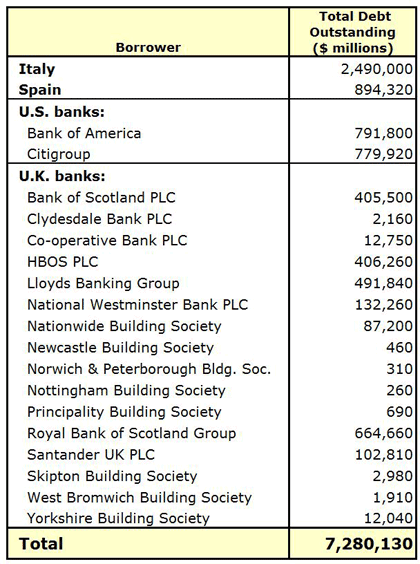
chart1

But the most shocking news about this crisis is not how often banks and governments have already been downgraded … it’s how many MORE deep downgrades are now on the way!

How do we know?

Because the credit agencies themselves have warned that most of the downgraded countries are now on the chopping block for still more rating cuts.

Because the government bonds of countries like Spain and Italy are already trading at prices that imply far lower ratings.

And because the cost of insuring those bonds against default has already surged to levels that also signal far lower ratings.

Moody’s itself admits that these kinds of market indicators can often warn you about coming troubles far sooner than their own ratings!

Hard to believe?

Then look at this chart from Moody’s Analytics (October 6) on the company’s sovereign debt ratings of Greece. (I’ve added the titles, but the underlying chart is from Moody’s.)
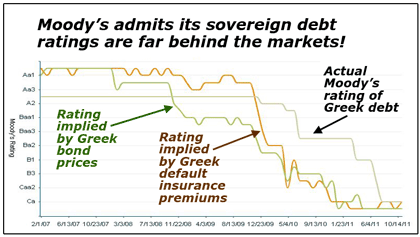
chart2

The analysts at Moody’s Analytics have plotted Greek bond prices on a scale that reflects the implied rating bond investors are assuming (the green line in the chart).

Plus, they’ve done the same for default insurance premiums on Greek debt (brown line).

Well, guess what! This chart shows that …

1.) Bond investors first “downgraded” Greek debt in a big way back in the fall of 2008.

2.) Default insurance traders followed with their big “downgrade” about a year later, toward the end of 2009.

3.) Moody’s itself didn’t announce its first major downgrade until the late summer of 2010 — nearly two years after the bond markets.

4.) And it wasn’t until this summer — nearly THREE YEARS after the first bond market signal — that Moody’s finally caught up with reality, downgrading Greece to Ca.

We’ve seen a similar pattern of falling behind reality at S&P and Fitch … with their ratings on countries, banks, big manufacturing companies, municipal bond insurers and many more. (For the evidence, see the case studies in my article of May 10, 2010.)

The lessons to be learned: When countries, banks, or any other borrower is in a death spiral …

• Moody’s and the other major rating agencies rarely give an advance warning. Instead, they lag far behind the markets.

• Eventually, they catch up with reality. Unfortunately, however, by that time, the debt is already a disaster zone and most investors have already suffered massive losses.

• If you see a country’s bond prices plunge in the open market, it can be a reliable early indicator of surging default risk.

• And if you see default insurance premiums following a similar pattern, it can be a very reliable confirming indicator. That’s why we report regularly on both here in Money and Markets.

Bottom line: These danger signs are exactly what we’ve been telling you about each week for countries like Spain, Italy, Belgium, France and EVEN GERMANY!

Why is this so important? For one simple reason:

The bigger the rescue package announced on October 23, the bigger the damage to the finances — and to the credit ratings — of the countries that must finance the rescue!

And the more their credit ratings fall, the more expensive it will be for them to raise the money.

Ultimately, even the rescuers will need a bailout of their own, but none will be forthcoming.

This is why the cost of default insurance for France and Germany is now indicating a far higher default risk than it did even during the debt crisis of 2008-2009.

This is why the bonds of most European governments have been plunging in spite — or even because — of the tall promises we’ve been hearing in recent days.

And this, Subscriber, is why even the “mother of all bailouts” — or whatever is announced on October 23 — cannot, I repeat CANNOT, save Europe or the euro!

Yes, politicians may persuade some folks that they’ve “finally put this crisis to rest,” as they’ve done so many times before.

And yes, Wall Street may rejoice temporarily, as they’ve also done many times before.

But that’s not the same as stability. It’s not even enough to kick the can down the road. Quite the contrary, with both Europe and the U.S. now caught in a great debt trap, all the evidence indicates that the fanfare and hoopla are nothing more than a set-up for the next major collapse.

My recommendations:

Step 1. Consider any stock market rally — in anticipation of, or in reaction to, the October 23 Europe rescue package — a trap to avoid.

Step 2. Use any such rallies as opportunities to SELL your most vulnerable shares.

Step 3. To help determine which of your stocks are likely to be the most vulnerable, use our Weiss Watchdog. You can access it from the menu bar at the top of www.moneyandmarkets.com or you can point your browser to www.weisswatchdog.com.

Step 4. Also use Weiss Watchdog to check the safety of your bank, credit union or insurance company.

Step 5. Once the bulk of your money is secure, think seriously about seeking the massive profit opportunities that can be created by precisely this kind of crisis.

Good luck and God bless!

Martin

About Money and Markets
For more information and archived issues, visit http://www.moneyandmarkets.com
Money and Markets is a free daily investment newsletter published by Weiss Research, Inc. This publication does not provide individual, customized investment or trading advice. All information is based upon data whose accuracy is deemed reliable, but not guaranteed. Performance returns cited are derived from our best estimates, but hypothetical as we do not track actual prices of customer purchases and sales. We cannot guarantee the accuracy of third party advertisements or sponsors, and these ads do not necessarily express the viewpoints of Money and Markets or its editors. For more information, see our Terms and Conditions. View our Privacy Policy. Would you like tounsubscribe from our mailing list? To make sure you don’t miss our urgent updates, just follow these simple steps to add Weiss Research to your address book.

Attention editors and publishers! Money and Markets content may be republished with a link to the full story on MoneyandMarkets.com. Such republication must include attribution with a link to the MoneyandMarkets home page as follows: “Source:http://www.moneyandmarkets.com

test-php-789





