
Daily Updates
A brief comment from the extensive analysis contained in Weldon’s Money Monitor.
“And in terms of Anglo-currency action, we again turn the spotlight to the north and shine it on the Canadian Dollar, particularly given the tendency for the Canuck Buck to LEAD the US Dollar Index, as evidenced within the multi-year overlay chart on display below. Subsequently the preliminary upside breakout in the US currency versus the Canadian unit, at the very least, begs a cautious attitude as it relates to the US Dollar Index.
We spotlight the ‘upside’ leadership (USD downside) shown by the Canuck Buck during the dollar’s bear move in 2005-2007 … AND … the fact that the Canadian Dollar ‘peaked’ (USD-CAD bottomed) nearly six months prior to the major low set by the USDollar Index during 2008, perhaps an ominous sign for perma-greenback-bears !!!!”

” … we still believe the Dollar is in the process of forging a significant low, and global stocks are in the process of forging a significant high.
And we are staying alive, for the REAL ‘next big’ move, of which we got a
preview last Friday !!!!”
Weldon’s Money Monitor offers a FREE 30 Day Trial Subscription. For subscription information contact Eileen @Weldononline.com or Visit www.Weldononline.com for a FREE Trial.
A FREE 30 Day Trial Subscription is defined as a single Trial that is limited to a one-time Signup. Signing up for multiple trials under different names, Fraudulent contact information is illegal. Weldon’s Money Monitor takes this seriously..
Editor Note: Money Talks highly recommends that you make a regular trip to this monday morning site to this Don Vailoux monday report where he analyses an astonishing 40 to 50 Stocks, Commodities and Index charts and, provides a “Bottom Line” and some very interesting commentary.
– a few of the 40+ charts and commentary below. Full site HERE.
Ed Note: Be sure to read the The Bottom Line below this brief commentary and charts.
U.S. equity index futures are slightly higher this morning. S&P 500 futures are up 1 point in pre-opening trade. Futures are responding to news that the UAE Central bank is willing to stand by banks in Dubai during Dubai World’s liquidity crisis.
Canada’s economy grew in the third quarter, but at a slower than expected rate. Consensus was a gain of 1.0%. Actual was a gain of 0.4%.
Goldman Sachs upgraded the U.S. steel sector from neutral to attractive. Goldman sees higher demand and prices for steel. It added U.S. Steel to its Conviction Buy list. In addition, Goldman favours Steel Dynamics, AK Steel and Nucor. The Market Vector Steel ETF is up more than 5% in pre-opening trade. ‘Tis the season for U.S. industrial stocks and ETFs to move higher!
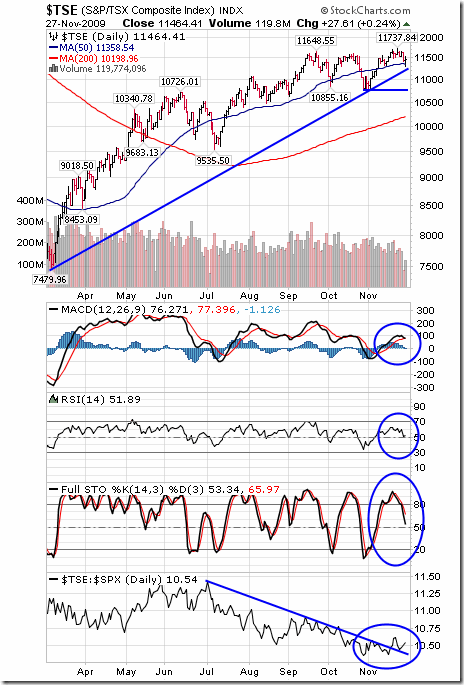
The TSX Composite Index lost 124.92 points (1.00%) last week. Intermediate trend remains up. The Index tested its 50 day moving average on Friday, but remains above its 50 and 200 day moving averages. Short term momentum indicators have rolled over. Stochastics fell below 80% on Thursday and MACD registered a negative cross over from a short term overbought level on Friday. Strength relative to the S&P 500 Index is showing early signs of changing from negative to positive. Seasonal influences currently are positive. Downside risk is to support at 10,745.25.
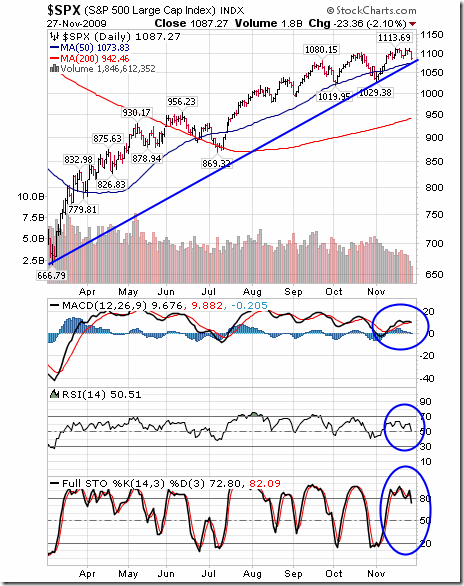
The S&P 500 Index slipped 4.11 points (0.38%) last week. Intermediate trend remains up. The Index remains above its 50 and 200 day moving averages. Notice the significance of its 50 day moving average as a support level during the past six months. Once again, that level (currently 1073.83) is being tested. Short term technical parameters are turning negative. Stochastics fell below 80% on Friday and MACD recorded a negative crossover from a short term overbought level. Seasonal influences remain positive. Downside risk is to support at 1,029.38.
The Nikkei Average dropped 416.17 points (4.38%) last week. Intermediate trend remains down. The Average remains below its 50 day moving average and broke below its 200 day moving average on Friday. Short term momentum indicators are trending lower, currently are oversold, but have yet to show signs of bottoming. Strength relative to the S&P 500 Index remains negative.

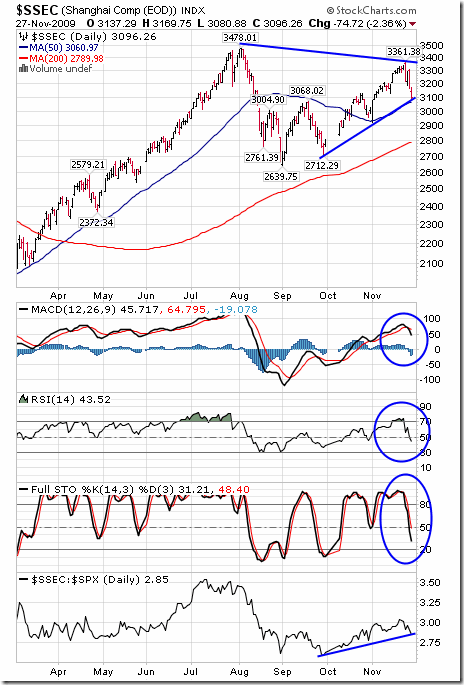
The Shanghai Composite Index plunged 212.08 points (6.31%) last week. Intermediate trend remains up. The Index remains above its 50 and 200 day moving averages. Short term momentum indicators are trending lower from overbought levels, but have yet to show signs of bottoming. Strength relative to the S&P 500 Index remains positive, but could be showing early signs of change.
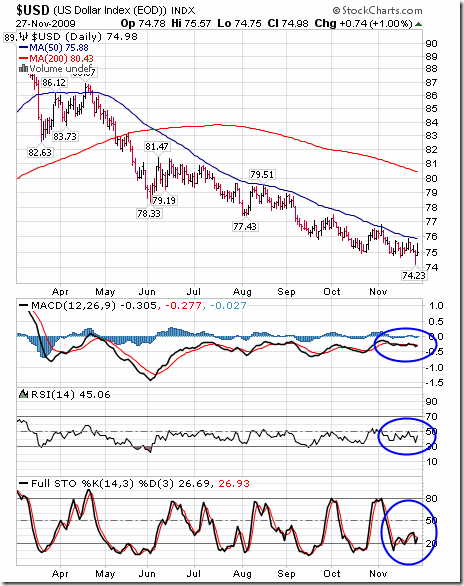
Technical action by the U.S. Dollar continues to dominate short term fluctuation in equity and commodity markets. Intermediate trend remains down. The Dollar slipped 0.68 last week after finding resistance once again at its 50 day moving average. Subsequently, it plunged to a new 14 month low. On Friday, it quickly recovered on the Dubai news and once again is testing its 50 day moving average currently at 75.88. Short term momentum indicators are neutral to slightly over sold.
The Bottom Line
North American equity markets appear poised to enter into a short term correction lasting 2-3 week. The correction will offer an opportunity to accumulate favoured equities and ETFs that will benefit from continuation of the period of seasonal strength.
Ed Note: much much more at Don Vialoux’s Monday Site HERE.
Don Vialoux has 37 years of experience in the Investment Industry. He is a past president of the Canadian Society of Technical Analysts (www.csta.org) and a former technical analyst at RBC Investments. Now he is the author of a daily letter on equity markets available free on the internet. The reports can be accessed daily right here at www.dvtechtalk.com.
Impossible! That’s what institutional investors say about “Timing the Market”. Mr. Vialoux will explain that, indeed, it can be done with the appropriate analysis. He also will explain why timing the market will be important during the next decade. Buy and Hold strategies are not working anymore; Investors are looking for alternatives. Mr. Vialoux will demonstrate four techniques that can be used to time intermediate stock market swings lasting 5-15 months. The preferred investment vehicles for investing in intermediate stock market swings are Exchange Traded Funds.
Comments in Tech Talk reports are the opinion of Mr. Vialoux. They are based on technical, fundamental and/or seasonal data that is believed to be accurate. The comments are free. Mr. Vialoux receives no remuneration from any source for these services. Comments should not be considered as advice to buy or to sell a security. Investors, who respond to comments in Tech Talk, are financially responsible for their own transactions.
Martin here with an urgent reminder that, despite what you may be hearing from Washington, risk is still a four-letter word.
And despite solemn vows to the contrary, the U.S. government is promoting risk with new-found enthusiasm and gall.
Again!
Yes, Fed Chairman Bernanke says he wants to avoid the possible risk of a future speculative bubble.
And yes, Treasury Secretary Geithner says he wants to reform financial regulation to avoid a future debt disaster.
But even while they give lip service to protecting you, they stand by passively as derivatives grow explosively.

Derivatives are debts and bets of all shapes and sizes, especially on interest rates, bonds, mortgage-backed securities, and other fixed instruments.
They were at the epicenter of the financial earthquake that shook the world last year. They triggered the demise of Bear Stearns, Lehman Brothers, AIG, and many others. And they’re still causing a series of aftershocks around the world, as in Dubai late last week.
So you’d think the authorities would have taken steps to reduce their threat to the U.S. banking system.
Not quite! Despite a brief reduction in derivatives outstanding in last year’s third quarter, U.S. commercial banks now hold a grand total of $203.5 trillion in derivatives, a new all-time high.
What’s worse, there has been no change whatsoever in the stranger-than-fiction facts behind that number — namely that …
A whopping 97 percent of all U.S. bank-held derivatives are concentrated in the hands of just FIVE institutions — JPMorgan Chase, Goldman Sachs, Bank of America, Citibank and Wells Fargo.
JPMorgan alone holds $79.9 trillion in derivatives — more than the grand total held by Bank of America and Citibank combined. (For the evidence, click here.)
Over 96 percent of all U.S. bank-held derivatives are traded over the counter, outside of any regulated exchange — a wild zone where neither central authority nor national responsibility play a significant role. (The evidence.)
Although some banks have made some progress in reducing their credit exposure, Citibank is still risking over double its capital … JPMorgan is still risking nearly three times its capital … and Goldman Sachs is still risking over NINE times its capital — all on the bet that their counterparties will not default.
The derivatives held by insurance companies like AIG aren’t even included in this tally. Yet, in a confidential memorandum leaked to the press earlier this year, AIG executives confessed that
“Systemic risk [triggered largely by derivatives] afflict all life insurance and investment firms around the world … If AIG were to fail, it is likely to have a cascading impact on a number of U.S. life insurers already weakened by credit losses. State insurance guarantee funds would be quickly dissipated, leading to even greater runs on the insurance industry.”
(For your reference, AIG’s memo is up on our website with key sections highlighted. Click here to view.)
Globally, the monster is three times larger than the $203.5 trillion in derivatives held by U.S. banks: According to the Bank of International Settlements (BIS), the worldwide total of just the unregulated, over-the-counter derivatives alone was $604.6 trillion at mid-year 2009. Although down from 2008 peak levels, it was up sharply from year-end 2008. (The evidence.)
Global authorities claim they want to tame this monster. In practice, however, they’re doing everything they can to feed it and keep it growing.
It’s the same derivatives monster that former Fed Chairman Alan Greenspan & company fought to protect back in the 1990s.
And it’s the same derivatives monster that Bernanke and Geithner are struggling so strenuously to protect today.
How? We’ve detailed and quantified the weapons of mass expansion they’ve been deploying in recent months:
- The giant bailouts …
- Near-zero interest rates …
- Mr. Bernanke’s trillion-dollar-plus purchases of mortgage-backed securities, and …
- His 45-to-1 acceleration in monetary expansion we detail in “Bernanke gone berserk! Bank reserves explode!, plus …
- His massive efforts to stimulate asset inflation and speculative bubbles, which Mike Larson documents in “The Fed’s Latest, Greatest Round of Asset Inflation” and “See no Asset Bubbles … Hear No Asset Bubbles … Speak no Warnings About Asset Bubbles.”
But there’s more …
Extend and Pretend
New tax rules issued by Mr. Geithner’s Treasury Department three months ago are now prompting banks around the country to sweep bad maturing loans under the rug simply by extending their terms — despite deteriorating collateral values and even despite questionable payment history.
These tactics — widely known in the industry as “extend and pretend” or “delay and pray” — are very similar to those used by savings and loans in the 1970s and early 1980s, also with the tacit encouragement of the regulators.
The big difference: Today, a far larger percentage of those bad debts are leveraged up with derivatives, another form of fuel for the growing monster.
Right now, the banks’ extend-and-pretend tactics are especially popular in the one loan sector that has the biggest troubles: commercial real estate.
No one knows which banks are the biggest offenders. But we do know which ones are the most exposed:
As a rule, a bank’s nonperforming commercial real estate loans should be no more than a fraction of a percent of total assets. In contrast …
- Tamalpais Bank of San Rafael, California has 4.16 percent of its assets tied up in nonperforming commercial real estate loans
- Builders Bank of Chicago — 4.27 percent
- Mellon United National in Miami — 4.46 percent
- Michigan Commerce Bank in Ann Arbor — 4.55 percent
- Saehan Bank in Los Angeles — 4.57 percent
- Bank of Florida Southwest in Naples — 4.7 percent
- Bank of Miami in Coral Gables — 5 percent
- Sun American Bank in Boca Raton, FL — 5.37 percent
- Savings Bank of Maine in Gardiner — 5.39 percent
- Westernbank Puerto Rico in Mayaguez, PR — 5.84 percent, and
- United Central Bank in Garland, TX — a whopping 9.95 percent.
None of these are pipsqueak institutions — all have total assets of at least half a billion. Plus, there are another 42 smaller U.S. banks with similar — or greater — exposure to bad commercial real estate loans. (For the complete list, click here.)
If the authorities had any semblance of respect for their own pronouncements, they’d crack down. Instead, they’re doing precisely the opposite — aiding and abetting a bad-loan cover-up with new accounting rules that make most of the cheating perfectly legal.
Looming FHA Fiasco
The U.S. Congress and the public are now painfully privy to the massive role that Fannie Mae and Freddie Mac played in enabling American homeowners to overborrow … enabling Wall Street to overleverage and fomenting the conditions that led to the housing bust and derivatives disaster of recent years.
So … is that why, in our infinite wisdom, we have encouraged the Federal Housing Administration (FHA) to do precisely the same thing, effectively picking up from where Fannie and Freddie left off? When will we ever learn?
Unfortunately, that may not happen until AFTER the FHA goes bankrupt.
According to the FHA’s own annual report, its Mutual Mortgage Insurance (MMI) capital ratio — its single most important measure of solvency — has plunged from 6.82 percent in 2006 to a meager 0.53 percent in 2009.

According to the National Housing Act, the FHA is required to keep this ratio at 2 percent or higher. So already, it is in violation of the Act. (For the evidence, click here.)
And despite promises to remedy the problem, the stated goals of the FHA — to replace much of the housing market lending support that was wiped away in the debt crisis — is merely dragging it deeper into the hole.
Bottom Line
In its encore performance to create a new speculative bubble, Washington has done virtually nothing to alter its old script. All it has done is replace some actors and change some names.
For you, that means two things:
First, it means that bull markets — especially in sectors and countries that help investors escape this madness — have obviously returned. And no matter how much we may question their underpinnings, pragmatic investors must take advantage of the short- and medium-term opportunities as they come.
More importantly, it means that risk is back … and with that risk comes the continuing danger of unexpected busts.
Bottom line: Continue to approach the financial markets with great caution, investing moderately, taking profits out along the way, and retaining a big stash of cash.
Good luck and God bless!
Martin
This investment news is brought to you by Money and Markets. Money and Markets is a free daily investment newsletter from Martin D. Weiss and Weiss Research analysts offering the latest investing news and financial insights for the stock market, including tips and advice on investing in gold, energy and oil. Dr. Weiss is a leader in the fields of investing, interest rates, financial safety and economic forecasting. To view archives or subscribe, visit http://www.moneyandmarkets.com.
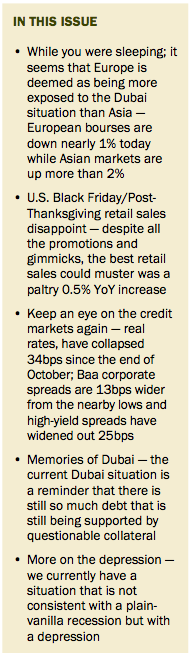
Last week, we received some classic guffaws when we responded to whether or not the recession has ended with this: “We’re not convinced, but even if it is statistically over, the depression is ongoing”.
We were reprimanded by former Fed Governor Mishkin for breeding “fear”. The eyes were rolling among the Squawk Box crew and we were told to tell that to Mr. Market, who has rallied more than 60% from the March lows (“artificial” lows, we were told off camera). After all, Mr. Market is so adept at calling the economy – like the peak in late 2007, literally weeks ahead of what the polite economics crowd dubs “The Great Recession”; or how adept Mr. Market was in calling the 2001 tech wreck; or the three failed attempts at predicting recovery over the past two years. Mr. Market’s ability at calling the economy, is shall we say, a tad spotty.
In fact, even with the massive amount of stimulus in modern history, all the economy could do was muster up a 2.8% annualized growth rate in Q3. If that number stands, it will go down as just about the poorest bounce off a recessionary environment on record. History, by the way, shows that 80% of the time, the opening quarter of the recovery ends up being a pretty good predictor over the extent of the economic pickup we see in the year that follows. So, that near 5% GDP growth backdrop being projected by Mr. Market right now looks to be more than just a tad dubious.
…..read more HERE. Subscribe for all David Rosenbergs reports HERE.
…..read more HERE. Subscribe for all David Rosenbergs reports HERE.
What You Don’t Want
Stockscores.com Perspectives for the week beginning Nov 30th, 2009

As investors, our natural inclination is to seek out stocks that have good qualities. We look for reasons to buy the stocks we are considering and often forget to look for the negatives. Since there are thousands of stocks to consider and almost all of them can have some reason for buying them, it may be better to reverse how we approach the analysis of stocks. Looking for reasons not to buy a stock will emphasize a higher standard for the stocks you do buy and will help to improve your overall market performance.
Here is a list of common reasons I use to throw a stock out of consideration:
Too Much Volatility
Volatility is uncertainty. Virtually every good chart pattern that I use to find winners demonstrates a break out from low volatility. The narrower the range before the breakout, the more important the breakout becomes. If the stock’s price is moving all over the place before it makes a break through resistance then there is a much greater chance that the breakout is false and will likely fall back. Ignore stocks that have a lot of price volatility before the break out.
- Get the $3,600 StockSchool Pro Free by just opening an account at:

- DisnatDirect named the number one Canadian brokerage for Traders by Surviscor! Open and Fund a brokerage account with DisnatDirect and receive the StockSchool Pro home study course free, including special Pro level access through the DisnatDirect client website. Offer only available to Canadian residents. For information, click here
Not Enough Reward for the Risk
A stock can go two ways, up or down, after you buy it. If the upside potential is not enough to justify the downside risk, then you should ignore the opportunity. I like stocks to have at least double the upside potential for the downside risk. That way, you don’t have to be right even half of the time to make money, provided you are disciplined of course.
Lack of Optimism
Fundamentals do not matter. It is the perception of Fundamentals that matter. If investors are not showing some optimism about a company’s prospects then it is likely that they are not paying any attention to the company’s fundamentals. Look for rising bottoms on the chart as an indication that investors are optimistic, if there aren’t any, leave the stock alone.
No Abnormal Behavior
The stock market is efficient most of the time. That means that you can not expect to consistently beat the stock market because all available information is priced in to the stock and your success at predicting new information can only be random. To beat the market, we have to look for break downs in market efficiency. I find that the best way to do this is look for abnormal behavior in the trading of a stock because it implies that there is significant new information playing a role in the stock’s performance. I don’t consider any stock that lacks abnormal behavior in its recent trading.
Too Far Up
The higher a stock goes, the riskier it becomes. I don’t like to chase stocks higher. If I look at a 6 month chart of a stock and it has made more than two steps up, I don’t consider it. A one day run of substantial gains is not a concern; I want to ignore stocks that have been in upward trends for some time. Look for stocks that are breaking from periods of sideways trading, not up trends.
Lack of Liquidity
The more often a stock trades, the easier it is to get in and out of it. Stocks that are not actively traded tend to have wider spreads between their bids and asks and it can be difficult to move in and out of the stock. Don’t consider stocks that don’t trade every day and they should trade at least 50 times a day but more is better.
Mixed Messages
I always try to look at a stock’s chart on more than one time frame. If the message is not the same on both charts, I leave them alone. When day trading, look at the daily and intraday charts. When position trading, look at the daily and weekly charts.
Any time you think a stock has great potential, give this list a look and see if any of these factors show up. If so, it may be a good idea to move on and look for something else.

Since the US markets were closed on Thursday and only traded for half a day on Friday, it is hard to get a read on new opportunities for next week. I was able to find a few good trade set ups earlier in the week that I featured in the daily newsletter. Each are still worth considering:

1. T.ORA
T.ORA has been moving higher for about two weeks after a break out of a trading range. Volume has been rising steadily over the past couple of months. Looks good so long as it can hold above support at $3.55.

2. CWST
CWST broke out on heavy volume from an ascending triangle earlier this week and has been consolidating over the last three days. I think you could put a tight stop at $3.79, with the understanding that there is a higher probability of being stopped out than if you put your stop at daily support at $2.90, but you also get a better risk reward ratio.

Click HERE for the Speaker Lineup and click HERE if you want to learn from some of the timeless advice from some of worlds best traders including the very successful Tyler Bollhorn.

Tyler Bollhorn started trading the stock market with $3,000 in capital, some borrowed from his credit card, when he was just 19 years old. As he worked through the Business program at the University of Calgary, he constantly followed the market and traded stocks. Upon graduation, he could not shake his addiction to the market, and so he continued to trade and study the market by day, while working as a DJ at night. From his 600 square foot basement suite that he shared with his brother, Mr. Bollhorn pursued his dream of making his living buying and selling stocks.
Slowly, he began to learn how the market works, and more importantly, how to consistently make money from it. He realized that the stock market is not fair, and that a small group of people make most of the money while the general public suffers. Eventually, he found some of the key ingredients to success, and turned $30,000 in to half a million dollars in only 3 months. His career as a stock trader had finally flourished.
Much of Mr Bollhorn’s work was pioneering, so he had to create his own tools to identify opportunities. With a vision of making the research process simpler and more effective, he created the Stockscores Approach to trading, and partnered with Stockgroup in the creation of the Stockscores.com web site. He found that he enjoyed teaching others how the market works almost as much as trading it, and he has since taught hundreds of traders how to apply the Stockscores Approach to the market.
References
Get the Stockscore on any of over 20,000 North American stocks.
Background on the theories used by Stockscores.
Strategies that can help you find new opportunities.
Scan the market using extensive filter criteria.
Build a portfolio of stocks and view a slide show of their charts.
See which sectors are leading the market, and their components.
Disclaimer
This is not an investment advisory, and should not be used to make investment decisions. Information in Stockscores Perspectives is often opinionated and should be considered for information purposes only. No stock exchange anywhere has approved or disapproved of the information contained herein. There is no express or implied solicitation to buy or sell securities. The writers and editors of Perspectives may have positions in the stocks discussed above and may trade in the stocks mentioned. Don’t consider buying or selling any stock without conducting your own due diligence.
-
I know Mike is a very solid investor and respect his opinions very much. So if he says pay attention to this or that - I will.
~ Dale G.
-
I've started managing my own investments so view Michael's site as a one-stop shop from which to get information and perspectives.
~ Dave E.
-
Michael offers easy reading, honest, common sense information that anyone can use in a practical manner.
~ der_al.
-
A sane voice in a scrambled investment world.
~ Ed R.
Inside Edge Pro Contributors

Greg Weldon

Josef Schachter

Tyler Bollhorn

Ryan Irvine

Paul Beattie

Martin Straith

Patrick Ceresna

Mark Leibovit

James Thorne

Victor Adair