
Daily Updates
Today’s Notes:
1. Vancouver Cambridge Symposium January 17th.
2. The Golden Constant
2. Hockey Night in Canada
THE GOLDEN CONSTANT
Yes, even in these days of dire economic straits for the entire world, there are opportunities in discovery for you to create legacy wealth. Gold is still one of those opportunities and today you must own and hold some gold bullion or coins. Gold is morphing as you read this Morning Note into its true historical…
….read more HERE.
Monday’s Notes:
1. Flawed Theories
2. Revett Minerals Agrees With Quaterra Resources
Most analysts tend to focus on the energy equation. Access to cheap energy sources is critical for an economy to prosper. “Cheap” is at least as important as “clean” when it comes to energy. I want to discuss the recent ClimateGate scam that seems to have been discovered through an examination of IPCC emails on a university (East Anglia)computer in England. Here the ultimate nature of the global warming research case is exposed.
….read the whole commentary HERE
A Debt-Induced Revolt of Free Enterprise?
2/01/09 London, England – US personal income rose in October. But it was boosted by government benefits, says David Rosenberg. Take away the free money from the feds and income actually went down.
Income has been going down for a long time in the US. English colleague Brian Durrant wonders why there is no revolution:
“Consider a country. For the top 20% of the population real incomes have increased by 60% since 1970. But for the other four-fifths real income has fallen by more than 10%. Am I talking about Guatemala or Bolivia? These sorts of inequalities have in the past provoked resentment sometimes articulated through revolutionary movements and social unrest. But I am not talking about a tiny Latin American state; these figures apply to the US. How can this be? Middle class America is surely better off compared to 1970; if you look at higher car ownership, better housing, more white goods and gadgets. The answer is debt. No wonder the politicians are frightened of it contracting!”
We have been saying that the last 10 years was a ‘lost decade’ in terms of income, employment and stock market growth. For most people, their whole adult lives have been spent slipping backward. Since the Carter Administration, the typical American has lost income. A whole generation made no financial progress.
But they didn’t revolt. Instead, they borrowed. It gave them more gadgets, gizmos and floor space. It also gave them the impression that things were getting better. Now we’ve reached the end of that period of debt expansion. Now debt is contracting. So are lifestyles…And so is the foundational American faith in free enterprise.
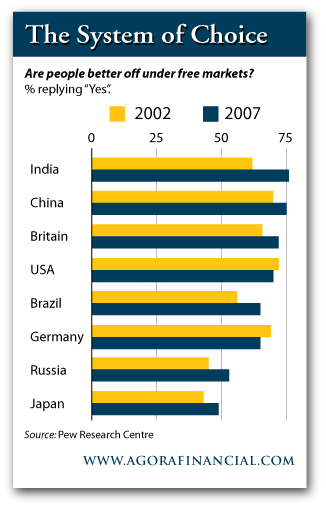
America flourished because its people believed in free enterprise and controlled public spending. Now, they seem to believe the exact opposition. That business must be carefully controlled…and the feds can spend however much they want.
But check this out. Now, people in communist China have more faith in free enterprise than Americans do.
….read more HERE.
I’m not so much concerned
about the return on my money
as the return of my money.
– Will Rogers, 1933
Toothpicked, straw-hatted Will Rogers was a journalists’ dream, combining common sense with a sense of humor that could trump any newsman of his day, an era that was characterized more by its hopeless and helpless ennui, than its promise for a better tomorrow. During the Great Depression, just breaking even by stuffing your money in a mattress was considered to be a triumph of conservative investment. Likewise, during the past 18 months there have been similar “Will Rogers” moments. Perhaps remarkably, during the week surrounding the Lehman crisis in September of 2008, yours truly frantically called my wife Sue to empty our two local bank accounts into apparently safer Treasury bills. I was not the only PIMCO professional to do so. Preserving principal as opposed to making it grow was the priority of the day – digging a foxhole instead of charging enemy lines seemed paramount.
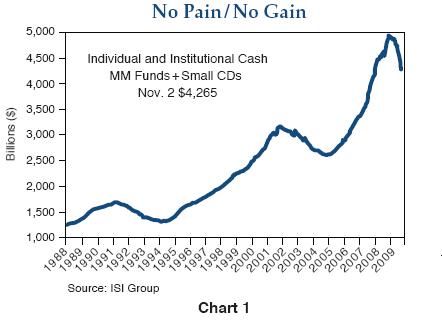
My how things have changed! With the global financial system apparently stabilized, returns “on” your money are back in vogue, and conservative investors who perhaps appropriately donned a Will Rogers mask nary a fortmonth ago are suddenly waking up to the opportunity cost of 0% cash versus appreciated assets at renewed double-digit annual rates. That 0% yield is not a joke. Almost all money market accounts – totaling over $4 trillion dollars, shown in Chart 1 – yield close to nothing, so close to nothing that I mistakenly did a double take when reviewing my monthly portfolio statement.“Yield on cash,” read the buried line on page 15 of the report, “.01%.”
Well now, I say to myself, this is very interesting from a number of different angles. If I was hoping to double my money, it would take approximately 6,932 years to get there at that rate! Somehow, that wouldn’t satisfy even Will Rogers, who might be choking on his toothpick or at least eating his straw hat in amazement. Secondly, being a savvy professional investor and all, I knew that money market funds actually earned 20 basis points or so on my money, but in this case were allocating a paltry one basis point to me. The words of the Beatles’ “Taxman” immediately popped into mind: “That’s one for you, nineteen for me – TAXMAN!” Ah yes, but in this case it was the Fed and Wall Street that were passing the collection plate. Whether it was really “God’s work,” as Goldman’s Lloyd Blankfein asserted, I wasn’t quite sure. If there was a “temple” in the vicinity I was thinking that God should be driving the moneychangers out as opposed to inviting them in for a pep talk.
Ah, but this is not a vindictive diatribe, although to me, money changers resemble Mammon more than archangels, and they all make too much money, including PIMCO. My point is to recognize, and to hope that you recognize, that an effective zero percent interest rate, as a price for hiding in a foxhole, is prohibitive. Like the American doughboys near France’s future Maginot line in WWI – slumping day after day in a muddy, rat-infested pit – when the battalion commander finally blew his whistle to charge the enemy lines, it probably was accompanied by some sense of relief; anything, anything but this! Anything but .01%!
Recently, approximately $20 billion a week has been exiting those payless, seemingly godless funds in search of a higher-yielding Nirvana. Yet, as Will Rogers knew, and Lehman Brothers demonstrated to another generation, the pain of the foxhole can immediately transition to the dodging of real bullets on the investment battlefield. Moving out on the risk asset spectrum has worked wonders since March of this year, but it comes with the risk of principal loss – failing to receive the return of your money. When viewed from 30,000 feet, there is even a systemic risk that new asset bubbles are in the formative stages – perhaps because of the .01%. Gold at $1,130 an ounce, global equity markets up 60-70% from their 2009 lows, a cascading dollar now 15% lower against a basket of global currencies just 12 months ago, oil at 80 bucks, mortgage rates at 4% thanks to a $1 trillion dollar credit card from the Fed; the list goes on. The legitimate question of the day is, “Is a 0% funds rate creating the next financial bubble, and if so, will the Fed and other central banks raise rates proactively – even in the face of double-digit unemployment?” As Chicago Fed President Charles Evans said in a recent speech, “This notion is often described as an imperative to ‘lean against a bubble,’ meaning that a central bank should act to lower asset prices that by historical standards seem unusually high.”
Yet even if the Fed and others are becoming sensitized to the dangers of up as opposed to exclusively down asset prices, it would seem that now is not the time to be affirming their bipolarity. Asset price rebounds (aside from the historic highs in gold) have followed even more dramatic slumps. A 60% rise in the stock market does not compensate for a 60% decline. Strangely enough, investors are still out 36% of their money once this down elevator/up elevator example plays out. And the simple analysis is that the private sector has still not taken the baton from government policymakers: There has been no public/private sector handoff. Bank lending is still contracting in the U.S. and weak in most other G-10 countries. Unemployment is still rising and approaching historic (ex-Depression) cyclical peaks.
Raise interest rates with 15 million jobless and 25 million part-time working Americans? All because gold is above $1,100? You must be joking or smoking – something. We will need another 12 months of 4-5% nominal GDP growth before Bernanke and company dare lift their heads out of the 0% foxhole – mini-bubbles or not. Instead, the heavy lifting or the charging of enemy lines in the case of this metaphor will likely be done by other central banks – already in Australia and Norway. In addition, and importantly, China may abandon its dollar peg within six months’ time and with it, its own easy monetary policy that has fostered more significant mini-bubbles of lending and asset appreciation on the Chinese mainland. With renewed upward appreciation of the yuan may come potentially volatile global asset price reactions to the downside – higher Treasury yields, and lower stock prices – which the Fed must surely be leery of before making any upward move, of its own, and before moving on, let me state the obvious, but often forgotten bold-face fact: The Fed is trying to reflate the U.S. economy. The process of reflation involves lowering short-term rates to such a painful level that investors are forced or enticed to term out their short-term cash into higher-risk bonds or stocks. Once your cash has recapitalized and revitalized corporate America and homeowners, well, then the Fed will start to be concerned about inflation – not until. To date that transition is incomplete, mainly because mortgage refinancing and the purchase of new homes is being thwarted by significant changes in down payment requirements. The Treasury as well, has a significant average life extension of its own debt to foist on investors before the Fed can raise short-term Fed Funds.
OK, so where does that leave you, the individual investor, the small saver who is paying the price of the .01%? Damned if you do, damned if you don’t. Do you buy the investment grade bond market with its average yield of 3.75% (less than 3% after upfront fees and annual expenses at most run-of-the-mill bond funds)? Do you buy high yield bonds at 8% and assume the risk of default bullets whizzing at you? Or 2% yielding stocks that have already appreciated 65% from the recent bottom, which according to some estimates are now well above their long-term PE average on a cyclically adjusted basis? Two suggestions. First, as emphasized in prior Investment Outlooks, the New Normal is likely to be a significantly lower-returning world. Diminished growth, deleveraging, and increased government involvement will temper profits and their eventual distribution to investors in the form of dividends and interest. As banks, auto companies and other corporate models become more regulated and therefore more like utilities and less like Boardwalk and Park Place, they will return less.
Which brings up the second point. If companies are going to move toward a utility model, why suffer the transformational revaluation risk of equities with such a low 2% dividend return? Granted, Warren Buffet went all-in with the Burlington Northern, but in doing so he admitted it was a 100-year bet with a modest potential return. Still, Warren had to do something with his money; the .01% was eating a hole in his pocket too. Let me tell you what I’m doing. I don’t have the long-term investment objectives of Berkshire Hathaway, so I’m sort of closer to an average investor in that regard. If that’s the case, I figure, why not just buy utilities if that’s what the future American capitalistic model is likely to resemble. Pricewise, they’re only halfway between their 2007 peaks and 2008 lows – 25% off the top, 25% from the bottom. Their growth in earnings should mimic the U.S. economy as they always have, and most importantly they yield 5-6% not .01%! In a low growth environment, it seems to me that a company’s stock should yield more than its less risky debt, and many utilities provide just that opportunity. Utilities and even quasi-utility telecommunication companies now yield between 5 and 6%, whereas their 10- and 30-year bonds yield less and at a higher tax rate to you the investor.
So come on you frustrated Will Rogers lookalikes. Join the wimp who pulled his money out of the bank just 14 months ago. Look at your monthly statement, zero in on that .01% yield and say to yourself, “I’m as mad as hell, and I’m just not going to take this anymore!” You can’t buy the Burlington Northern – Warren Buffett has scooped that up – and most other choices offer tempting returns, but potential bullets as well. Buy some utilities. It may not be as much fun as running a railroad, but at least you’ll know who to call if the lights go out.
William H. Gross
Managing Director – Pimco
U.S. President Barack Obama made news in China last month when he announced the need to tackle the U.S. deficit to avoid a “double-dip recession.” The statement triggered speculation that America’s chief creditor admonished the President to get his fiscal house in order.
While most analysts have spent the past year arguing China is caught in a “dollar trap,” the timing and location of Mr. Obama’s statement indicates the Chinese have learned some key lessons from the last great dollar crisis. Most importantly, they appear to understand that “dollar diplomacy” is a useful tool to make U.S. policies more favorable to protecting the value of China’s $2 trillion in reserves.
To understand this, it’s worth a brief historical review of the problem facing major U.S. creditors in the late 1970s. In 1978, concern about the dollar’s health reached the top of the international economic agenda. U.S. trading partners, such as West Germany and the Organization of the Petroleum Exporting Countries (OPEC), grew particularly worried as the dollar’s weakness eroded their competitiveness or jeopardized the value of their dollar-denominated reserves. OPEC faced an especially acute problem, because the dollar served as oil’s invoice currency, meaning the oil-exporting nations had no alternative to dollar accumulation. In June 1978, for example, one estimate put Saudi Arabia’s foreign assets and reserves at $65 billion—80% of which were said to be held in dollars.
While China’s dollar reserves are orders of magnitude larger than those held by Saudi Arabia in the late 1970s, the Saudis still faced the fundamental “dollar trap” predicament: Any major effort to shift reserves from dollars to another currency would accelerate the dollar’s decline and erode the value of the remaining reserves.
Yet rather than passively accepting a fate of accumulating increasingly devalued dollars, the OPEC countries engaged in careful diplomacy, bringing pressure to bear on the United States that ultimately contributed to a tougher inflation policy. First, OPEC countries publicly discussed pricing oil in a currency other than the dollar, such as the International Monetary Fund’s special drawing rights. The cartel requested a study on the effect of invoicing oil in an alternative currency, and an OPEC committee proposed using a basket of currencies to price the commodity. One member of the cartel—Kuwait—said it would accept sterling instead of dollars.
Second, some OPEC members raised the possibility of an oil-price hike to compensate for the erosion of the dollar’s value through unchecked inflation……
….read more HERE.
Not that there’s a link between the two, but as the legendary Peter Grandich celebrates his silver anniversary as a market commentator, he tells The Gold Report in this exclusive interview that having been left behind in the big run-up in gold, silver’s time has come to steal the limelight for a while. Peter, who started publishing The Grandich Letter 25 years ago and this month celebrates his first anniversary as Agoracom’s market analyst too, also considers the current stock market rally as a gift delivered in the eye of the storm. Longer term, he expects America’s underlying economic problems to result in prolonged sagging trading performance such as Japan has experienced over the past 20 years. Accordingly, he’s alerting investors “to remove their bullish hats if they’re still wearing them.” As Peter’s motto goes, “It’s better to be a live chicken versus a dead duck.”
The Gold Report: When he was in China, President Obama said “It’s important to recognize if we keep on adding to the debt, even in the midst of this recovery, at some point people could lose confidence in the U.S. economy in a way that could actually lead to a double-digit recession.” He went on to indicate that Congress or he would be considering some tax cuts, but also some fiscal spending to counteract the unemployment. Other than preparing the populace for another potential downturn, what’s wrong with this approach?
Peter Grandich: You can’t have your cake and eat it, too. So I think it was rhetoric and I think the market realized that he was speaking out of both sides of his mouth. If you’re going to use stimulus, someone has to pay for that stimulus and that stimulus will be paid for with higher taxes. The government, just like a company, can look to cut expenses, but they’re not; they’re spending more. They could work on entitlements and they are working on the healthcare side, but it’s evident, at least to me, that in the end we’re looking at a much higher cost.
TGR: If it’s rhetoric, why would he say there’s a potential second leg to this downturn?
PG: Political cover. You could argue that he’s saying what could happen down the road if people don’t support his agenda.
TGR: Wouldn’t that increase caution, when people are already cutting back because they fear there’s more to come?
PG: The problem is that there is no easy solution. Some of us felt a year ago that the best solution, although far more painful initially, would be just let the markets decide. Even if it meant a depression-like state, let the markets adjust for assets that are too expensive and for debt. That seemed better than throwing sand at the ocean, thinking that if you somehow hold the economy together—even though you create a whole lot of new money—you can magically take that money out of the system once things turn around. All we’ve really done is kick the can down the road and the can is much, much heavier to kick when the next time to kick it comes further down the road.
TGR: In the context of your kicking-the-can metaphor, you recently said that future historians will blame Alan Greenspan for the downfall of the U.S. economy, due to policies that led to the bubble of all bubbles. Can you elaborate on that?
PG: I think history will show that he was really a driving force in what led to the enormous problems that the United States now faces. Not more than three or five years ago, and certainly for 10 years before that, Alan Greenspan was hailed as the great financial and economic savior. He received many accolades for supposedly keeping the U.S. economic engine going and creating all sorts of growth. It’s become abundantly clear now that people have found what was swept under the carpet, that he really created the worst of all worlds by a monetary policy that was way over-stimulated. In fact, in the aftermath of the mortgage crisis in testimony before Congress, he basically admitted that he didn’t realize how severe the mortgage problem was. Imagine what would have happened to the market if he had said that when he was in office.
TGR: Will historians put some blame on Bernanke and Paulson, too, for increasing debt in reaction to the bubble’s bursting?
…..read more including Silver Commentary HERE.
On Major Moves, Grandich has been very right and not only saved many investors fortunes, but expanded them dramatically. On November 3, 2007 at the MoneyTalks Survival Conference, Peter Grandich of the Grandich Letter warned that “an unprecedented economic tsunami will hit American beginning in 2008”. Peter advised publicly to short the US market two days from the top in October, 2007 and stayed short until the last week of October, 2008. He began to buy stocks in March 7th, 2009. He also bought oil and oil related investments near the lows after the dive from $147.
….go to visit Peter’s Website.
-
I know Mike is a very solid investor and respect his opinions very much. So if he says pay attention to this or that - I will.
~ Dale G.
-
I've started managing my own investments so view Michael's site as a one-stop shop from which to get information and perspectives.
~ Dave E.
-
Michael offers easy reading, honest, common sense information that anyone can use in a practical manner.
~ der_al.
-
A sane voice in a scrambled investment world.
~ Ed R.
Inside Edge Pro Contributors

Greg Weldon

Josef Schachter

Tyler Bollhorn

Ryan Irvine

Paul Beattie

Martin Straith

Patrick Ceresna

Mark Leibovit

James Thorne

Victor Adair