
Daily Updates
Trade With Control in 2010 – Resolutions for Every Trader
Stockscores.com Perspectives for the week beginning Dec 27th, 2009

Best wishes for 2010!
1. I Will Remember Risk
Every time we make a trade, we must let the risk of the trade determine how many shares we take in the position. If we take more risk than we are comfortable with, we are more likely to make emotional mistakes that will cost us money.
2. I Will Remember Reward
A trade must have enough profit potential to justify the risk of the trade. As a general rule, a trade should have twice as much reward potential for the risk you take.
3. I Must Limit Losses
A big loss in your portfolio can outweigh the gains made on 10 other trades. Limit the size of your losses and stick to the limits. If a trade does not work out, take a small loss and move on.
4. I Must Not Limit Profits
While it feels good to lock in a profit, we should lock in our gains when the market tells us the stock is more likely to go lower than higher. Let profits run until then.
5. I Need to Keep it Simple
In the search for trading success, many traders get very complex in their analysis. Good traders keep it simple, and focus on doing the simple things right.
6. I Will Remember that Public Information is Useless Information
If information is known by the general public, then it is priced in to the stock. The stock market moves on what will happen in the future, not on what has already happened.
7. I Will Focus on Abnormal Behavior
The stock market is efficient most of the time. That means that you can not expect to consistently beat the stock market unless you focus on opportunities where the efficiency of the market is breaking down. That tends to happen when stocks are behaving abnormally.
8. I Will Trade With Confidence
So much of trading success is mental. To make money, you have to believe in what you are doing and execute your trading plan. Start slowly and build up your confidence before you take too much risk.
9. I Will Learn Before I Trade
Most stock traders lose money because most stock traders don’t take the time to learn how to trade. Tools are only useful if you know how to use them.
10. I Will Not Try to be an Overnight Success
If you aspire to make money from the market, realize that the process to learn how to trade will take time. Getting rich quick from the stock market is no more likely than attaining wealth by playing blackjack. Good traders don’t gamble.

The markets are very slow at this time of year and there are few good trading opportunities. Expect activity to pick up after the first week of January.
This year was one of the most unusual I have ever seen. In March, investor psychology could not have been any more negative; there was complete fear among most investors which, of course, means there is great opportunity. The sky did not fall as so many thought it would and the market enjoyed one of the best rallies ever after making its low early in March.
The question we all now face is, will the buyers continue to push stocks higher?
2009 is finishing with some pretty optimistic chart patterns on the major market indexes. This week, I go through each of these charts and provide a short analysis to help you determine what your strategy should be as 2010 begins.
The state of the overall market should determine your strategy. If the market appears likely to move higher, position trading strategies like the Stockscores Simple or the swing trading strategy Pull Back Plays are good choices. If the market is going lower, short selling strategies like the Reversal of Fortune, Pull Up Plays or Long Term Breakdowns will enjoy the best success.
So, as 2009 comes to a close, here is my current analysis on the four major market indexes that I like to follow. This analysis can change quickly, to stay updated on where the markets are likely headed, check out the weekly Market Minutes videos from the link on the Stockscores.com home page.

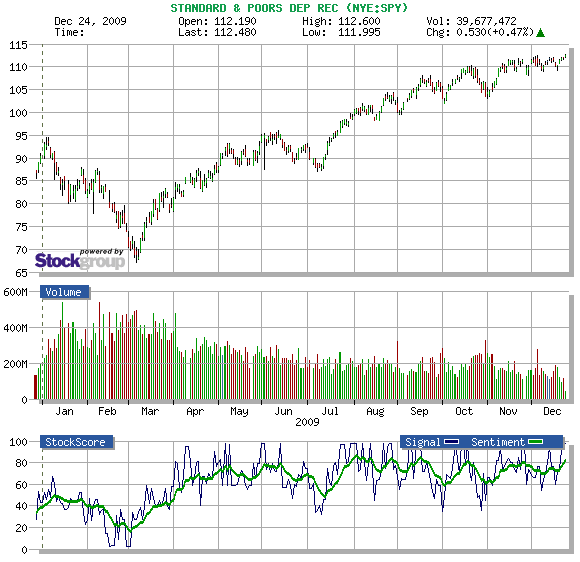
1. SPY
The S&P 500 is represented by the Exchange Traded Fund, SPY. This ETF is just breaking through resistance after spending a couple of months trending sideways. The buyers are in control and we should continue to favor buying strategies until the trend reverses.
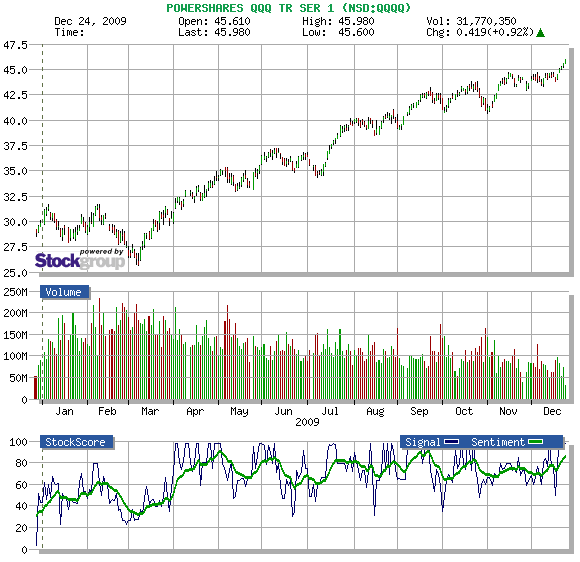
2. QQQQ
The Nasdaq 100 is a showcase for mostly technology companies and is represented by the ETF, QQQQ. This market has been a leader in the past couple of weeks and was the first to make the break through resistance. I expect these stocks will continue to lead the market higher in the very short term before that money rotates out in to other sectors. Stay on the buy side of the market for these stocks.
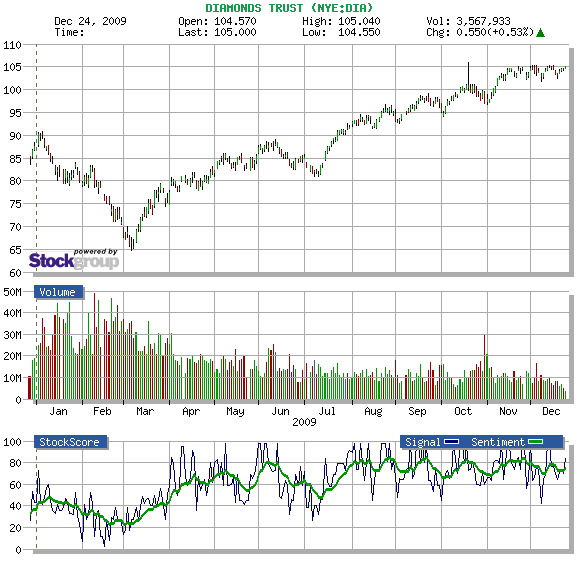
3. DIA
The Dow represents the largest companies in the world and is a good proxy for the global economy. The DIA is lagging the S&P and Nasdaq as it has not yet broken through resistance but its chart is an optimistic one with the buyers in control.
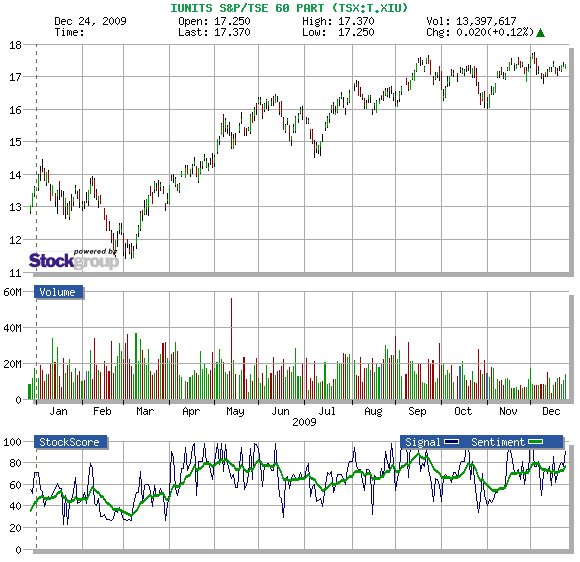
4. T.XIU
The TSX 60 is the benchmark for the Canadian markets and is represented by the ETF T.XIU. This index is based heavily on commodity stocks, particularly energy and mining. Since the global recovery will require commodities, this is a good index to track. The chart for the T.XIU is in an optimistic sideways pattern but the chart is a bit deceptive. Unlike the US Dollar, the Canadian has been strong over the past few months which means this market has been an outperformer for foreign investors who are seeing gains in their stocks but also in the underlying currency of those stocks. Remain on the buy side of this market until the chart pattern is reversed.
Click HERE for the Speaker Lineup and click HERE if you want to learn from some of the timeless advice from some of worlds best traders including the very successful Tyler Bollhorn.

Tyler Bollhorn started trading the stock market with $3,000 in capital, some borrowed from his credit card, when he was just 19 years old. As he worked through the Business program at the University of Calgary, he constantly followed the market and traded stocks. Upon graduation, he could not shake his addiction to the market, and so he continued to trade and study the market by day, while working as a DJ at night. From his 600 square foot basement suite that he shared with his brother, Mr. Bollhorn pursued his dream of making his living buying and selling stocks.
Slowly, he began to learn how the market works, and more importantly, how to consistently make money from it. He realized that the stock market is not fair, and that a small group of people make most of the money while the general public suffers. Eventually, he found some of the key ingredients to success, and turned $30,000 in to half a million dollars in only 3 months. His career as a stock trader had finally flourished.
Much of Mr Bollhorn’s work was pioneering, so he had to create his own tools to identify opportunities. With a vision of making the research process simpler and more effective, he created the Stockscores Approach to trading, and partnered with Stockgroup in the creation of the Stockscores.com web site. He found that he enjoyed teaching others how the market works almost as much as trading it, and he has since taught hundreds of traders how to apply the Stockscores Approach to the market.
References
Get the Stockscore on any of over 20,000 North American stocks.
Background on the theories used by Stockscores.
Strategies that can help you find new opportunities.
Scan the market using extensive filter criteria.
Build a portfolio of stocks and view a slide show of their charts.
See which sectors are leading the market, and their components.
Disclaimer
This is not an investment advisory, and should not be used to make investment decisions. Information in Stockscores Perspectives is often opinionated and should be considered for information purposes only. No stock exchange anywhere has approved or disapproved of the information contained herein. There is no express or implied solicitation to buy or sell securities. The writers and editors of Perspectives may have positions in the stocks discussed above and may trade in the stocks mentioned. Don’t consider buying or selling any stock without conducting your own due diligence.
Quotable
“God bless us every one!” said Tiny Tim, the last of all.” – Charles Dickens
FX Trading – Twelve Themes of Christmas (guesses, wishes, and concerns)
1) The dollar has bottomed on a multi-year basis after a major test in 2009.
2) Interest rates are going higher as this recovery “normalizes” in 2010; we see 5% on the 10-year T-note before the year is done.
3) US job growth will be surprisingly strong.
4) There will be a crisis within the Eurozone late in 2010 that will shake the foundation of the euro as a single currency.
5) Asian-block currencies will breakout against the developed world majors and move higher.
6) Extremely tight intermarket correlations will finally begin to breakdown and currencies will be increasingly judged on both fundamentals and yield differentials.
7) Stock market volatility will increase as government backstops disappear. Stocks will initially get hammered on the broader realization the real economy is improving i.e. money flow.
8) China will continue to rock through mid-year, but at some time during the second half of 2010 it will experience a major financial disruption that will rock markets around the globe.
9) Gold sees $700 before $1,500 (Sorry Dad!)
10) South Africa begins to unravel politically (it intensifies for international consumption) and the rand gets hammered.
11) Russia makes another major incursion west, increasing its “buffer zone;” continuing to pressure Baltic and Central European Currencies.
12) Thank you for reading Currency Currents and putting up with our rants, raves, mistakes, bad calls, and curmudgeon-ness (I don’t think it’s a word but fits well here). We hope we have shared some things good; we know we have received many things good from the amazing quality of people who read CC each day.
Merry Christmas and Happy New Year!
Jack Crooks
Black Swan Capital LLC
www.blackswantrading.com
BIG PICTURE- “It’s a question of how do you achieve the deleveraging. Do you go through a long period of slow growth, high savings and many legal problems or do you accept higher inflation? It would ameliorate the debt bomb and help us work through the deleveraging process” – Kenneth Rogoff, Professor of Economics at Harvard, Former Chief Economist at the International Monetary Fund
Make no mistake; the developed world is drowning in debt and as outlined above, there are only two viable options – a global economic depression or very high inflation. It is our contention that the policymakers have chosen the latter option and over the following years, we will experience the trauma of severe inflation.
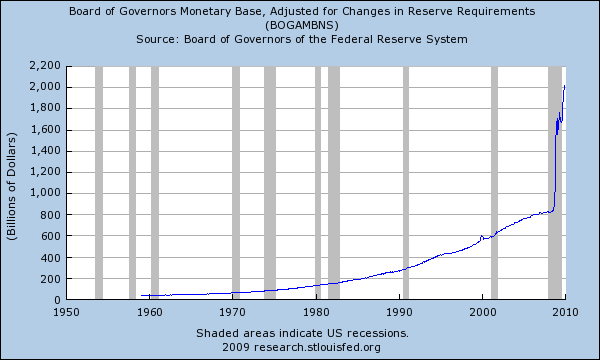
Look. The American government is staring at total obligations of US$115 trillion, America’s debt to GDP ratio is off the charts and the American public is also up to its eyeballs in debt. Under this scenario, you can bet your bottom dollar that the American establishment will try to reduce this debt overhang through a process known as monetary inflation. If you have any doubt whatsoever, take a look at Figure 1 which captures the incredible expansion in America’s monetary base. As you can see, over the past two years, the monetary base in America has expanded from US$827 billion to an astonishing US$1.93 trillion! Up until now, this surge in the monetary base has not permeated through the broad economy but once the money velocity picks up, the money supply will zoom and the end result will be surging price inflation.
Figure 1: Explosion in America’s monetary base
It is notable that America is not alone in pursuing inflationary policies; most nations all over the world are printing money and debasing their currencies. In this era of globalisation, no country wants a strong currency and everyone is engaged in competitive currency devaluations. Given this reality, we firmly believe that this money and debt creation will cause an inflationary holocaust over the coming years.
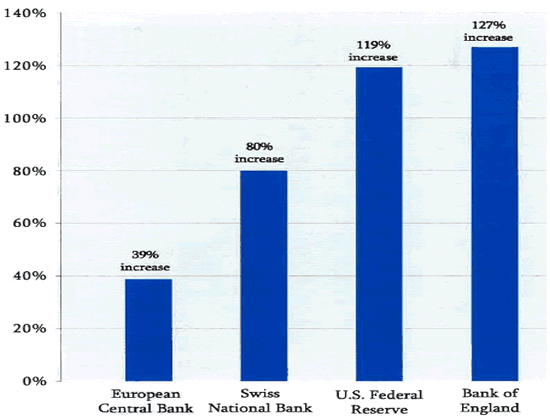
In fact, those who erroneously believe that deflation is unavoidable should review Figure 2 which highlights the mind-boggling expansion in the balance sheets of various central banks. As you can see, America alone is not the only nation guilty of printing money; the Europeans have also jumped on this train to Inflationville.
Now, we are aware that many prominent commentators are still calling for deflation and their argument is based on the strength in American Treasuries. “After all, how can inflation be a problem when bond yields are so low?” seems to be their reasoning. Well, these deflationists seem to be missing the point because the American Treasury market is no longer a free market and we would argue that the Federal Reserve’s intervention is largely responsible for keeping bond yields artificially low. It is noteworthy that over the past several months, the Federal Reserve has purchased most of the newly issued American Treasuries. It goes without saying that the American central bank is engaged in this desperate act in order to keep interest-rates low. However, it is buying these Treasuries by creating money out of thin air. This is inflationary.
If our assessment is correct, somewhere down the road, the Federal Reserve will lose its battle and long-dated American Treasuries will plummet in value. As more and more bond investors wake up to the looming inflationary menace, they will start demanding a higher rate of return on their capital. When that happens, the dyke will break and the Federal Reserve will become irrelevant.
We have no doubt in our minds that over the next decade, various central banks will intensify their money-printing efforts and Mr. Bernanke will lead by example. After all, America has run out of choices and if the Federal Reserve does not inflate away this mountain of debt, the biggest sovereign default in history is guaranteed. Now, given the ability of the Federal Reserve to create confetti money, we are convinced that it will opt for the inflation tonic. Remember, inflation dilutes the purchasing power of each unit of money and it will make America’s debt more manageable. Of course, this inflationary agenda is not a secret and this is why many creditor nations with huge reserves are beginning to diversify out of the American currency.
It is our observation that throughout history, monetary inflation has caused asset prices to rise and this time should be no different. In the past, when inflationary expectations spiralled out of control, hard assets were the prime beneficiaries and this trend is likely to remain intact in this inflationary episode. If our assessment is correct, over the coming years, stocks, precious metals, commodities and real-estate will appreciate in value versus paper currencies. Furthermore, on a relative basis, we expect precious metals and commodities to outperform all other asset-classes. Conversely, we anticipate that cash and fixed income instruments will probably turn out to be the worst assets to own over the next decade.
Bearing in mind the looming inflationary nightmare, we urge you to protect your purchasing power by allocating capital to precious metals and commodities related businesses. Finally, we suggest that you consider allocating a portion of your capital to the fast growing economies in Asia (China, India and Vietnam).
For our part, we have invested our clients’ capital in world-class businesses in our preferred themes and we expect our holdings to benefit during this low-growth, high-inflation environment.
Puru Saxena
www.purusaxena.com
PuruSaxena Wealth Management offers discretionary wealth management, advisory and research services to private and corporate clients. Our investment strategies are designed for long-term capital appreciation and our prime objective is to produce growth over the entire business cycle.
Our clients benefit from our time-tested investment philosophy, penetrating research and sound portfolio-management techniques. We have the capability to access global markets and invest in all asset-classes (stocks, fixed income and commodities) depending on the prevailing market conditions and each client’s specific requirements. Through regular communication, we strive to make investing an educational process and our research reports enhance our clients’ knowledge and understanding.
As an independent firm, we are driven solely by performance. Accordingly, we conduct extensive ongoing research in order to identify and allocate capital to fundamentally superior assets. Our fee-based portfolio-management solutions align our interests with our clients and reward us for producing growth.
Our boutique operation enables us to offer our clients a unique experience through our commitment to personal service and communication. We monitor and look after our clients’ assets with utmost care and concern.
Our world is constantly transforming itself, with economic, political and social conditions evolving at an alarming rate. In today’s complex environment, we represent a beacon of light offering our clients clarity and vision.
Puru Saxena Wealth Management is an established money-management firm in Hong Kong. We are regulated by the Securities & Futures Commission of Hong Kong and registered with the Confederation of Insurance Brokers.
12/22/09 Paris, France – The price of gold fell $15 yesterday, to close below $1,100. We expected a correction in the gold market. But we thought it would come along with a correction in the stock market. Stocks rose 85 points on the Dow yesterday.
We take this as a warning: something is going on that we don’t understand. That said, there’s a lot going on that we don’t understand.
But the broad patterns generally make sense. Boom was followed by bust. As dear readers know, the force of a correction is equal and opposite to the deception that preceded it. The deception of the Bubble Era being exceptional, the correction would be exceptional too – even under the best of circumstances.
But these are not the best of circumstances. Because several other things are happening…things that need to be reckoned with, too.
- The US is losing its privileged place in the world. Americans now compete with many other people in many other places for the world’s resources – including its savings.
- The international monetary system, an experimental system built of paper dollars, may be falling apart.
- The days of cheap and bountiful energy are over.
- Governments are going broke. State governments. National governments. In Europe. In the Middle East. And in America.
- The engine of economic growth – Americans’ willingness to go into debt in order to consume more and more of the world’s output – has gone into reverse.
- And, governments are meddling on an unprecedented scale…delaying and avoiding necessary adjustments, possibly turning an ordinary depression into a Great Depression…or even a Much Greater Depression.
These are not small challenges. Any one of them would be a worthy crisis on its own. Put them together and you have the makings of a catastrophe.
What will happen? Don’t know. Wish we did.
A series of mini-disasters? Or one big planet-wide blow-up?
Or, are the authorities so smart that they can engineer trouble-free solutions to these challenges?
If you have confidence in Obama…Bernanke…Geithner…Congress…the European Central Bank…the Bank of China…and so forth… Well, you have no business reading The Daily Reckoning! Heck…let them figure it out. Everything will be fine. Go back to the TV…
If, on the other hand, you have a sly suspicion that the authorities are headed for the rocks…you should own some gold. Traditionally, gold is what people buy when they are afraid things might not work out as planned.
Bill Bonner
Since founding Agora Inc. in 1979, Bill Bonner has found success and garnered camaraderie in numerous communities and industries. A man of many talents, his entrepreneurial savvy, unique writings, philanthropic undertakings, and preservationist activities have all been recognized and awarded by some of America’s most respected authorities. Along with Addison Wiggin, his friend and colleague, Bill has written two New York Times best-selling books, Financial Reckoning Day and Empire of Debt. Both works have been critically acclaimed internationally. With political journalist Lila Rajiva, he wrote his third New York Times best-selling book, Mobs, Messiahs and Markets, which offers concrete advice on how to avoid the public spectacle of modern finance. Since 1999, Bill has been a daily contributor and the driving force behind The Daily Reckoning .
Special Report:The Endless PAYCHECK PORTFOLIO: In three simple steps, unleash a steady flow of work-free income… starting with up to 75 automatic “paychecks” deposited directly into your account.
Richard Russell has made his subscribers fortunes. One of the best values anywhere in the financial world at only a $300 subscription to get his DAILY report for a year. HERE to subscribe. Amongst his achievements Richard was in cash before the 2008/2009 Crash and he has been Bullish Gold since below $300
Ed Note: Richard Russell is still bullish Gold and holds one of the largest single positions he has held in his life in the precious metals.
Question — Russell, you’re PTI has been rising for months. You have always held that “your PTI is smarter than you are.” If that’s the case, then why haven’t we loaded up on stocks and stayed with them as long as your PTI is in its bullish trend?
Answer — If you remember, I suggested buying DIA (proxy for the Dow) very close to the March lows. But after thinking it over, and after studying the March “bottom,” I was convinced that the March lows did not conform with my concept and experience with a true bear market low. I therefore suggested, “get out.”
I well remember Robert Rhea’s description of the great rally that followed the 1929 crash. Rhea said — that post-crash rally was taken to be a resumption of the great bull market. Volume was huge on the rally. But when it topped out and collapsed, more people were hurt than had been hurt during the ’29 crash.
I never ask my subscribers to do something that I wouldn’t do. I chose not to load up on stocks or DIAs during the advance from the March lows. That decision helped me to sleep soundly at night. Now the market is acting erratically. Time after time one Average (Industrials or Transports) climbed to a new high unconfirmed by the other. There has been a lot of divergence in which one Average advances while the other declines. There have also been a preponderance of “distribution days.” If I had held a full portfolio of stocks over the last few months, I would have been tempted to “clean house.”
I continue to emphasize the thesis that great profits are made in the buying. It’s been 28 years since the last great buying area appeared. That was the last time stocks could have been accumulated at great values. We’re overdue for another such “bargain period.” They’re known as authentic bear market bottoms.
The 84 yr. old writes a market comment daily since the internet age began. In recent years, he began strongly advocated buying gold coins in the late 1990’s below $300. His position before the recent crash was cash and gold. There is little in markets he has not seen. Mr. Russell gained wide recognition via a series of over 30 Dow Theory and technical articles that he wrote for Barron’s during the late-’50s through the ’90s. Russell was the first (in 1960) to recommend gold stocks. He called the top of the 1949-’66 bull market. And almost to the day he called the bottom of the great 1972-’74 bear market, and the beginning of the great bull market which started in December 1974.
-
I know Mike is a very solid investor and respect his opinions very much. So if he says pay attention to this or that - I will.
~ Dale G.
-
I've started managing my own investments so view Michael's site as a one-stop shop from which to get information and perspectives.
~ Dave E.
-
Michael offers easy reading, honest, common sense information that anyone can use in a practical manner.
~ der_al.
-
A sane voice in a scrambled investment world.
~ Ed R.
Inside Edge Pro Contributors

Greg Weldon

Josef Schachter

Tyler Bollhorn

Ryan Irvine

Paul Beattie

Martin Straith

Patrick Ceresna

Mark Leibovit

James Thorne

Victor Adair