
Daily Updates
Now am not a trader nor do I rely on charts but those who do, tell me that dollar has broken a “falling wedge” and is all set to rally a great deal in the coming weeks. Most reaserch houses have put in dollar targets of anywhere between 78 and 83.
JP Morgan: 78
Morgan Stanley 82
CLSA 83
GS: They still cant believe dollar is rallying let alone leaving a target.
Regardless what the dollar index may finally rally to, it is quite clear that dollar has done an about turn in its multi month fall atleast for the near future.
And that brings us to the object of our discussion: Why is the dollar rising?
There are 3 reasons all of which I have heard over the last 3 weeks:
Improving economic fundamentals:
Well well well. Am not sure how to say this. If you really think the economy has improved and it warrants the move of capital from high growth countries (China, Brazil and India) to a relatively low growth country with labor unemployment rate at 10% and banking failure touching 140 with deficit at an all time high of $1.5 trillion and a population that is increasingly dependent on federal aid, then am sorry to be rude, you need to do your financial education again and probably my suggestion, do not trade your own money. So when will I say economy has improved? For me economy will be on the mend when I see unemployment rate firmly below 8%. I need clear proof that jobs have been created in a sustainable period of 3 months. The fall in unemployement in Nov was aided by temp workers and not by permanent job creation.
Secondly, once the Unemployment picture stabilizes, I need to see FDIC bank default slowing down. Right now the problem list on FDIC site is 552 banks to fail. My own analysis is 1800 banks at unemployment rate of 9.8%.
Thirdly, I need to see a stable growth rate (Retail,auto, tech exports) when the QE ends.
Finally, I need the fiscal deficit well and truly below 6%. currently it is at a astounding 11%. Only UK is worse among the G7 economies.
If I see these few points clearly pointing to growth and stability, I will be the leader of the pack who will be bullish on the US recovery. Right now, US economy is under extended Quant Easing, and even then is not able to racket up a sustainable growth rate. Instead of an end to QE, they are talking of an extension of QE (read $400 bn blank cheque to Fannie Mae and Freddi Mac).
Now investors are not fools to have not seen these simple reasons and therefore I dont think it is investors who are bullish on the US economy who are driving up the dollar. Analyst and economist community by reason and history are nuts and in most cases are unaware of economic truths and therefore the folks who say “flow of capital back to US on back of recovery” should only be used as contrarian indicators in your analysis.
…..read more and view charts HERE.
Comment on the Stock Market by Mark Leibovit:
There are many bemoaning the fact that this rally has lacked volume, especially over the last week or so. The reality of the matter is that this entire rally phase off of the March low has been on subpar volume. This entire rally has been due to the cheap money policies of the Fed which allows banks access to interest free money that ends up in the equity markets. Joe six pack has not been a participant as the equity market is now the personal casino of big banks. It will be interesting to see how the equity market reacts when the bond market forces interest rates higher regardless of what the Fed’s intentions are. For now, market momentum is pointing higher.
However, I am on the lookout for the possibility of a sharp correction within the first quarter of 2010. At the moment I am not acting on that belief, but I would caution chasing the market at this time. Even if my scenario for overall market strength well into 2010 materializes, I am confident we will be given an opportunity to purchase at lower levels.

More kudos – Mark Leibovit was named the #1 Intermediate Market Timer for the 10 year period ending in 2007; the #1 Intermediate Market Timer for the 3 year period ending in 2007; the #1 Intermediate Market Timer for the 8 year period ending in 2007; and the #8 Intermediate Market Timer for the 5 year period ending in 2007. NO OTHER ANALYST SURVEYED APPEARED IN ALL FOUR CATEGORIES FOR INTERMEDIATE MARKET TIMING AS PUBLISHED IN TIMER DIGEST JANUARY 28, 2008!
For a trial Subscription of The VR Silver Newsletter covering Stocks, Bonds, Gold, US Dollar, Oil CLICK HERE
Comment on the Stock Market by Dennis Gartman:
EQUITIES AROUND THE WORLD ARE AGAIN A BIT BETTER, with our Int’l Index rising 0.3%, or 23 “points” better than where it stood the day previous. We have been, for the past several weeks, bullish of equities, but “hedged” with a long position in the US dollar, betting upon the notion that the widely held thesis that stocks may only rise as the dollar falls shall prove ill-advised. Since the trade’s inception our thesis has held and we are comfortable holding the position a while longer, but fearful that the stock side of the trade, which has “carried the water” thus far, may stumble, leaving it to the dollar side to pick up the slack.
This brief initial comment from the Legendary Trader Dennis Gartman. For subscription information for the 5 page plus Daily Gartman Letter L.C. contact – Tel: 757 238 9346 Fax: 757 238 9546 or E-mail:dennis@thegartmanletter.com HERE to subscribe at his website.
Comment on the Stock Market by Richard Russell:
It’s easy to be deceived by the near-term picture. By that I mean it’s easy to lose perspective when you are struggling with the daily and even the weekly market action.
Over the long-term, the big fundamental picture will often reveal itself. For instance, consider this. In January 2000, the Dow was selling for just over 11000. At the same time gold was selling for about $280 an ounce.
Today the Dow is selling for about 10500, actually below its year 2000 price. Gold is selling for over 1100, four times its year 2000 price. So what does that tell us? Gold has represented the standard for wealth for over 5000 years. Consequently the above tells us that the Dow and the stock market have failed to conserve our wealth.
Richard Russell has made his subscribers fortunes. One of the best values anywhere in the financial world at only a $300 subscription to get his DAILY report for a year. HERE to subscribe. Amongst his achievements Richard was in cash before the 2008/2009 Crash and he has been Bullish Gold since below $300
Follow these 10 ETF investment rules and build a global portfolio that will beat the benchmarks:
1. Liquidity First:
Before you even think of building an investment portfolio, you should set aside about six months of income in a “rainy day” account. This could be put into a money market fund or U.S. Treasury securities. Having this money set aside will ease your mind and allow you to be more open and creative with your global portfolios.
2. Separate Portfolios:
You should separate your core conservative portfolio from your growth portfolios. With the core conservative portfolio, your top priority is capital preservation and growth is a secondary consideration. Your growth portfolios are more speculative with capital growth as the primary goal. This is how the Chartwell ETF Focus List is organized and why my asset management and premium Global (core) and Emerging Markets (growth) Hedge portfolios are organized with the core/growth portfolio strategy in mind.
If you have a long-term perspective, you might consider annuities specially structured for ETF portfolios as your core portfolio.
3. Think Global and Really Diversify Your Portfolios:
You need positions in your portfolios that are likely to offset each other as unexpected events and market movements become a reality. This is not accomplished with different sectors ETFs or a mix of small cap, mid cap and large cap ETFs. Rather the goal is to have some investments that are on both sides of risks.
For example, if the US dollar declines, have some investments in precious metals or denominated in other currencies such as Switzerland or Australia or Singapore ETFs. If inflation heats up have some investments that hedge this risk such as timber, gold or Treasury inflation protected bonds (TIPs). If the dollar strengthens in 2010, EUM might be a good hedge as more speculative markets will likely take a hit. If political events or policies in one country take a turn for the worst, it is helpful to have investments in other well developed countries to offset any loss of value.
You get the idea, spread your risk and avoid having one ETF account for more than 5-10% of your core portfolio. While a rising tide does tend to lift all boats – some soar and others lag. In 2009 for example, while Russia (RSX), Brazil (EWZ) and Peru (EPU) were up over 100% in dollar terms through early December, Japan (EWJ) and Switzerland (EWL) were up less than 15%.
4. Be Careful What Countries You Pick:
….read more HERE.
Via Richard Russell: Gold — We’re told that “the gold bubble” has popped. “Quick, sell your gold jewelry as fast as you can, because the bubble has burst, and this is the top for gold.” But a lot of smart folks are taking an opposite stand. This from this weekend’s business section of the New York Times — “It’s not like a bunch of weirdo gold guys saying the world is going to come to an end. Now you have people who have a lot of credibility, a history of making sound investment decisions, saying this is the right place to be. That’s very reinforcing and has legitimized where gold is today.” John Hathaway, manager of the $11.1 billion Tocqueville Gold Fund.
By Jim Sinclair in CommodityOnline.com
The gold bears are out today as the aired 2010 predictions are being issued by talking heads.
Some pro-gold stars like Mark Faber and Jim Rogers are being interviewed every day and are predicting a dollar rally. That is scary to those that have followed them and is making them emotional.
This is the end of the year and there isn’t a market for much right now. There is profit taking on gold spreads as taxes on commodity trades as regular income are anticipated to rise meaningfully in the near future.
The ease in the US dollar is being considered as yearend as most predictors are friendly to the dollar short term.
The London markets are closed today
In the grand scheme of things this period is quintessence in its meaningless nature. Stay the course.
Following are the gold-predictions from Jim Rogers, Marc Faber, and Nouriel Roubini
Marc Faber
In the 1980s the US Dollar was a very strong paper currency compared to the Mexican Peso. Today, there is no paper currency that is as strong relative to the US Dollar as the US Dollar was relative to the Peso in the 1980s! The only “currencies” that have a chance of becoming as strong against the US Dollar as the US Dollar was against the Peso between 1979 and 1988 are precious metals such as gold, silver, platinum, and palladium.
According to Dr Faber he is buying lots of gold exploration stocks and gold producers because their prices were ridiculously cheap. Dr. Faber, who wrote the best-selling book Tomorrow’s Gold and has long been a holder and proponent of physical gold as a hedge against inflation says gold stocks are the best bet against global financial meltdown.
Jim Rogers
….read Rogers and Roubini HERE.
Editor Note: Money Talks highly recommends that you make a regular trip to this monday morning site to this Don Vailoux monday report where he analyses an astonishing 40 to 50 Stocks, Commodities and Index charts and, provides a “Bottom Line” and some very interesting commentary.
– a few of the 40+ charts and commentary below. Full site HERE
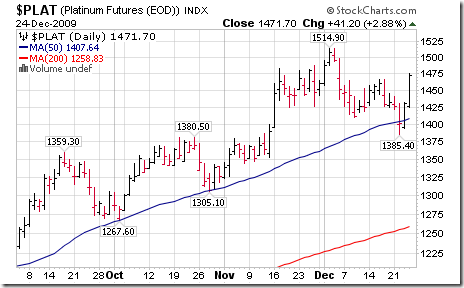
Platinum was notably stronger. It gained $15 U.S. to $1,486 per ounce on two announcements. Late last week, the Securities & Exchange Commission approved trading in Platinum as an Exchange Traded Fund. Demand for Platinum for collateral for the ETF is expected to increase at least temporarily. This morning Toyota announced plans to increase its production by 17% in 2010. Platinum is used in auto catalytic converters. ‘Tis the season for Platinum to move higher from the end of December to the end of May! Platinum is testing resistance at 1,514.90 U.S. per ounce. Intermediate upside potential on a break above resistance is $1,657 U.S. per ounce.
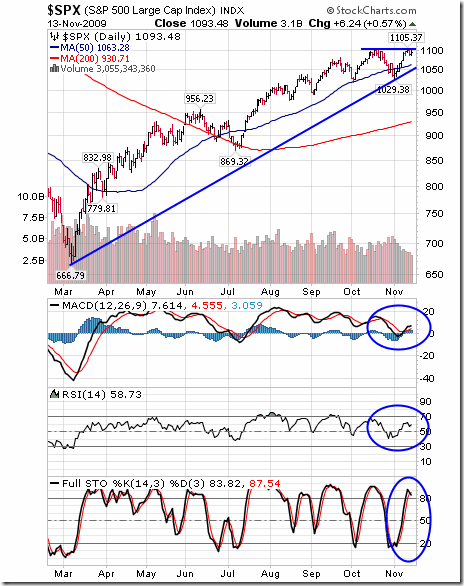
The S&P 500 Index added 24.01 points (2.18%) last week. An upward intermediate trend was confirmed on Thursday when the Index moved above resistance at 1,119.13 to reach a 14 month high. Once again, its 50 day moving average proved to be a reliable intermediate support level. Short term momentum indicators are overbought, but have yet to show signs of rolling over. Seasonal influences remain positive.
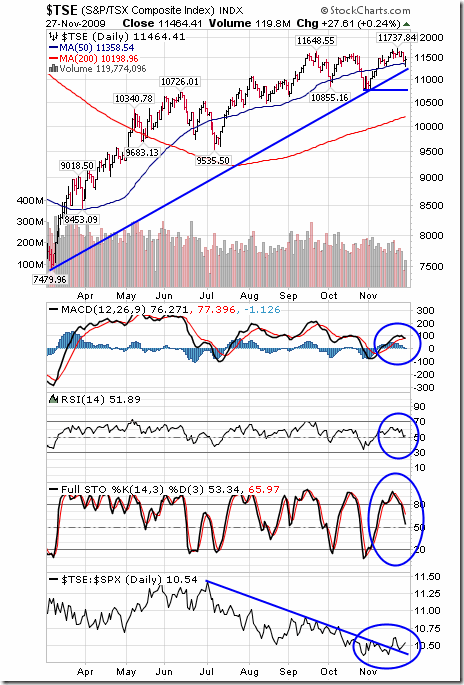
The TSX Composite Index gained another 291.21 points (2.54%) last week. Intermediate trend remains up. The Index is testing resistance at 11,816.33. Its 50 day moving average has proven to be a reliable intermediate support level. Short term momentum indicators are overbought, but continue to trend higher. Strength relative to the S&P 500 Index remains negative. Seasonal influences remain positive.
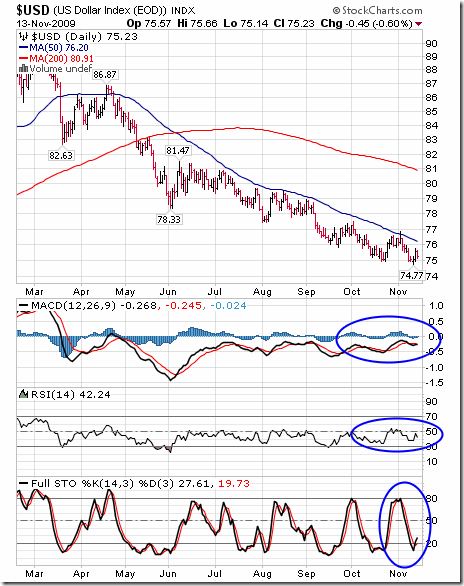
The U.S. Dollar was virtually unchanged last week. Short term momentum indicators are overbought and showing early signs of peaking. (e.g., RSI briefly moving above 70% and falling below that level on Thursday, an RSI sell signal). Significant overhead resistance exists at 79.51 and its 200 day moving average at 79.34. Money flows triggered by year end transactions by international corporations during the last two weeks in December historically places pressure on the U.S. Dollar. Thereafter, the U.S. Dollar tends to move higher into April.
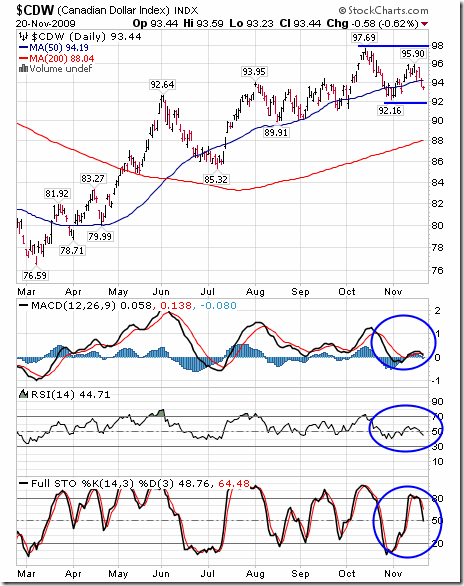
The Canadian Dollar gained 1.39 cents U.S. last week and moved above its 50 day moving average. Short term momentum indicators are recovering from slightly oversold levels. Rumors continue to circulate that Canadian Dollars are being purchased by the Russian and Chinese central governments in order to diversify their currency reserves away from the U.S. Dollar. Technical signs of a move above or below its three month trading range between 92.16 and 97.69 cents U.S. are lacking.
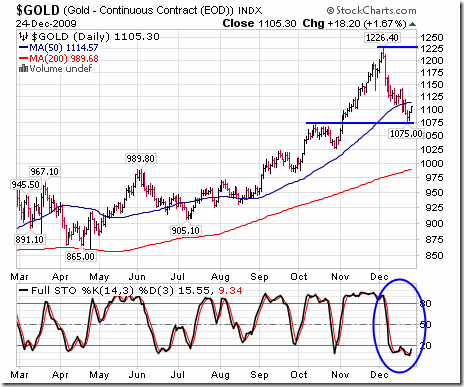
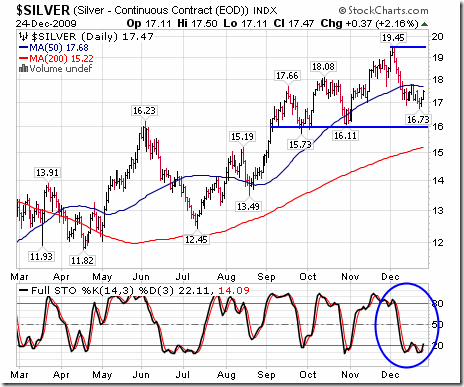
Short term momentum indicators for gold and silver are oversold and recovering. Both are near the top of a previous trading range where support normally appears. A short term roll over of the U.S. Dollar is contributing to their strength. Growing economic demand for silver is an extra benefit. ‘Tis the season for silver to move higher!
The Bottom Line
‘Tis the season for equity markets to move higher until at least early January! Enjoy the ride. Take advantage of strength to take seasonal profits in sectors such as natural gas, agriculture and Canadian financial services. Add to sectors on weakness that recently entered their period of seasonal strength including small cap, silver and platinum.
An Outlook for the Investment Industry during the Next Decade
The past decade has been described as a nightmare decade for equity investors. The U.S. stock market is about to post its worst performance for any calendar decade in nearly 200 years. Since December 31st 1999, the S&P 500 Index has declined 23.2% and the Dow Jones Industrial Average has fallen 7.8%. Returns by the TSX Composite Index were better, but were realized despite an extraordinary period of volatility. The TSX Composite gained 41.3% since its close December 31st 1999. Will North American equity indices fair better in the next decade? The answer is “Yes”, but not without more pain during the first half of the 2010 -2019 period. Fortunately, changes in the investment industry and new investment styles will offer profitable opportunities for the astute investor throughout the next decade
Why more pain in the first half of the next decade? North American equity markets have a history of moving in alternate long term cycles lasting an average of 16 years. These cycles tend to be generational: the 1930 to 1950 period was the post depression era, the 1950 to 1966 period was the baby boom era, the 1966 to 1982 period was the skeptical era and the 1983 to 1999 period was the technology era. The baby boom and technology eras were characterized by relatively consistent strong equity markets. The post-depression and skeptical eras were characterized by exceptional volatility, but virtually no returns. The current 16 year period is following the pattern of the post-depression and skeptical eras. The current era started in 2000 and is expected to last until 2015. North American equity markets are scheduled to record another six years of high volatility and low returns.
Investors have found through experience during the past decade that owning equities, Exchange Trade Funds and mutual funds for an indefinite period of time has been hazardous for their investment health. A buy and hold investment style has been dead during the 2000-2009 decade and is scheduled to be dead for another six years.
The astute investor has learned that timing the market by owning equity investments for periods lasting two to seven months provides downside protection when markets are trending lower and upside potential when markets are trending higher. A favoured way to time the market is to use a combination of technical, fundamental and seasonality analysis. The key with the multi-analysis process is to know when to sell. All equities are bought with the intention of being sold either when the original reason for their purchase has been achieved or when reasons for their purchase have not met expectations. An increasing number of astute investors and investment advisors are expected to use this strategy during the next decade.
Investors and investment advisors will become more knowledgeable about their equity investments during the next decade. Investors want to know why they own selected investments, when to add to positions and when to sell. The internet is the answer. Access to investment information on the internet has virtually exploded during the past few years and will continue to grow at an accelerated rate during the next decade.
The use of technical and seasonality analysis will expand significantly during the next decade. Using fundamental analysis alone, when making investment decisions, was significantly discredited during the stock market meltdown from September 2008 to March 2009. Understanding investor psychology plays an important role when making investment decisions. An increasing number of fundamental analysts have been willing to acknowledge that they use technical analysis to supplement their investment decisions. The media also have given more credence to technical analysis in recent years. The acceptance of seasonality analysis remains in its infancy, but has grown significantly during the past two years.
The “compliance” pendulum toward greater regulation over the investment industry will swing back to reality during the next decade. Most investment advisors are bright, articulate and creative people dedicated to serving their clients. Unfortunately, the recent Asset Backed Commercial Paper (ABCP) debacle and a few “bad apples” such as Bernie Madoff have triggered over-regulation of the industry, particularly with investment advisors at Canada’s largest investment dealers. Net result is that investment advisors are spending more time and effort to satisfy their compliance departments and their creativity has been significantly stifled. At least some investment advisors will choose to move to investment firms where creativity is encouraged within a reasonable compliance regime.
Exchange Traded Funds will continue to take market share away from the traditional mutual fund industry. Most mutual funds on both sides of the border have a history of consistently underperforming relative to their benchmarks. A major reason for underperformance is their high management expense ratios. An increasing number of independent investors and investment advisors are choosing Exchange Traded Funds with lower management expense ratios and no limitation on timing of purchases or sales. Eventually, fees to investment advisors, who buy mutual funds for their clients, will decline and management expense ratios in Canada will adjust lower, but not without significant resistance by the mutual fund industry and Canada’s major investment dealers.
The trend toward actively managed exchange traded funds will continue. The industry currently is in its infancy in North America. Their success depends upon their low cost relative to traditional mutual funds and their ability to outperform the market.
A logical source of people, who will manage future actively managed funds, are successful managers in the mutual fund industry. Successful fund managers with good track records are out there who would love to manage their own exchange traded fund instead of participating in a larger entity.
Don Vialoux has 37 years of experience in the Investment Industry. He is a past president of the Canadian Society of Technical Analysts (www.csta.org) and a former technical analyst at RBC Investments. Now he is the author of a daily letter on equity markets available free on the internet. The reports can be accessed daily right here at www.dvtechtalk.com.
Impossible! That’s what institutional investors say about “Timing the Market”. Mr. Vialoux will explain that, indeed, it can be done with the appropriate analysis. He also will explain why timing the market will be important during the next decade. Buy and Hold strategies are not working anymore; Investors are looking for alternatives. Mr. Vialoux will demonstrate four techniques that can be used to time intermediate stock market swings lasting 5-15 months. The preferred investment vehicles for investing in intermediate stock market swings are Exchange Traded Funds.
Comments in Tech Talk reports are the opinion of Mr. Vialoux. They are based on technical, fundamental and/or seasonal data that is believed to be accurate. The comments are free. Mr. Vialoux receives no remuneration from any source for these services. Comments should not be considered as advice to buy or to sell a security. Investors, who respond to comments in Tech Talk, are financially responsible for their own transactions.
-
I know Mike is a very solid investor and respect his opinions very much. So if he says pay attention to this or that - I will.
~ Dale G.
-
I've started managing my own investments so view Michael's site as a one-stop shop from which to get information and perspectives.
~ Dave E.
-
Michael offers easy reading, honest, common sense information that anyone can use in a practical manner.
~ der_al.
-
A sane voice in a scrambled investment world.
~ Ed R.
Inside Edge Pro Contributors

Greg Weldon

Josef Schachter

Tyler Bollhorn

Ryan Irvine

Paul Beattie

Martin Straith

Patrick Ceresna

Mark Leibovit

James Thorne

Victor Adair