
Daily Updates
WHERE IS THE CANADIAN DOLLAR GOING?
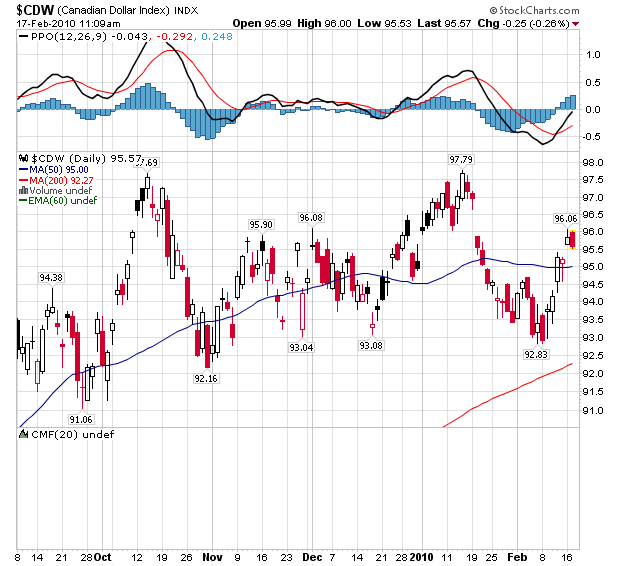
What was impressive about the Loonie of late was that even as it was pulling back against the U.S. dollar during this most recent experience with risk aversion amidst the intense Euroland fiscal problems and the uncertain climate for commodities generated by the recent rounds of Chinese policy tightening measures, was that it managed to hold up so well against the basket of non- greenback currencies.
We still like the Canadian dollar on a long-term basis. The domestic fundamentals on a relative basis are very strong, especially as they pertain to external balance sheets and fiscal finances. The fair-value line is moving up between 1-2 cents every year and as a result, the Loonie, at just under 96 cents, is only ‘expensive’ by 3 pennies or so.
Still, the CAD is overvalued and the time to have loved it was when it was closer to being undervalued by a dime and was struggling near the 80 cent mark. Back then, the oil price was at $40/bbl, copper was $1.50 a pound, and gold was $900 an ounce — and the People’s Bank of China was dramatically easing policy, not tightening it. So, it was much easier at that point to fall in love with the Loonie and ride it up for the next 18 cents on the upside.
But at this point, on a near-term tactical basis, we will be content on maintaining a moderately bearish stance so that we can take advantage of any near-term or intermediate-term weakness that could take the Canadian dollar back into undervalue terrain and thereby augment our long-term positions. Remember, the strategy is to buy low and sell high; not the other way around.
…..read more Breakfast with Dave HERE.
Chart via MoneyTalks
A brief comment from the extensive analysis contained in Weldon’s Money Monitor. Michael Campbell calls Greg Weldon – “The One Analyst other Analysts can’t Wait to Read.” Visit www.Weldononline.com for a FREE Tr
On October 25, 1854, in the Crimean War, 673 members of the British Cavalry, ‘charged’ across ‘The Valley of Death’, to engage twenty Russian ‘battalions’ supported by fifty pieces of heavy artillery, and assisted on the flank by the French cavalry. It was the ‘Battle of Balaclava’.
Historians suggest that the Russian commanders believed the British horse soldiers were drunk, as they charged across the wide open field, defining the ‘valley’ by the Fedyukhin and Causeway Heights, taking heavy casualties.
From this, the famous French phrase … “C’est de la folie” was born …
… which, in English, means … “it is madness”
Indeed, thoughts of a successful reflation package to be offered by the EU and/or ECB … is madness.
The European fiscal picture is … madness.
“Charging across the fiscal valley-of-death, the European governments are getting slaughtered, and the currency is at risk”.
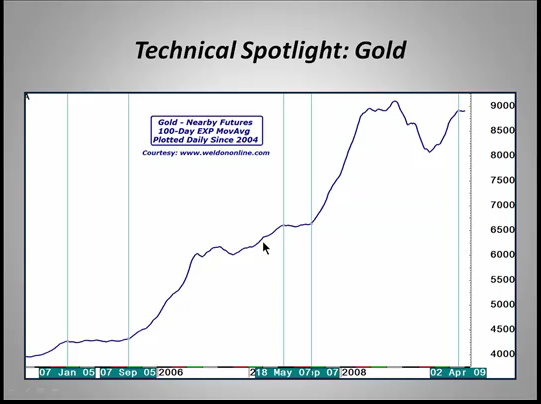
“The Gold market is NOT going to ‘fall’ for the Three Card Monty, and bullion bulls refuse to be the ‘mark’ for EU-debt-hustlers, as we shine the spotlight on Monday’s upside breakout in the Eurocurrency ‘denominated’ price of Gold, shown in the longer-term weekly chart on display below. Not only has EUR-Gold violated the 800 euro-per-ounce level, but we also focus on the fresh bull signal emanating from the long-term Oscillator.
Weldon’s Money Monitor offers a FREE 30 Day Trial Subscription. For subscription information contact Eileen @Weldononline.com or Visit www.Weldononline.com for a FREE Trial.
A FREE 30 Day Trial Subscription is defined as a single Trial that is limited to a one-time Signup. Signing up for multiple trials under different names, Fraudulent contact information is illegal. Weldon’s Money Monitor takes this seriously..
Posted: 16 Feb 2010 05:35 PM PST
While I’m quite pleased with gold’s performance, I believe we need two consecutive closes above $1,125 to truly feel the correction is now fully behind us. Because you could find a needle in a haystack faster than a true gold bull (up until today anyway), the overwhelming number of gold bears and weak-knee bulls are not likely to throw in the towel just yet. The next few days’ worth of trading should be a good two-way battle. Trading between $1,100 and $1,125 for several days or a couple of weeks won’t be a bad thing. Stay tuned.
As noted repeatedly, I ‘m not looking for a collapse (or anything like one) in the U.S. stock market but rather a market that goes no where’s fast up or down “net” over time. Many people have questioned why although outright bearish on U.S. equities, why I’m not going short? I believe the action the last couple of weeks is what we can expect for months and years to come. Unless one is literally an hour or day trader, there’s just not going to be many lengthy and large scale moves up or down that one can profit from being short or long. In fact, I think spread traders stand the best chance for the foreseeable future.
Per last Friday’s show with George, it appears Zijin Mining and Continental Minerals have a “volunteer” pool agreement in regards to the possibility of Zijin buying more shares. I remain very bullish on KMK being a takeover target.
I was both honored and humbled by a guest on BNN today. His most kind words were expressed at the 5:55 minute mark.
Did the Saudi’s suggest more drastic action in their coy response?
Donner Metals continues to have very good news on the drill front.
Timmins Gold is transitioning from a pure exploration company to an emerging producer with plenty of exploration upside potential. The expectation is this can lead to a revaluation that over the next 12 -24 months can provide triple-digit return on the share price.
I will be on BNN’s “Market Call” Monday, March 8th at 1PM EST.
On Major Moves, Grandich has been very right and not only saved many investors fortunes, but expanded them dramatically. On November 3, 2007 at the MoneyTalks Survival Conference, Peter Grandich of the Grandich Letter warned that “an unprecedented economic tsunami will hit American beginning in 2008”. Peter advised publicly to short the US market two days from the top in October, 2007 and stayed short until the last week of October, 2008. He began to buy stocks in March 7th, 2009. He also bought oil and oil related investments near the lows after the dive from $147.
….go to visit Peter’s Website.
The call for this week: China is closed for the Chinese New Year this week (The year of the Tiger), so China is not going give us a hint as to if our markets are bottoming like it did last year. Still, we are pretty excited since today is session 18 in the envisioned 17- to 25-session “selling stampede” and we are looking for a bottom. Interestingly, so is the astute Lowry’s service. To wit:
“A well-known market analyst was said to have once remarked that every bull market has at least one pullback that fools investors into thinking a new bear market has begun. To create this deception, these pullbacks need to be severe enough to raise expectations a new bear trend is underway – such as might occur with a correction of 10% or more. But, to be deceptive, such declines should be relatively rare occurrences, which runs counter to the general perception. . . . So, rather than being commonplace, pullbacks of these magnitudes are relatively infrequent. . . . How then, are investors to differentiate between these corrections and the beginnings of a new bear market? One similarity in each of these cases of corrections reaching 10% or deeper is that they typically occurred well into the second stage (the Holding and Upgrading Zone) of the bull market. That is, profit-taking has already been well established, as reflected in a sustained uptrend in our Selling Pressure Index, thus setting the stage for deeper than normal corrections. In the present case, however, the Selling Pressure Index was recording an 18-month low in mid-January when the (stock) market correction began. Thus, based on the long history of the Lowry Analysis, the probabilities do not favor a 10% plus correction occurring at this relatively early stage of the uptrend.”
….read the entire report HERE.
In last week’s column, I reviewed the profits you should have bagged the week earlier. Total now, since March of last year, assuming you followed all of my suggestions: 11 closed out trades, including 9 winners — with gains of as much as 91.7% — one breakeven trade, and one loser. Not bad for just over 10 months.
I also reviewed with you three major reasons why the bull market in natural resources is still very much intact. More on that in a minute.
First, a warning: For the next three to six months, the markets will be shifting into a period of extreme volatility. It will be characterized by wild swings that will spook even the savviest and most professional of traders.
So you’re going to need nerves of steel. I’ll be sure to give you the extra guidance that you’ll need.
After all, not only are the cycles in the markets themselves shifting — but so are the underlying fundamentals. I’m not talking about any particular economic statistic. On a case-by-case basis, they don’t mean much.
That’s important to understand, because even when taken together, most economic data is not very helpful for investing because they are backward looking.
Stats such as unemployment, layoffs, manufacturing data, inventories, payrolls, even gross domestic product — tell you what happened, not what’s going to happen
For a forward-looking perspective that can help you anticipate what the markets are likely to do, you have to use the study of the science of cycles. That’s what I do, and I’ve been doing it extensively for almost thirty years.
And right now, the main cycles affecting all markets are shifting from strongly upward trending … to short-term, violently choppy patterns.
So you are bound to see …
A multi-month period of very large swings, in almost all markets. I’m talking several hundred points up and down in the Dow … $100 to $200 trading ranges in gold … $20 to $30 trading ranges in oil … and violent moves in just about everything publicly traded.
Importantly, you are also about to see …
Mass confusion in society at large. You will see mixed economic data streaming out. Many stats good; many terrible. For those who follow the fundamental forces impacting the economy and markets, you will be in a state of utter confusion.
You will also see tremendous swings in politics, both domestically and internationally. Obama’s popularity sinking like a rock … then surging … only to sink again. Crises in Europe, like that of Greece, will burst onto the scene, only to be resolved a few days later, then re-emerge in another country.
You will see increased trade tensions between countries … accusations … bickering, and more.
And, you will see investors swing from extreme optimism … to severe pessimism, and back.
But most of all, the majority of investors will get chopped to pieces in the markets.
Make No Mistake About It:
You’re Entering Six Months of Investor Hell.
The best way to handle it …
A. Do NOT overtrade. Overtrading in general tends to lead to losses, no matter what the markets are doing.
In periods where the markets are swinging wildly, overtrading is often disastrous.
B. When you trade for speculative purposes over the next six months, be especially keen to try and buy on weakness and sell on strength … and always use a protective stop to limit your risk.
Moreover …
C. Don’t let emotions or the news get to you! I don’t know a single successful investor or trader who watches CNBC or Bloomberg, or listens to any business radio show.
They’re great entertainment, and ok to watch or listen to when you are not making investment or trading decisions.
But no matter what you do, never, I repeat never, invest based on the news. And never let any news or any kind of business media allow you to become emotional. It’s a sure fire way to lose money.
Most of all …
D. Keep the long-term in perspective for your core investment positions.
Long-term trends do not change that often. They span years, even decades. So to maximize your profit potential from them, you simply can’t let the short-term sway you.
Consider the natural resource bull markets. Last week, I gave you three undeniable long-term fundamental forces that are driving those markets higher.
Now consider the following research, released late last year by the think-tank, the Global Footprint Network …
It now takes almost 18 months for the Earth to regenerate what humanity consumes in one year.
Put another way, just to sustain current natural resource consumption levels — 1.4 planet Earths are needed, RIGHT NOW.
Even more shocking from the institute’s research is the new data it published projecting what the world would consume if everyone on the planet lived like a resident of various emerging and developed countries.
You can see the data graphically displayed in the table to the right.
On the low end, if everyone in the world used natural resources at India’s very low rate of consumption, an additional planet equal to 40% of the Earth’s size would be needed, RIGHT NOW.
At China’s higher level of consumption, one full additional planet would be needed, RIGHT NOW.
If everyone consumed natural resources at the rate U.K. citizens are, an additional 3.4 planets would be needed.
And if everyone consumed resources at the rate U.S. citizens are, an additional FIVE MOTHER EARTHS WOULD BE NEEDED RIGHT NOW JUST TO BALANCE SUPPLIES WITH CONSUMPTION!
Naturally, consumption levels in the rest of the world are not likely to climb to the U.S. level of use.
But even if they were to rise to just half of U.S. consumption levels, you would still need 2.5 Mother Earths to balance the growing demand with consumption.
More from the institute …
The average American uses a whopping 23 acres worth of biocapacity, while the average European uses only about half that.
The U.S. represents just 4.5% of the world’s population, but consumes more than five times as much natural resources, a full 23% of world biocapacity.
China now consumes about the same level of resources that the U.S. does, but with its population more than four times larger, per capita resource consumption in China is less than one-fourth that of an American.
But that’s today. Five, 10, 20 years from now, China (and India) will likely be consuming far more natural resources, while I doubt U.S. or any other Western economy’s consumption will fall very much.
Bottom line to all this: The world is facing a massive shortage of basic natural resources that will, in just a few years, reach crisis levels.
Stay tuned, and as always, best wishes …
Larry
P.S. Uncommon Wisdom has teamed up with the Red Cross to help bring in donations for the earthquake victims in Haiti. If you’d like to make a contribution, just click here now.
This investment news is brought to you by Uncommon Wisdom. Uncommon Wisdom is a free daily investment newsletter from Weiss Research analysts offering the latest investing news and financial insights for the stock market, precious metals, natural resources, Asian and South American markets. From time to time, the authors of Uncommon Wisdom also cover other topics they feel can contribute to making you healthy, wealthy and wise. To view archives or subscribe, visit http://www.uncommonwisdomdaily.com.
-
I know Mike is a very solid investor and respect his opinions very much. So if he says pay attention to this or that - I will.
~ Dale G.
-
I've started managing my own investments so view Michael's site as a one-stop shop from which to get information and perspectives.
~ Dave E.
-
Michael offers easy reading, honest, common sense information that anyone can use in a practical manner.
~ der_al.
-
A sane voice in a scrambled investment world.
~ Ed R.
Inside Edge Pro Contributors

Greg Weldon

Josef Schachter

Tyler Bollhorn

Ryan Irvine

Paul Beattie

Martin Straith

Patrick Ceresna

Mark Leibovit

James Thorne

Victor Adair