
Daily Updates
Small Mining and Global Exploration stocks that are either under-researched or have no published Equity Research.
Gold, Base Metals, Uranium and Iron Ore.
For the power point Presentation Click HERE *Note – You can advance this discussion by clicking on the fast forward button OR the index funtion on the right side of the webpage.
Also: Gold Sector Review pdf HERE
By Failing to Lock Up Canadian Oil Supplies, U.S. Exposes National Energy Plan Flaws
Asia to Canada: Let’s Make a Deal
Critics have blasted U.S. leaders and U.S. oil companies for not locking up as much of Canada’s vast supply of reliable oil as possible. By failing to do so, the United States essentially opened the door for China and other Asian nations, which have been ardently courting Canada.
Just last September, we saw PetroChina Co. Ltd. (NYSE ADR: PTR) pay Athabasca Oil Sands Corp. (PINK: ATHOF) $1.9 billion in cash for a 60% stake in two undeveloped Canadian oil sands projects. It was PetroChina’s biggest acquisition in North America.
In October, state-owned Korea National Oil Co. (KNOC) snatched Canada’s Harvest Energy Trust for $1.8 billion in cash, and the assumption of more than $2 billion in debt – meaning the deal was done at a hefty premium to its market value. KNOC hopes to ship Alberta oil sands to refineries in South Korea. That move not only helped concretize that Asian nation’s plan to quadruple production from current levels to 300,000 barrels daily by 2012, it also enabled it to move assets out of depreciating greenbacks and into appreciating oil.
Just two weeks ago, the China Petroleum & Chemical Corp. (NYSE ADR: SNP), also known as Sinopec, offered $4.6 billlion for a minority stake in the Syncrude Canada Ltd. oil sands plant. This attempted deal is causing waves, at least in Canada.
Sinopec is Asia’s biggest refiner, with an expanding capacity to process heavy oil, the kind Syncrude produces before upgrading to synthetic crude. Syncrude is the world’s largest producer of light sweet crude oil from oil sands.
The deal would give Sinopec a veto over any decision for Syncrude to invest in upgrading more oil in Alberta. That province would clearly prefer to see upgrading done at home, since bitumen processing creates jobs and tax revenue. This is the first time a Chinese state-owned enterprise is taking on a share in a major oil producer, so the Canadian government could soon be placing its foreign-investment-review policies under a powerful microscope.
Remember, too, that because of its centralized decision-making, China’s government can act much more quickly, and without having to fear any public-opinion backlash. In the past, China also hasn’t had to worry much about environmental groups or non-governmental organizations (NGOs) – just ask Tibetan protestors.
Another advantage Asian culture has in the realm of planning is its tendency to take a much longer view of major issues. For example, Chinese planners don’t just consider the next quarter or the next year, they will look decades – or even generations – into the future, and will plan accordingly. It’s a lesson Western corporate leaders would do well to observe, and perhaps even copy.
Considering the massive modernization most of Asia is undergoing, you can continue to expect an aggressive acquisition stance to be the norm for some time.
After years of developing nations accumulating western fiat currencies through exports, we’re now witnessing a massive generational transfer of wealth from West to East.
Obama’s Flip Flop
This is sure to remain a hot issue. But I believe that President Obama’s approach may well be an excuse to favor homegrown U.S. businesses with a less obvious “Buy American” policy. Here’s what I mean.
I find it particularly interesting that President Obama recently did a complete 180-degree turnabout on his energy policy by opening parts of the Atlantic Ocean and Gulf of Mexico to oil drilling.
Money Morning Chief Investment Strategist Keith Fitz-Gerald attributes the change to an administration realization that a weakening greenback makes it difficult for America to accumulate oil assets outside U.S. borders. I think Fitz-Gerald is right.
So in one fell swoop, the new president can address multiple issues with this single move. U.S. oil producers must be ecstatic to now be able to explore, at home, over vast areas, and using current technologies. The lure of some attractive discoveries is strong. At the same time, the president can now say that he’s dealing with the issue of energy security, since anything newly discovered will be located inside U.S. borders.
More importantly, though, President Obama’s cap-and-trade scheme may be nothing more than an insidious trap for foreign-energy producers, and an effortless windfall for American producers and distributors. Under such a system, one can imagine a scenario where oil exporters would be required to have a quota allowance to sell into the U.S. market to “comply with environmental laws,” where quota could only be bought from an American concern. And voilà, a large chunk of the profits end up at home here in the United States, while the exporter’s margins run thin.
It’s true that developing new technologies to produce oil from oil sands more cleanly would counter some of this problem, but that takes years of research and serious funding. Meanwhile it’s a pretty safe bet even more of those assets will continue to migrate into Asian hands.
New Video: Why Commodities Prices Will Explode on May 10th – A giant wave of money is making its way into the commodities sector… And Wall Street’s biggest banks are the ones behind it. In his new video, commodities expert Peter Krauth shows how you can use the hidden actions of these giant banks to pocket potential 15X returns… starting in the next 48 hours. Watch the video now.
About Money Morning – Your Guide to Financial Freedom
We’re in the midst of the greatest investing boom in almost 60 years. And rest assured – this boom is not about to end anytime soon.
You see, the “flattening of the world” continues to spawn new markets worth trillions of dollars; new customers that measure in the billions; an insatiable global demand for basic resources that’s growing exponentially ; and a technological revolution even in the most distant markets on the planet.
And Money Morning is here to help investors profit handsomely on this seismic shift in the global economy. In fact, we believe this is where the only real fortunes will be made in the months and years to come.
Marc Faber: “I’m ultra bearish about the world. I think we’re all doomed because the governments are taking over and they will all bankrupt us and expropriate us, but it may not happen tomorrow. So they’ll give us something to play with until the whole system breaks down, and that is a bull market. They’ll just print money and print more money.”
Faber believes that, due to stimulus money, markets can go much higher before another collapse happens. He thinks the intention behind the Goldman Sachs indictment is not to hurt the firm, but to provide a popularity gain for President Obama, whose ratings have plunged since taking office.
“Because I’m so bearish, what you shouldn’t own is cash,” says Faber. “Cash is going to be a disaster.”
Agricultural commodities were left in the dust as base metal prices boomed last year but now represent the better investment, commodities bull Jim Rogers told Reuters on Thursday.
Jim Rogers: “I’d rather buy agriculture which didn’t move up, and I don’t want to buy base metals because they did go up. I’m not selling base metals — I’m just watching,” he told Reuters in an telephone interview.
Prices for base metals soared in 2009 as global economies started to revive, with copper on the London Metal Exchange surging nearly 140 percent.
In contrast, many agricultural commodities struggled with CBOT wheat down more than 10 percent following a bumper global harvest and corn climbing less than two percent during 2009.
Rogers also pointed to the potential for agricultural commodities to outperform in the event of a major volcanic eruption in Iceland.
2010 List of Silver Mining Stocks and Companies
Compiling a list of silver companies is controversial as there are only very few pure silver plays. The white metal is mostly mined in combination with gold or base metals, which can dramatically change the bottom line of silver miners. In some cases the mining of base metals and gold can lead to negative cash costs for every ounce of silver produced.
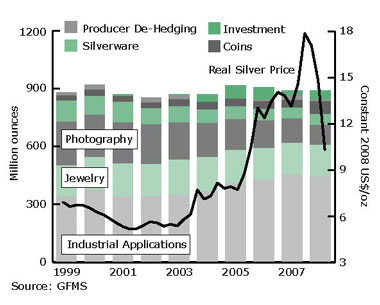
Silver is primarily used in jewelery and in industrial applications, as it is the best metallic electric conductor.
Expecting silver prices to multiply in the next 5 years these companies give extra leverage – if their plans come true.
…..read more and view the list HERE
Ed Note: The chart on Seasonal Silver I have posted is from Don Vialoux and this is his comment below:
“Silver’s seasonal strength is approaching an end in May.SI) Seasonal Chart”

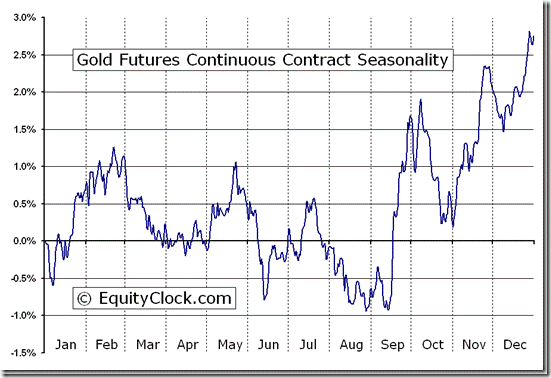
Strength in gold and gold stock happens at an interesting time. Strength is occurring despite strength in the U.S. Dollar. Historically, gold and gold stocks have moved inversely with the U.S. Dollar. Yesterday, the U.S. Dollar broke resistance to reach a 13 month high. That’s an encouraging sign for gold and gold stocks.
….read more HERE
…..read Brooke Thackray’s Seasonal Letter HERE
-
I know Mike is a very solid investor and respect his opinions very much. So if he says pay attention to this or that - I will.
~ Dale G.
-
I've started managing my own investments so view Michael's site as a one-stop shop from which to get information and perspectives.
~ Dave E.
-
Michael offers easy reading, honest, common sense information that anyone can use in a practical manner.
~ der_al.
-
A sane voice in a scrambled investment world.
~ Ed R.
Inside Edge Pro Contributors

Greg Weldon

Josef Schachter

Tyler Bollhorn

Ryan Irvine

Paul Beattie

Martin Straith

Patrick Ceresna

Mark Leibovit

James Thorne

Victor Adair