
Daily Updates
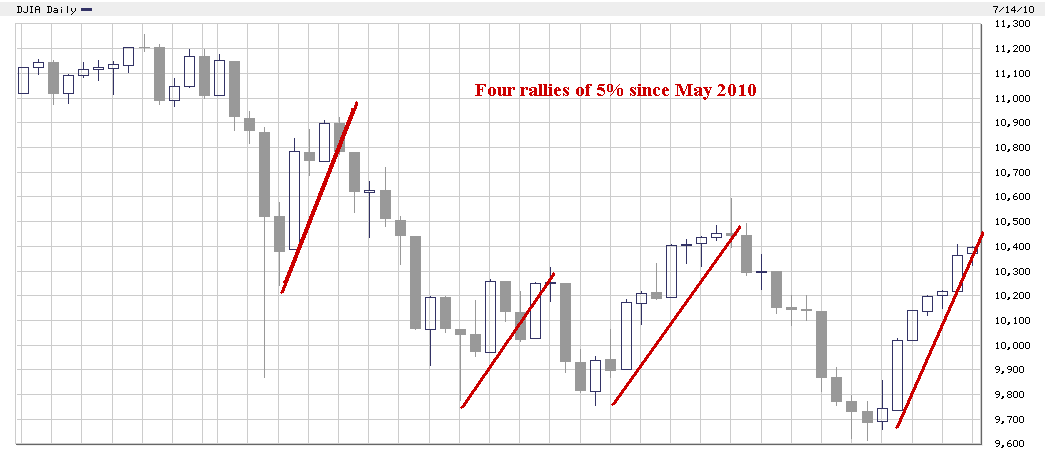
“Being fooled twice is enough to shame any investor, but how about three, or
even four times?
The current rally marks the fourth time since early May that the Dow Jones Industrial Average has bounced more than 5%. Previous bounces have taken the Dow above key resistance levels, and yet subsequent declines have resulted in even lower lows. Essentially, the recent pattern surrounding key technical breakdowns and breakouts suggests the Dow is nearing yet another turning point.
It is easy for bulls to fall into another technical trap, since the Dow has climbed above the 50-day simple moving average, which has acted as resistance since the Dow first fell below it in early May, and is now peeking above a downward sloping line that started at the April 26 high and connects the June 21 high. But rather than embolden bulls, the apparent breakout should actually make them skeptical, especially following a six-session rally. “
Other traps of note:
-When the Dow fell below the 200-day moving average;
-After the Dow closed above the 50-day moving average
-When the Dow hit a new low for the year.
-The break below the June 8 low of 9757 (confirming a head-and-shoulders pattern)
Kilgore warns that “those reacting to technical breakdowns and breakouts have been fooled many times. And keep in mind that the Dow’s last six-session winning streak ended on April 26, the day before the market correction began.”
Over the course of his relatively brief career as the head of Fidelity’s Magellan Fund, Lynch left in his wake returns that most people can only dream about.
In his 13 years at the helm, Lynch’s funds delivered a 29.2 percent annual return — nearly doubling the return of the S&P 500.
And had you been lucky enough to spot this rising star when he began, you could have banked a 2700% gain by the time he called it quits.
A $10,000 investment in the Magellan Fund was worth $280,000 13 years later.
Rule 1: Investing is fun and exciting, but dangerous if you don’t do any work.
Rule 2: Your investor’s edge is not something you get from Wall Street experts. It’s something you already have. You can outperform the experts if you use your edge by investing in companies or industries you already understand.
Rule 3: Over the past 3 decades, the stock market has come to be dominated by a herd of professional investors. Contrary to popular belief, this makes it easier for the amateur investor. You can beat the market by ignoring the herd.
Rule 4: Behind every stock is a company. Find out what it’s doing.
Rule 5: Often, there is no correlation between the success of a company’s operations and the success of its stock over a few months or even a few years. In the long term, there is a 100% correlation between the success of the company and the success of its stock. This disparity is the key to making money; it pays to be patient, and to own successful companies.
Rule 6: You have to know what you own, and why you own it. “This baby is a cinch to go up” doesn’t count.
Rule 7: Long shots almost always miss the mark.
Rule 8: Owning stocks is like having children — don’t get involved with more than you can handle. The part-time stockpicker probably has time to follow 8-12 companies, and to buy and sell shares as conditions warrant. There don’t have to be more than 5 companies in the portfolio at any one time.
Rule 9: If you can’t find any companies that you think are attractive, put your money in the bank until you discover some.
Rule 10: Never invest in a company without understanding its finances. The biggest losses in stocks come from companies with poor balance sheets. Always look at the balance sheet to see if a company is solvent before you risk your money on it.
Rule 11: Avoid hot stocks in hot industries. Great companies in cold, non-growth industries are consistent big winners.
Rule 12: With small companies, you are better off to wait until they turn a profit before you invest.
Rule 13: If you are thinking of investing in a troubled industry, buy the companies with staying power. Also, wait for the industry to show signs of revival. Buggy whips and radio tubes were troubled industries that never came back.
Rule 14: If you invest $1000 in a stock, all you can lose is $1000, but you stand to gain $10,000 or even $50,000 over time if you are patient. The average person can concentrate on a few good companies, while the fund manager is forced to diversify. By owning too many stocks, you lose this advantage of concentration. It only takes a handful of big winners to make a lifetime of investing worthwhile.
Rule 15: In every industry and every region of the country, the observant amateur can find great growth companies long before the professionals have discovered them.
Rule 16: A stock market decline is as routine as a January blizzard in Colorado. If you are prepared, it can’t hurt you. A decline is a great opportunity to pick up the bargains left behind by investors who are fleeing the storm in panic.
Rule 17: Everyone has the brainpower to make money in stocks. Not everyone has the stomach. If you are susceptible to selling everything in a panic, you ought to avoid stocks and stock mutual funds altogether.
Rule 18: There is always something to worry about. Avoid weekend thinking and ignore the latest dire predictions of the newscasters. Sell a stock because the company’s fundamentals deteriorate, not because the sky is falling.
Rule 19: Nobody can predict interest rates, the future direction of the economy, or the stock market, Dismiss all such forecasts and concentrate on what’s actually happening to the companies in which you have invested.
Rule 20: If you study 10 companies, you will find 1 for which the story is better than expected. If you study 50, you’ll find 5. There are always pleasant surprises to be found in the stock market — companies whose achievements are being overlooked on Wall Street.
Rule 21: If you don’t study any companies, you have the same success buying stocks as you do in a poker game if you bet without looking at your cards.
Rule 22: Time is on your side when you own shares of superior companies. You can afford to be patient — even if you missed Wal-Mart in the first five years, it was a great stock to own in the next five years. Time is against you when you own options.
Rule 23: If you have the stomach for stocks, but neither the time nor the inclination to do the homework, invest in equity mutual funds. Here, it’s a good idea to diversify. You should own a few different kinds of funds, with managers who pursue different styles of investing: growth, value small companies, large companies etc. Investing the six of the same kind of fund is not diversification.
Rule 24: Among the major stock markets of the world, the U.S. market ranks 8th in total return over the past decade. You can take advantage of the faster-growing economies by investing some portion of your assets in an overseas fund with a good record.
Rule 25: In the long run, a portfolio of well-chosen stocks and/or equity mutual funds will always outperform a portfolio of bonds or a money-market account. In the long run, a portfolio of poorly chosen stocks won’t outperform the money left under the mattress.
As the mercury rises, most of us would prefer to hear the word “dip” only in relation to pools, lakes or beaches. Unfortunately, the doom-mongers have hijacked this word and incorporated it into their latest dark scenario: a double-dip recession.
There’s no question that chatter about a double-dip has intensified. The dippers cite several points in their favor: a still anemic housing market; a sluggish jobs picture; Europe’s sovereign-debt problems and big austerity drive; China’s slowing growth; and massive overcapacity in the U.S. economy.
Despite all that, there is still plenty of evidence that the double-dippers don’t have all the cards.
…..read more Why the Doomsayer’s are Wrong
NO DOUBLE DIP? – For Those Still Clinging To Hope, Here Is David Rosenberg: “This Is The Weakest Post-Recession Recovery On Record”
We have been on the receiving end of endless analysis suggesting that double-dip risks are either zero or completely trivial. And, the primary reasons given are the positively sloped yield curve, negative real short-term rates, no sign of inventory excess and no sign of a flattening in the trend in the leading indicators (aside from the ECRI, we would suppose). We were sent one particular Street report yesterday that began with a comment on how the analysis incorporated data from the last eight recessions in the United States.
The question we have is why these other eight recessions in the post-WWII era are relevant. This wasn’t just a blip or correction in GDP due to a manufacturing inventory-led recession. This was a traumatic asset price deflation and credit contraction of historical proportions. In essence, this was — or still is — a balance sheet recession that has absolutely nothing in common with the experience of the post-war business cycle when recessions were temporary dips in GDP in the context of a secular credit expansion. And, this wasn’t just a U.S recession and debt-deleveraging cycle — it was global in nature.
And, just in case it is still unclear, Rosenberg sees much pain in the future: ” if the peak inventory contribution is behind us, and all we have left is a baseline growth trend in real final sales of 1.2%, then how does the economy not contract in the coming year — when the consensus expects to see peak earnings?
….read David Rosenberg’s full Report NO DOUBLE DIP?
Double-Dippers Are All Wet Ignoring Yield Curve: Caroline Baum
There have been whispers, or maybe it’s just wishful thinking, that the Federal Reserve might buy more long-term bonds, lowering interest rates and making housing more affordable. (You know that modified mortgage that didn’t work out so well? Have we got a deal for you!)
At 4.6 percent, 30-year mortgage rates are already at historic lows, yet housing demand cratered as soon as the government’s homebuyer tax credit expired in April. If you think lowering long-term rates and reducing the spread between short and long rates will stimulate the economy, think again. The steep yield curve is the most powerful thing the economy has going for it right now.
….read more Double-Dippers Are All Wet Ignoring Yield Curve

Ferguson Sees U.S. Default on Social Security, Medicare. Reflects on Greece and Wealth Funds
This brief initial comment from the Legendary Trader Dennis Gartman. For subscription information for the 5 page plus Daily Gartman Letter L.C. contact – Tel: 757 238 9346 Fax: 757 238 9546 or E-mail: dennis@thegartmanletter.com For a Trial Subscription go to The Gartman Letter)
Canada is “on a roll.” Her banks are amongst the world’s most solvent. Her productivity levels are amongst the world’s highest. Her people’s educations are amongst the world best; her ports are busy; her capital markets growing more and more valid and more and more important with each passing year… and her people own houses at very nearly the same rate as do Americans but without the supposed “benefit” of being able to write off the mortgage interest. Oh, and she’s got “stuff” that the rest of the world needs, including grain, fuel and minerals.
We have long said that it was only a matter of time until the Canadian dollar traded “to and through par,” and we are more convinced of that now than we were previously. The employment data released Friday makes it a certainty that the Bank of Canada shall have to err upon the path of tighter rather than easier monetary policies going forward. Carney & Company have no choice but to tighten… perhaps several times… their policies in the weeks and months ahead, even if this past amazing employment number is revised downward to something a bit less amazing. Can we imagine the o/n base rate in Canada moving 100 bps higher by the year’s end? Easily. Can we imagine it 200 bps higher by the end of ’11? Easily there also. Can we imagine “par” by the end of this year for the C$ vs. the US$… yes, easily again. Indeed, we‘d be quite surprised were it not to trade there.
For a Trial Subscription go to The Gartman Letter)
-
I know Mike is a very solid investor and respect his opinions very much. So if he says pay attention to this or that - I will.
~ Dale G.
-
I've started managing my own investments so view Michael's site as a one-stop shop from which to get information and perspectives.
~ Dave E.
-
Michael offers easy reading, honest, common sense information that anyone can use in a practical manner.
~ der_al.
-
A sane voice in a scrambled investment world.
~ Ed R.
Inside Edge Pro Contributors

Greg Weldon

Josef Schachter

Tyler Bollhorn

Ryan Irvine

Paul Beattie

Martin Straith

Patrick Ceresna

Mark Leibovit

James Thorne

Victor Adair