
Daily Updates
Exactly one year ago, in the first Weiss global forum, we forecast a massive shift in wealth from Western countries bogged down in debt and recession … to Asia and emerging markets enjoying rapid growth.
Now, that shift is in full swing!
So, last week, I again gathered my team of international experts to tell you what we think is coming next.
Joining me were Mike Larson in North America, Claus Vogt in Europe, Tony Sagami on Asia, and Rudy Martin, our expert on South America. Plus, I also invited Ron Rowland, one of the nation’s foremost experts on international exchange-traded funds (ETFs).
Here’s the edited transcript …
Martin Weiss: We have two important missions today:
First, we will gather our collective knowledge and give you our eight new forecasts for 2010 — some very negative, some very positive.
And second, we will give you specific, actionable recommendations using exchange-traded funds or ETFs. Fortunately for the average investor, there are now hundreds of ETFs available to help protect you or profit from almost any trend anywhere — U.S. markets, foreign markets, up markets or down markets. And that’s why I’ve also invited Ron Rowland — to give us his ETF picks based on everything we cover here today.
Mike, last time we had a global forum we shifted from west to east — the path of the flow of capital, so let’s follow the same pattern and start first here in the U.S. with your forecast.
Mike Larson: Sure, Martin. Here’s my forecast for the U.S.
Forecast #1. The Obama administration and Congress will be paralyzed, unable to pass another big stimulus package, and unable to prevent a double-dip recession.
Just in the past few weeks, we’ve seen an outpouring of bad data and news on the economy — GDP slowing sharply, a key manufacturing index hitting a seven month low, home sales running at the lowest level in nearly a half-century, bank lending falling.
Martin: Not to mention the horrendous jobs reports!
Mike: Yes! And in response, you’re already starting to hear some voices clamoring for another stimulus package. But while the Obama economy is sinking fast … the Obama administration is moving slowly. Congress is paralyzed.
Martin: Of course! People are saying: “Hey, you’ve spent a fortune of our money on the first bailout for the economy, and it bought us peanuts. Now, you want to spend another fortune on another bailout and throw us some more peanuts!?”
The president obviously does not have the political capital to make even that much happen.
Mike: And he doesn’t have the financial capital! The Congressional Budget Office estimated that the president’s budget will produce a deficit of $1.5 trillion this year and $1.3 trillion in 2011, already far worse than they thought just a year ago.
Martin: Actually their estimate was based on the situation in the economy before it started sinking in the last couple of months.
Mike: Exactly! Now, all their deficit projections aren’t worth the paper they’re printed on. They’re going to get far lower income tax revenues than they’ve been expecting. They’re going to have far bigger bills for unemployment checks than they’ve been expecting. Even if the economy just slows down moderately, the deficit could explode well past $2 trillion in 2011.
And it’s the exploding deficit that’s bringing massive political resistance to more stimulus on both sides of the aisle.
Martin: With the administration and Congress paralyzed, and the economy sinking, what does that mean?
Claus Vogt: I want to give you my perspective on this from Berlin, if I may.
Martin: Go ahead, Claus.
Claus: Five years ago, my co-author and I wrote a book, the Greenspan Dossier, predicting a housing bust in the U.S. and in Europe — and in response, big money printing by Greenspan and the European Central Bank. Then, last year, we wrote a second new book, predicting still more money printing — this time by Bernanke and the European Central Bank.
Now, our forecast is this:
Forecast #2. The entire burden of fighting recession and financing deficits will fall on central banks. Therefore, Bernanke and his counterparts in Europe will launch a second, even bigger round of money printing.
They call it QE2 — quantitative easing #2. But regardless of the fancy names, everyone in Washington and on Wall Street knows exactly what it is: Running the printing presses. Flooding the world with dollars.
Those paper dollars will not create real prosperity in the United States or Europe. At best, they create a temporary, false prosperity. And no matter what, a substantial portion of that money winds up flowing to other countries where there is true, fundamental growth.
Martin: Let’s get down to the question of where that money will go.
Claus: First, I think we need to clarify where it will not go, which ties into my next forecast.
Forecast #3. The sovereign debt crisis will soon return with a vengeance — first in Eastern Europe, then in the U.S. and the U.K.
If anyone in this conference thinks the sovereign debt crisis is “over,” I invite you to come to Berlin and see what’s really going on here. It’s not over. Not by a long shot.
Martin: Even though the IMF and the EU bailed out Greece, Portugal, Spain and all the other PIIGS countries.
Claus: Ha! Everyone seems to think it was the IMF and the EU that bailed out the PIIGS. Not true! It was mostly German money that bailed them out. But that bailout is now causing fatal political problems for Angela Merkel and for her coalition partner, Guido Westerwelle. And everyone seems to forget that the PIIGS countries are not the only ones in trouble.
The most shocking forecast didn’t come from me. It came from one of the world’s most respected institutions — about 700 kilometers southwest of me. I am talking about the Bank of International Settlements in Basil, Switzerland — the BIS.
Martin: The central bank of central banks!
Claus: Exactly. That is what it is. The BIS provides proof that the sovereign debts of the United States are worse than the sovereign debts of PIIGS countries like Ireland and Spain.
Martin: Show us that proof.
Claus: I was planning to. The BIS says the government debts in Spain are 73% of GDP and the debts in Ireland are 83% of GDP. In the U.S., they’re even bigger — 90% of GDP.
But that’s nothing in comparison to what they’re projecting for the future. The BIS says that, if the U.S. government allows current trends to continue …
Forecast #4. The government debt burden in the United States will soon be worse than the debt burden in Greece! Ultimately, the debt burden in the U.S. will reach 400% of GDP, more than triple the debt burden of Greece today.
Martin: How much is it in Greece today?
Claus: 129% of GDP.
Martin: And in the U.S.?
Claus: 90% of GDP this year, 95% next year and, in the future, 400%. Three times worse than Greece!
Remember: This is not my personal forecast; it’s the projection from the Bank of International Settlements.
Martin: And the consequence of all this?
Claus: More recession in Europe and the U.S., more money printing to offset the shocks, more declines in the euro and the U.S. dollar … and at best, more false prosperity. So to answer your question, all those dollars are going to naturally flow to where the real prosperity is.
Martin: I think that’s our cue to switch to the good news side of this story. Tony?
Tony Sagami: I’ve been champing at the bit to jump in here and give you an entirely different perspective on this crisis. As you know, I was born in Japan. I now live in Asia. I’ve just made multiple research trips to China, Singapore, Indonesia. And when I see the tremendous contrasts between Asia and the U.S., they remind me of the father with two daughters.
One daughter was the pessimist; the other, the optimist. The father gave the pessimistic daughter a pony and she responded “Darn! Now I have to feed it and someday it’ll get sick and die.”
He then gave the optimistic daughter a pile of horse manure. But she exclaimed, “Yippee! With all this manure, there’s got to be a pony here somewhere.”
And I’ve got to tell you: While you guys have been talking all about the horse manure in the West, investors here in Asia have been riding one of the prettiest ponies to profits we’ve ever seen.
Martin: Touché!
Tony: You said that a lot of the money the Fed will print will flow to where the real growth is, where the growth is based on real demand, not just funny money. That’s China and the rest of Asia.
Martin: But some people are saying China is booming so fast it could be another big bubble.
Tony: They’re talking about the real estate market specifically. And yes, in some parts of China, like the affluent eastern coastal cities, real estate is overheated. But in central and western China, real estate is still very affordable, and it’s still solid. Plus, you’ve got to put China’s real estate market into the context of a broad comparison between the U.S. and Chinese economies.
China is embracing capitalism and free enterprise at every opportunity. The U.S. is moving in precisely the opposite direction.
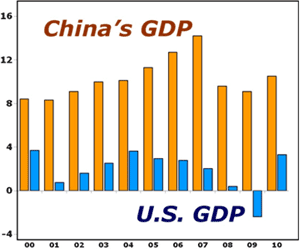
In the U.S. last year, even despite all the bailouts, the economy contracted by 2.4%. Meanwhile, China’s economy GREW by 9.1%. That’s a huge difference!
Martin: And right now?
Tony: Right now, the U.S. is growing at an annual rate of about 2.5%.China is expected to grow 10.5%, or at least four times faster.
Go back in time, and you see the same pattern, year after year after year.
Just recently, China’s industrial company profits surged 82%.
Retail sales soared 18%, six times better than in the U.S.
China’s exports in June surged 44% compared to last year; while U.S. exports increased by a measly 2%.
China now consumes more energy than the United States. Even General Motors now sells more cars in China than it sells in the U.S.
Martin: So what’s your forecast for China?
Tony: I think it’s a no-brainer.
Forecast #5. Starting right now and continuing for years, the growth in China will to be at least four times greater than that of the U.S. and Western Europe.
Martin: Are you saying China will never suffer a setback?
Tony: No. But remember earlier how Mike said it will be tough to put another big stimulus package together in the States? Not so in China! In China, at any sign of trouble, the government would swoop down with a mega-stimulus package in a heartbeat. And they don’t need to borrow or print money to do that.
Martin: Because they have the financial resources.
Tony: Darn right they do! Which leads me to my most important comparison:
If you add up all of America’s gold in Fort Knox and other vaults, plus all the foreign currency reserves and drawing rights at the U.S. Treasury, you get a grand total of $490 billion.
Martin: That’s our government’s cash in the bank, so to speak — for international transactions.
Tony: Right, but against that, we have debts to foreigners of $2.1 trillion.
Martin: Not to mention the trillions in domestic debts.

Tony: Yes, but right now, I’m talking strictly about debts to foreigners.
And if you subtract America’s foreign debts from America’s cash, you’ll see that the U.S. is under water to the tune of $1.6 trillion.
Meanwhile, China has total gold and reserves of $5 trillion, minus only $374 billion in foreign liabilities. So it’s in the black to the tune of $4.6 trillion!
Here’s the bottom line: China sits on the biggest mountain of cash in the entire world, while the United States is down in the deepest valley of debt in the entire world!
Martin: Everyone talks about this. But until you see these numbers in black and white, you don’t always grasp the sheer enormity of this situation.
Mike: So what’s the strategy? From a pure balance sheet perspective, which country would you be buying and which one would you be selling?
Tony: The answer should be obvious.
Ron Rowland: Wait, gentlemen! I look at all the international markets all the time. And I don’t think we want to drive our viewers to the conclusion that they should be willy-nilly selling the U.S. and willy-nilly buying China.
Tony: That’s not my intent.
Martin: Gentlemen, can we save the strategy discussion for a moment? That’s also when Ron will give us his top ETF picks. Please continue, Tony.
Tony: What I was going to say is that China is not alone. Consider Singapore, for example. Look at how quickly Singapore’s GDP is jumping. Just now, in the second quarter of this year, its economy expanded at an annual rate of 19.3%!
That’s eight times faster than the GDP growth in the United States. But if you think Singapore is doing well, consider Indonesia, which is my next forecast.
Forecast #6. Over the next 12 months, investors in Indonesia will make even more money than investors in China.
Last year, I went to Indonesia and I was blown away by what I found.
Martin: And you joined us in a conference like this one. You said Indonesia would be among the best performing stock markets in the world this year.
Tony: I said Indonesia was growing like a weed and now it’s growing even faster. I said investors could make a fortune in Indonesia, and that’s exactly what’s happening. Its stock market is up 20% so far this year. Its currency has surged 5%. And it’s just warming up.
Everyone now knows about the massive shift in capital and wealth from West to the East that we talked about in our first global forum a year ago. What most people don’t know is that Indonesia is getting a supersized share of that wealth.
Martin: How do you know that?
Tony: Because foreign investment in Indonesia has surged 51% compared to last year. This is a megatrend of far-reaching consequences.
Martin: But this is not strictly an Asian phenomenon, is it? The money isn’t just flowing East, it’s also flowing South, especially to South America.
Tony: Of course.
Martin: Which is why I’ve also invited our South America specialist, Rudy Martin, to this global forum.
Rudy Martin: Thank you, Martin. It’s about time you invited me! My forecast is:
Forecast #7. While Asia outperforms the U.S. and Europe, Brazil and Chile will outperform most of Asia!
Martin: Explain why — in a nutshell.
Rudy: Mainly because the big growth spurt in China and Asia was the first wave. Now, the big growth spurt in countries like Brazil and Chile is the second wave. I don’t doubt that there are huge profits to be made in China and Indonesia. But if you’re looking for the next China, the next massive growth spurt that will carry forward for many years, you should go to South America.
Martin: An echo boom?
Rudy: No, I wouldn’t put it that way. Sure, South America exports to China and Asia, and that was kind of the starter engine for growth in South America. But now we have our own internal growth engines that are powered by domestic demand.
Martin: And you’re saying Brazil and Chile are the leaders.
Rudy: Yes! Just a few years ago, over half of Brazil’s people were at the margins of society, outside the cash economy. Now, those same people open bank accounts. They use credit cards. They pay taxes. Just a few years ago, Brazil was importing energy. Now it’s entirely self-sufficient in energy and awash in new oil discoveries.
Martin: And Chile?
Rudy: Believe it or not, Chile has come so far so fast it’s now classified as a developed economy.
Chile produces more copper than any other nation in the world — five times more than the United States. While U.S. consumers are strapped for cash and cutting back, Chile’s are cash rich and spending more. While U.S. banks are struggling, Chile’s banks just enjoyed a 57% jump in profits in the first half.
Martin: What about the earthquake?
Rudy: It was very sad. But now you’ve got $8 billion in reconstruction spending pouring into the economy.
Martin: Do me a favor. Compare Brazil and Chile to Russia, India and China.
Rudy: I think they’re fundamentally stronger! Unlike Russia and China, Brazil and Chile have true Democratic elections and the rule of law. And unlike India’s, their exports are broadly diversified. Plus here’s the biggie: Unlike the U.S., Brazil and Chile have virtually no foreign debts.
Martin: Gentlemen, the big picture is very clear — bad news in the U.S. and Europe, good news in Asia and South America. Now let’s get down to the heart of the matter — how investors can make money.
Ron: My forecast is simple.
Forecast #8. Some of the greatest fortunes in the world will be made in international ETFs!
I’m talking about exchange traded funds that are dedicated to foreign markets.
Martin: Counting strictly ETFs that target single countries, how many are there exactly?
Ron: Right now, there are 86 single-country ETFs — one or more for each of the major countries in the global markets today. Australia, Brazil, Chile, China, India, Indonesia, Singapore, South Korea, Thailand.
You can pick almost any country with a viable stock market, and no matter where it is, you can click your mouse or call your broker to buy an ETF for that country. You put it in your regular brokerage account. And you’ll instantly have a nice, liquid, diversified basket of that country’s leading companies.
Martin: And they’ve outperformed the Dow, I presume.
Ron: They’ve beat the pants off all the U.S. indexes!
Martin: Can we be more specific about this?
Mike: I have some data and charts our research department put together. So if you don’t mind, let me run through them to support Ron’s point about outperformance.
Since the March low of last year, the best performing major U.S. index has not been the Dow or S&P — it’s been the Nasdaq Composite. But among all the stock indexes around the world, the Nasdaq Composite now ranks 104th.
Martin: Are you saying there are 103 other indexes in other countries that have outperformed the best performing index in the U.S.? I presume the same holds true for the ETFs that are tied to those indexes.
Ron: We don’t have ETFs yet for all the indexes. But yes, the same pattern holds true.
Mike: Here are the facts:
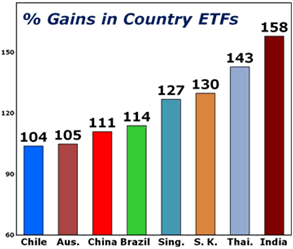
Since the March lows of last year, the Chile ETF is up 104%. The Australia ETF is up 105%. One of the leading China ETFs is up 111%, Brazil is up 114%. And you can go right down the list: Singapore — 127%, South Korea — 130%, Thailand — 143%, and India — 158%.
Martin: You picked the low as your starting point. But many people like to look at their performance on a calendar year basis and, comparing it to the Dow. Can you do that for these markets?
Mike: Sure. Let’s look at 2009. If you had bought the ETF that tracks the Dow Jones Industrials at the beginning of the year and sold it at the close of last year, you’d have a gain of 22.8%, including dividends

Martin: Not bad.
Ron: No. But wait till you see the data on the country ETFs!
Martin: OK, go ahead, Mike.
Mike: The Singapore and Australia ETF were both up 68%, 3 times better than the Dow. South Korea was up 71%, or 3.1 times better. Thailand was up 81%, 3.6 times better than the Dow.
Chile — up 86%, 3.8 times better. India — up 102%, four and a half times better. And with the Brazil ETF, you’d be up 121%, beating the Dow by more than five to one! For every $10,000 you might have made in the Dow, you could have made $53,000 just by buying the Brazil ETF.

Martin: That was 2009.What about this year to right now?
Ron: A bit different in the particulars, but the same basic principle!
Mike: Right. So far this year, the Dow Index is up a meager 2.2%.
Ron: But to be fair, you should compare it to the Dow ETF which includes dividends.
Mike: That particular ETF is up about 3.7%. A couple of foreign markets, like Brazil and Australia, are down a tad. But many foreign markets are, again, greatly outperforming the Dow ETF.
South Korea and India are up 2 times more than the Dow and Chile, which we talked about earlier, is beating the Dow by5.5 to one this year.
For every $10,000 you might have made in a Dow ETF this year, you could have made $55,000 simply by buying the Chile ETF.
Martin: That is kind of short-term oriented — just 2009 and 2010.Ron if you were a long-term investor what would you see there?
Ron: If you want to invest with core, long-term money, go all the way back to the beginning of 2003 and consider how much you could have made.
Mike: In Singapore, you could have made 274% …South Korea — 194% … Mexico — 363% … and, again, in Brazil — 972%. That was eighteen times better than the Dow.
Ron: If you had started with $100,000, you’d have a profit of $972,000 today. And if you add back in your original $100,000 investment, you’d have a total of $1,02,000 in your portfolio right now.
Plus, if you’re not confident in just a single country, there are 90 international ETFs that focus on broader regions — the Pacific Basin East Asia minus Japan, Southeast Asia, Latin America, and many more.
All told, including all the different ones we’ve mentioned today, we count at least 225 international ETFs available to U.S. investors — all regulated by the U.S. authorities, all listed on major U.S. exchanges.
Martin: This is all for up markets. What do you do in down markets?
Ron: I buy inverse ETFs. With inverse ETFs, the more the market falls, the more money you can make.
Mike: Most people don’t realize how easy it is to buy inverse ETFs and how many there are. I count exactly 100! One hundred ETFs that are designed and built, from the ground up, for declining markets. You never have to go short. You never buy options. You never open a margin account or borrow money.
You just buy low and you sell high — exactly like you would with any stock, in a regular stock brokerage account, online or offline. That’s it.
Martin: Overall, I find that most investors are very comfortable with ETFs.
Ron: Yes, because as Mike just said, they’re so easy to buy. You buy them like any stock — online or offline, with tiny commissions, without the restrictions and without most of the crazy fees you have to deal with when buying traditional mutual funds. You can buy and hold and your costs are small. Or you can trade frequently, and your costs are still relatively small.
Martin: Ron, this is your entire focus, your specialty — ETFs. But now my question is: What’s your long-term strategy?
Ron: Overall, use strength in the West to reduce your exposure and use weakness in the East to increase your stake.
Martin: So what you are saying is wait for rallies in the U.S. markets to sell and wait for declines or corrections in Asia to buy.
Rudy: And the South America! Everyone always seems to forget us in South America! I think that’s a mistake.
Tony: I totally agree with that strategy. We all know that, on a short-term basis, that when markets sink in the West, they also decline in the East. Or on days when they soar in the East, they also tend to rise in the West. But that’s very deceptive. If you look beyond the short-term fluctuations, you’ll see a very different story. You’ll see the West zigzagging down … while Asia zigzags up.
Ron: Are you ready for my picks now?
Martin: Yes, but first, let’s give our viewers a basis for measuring the value of your picks, for evaluating your recommendations.
Mike: That’s a great chance for me to go over those numbers as well.
Ron started managing international portfolios over 14 years ago. And for that entire period, his cumulative performance has been fifteen times better than the benchmark index of global markets. That’s real accounts, with real money in real time.
Martin: What about the risk?
Mike: The risk he has taken to achieve that performance has been significantly lower than the risk of investing the benchmark.
Martin: I think that’s the key — managing the risk.
Mike: I agree. Because that helps get international ETFs out of the realm of left-field investments and into the realm of core portfolio investments that the average investor can consider.
Plus, two more points: Ron has been rated #1 by Money Manager Review. And in the past 15 years, he has been ranked #1 or #2 by Hulbert — for cumulative performance since inception among all the mutual fund and ETF analysts that Hulbert tracks.
Martin: Congratulations, Ron.
Ron: Thank you. Plus, I now have the additional advantage of getting all the best research from our own experts.
Martin: Of course that doesn’t mean you never have a losing year or that every recommendation is going to be a winner. Plus, we all know that past performance is past performance and the future is a different story entirely.
Ron: Of course. But here are my top picks based on my analysis and based on the fundamentals we’ve covered today.
Martin: Would you buy these immediately?
Ron: Not necessarily. Remember what we said earlier. Sell the U.S. and Europe on strength. Buy Asia and South America on weakness.
Martin: OK. Give us the first one.
Ron: The first is Market Vectors Indonesia (symbol IDX).
Martin: Tony, what do you think of that?
Tony: Nice pick! As I said before, Indonesia is the largest economy in Southeast Asia. Yet, it’s an undiscovered gem, largely overlooked by investors.
Martin: And the second pick?
Ron: My second pick is iShares MSCI Chile (symbol ECH).
Rudy: That ETF includes my favorite Chilean bank stock that has just rocketed from $60 per share to $90 per share. It includes my favorite Chilean airline stock which just shot up from $18 to $25 per share. It includes a huge Chilean potash producer which just jumped 25%. I like every single one of the stocks in that ETF.
Martin: But Ron, you said you would not rush out and buy it today, that you’re waiting for some weakness. So that begs the question, how can viewers get your timing signals?
Ron: I explain it all in a special report I’ve just posted online. Always bear in mind, however, I never make static, buy-and-hold recommendations. In the global markets, you have to invest dynamically. In other words, you have to move your funds to the countries and regions with the best risk and reward now and then move on when those dynamics change, be it three months from now or three days from now.
I show you how in my report. But this time, I think you’ve got to do more than read it. Heck, everyone reading our materials knew about all this a long time ago. They knew China was growing by leaps and bounds, multiplying investor wealth ten-fold and more. They knew that China wasn’t alone — that there were other countries which were going to do even better.
But knowledge alone is not enough. The only people who make money are the ones who also have the courage to transform their knowledge into action. Same for investors. Until you act on what you know, those kinds of profits will continue to be out of your reach.
Martin: Well said, Ron! Thank you, everyone!
Editor’s note: For Ron Rowland’s report on international ETFs — just updated and posted online in the wee hours this morning — click here.
This investment news is brought to you by Money and Markets. Money and Markets is a free daily investment newsletter from Martin D. Weiss and Weiss Research analysts offering the latest investing news and financial insights for the stock market, including tips and advice on investing in gold, energy and oil. Dr. Weiss is a leader in the fields of investing, interest rates, financial safety and economic forecasting. To view archives or subscribe, visit http://www.moneyandmarkets.com.
The Bottom Line
Short term caution is appropriate. An important low for equity markets in late September/October continues to line up.
A 7 chart sampling below of the 45+ Charts Don Vialoux analyses in this great Monday comment HERE.
U.S. equity index futures are higher this morning. S&P 500 futures are up 3 points in pre-opening trade. Index futures are responding to mergers and acquisition news. Potash Corp. rejected BHP Billiton’s take over offer and is actively seeking a white knight. Possible suitors include Sinochem and Vale. In addition, Hewlett Packard bid $24 per share for 3PAR. Dell previously bid $18 per share for 3PAR.
The Australia All Ordinaries Composite Index slipped 0.36% following news that the election in Australia did not arrive at a majority. The Labour party and the Liberal/National coalition each won 73 seats out of the available150 seats. The remaining four seats were won by independents. Negotiations and recounts will determine the victor in due time. BHP Billiton and Rio Tinto rallied in anticipation of a scrapping of the extra 30% tax on the profits of Australian iron ore and coal production.
The S&P 500 Index fell 7.56 points (0.70%) last week. Intermediate trend remains down. Support is at 1,010.91. Resistance is forming at 1,129.24. The Index once again found resistance near its 200 day moving average and fell last week below its 50 day moving average. Short term momentum indicators are trending down. Stochastics already are oversold, but have yet to show signs of bottoming.

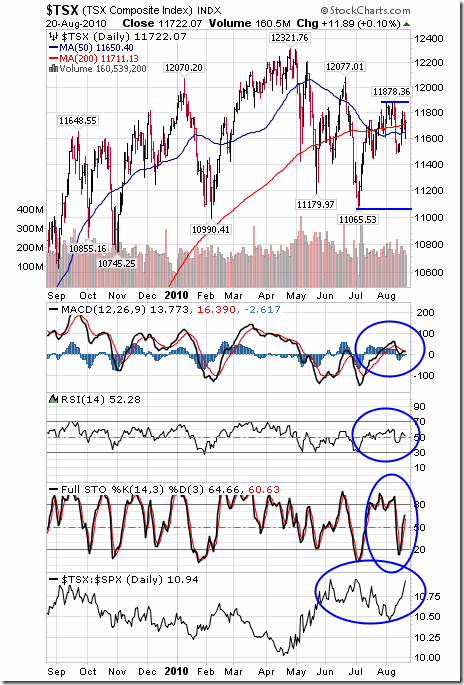
The TSX Composite Index added 193.82 points (1.68%) last week. Intermediate trend remains down. Support is at 11,065.53. Resistance is forming at 11,878.35. The Index is bouncing back and forth around its 50 and 200 day moving averages. Short term momentum indictors are neutral. Strength relative to the S&P 500 currently is undetermined.
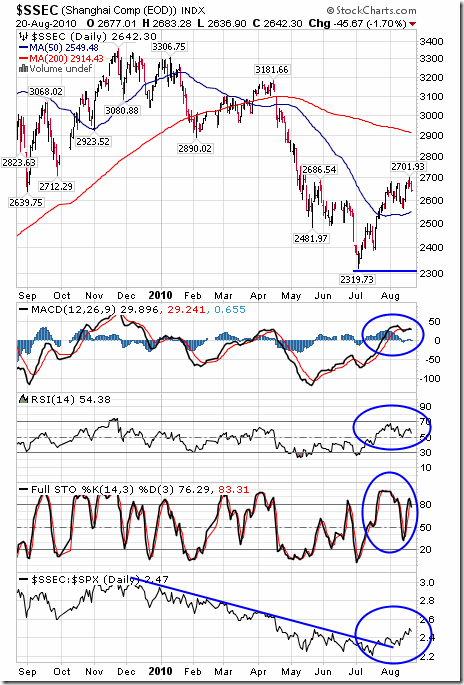
The Shanghai Composite Index added 36.20 points (1.39%) last week. Intermediate trend changed from down to neutral last week when the Index moved above resistance at 2,686.54. Short term momentum indicators are trending higher. Stochastics already are overbought, but have yet to show signs of peaking. Strength relative to the S&P 500 Index recently changed from negative to positive.
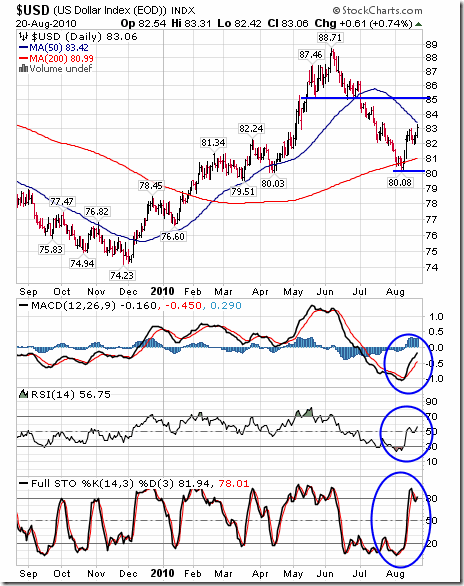
The U.S. Dollar Index added 0.10 last week and currently is testing its 50 day moving average. Support is at 80.80. Resistance and short term upside potential is to 85.03. Short term momentum indicators continue to trend higher. Stochastics already are short term overbought, but have yet to show signs of peaking.
Natural gas fell 20.90 cents (4.82%) last week. Short term momentum indicators are trending lower.

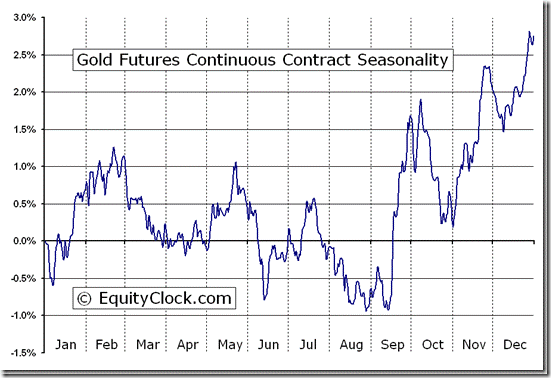
Seasonal influences turn positive near the end of August. Ditto for gold bullion!
Natural Gas Futures (NG) Seasonal Chart

Gold Futures (GC) Seasonal Chart
……Go HERE to view all 46 Charts and Commentary
Market Buzz – For “ABC” Record Profits Come as Simple as Q1, Q2, and forward Q3
Toronto’s main index scraped and clawed its way to a meager 11.89 point gain this Friday to 11,722.07 as investors continued to react to figures released Thursday, which showed an unexpected rise in weekly U.S. jobless claims to half a million and a big drop in manufacturing activity in the Philadelphia region. For the week however, the S&P TSX Composite was quite strong posting a 1.68 per cent gain.
The poor jobs data was once again the focus and again, we think the focus is where it should be. For the current fiscal stimulus-led recovery to morph into an organic sustainable economic recovery, North American has to create jobs. This continues to be a challenge and so should the recovery.
In other news, Statistics Canada reported that the country’s annual inflation rate rose to 1.8 per cent in July, up from one per cent. The agency said new harmonized sales taxes in Ontario, British Columbia and a higher HST rate in Nova Scotia affected consumer prices in July – and let us all collectively give another loud cheer for this much loved tax.
For better and brighter news, we look to Asia Bio-Chem Group Corp (ABC:TSX-V), from our Canadian Small-Cap Universe (www.keystocks.com). The company manufactures and sells cornstarch and related products in the Peoples Republic of China (PRC).
This past week, the company reported that its revenues for the quarter ended June 30, 2010, jumped 144.1 per cent to $56.88 million from $23.30 million in the same period of the prior year. Perhaps more impressive, net income jumped 937 per cent to $4.5 million, or $0.06 per share, compared to $0.4 million, or $0.01 per share, in the corresponding period of 2009.
During the quarter, total production increased by 143.5 per cent to 172,611 tonnes from 70,894 tonnes in the same period of the prior year.
This coming week, we look forward to the Q1 2011 release from MOSAID Technologies Inc. (MSD:TSX). Based in Ottawa, Ontario, MOSAID is one of the world’s leading intellectual property companies. The company licenses patented intellectual property in the areas of semiconductors and telecommunications systems and develops semiconductor memory technology.
The company will issue a news release on its first quarter results for fiscal 2011 on Thursday, August 26, 2010, after market close. An analyst conference call and webcast will begin at 5:00 p.m. Eastern Time.
Net income for the period increased 41.4 per cent to $63.7 million, or $0.26 per share, in Q2 2010 compared to $45.0 million, or $0.23 per share, in the same period in 2009.
Looniversity – The Time Value of Money
A dollar should always be worth a dollar right? Not necessarily. The value of a dollar changes dramatically depending on when you take control of the dollar and invest it. The critical variable in the exact value of a dollar is time.
If someone owes you a dollar, do you want him to pay you today or next year? The answer is “today.” With inflation consistently destroying the purchasing power of a dollar, a year from now, a dollar will be worth slightly less than it is today. “Inflation” is an economic term used to describe the gradual tendency of prices to rise over time. If inflation is 2% per year, that means that prices, on average, will rise 2% over the next year, which means that your dollar can purchase $0.02 less in a year than it can today. That’s right, all you mathematicians out there – with 2% inflation, a dollar today is worth only $0.98 in a year.
However, if you got the dollar back today, you could invest it. If you invested it and your investment returned 10% over the course of the year, then you’d have $1.10 at the end of the year. So your money would be growing instead of shrinking and you’d be staving off the negative effects of inflation.
Put it to Us?
Q. I have a daughter who just turned four and I would like to start educating her about money and finance in general. Where is a good place to start?
– Warren Reynolds; Calgary, Alberta
A. A great lesson to start with your little one involves explaining, “Where does money come from?” An ideal time to begin teaching your child about the basics of money is when she first begins to notice it. Typically, in a child’s world, money comes from Mom and Dad’s pockets and when Mom and Dad are tapped, a machine magically spouts dollars after merely pushing a few buttons. It’s natural for her to assume that money is readily available whenever it’s needed.
When she can’t understand why you can’t meet her every demand – and you’re about to use a standby response such as, “Money doesn’t grow on trees” – remember that a more constructive explanation may serve both of you better.
Even very young children can begin to understand the concept of earning money. Explain to your child that money is earned by working and that you should only spend what you earn. To help her understand what it’s like to get paid on a schedule, begin paying an allowance. Then, help her set goals for how she spends and saves her allowance. It’s important, however, to make sure that you stick to the payment schedule, otherwise the lesson may be lost.
KeyStone’s Latest Reports Section
- Oil & Gas Service Stock Returns to Growth & Profitability in Q2 & Post Positive Management Outlook for Balance of 2010 (Flash Update)
- Q2 2010 EPS & Revenues Surge for China-based Agricultural Manufacturer, Announced New Growth Initiative – Stock Added to Focus BUY List (Flash Update)
- China-based Forestry Company Beats Q2 2010 EPS Estimates – Rating Maintained (Flash Update)
- Specialty Paper Manufacturer Shares Hit New All Time High, Up 158% in Seven Months, Solid Q2 Results – Rating Maintained (Flash Update)
- Wireless Phone Retailer Posted Unexpectedly Strong Q2 Growth & Holds Solid Cash Position – Maintain Long-Term BUY Rating (Flash Update)
Small Cap Stocks
The last time I was on the Business News Network (“BNN”) television, I was asked to participate in the Small Caps segment. What I found interesting about my interview on BNN was the amount of e-mails the producer sent me before I appeared on the show. I was asked to pick five or so companies that I could or would comment upon. There were 75 e-mails from viewers who wanted my opinion on junior resource companies. What was amazing is the fact that I had heard of so few of these companies. Certainly, with more than 4,000 junior resource companies, no one can know them all.
So, after reading all 75 e-mails, I actually felt relieved that I could comment with conviction on a few more than five companies. Taking junior resource companies at random and knowing about 7% in a significant enough way to comment is perhaps acceptable, but it brought to my attention the whole “investing/speculation” genre that surrounds the junior mining sector.
Many of us (and perhaps I am guilty as well) give a false sense of what most of the companies really represent. In many cases these companies are nothing more than a dream, and a good measure of hope is mixed in to keep investors holding their stock.
I refer to these types of companies as “story stocks”; each one has a unique “story”—about how it used to be a mine, or the previous owner did not perform the correct analysis or looked in the wrong place, or was right next to the greatest discovery in the history of mankind. On and on the stories go, and this is quite entertaining at cocktail parties. However, very few are bragging these days about the type of money they are making in these markets.
Last August I was interviewed on Michael Campbell’s Money Talks and mentioned to the listeners that not only had the credit crisis begun, but also that some in the junior resource sector were done! In fact, on another Michael Campbell show I went way out on a limb and said the uranium sector would be especially hard hit. Many companies would not be able to raise more money and subsequently would basically go out of business.
Here it is, a years later, and indeed numerous Uranium companies are indeed –“no more”.
During the BNN interview I ranted a bit, stating that when people things they usually buy the best they can afford. But when it comes to stock investing, many people look for the cheapest stocks they can find. This is not the way to invest—to be successful, you want your money to purchase the very best companies as well. Generally, cheap stocks are cheap for a reason.
There is a paradox here, though, and I did not have time to state it on the TV show. Many junior and senior resource companies are at very attractive levels right now, and astute investors should be carefully selecting bargains at this time. August is historically the best month to buy in to the precious metals, and many of the better-run companies are selling at attractive valuations.
In summary, don’t let the summertime blues get you down. Look at the opportunities available, but please, if you are deciding between companies where one sells at $50.00 and one at $0.25, be as certain as humanly possible that the cheaper one truly is superior, not just cheaper.
David Morgan
For Free information on how to invest in silver without getting burned click here. Mr. Morgan has followed the silver market daily for more than thirty years. Much of this Web site, The Morgan Report, is devoted to education about the precious metals. To start a silver savings plan click here.
U.S. Stock Market – I don’t know what’s sinking faster – Obama’s popularity or the jobs market. 500,000 unemployment claims announced this morning instantly deflated the “Don’t Worry, Be Happy” crowd’s hope. While I still think they can manage a rally into the Labor Day weekend, I believe it’s becoming abundantly clear that the wheels have fallen off the so-called economic recovery.
Gold – We had a technically bullish “outside day” up on the daily bar chart yesterday – whereby the high was higher and the low was lower than the previous session’s trading range, with a higher close. While the perma bears and the media that still flocks to them will bark one more time around the old highs, they’re constant crying wolf is at most a nuisance and very sad if it wasn’t so darn funny how people still react to the gang that couldn’t shoot straight.
U.S. Dollar – The dollar’s dramatic slide from early June did indeed witness a bounce off critical support around 80. Any further rise should be contained by the 50-Day M.A. around 83.60. It’s only a question of when, not if in my mind, we break below 80 and within 1-3 years, make new lows below 70.
U.S. Bonds – While I’m very bearish I don’t think it’s time yet to go short. We could see the 10-yr. note back near 2% if the economy begins to accelerate to the downside.
Oil and Natural Gas – No desire to be long or short.
Must Read Article: The Best Gold Interview of 2010
Mining and Exploration Shares – I believe we can continue to see more takeovers and mergers as mining/exploration shares are historically cheap relative to metal prices.
A few model portfolio and Grandich client companies that I consider are potential takeover targets (I’ve no knowledge of any interest) are:
Nevsun Resources
Taseko Mines
Continental Minerals
Donner Metals
-
I know Mike is a very solid investor and respect his opinions very much. So if he says pay attention to this or that - I will.
~ Dale G.
-
I've started managing my own investments so view Michael's site as a one-stop shop from which to get information and perspectives.
~ Dave E.
-
Michael offers easy reading, honest, common sense information that anyone can use in a practical manner.
~ der_al.
-
A sane voice in a scrambled investment world.
~ Ed R.
Inside Edge Pro Contributors

Greg Weldon

Josef Schachter

Tyler Bollhorn

Ryan Irvine

Paul Beattie

Martin Straith

Patrick Ceresna

Mark Leibovit

James Thorne

Victor Adair