
Daily Updates
Comment by Richard Russell – Dow Theory Letters:
Dennis Gartman is an experienced commodity trader. Dennis has been very cautious about gold; he “sort of” likes gold, so he calls himself a “gold agnostic.” For this reason its most interesting to read what Dennis says about gold in today’s report.
“Turning, then to gold and other metals, prices turned sharply for the better yesterday as the world rushed out of equities and looked for any safe harbors that were available. Certainly the rush to the Swiss franc was obvious, as noted above, and so too the rush into sovereign debt securities. But frankly, the rush was on to gold once again. We remain long what we have referred to as an ‘insurance’ position in gold, but we own it in terms of EUROs and /or of British pounds sterling, otherwise we remain an agnostic. To assuage our friends who are gold-bug-leaners, we shall not be short of gold. Nothing likely shall ever turn us manifestly bearish of it. But for the moment we are simply hard upon the sidelines, owning only this small ‘insurance’ position and comfortably in that position.
Might we be enticed back to the bullish side of the market eventually? Of course we might. If the situation in the global equities markets became dire, we might move from agnosticism to ‘faith.” If we were to see the monetary authorities throwing caution to the wind and massively explode their balance sheets, we might be enticed away from our agnosticism to ‘faith.’ If the political situation were to become untoward,and patently uncomfortable, we’ll throw our agnosticism in to a heap and join the gold market faithful. But until then, agnosticism works for us.”
Russell response — I can understand Gartman’s caution. Dennis is an old-time trader, and he’s seen a lot of traders get killed by taking huge and wrong positions.
My own position is that gold is in a clear and obvious primary bull market. These situations come along maybe two or three times in a lifetime. I was convinced back in 1999 that the bear market in gold had ended with gold selling at 256. In the year 2000 they were literally giving gold mining shares away. At that time gold shares were so ridiculously cheap that I told subscribers that they should buy these stocks (many selling for just a few dollars a share) and hold them as perpetual warrants. – Richard Russell – Dow Theory Letters
Interesting BNN Interview:
Kaminak Gold’s CEO was on BNN earlier today. I’ve bet the ranch (so to speak) on Silver Quest Resources (I’ve bet my lungs before and lost). I like to bring your attention to his notation about soil samples and the results from drilling under them and suggest you look back at SQI’s press releases and their soil sample results – Peter Grandich Grandich.com – Grandich Client Update – Silver Quest Resources Continues to Grow The Capoose Resource
Fingers, toes and all other items available are crossed.Kaminak Gold has recently announced three major gold discoveries in the Yukon’s White Gold district (not the Klondike) causing the stock to climb sevenfold within the past year. BNN interviews the company’s CEO Robert Carpenter.
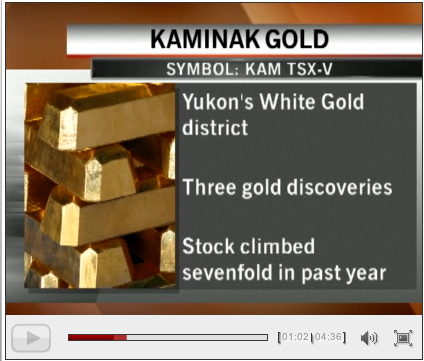
Click HERE to Watch BNN on the Yukon Gold Rush
My apologies for being so bold in the subject line. But this is one of the most important columns I’ve ever written. Why? Because today I am going to give you a major heads up on the trends I see unfolding over the next few months.
More importantly, I am also going to show you how those short-term trends are going to set the stage for the longer-term trends that you’re going to see unfold over the next few years.
First, a warning: The forecasts you’re about to read are controversial, and many will say I have lost my mind. No problem. Many have said the same about me numerous times in the past.
But the forecasts I speak of today are based entirely upon my proprietary trading models that are unlike any other in the world.
And today is not the first time my trading models have made spectacular calls. Since I developed them in 1982, they have successfully guided me and the investors that have followed me through every twist and turn in the economy and markets:
Through the 1987 stock market collapse, the ensuing bull market, the first Gulf War, the peak in the broad markets in 1999, the crash of 2000—2003, the 2007 peak in stocks, the bull market in gold right from day one, the bear market in the dollar, and more.
My systems flagged every one of those events and major trends well in advance.
I point this out not to brag, but merely to emphasize how important it is that you read on to learn what my models are saying now, and how seriously their messages should be taken.
They are not common forecasts. They are not based on linear logic, but rather, on more dynamic processes, which is what the markets themselves are. Dynamic.
So here are the forecasts and what you should be watching …
FIRST, the broad stock markets will attempt one or two more rallies over the next three weeks. The Dow may even get back to 10,700, or even nudge out a new high near 11,000.
But don’t you dare be fooled. The broad stock markets in the U.S. are now rolling over.
At a minimum, by November, we will see the Dow plunge to at least 9,000, with a high probability of falling to the 8,700 level.
But once you see the Dow Industrials below 9,000 — start preparing for another big rally in the markets, one that could last for years and eventually see the Dow Industrials more than triple by 2015, and soar to anywhere between 27,000 and 44,000.
How could that ever happen, you ask? Call me crazy. Call me nuts. But I’ve written about it before, and that kind of stock market inflation has happened in nearly every third-world and emerging economy on the planet.
The only difference is that this time, it will happen in the FIRST world, and chiefly in the U.S. No matter what the economy does.
Because very simply …
SECOND, as the Dow plunges going into November, the U.S. Federal Reserve will start printing more money to inflate away the problems. No matter how much it takes. Whether it’s another one trillion, five trillion, twenty trillion, or even thirty trillion dollars.
The Fed will do whatever it believes necessary to try and turn things around.
It will stop at nothing. The Fed, in the next round of this crisis, will even resort to more extreme measures, such as supporting the U.S. bond markets — and keeping interest rates at near zero — by forcing banks to buy U.S. bonds (like the Fed did during WWII).
By reversing the existing policy of paying banks interest on reserves parked at the Fed, and penalizing the banks instead for not lending out to the economy …
By slashing reserve requirements, by restricting foreign capital outflows, and more.
All of this will be ultimately designed with one end goal in mind: To massively DEBASE the U.S. dollar.
You see, the Fed thinks — rightly or wrongly, only time will tell — that by devaluing the dollar and eventually inflating financial assets higher, that trillions of dollars of wealth will be recreated.
Hence, from that will flow new businesses, a wave of new innovation, millions of jobs being brought back, millions more new jobs being created, real estate prices appreciating once again, and more. In short, everything will be hunky-dory once again.
As I said before, whether or not the strategy works remains to be seen. I doubt it will. But that’s not my main point.
My main point is that if you fight the Fed on this, you’re going to lose your shirt.
So once you see the Dow below 9,000, start getting ready to go LONG the market, because the Fed is determined — and does have the ability — to inflate the financial markets higher, much higher.
No matter what philosophical or political bend you come from, if you want to protect your wealth and grow it, don’t fight the Fed on the next plunge in the economy and the stock markets.
THIRD, gold will soon be giving you the ultimate opportunity to buy — before it heads to way north of $2,000 an ounce. The short-term cycles in gold point down into late August, when I expect gold to fall below $1,100 an ounce. It should, however, hold the $1,000 mark.
But no matter what, thereafter, gold should explode to new record highs, most likely by the end of the year — and then, through 2011 and 2012, march to at least $2,300 an ounce.
By 2015, I expect to see gold at near $5,000 an ounce.
The driving force will NOT be inflation. That will come later, and will show up in the CPI, but not for at least another couple of years.
The driving force instead, will be the final recognition that the U.S. is broke beyond repair … that the Fed will print however many trillions of dollars it wants to paper over the mess and retain control for as long as possible …
And that the U.S. dollar is doomed as a reserve currency.
So start preparing for all of this NOW, with the following steps. I cannot overemphasize them …
Step 1: Minimize your exposure to the stock market, right now. Get out of all stocks with the exception of core gold shares and other select natural resource, tangible asset stocks.
Later, in a few months, when the Dow falls below 9,000 — I will tell my Real Wealth Report members exactly how and what to get positioned in to capitalize on the Fed’s next aggressive moves, and the financial and tangible asset inflation we’re going to see.
Step 2: For any liquid cash you have, not earmarked for gold, keep it in safe, liquid, short-term investments such as money markets.
Or, use the strategy I’ve outlined in some of my special reports, which involves buying the iShares Barclays TIPS Bond Fund ETF (TIPS), but hedged by investing a third of what you place in that fund into the inverse bond fund, the Direxion Daily 10-Year Treasury Bear 3X Shares (TYO).
Step 3: If you don’t use the upcoming weakness in the gold market to buy or add to positions, I think you could be making a huge mistake.
The best way to buy gold, in my opinion, is the SPDR Gold Trust ETF (GLD). Each share represents 1/10 of an ounce of gold. When you buy this fund, it’s like buying a mutual fund, but one that holds only physical gold. Plus, you eliminate storage and shipping worries because the gold is held in trust for you.
Or, if you’d rather buy a gold stock mutual fund, consider the Tocqueville Gold Fund (TGLDX). As an alternative, look at the Market Vectors Gold Miners ETF (AMEX: GDX). This single investment holds 10 of the largest gold miners in the world.
No matter what you do, I urge you to stay open minded and think dynamically going forward. That means not accepting the status quo, not accepting mass hysteria, not following old models and old economic rules, and using “uncommon wisdom”. Period.
That will be the only true way to both psychologically and financially survive not just the next few months, but also the next few years.
All the best,
Larry
P.S. For ALL of my specific recommendations and precise buy and sell signals, become a member of Real Wealth Report, for a modest $99 a year. You’ll get 12 monthly hard-hitting issues packed with uncommon analysis and insights into today’s world and the great financial crisis … plus flash alerts, advance notice of special situations, and more.
It’s a value that can’t be beat. Become a member now by clicking here.
This investment news is brought to you by Uncommon Wisdom. Uncommon Wisdom is a free daily investment newsletter from Weiss Research analysts offering the latest investing news and financial insights for the stock market, precious metals, natural resources, Asian and South American markets. From time to time, the authors of Uncommon Wisdom also cover other topics they feel can contribute to making you healthy, wealthy and wise. To view archives or subscribe, visit http://www.uncommonwisdomdaily.com.
It’s summertime…and the livin’ is still easy here in France.
But the children are all gone. The house is quiet. Our office – usually a hive of activity when the children and their friends are here, checking email…searching for cheap tickets…or just hanging out – is as dead as a tomb. The only sign of life is the clicking of computer keys as your editor prepares his Daily Reckoning.
And what is there to reckon with today?
Slowly, the idea of “recovery” is fading. People are beginning to realize that we are in a Great Correction, not a typical post-war recession.
“The Never Ending Recession,” is one title in the financial news.
“Consumers slow to spend, businesses slow to hire,” The Washington Post sums up the situation.
“US Restaurants Starved for Business,” reports The Los Angeles Times.
The Dow fell 57 points on Friday, after a big down day on Thursday. Gold lost $6.
Are you invested in stocks, dear reader?
You are? Shame on you!
Of course, there are always one or two stocks that will buck the trend. And if you’re willing to wait, say, 20 years, you might be okay.
But in the next few years, US stocks are not likely to pay off. The stock market entered a bear phase in January 2000. Since then, stock market investors have made some money and lost some money. Some are ahead a little. Some are behind. Most have gotten nowhere.
But the bear still hasn’t fully expressed himself. The stock market still hasn’t reached its rendezvous with desperation. That’s when you will be able to buy stocks without worrying about further price erosion. That’s when the sellers have sold and the typical person wants nothing more to do with stocks.
The ideas of “stocks for the long run” and “stocks for everyone” are not permanent, universal truths. They are merely cyclical fads. People believe in stocks when stocks have been doing well. They stop believing in them when they stop doing well.
There are times when most people believe they should never buy stocks at all. They think stocks are a specialists’ game – for professionals who can take the time and trouble to figure out what is really going on in the companies they invest in. The notion that you can just buy a stock because you like the product…or because you’ve heard that the industry is doing well…is regarded as absurd. And it is absurd.
But it’s an absurdity that comes around in a bull market and disappears in a bear market. We’re in a bear market now. The next leg down should drive the last moms and pops out of the market and bring prices down to bargain levels.
The next leg down will also drive investors even further into the bond market. That’s right, dear reader, investors will jump from the frying pan of equities into the fire of US Treasury debt. They’ll be looking for a safe place for their money. And nothing will seem safer than the credits of the biggest economy on earth.
“Default?” “The US government?” “Don’t make me laugh,” they will say.
But the US will default – one way or another.
It has more financial obligations and commitments than it can bear. Somehow, someway, sometime they’ll have to be sloughed off – probably by a combination of trimming, taxing, and inflating.
And sooner or later, those super safe bonds will lose half their real value. Probably not sooner. But maybe later.
Bill Bonner
for The Daily Reckoning
Bill Bonner
for The Daily Reckoning
It’s hard to believe that more than ten years have gone by since we began writing The Daily Reckoning out of a Paris office back in July of 1999…
Since then, a lot has changed. We have seen the dot com boom and bust…a massive expansion of credit…real estate mania and meltdown…and epic highs and lows in the markets.
Nothing about the past ten years has been boring. And we have been there throughout, trying to help readers make some sense out of our global economy. And hopefully providing a few laughs along the way.
In short, we pen The Daily Reckoning each day – for free — to show you how to live well in uncertain times. We aim to make each article the most entertaining 15-minute read of your day.
If you haven’t signed up yet, I urge you to do so right here. And don’t worry. It’s 100% free – no credit card is required.
Gold Alert
Not more than an hour ago, I noted that one shouldn’t blink when it comes to gold’s pullback and whammo – a tremendous rally took place. How do I feel about this?
No matter how we finish, the perma-bears and the vast majority who continue to dislike and discourage gold ownership are in big trouble.
Hourly Chart via Money Talks

U.S. Stock Market – Technical’s continue to deteriorate while fundamentals are ugly and getting uglier. The “Don’t Worry, Be Happy” crowd is in full retreat and their only hope is the bears digest their gains and rest around Labor Day.
Chart via Money Talks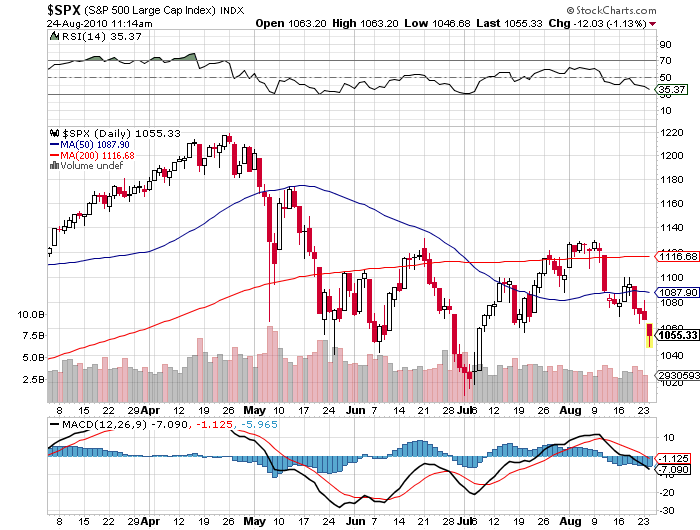
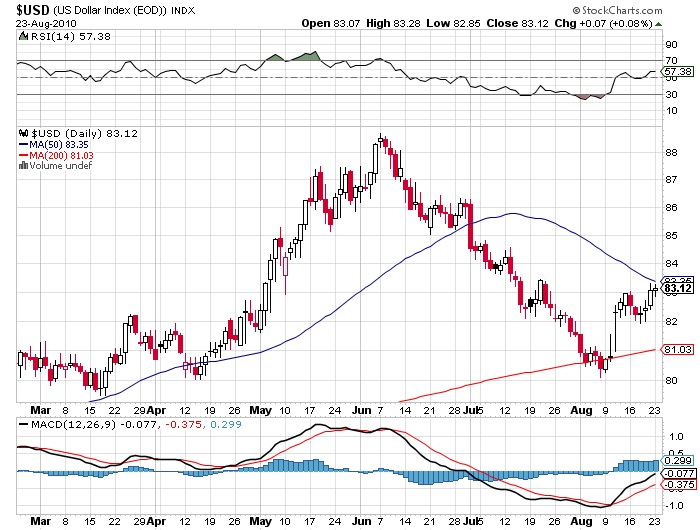
U.S. Dollar – The expected countertrend rally from a deeply oversold condition has indeed unfolded. I anticipate this blip up to be contained within the 50 – Day M.A. and the 84.50 area.
Chart Via Peter Grandich
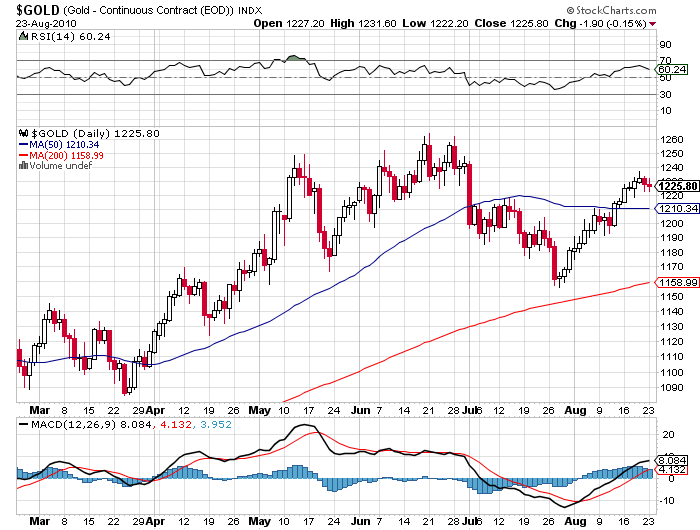
Gold – The angle of the recent acceleration to the upside begged for a short correction and here it is. Don’t blink as this healthy pullback should not be long and I believe we can be testing new highs in the Sept/Oct time frame.
Chart via Money Talks
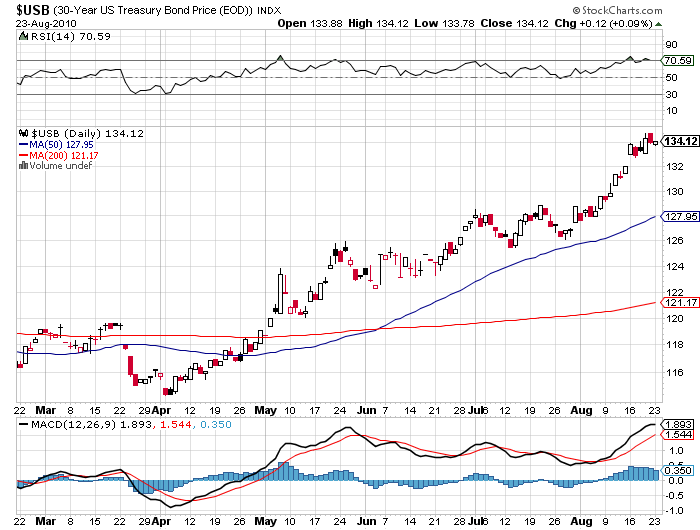
U.S. Bonds – I wouldn’t touch any maturities pass two years but don’t see any reason for rates to back up dramatically any time soon. If a corporation or person was to refinance, now is the absolute time.
Chart via Money Talks
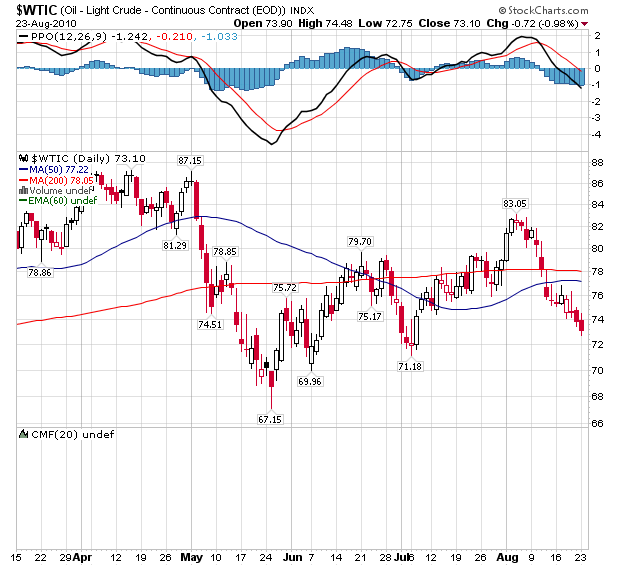
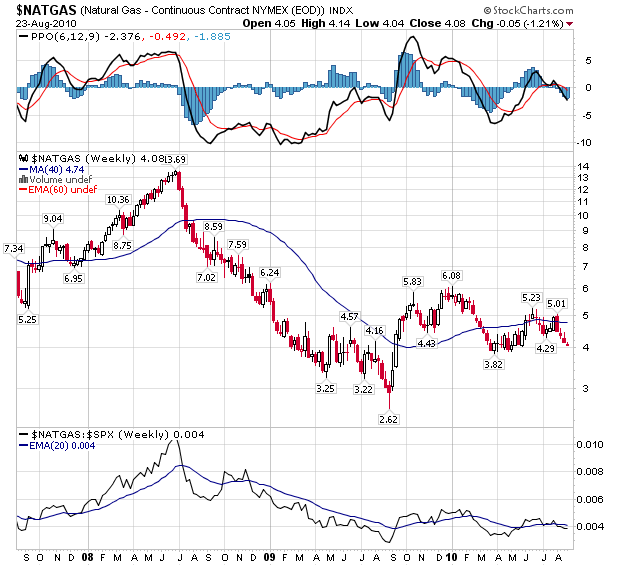
Oil and Natural Gas – I’ve avoided these markets for months and see no reason to get long or short. I would keep an eye on the Middle East as I believe that’s a question of when, not if, it “blast’s” onto the investing scene.
Charts via Money Talks
On Major Moves, Peter Grandich has been very right and not only saved many investors fortunes, but expanded them dramatically. On November 3, 2007 at the MoneyTalks Survival Conference, Peter Grandich of the Grandich Letter warned that “an unprecedented economic tsunami will hit American beginning in 2008”. Peter advised publicly to short the US market two days from the top in October, 2007 and stayed short until the last week of October, 2008. He began to buy stocks in March 7th, 2009. He also bought oil and oil related investments near the lows after the dive from $147.
….go to visit Peter’s Website
To HERE Peter speak and others speak on Trading go HERE:

We bought equities on July 21st, and have remained long of equities… basic, dividend paying, old-guard, boring companies that produce steel, or copper, or ball bearings, or girders, and if they do not make them, they move them; the things that if you drop them on your foot will hurt as we like to say…until only just recently, having taken to the sidelines on Friday – Dennis Gartman For a Trial Subscription go to The Gartman Letter)
The Dawes Premonition
–When a blind mathematician exits the market because an ominous technical omen indicates a crash ahead, what do you make of it?
–Last week the whole internet was abuzz with the phrase “The Hindenburg Omen.” The “Omen” is actually a convergence of technical and momentum indicators which, when sighted, usually leads to a big market correction. Its creator Jim Miekka has used it to forecast major market tipping points. And this week, Miekka told the Wall Street Journal he had heeded the warning and was out of the market completely.
–Miekka is right that September is historically a lousy month for stocks. Just why this has been the case is disputable. Is it well-rested and tanned North Atlantic fund managers getting back behind the desk and putting their brain in a psychologically defensive mode as the autumn and the winter approach? Is it cyclical? Is it random? Is it aliens?
–Add to the Hindenburg Omen the “Dawes Premonition.” Writing over in Money Morning today, Dawes (the editor of Slipstream Trader) concludes:
The weekly charts show a market that has crashed between 2007-2009 and then turned and rallied to the 50% Fibonacci level of 5000 over 2009-April 2010.
We are now at the point where the bear market rally is looking dead and buried and a resumption of the downtrend is about to occur.
The long term trend has already turned down in May when the 35 day MA crossed with the 200 day MA. The rally of the past month saw an intermediate uptrend in place which is on the edge of failing with the 10 day MA about to cross with the 35 day MA to the downside.
Therefore we are about to see all trends aligned, from the short term to the long term trend and they are all pointing down.
The distribution of the past year is looking very tired and another retest of the c.4200 lows in the ASX 200 is going to crack. That will give immediate targets to c.3900. And below there it looks very scary indeed.
If the market does crack under this 4,400 level then I wouldn’t be surprised to see the market swan dive to 3,900 in a matter of weeks.
–What about days? Today’s opening hasn’t been so flash. And with the news on the political scene getting increasingly bizarre – a unity government with Tony Abbot as Prime Minister and Kevin Rudd as a front-bencher and Foreign Minister – investors might start to get a bit nervous about what the political class is up to.
–Our suspicion is that it is better to have the political class bickering like children with one another than cooperating toward some common goal. That common goal – defined by them and not you – will probably include spending more of your money, raising taxes, and improving the planet in some undefined and unproven but costly way. We’d rather have them at each other’s throats than clutching for ours in tandem.
–At least Australia is not America, financially speaking. That economy appears to be circling the great historical drain. Economists told Bloomberg they expect existing home sales to have fallen by 12.9% from June. This shows that the recession in America never really ended. It just got papered over by asset inflation driven by Fed policy and government stimulus that lulled people into somnambulant complacency.
–Yet it’s clear that ordering extra gravy on your fries will not make you thin. For example, the arguments implying that stimulus spending “saved” Australia from the recession persist and are taken as a gospel truth by most in the media. But even if they are technically true – in the sense that you define recession as two consecutive quarters of a contracting economy – what has really been engineered?
–A recession is the natural way of correcting bad investments made at the end of the business cycle or a credit boom. Those bad investments are failed businesses or mis-allocations of credit that didn’t produce jobs, income, or a net economic benefit. Or sometimes people just don’t’ want to eat at Barnacle Bill’s.
–Preferences change with time. And time changes with time. The market economy – a complex adaptive system – sorts the wheat from the chaff and generally delivers consumers more choice and lower prices. When credit excesses emerge, the recession wipes away the slate and puts the economy and the job market back on a sound economic footing where real growth based on real demand from real savings can begin again.
–Maybe Barnacle Bill’s will make a comeback. Or the next big thing will be Mexican food. Or organic salads made from produce grown on sustainable farms. It will be something, but only if you allow recessions to do their work.
–Not that we’re arguing in praise of recessions, although maybe we should. But preventing them is a wilful denial that any bad investments were made in the previous boom. It’s like saying you don’t need to burn calories to lose weight. You just need to eat more and let fitness come to naturally, while you gorge on Tim Tams on your couch and watch Master Chef.
–To deny the necessity of a correction to bad investments and misallocated capital is to deceive people into behaving as if everything were fine. Instead of saving and building up the household balance sheet, people take on more credit and spend.
–This, in fact, is what “avoiding the recession” accomplished in Australia. It encouraged Australians to believe the world is not as financially dangerous place as it actually is and to continue with behaviour (taking on mortgage debt) which makes them even more vulnerable to the next credit shock. That is not “saving” anyone. That’s leading them straight into the waiting room of the next financial slaughterhouse.
–It would be nice if eating chocolate didn’t make your ass big. But it does. Each financial decision has consequences to. A government stimulus program is an attempt to avoid the consequences and costs for financial behaviour by passing them on to someone else. It feels good doing it because you’re avoiding pain and rewarding yourself by borrowing money someone else must repay.
–That might feel good, but it doesn’t seem very ethical. But postponing an inevitable day of reckoning by deceiving people about the real state of things might be the sort of thing Big Brother or the Nanny State prefers to do. It’s easier to spend what’s not yours. And it makes people more complacent and dependent, when their financial lives are destroyed, on the government. But perhaps that was/is part of the plan, too.
–In any event, nothing much has changed overnight in on our beautiful blue planet with its brittle and complex financial system. Bond yields remain at historic lows in one of the great ironic developments of the last fifty years (as investors confuse government bonds with safe financial ground). A great deal of confusion about corporate earnings is now making the picture for equities very murky. And the Federal Reserve has quietly begun monetising U.S. debt.
–Our view is that mild deflation will simply be the prelude to a defacto debt default/devaluation in the U.S. This event will be massively inflationary and lead to much higher global interest rates, much lower asset prices, and a premium bid on tangible assets. Speaking of which, it’s time for lunch. Brownies anyone? Until tomorrow!
The Daily Reckoning has turned Australian!
Sign up to The Daily Reckoning HERE – for FREE!
Dan Denning: Dan Denning is the author of 2005’s best-selling The Bull Hunter (John Wiley & Sons). He began his financial publishing career in 1997 and has covered financial markets form Baltimore, Paris, London and, beginning in 2005 Melbourne. He’s the editor of The Daily Reckoning Australia and the Publisher of Port Phillip Publishing.
-
I know Mike is a very solid investor and respect his opinions very much. So if he says pay attention to this or that - I will.
~ Dale G.
-
I've started managing my own investments so view Michael's site as a one-stop shop from which to get information and perspectives.
~ Dave E.
-
Michael offers easy reading, honest, common sense information that anyone can use in a practical manner.
~ der_al.
-
A sane voice in a scrambled investment world.
~ Ed R.
Inside Edge Pro Contributors

Greg Weldon

Josef Schachter

Tyler Bollhorn

Ryan Irvine

Paul Beattie

Martin Straith

Patrick Ceresna

Mark Leibovit

James Thorne

Victor Adair