
Daily Updates
We bought equities on July 21st, and have remained long of equities… basic, dividend paying, old-guard, boring companies that produce steel, or copper, or ball bearings, or girders, and if they do not make them, they move them; the things that if you drop them on your foot will hurt as we like to say…until only just recently, having taken to the sidelines on Friday – Dennis Gartman For a Trial Subscription go to The Gartman Letter)
The Dawes Premonition
–When a blind mathematician exits the market because an ominous technical omen indicates a crash ahead, what do you make of it?
–Last week the whole internet was abuzz with the phrase “The Hindenburg Omen.” The “Omen” is actually a convergence of technical and momentum indicators which, when sighted, usually leads to a big market correction. Its creator Jim Miekka has used it to forecast major market tipping points. And this week, Miekka told the Wall Street Journal he had heeded the warning and was out of the market completely.
–Miekka is right that September is historically a lousy month for stocks. Just why this has been the case is disputable. Is it well-rested and tanned North Atlantic fund managers getting back behind the desk and putting their brain in a psychologically defensive mode as the autumn and the winter approach? Is it cyclical? Is it random? Is it aliens?
–Add to the Hindenburg Omen the “Dawes Premonition.” Writing over in Money Morning today, Dawes (the editor of Slipstream Trader) concludes:
The weekly charts show a market that has crashed between 2007-2009 and then turned and rallied to the 50% Fibonacci level of 5000 over 2009-April 2010.
We are now at the point where the bear market rally is looking dead and buried and a resumption of the downtrend is about to occur.
The long term trend has already turned down in May when the 35 day MA crossed with the 200 day MA. The rally of the past month saw an intermediate uptrend in place which is on the edge of failing with the 10 day MA about to cross with the 35 day MA to the downside.
Therefore we are about to see all trends aligned, from the short term to the long term trend and they are all pointing down.
The distribution of the past year is looking very tired and another retest of the c.4200 lows in the ASX 200 is going to crack. That will give immediate targets to c.3900. And below there it looks very scary indeed.
If the market does crack under this 4,400 level then I wouldn’t be surprised to see the market swan dive to 3,900 in a matter of weeks.
–What about days? Today’s opening hasn’t been so flash. And with the news on the political scene getting increasingly bizarre – a unity government with Tony Abbot as Prime Minister and Kevin Rudd as a front-bencher and Foreign Minister – investors might start to get a bit nervous about what the political class is up to.
–Our suspicion is that it is better to have the political class bickering like children with one another than cooperating toward some common goal. That common goal – defined by them and not you – will probably include spending more of your money, raising taxes, and improving the planet in some undefined and unproven but costly way. We’d rather have them at each other’s throats than clutching for ours in tandem.
–At least Australia is not America, financially speaking. That economy appears to be circling the great historical drain. Economists told Bloomberg they expect existing home sales to have fallen by 12.9% from June. This shows that the recession in America never really ended. It just got papered over by asset inflation driven by Fed policy and government stimulus that lulled people into somnambulant complacency.
–Yet it’s clear that ordering extra gravy on your fries will not make you thin. For example, the arguments implying that stimulus spending “saved” Australia from the recession persist and are taken as a gospel truth by most in the media. But even if they are technically true – in the sense that you define recession as two consecutive quarters of a contracting economy – what has really been engineered?
–A recession is the natural way of correcting bad investments made at the end of the business cycle or a credit boom. Those bad investments are failed businesses or mis-allocations of credit that didn’t produce jobs, income, or a net economic benefit. Or sometimes people just don’t’ want to eat at Barnacle Bill’s.
–Preferences change with time. And time changes with time. The market economy – a complex adaptive system – sorts the wheat from the chaff and generally delivers consumers more choice and lower prices. When credit excesses emerge, the recession wipes away the slate and puts the economy and the job market back on a sound economic footing where real growth based on real demand from real savings can begin again.
–Maybe Barnacle Bill’s will make a comeback. Or the next big thing will be Mexican food. Or organic salads made from produce grown on sustainable farms. It will be something, but only if you allow recessions to do their work.
–Not that we’re arguing in praise of recessions, although maybe we should. But preventing them is a wilful denial that any bad investments were made in the previous boom. It’s like saying you don’t need to burn calories to lose weight. You just need to eat more and let fitness come to naturally, while you gorge on Tim Tams on your couch and watch Master Chef.
–To deny the necessity of a correction to bad investments and misallocated capital is to deceive people into behaving as if everything were fine. Instead of saving and building up the household balance sheet, people take on more credit and spend.
–This, in fact, is what “avoiding the recession” accomplished in Australia. It encouraged Australians to believe the world is not as financially dangerous place as it actually is and to continue with behaviour (taking on mortgage debt) which makes them even more vulnerable to the next credit shock. That is not “saving” anyone. That’s leading them straight into the waiting room of the next financial slaughterhouse.
–It would be nice if eating chocolate didn’t make your ass big. But it does. Each financial decision has consequences to. A government stimulus program is an attempt to avoid the consequences and costs for financial behaviour by passing them on to someone else. It feels good doing it because you’re avoiding pain and rewarding yourself by borrowing money someone else must repay.
–That might feel good, but it doesn’t seem very ethical. But postponing an inevitable day of reckoning by deceiving people about the real state of things might be the sort of thing Big Brother or the Nanny State prefers to do. It’s easier to spend what’s not yours. And it makes people more complacent and dependent, when their financial lives are destroyed, on the government. But perhaps that was/is part of the plan, too.
–In any event, nothing much has changed overnight in on our beautiful blue planet with its brittle and complex financial system. Bond yields remain at historic lows in one of the great ironic developments of the last fifty years (as investors confuse government bonds with safe financial ground). A great deal of confusion about corporate earnings is now making the picture for equities very murky. And the Federal Reserve has quietly begun monetising U.S. debt.
–Our view is that mild deflation will simply be the prelude to a defacto debt default/devaluation in the U.S. This event will be massively inflationary and lead to much higher global interest rates, much lower asset prices, and a premium bid on tangible assets. Speaking of which, it’s time for lunch. Brownies anyone? Until tomorrow!
The Daily Reckoning has turned Australian!
Sign up to The Daily Reckoning HERE – for FREE!
Dan Denning: Dan Denning is the author of 2005’s best-selling The Bull Hunter (John Wiley & Sons). He began his financial publishing career in 1997 and has covered financial markets form Baltimore, Paris, London and, beginning in 2005 Melbourne. He’s the editor of The Daily Reckoning Australia and the Publisher of Port Phillip Publishing.
Quotable
“It is obvious that in 2009, because of its structure, Germany took a much bigger hit than France. It is hardly surprising that they would catch up faster, but that is only due to the fact that they went down farther.” – Christine Lagarde, France’s Finance Minister (making excuses for why growth forecasts are being cut in France while German growth is exceeding expectations.)
FX Trading – Can stocks hang on?
A friend of ours forwarded on this chart from The Economist last week:
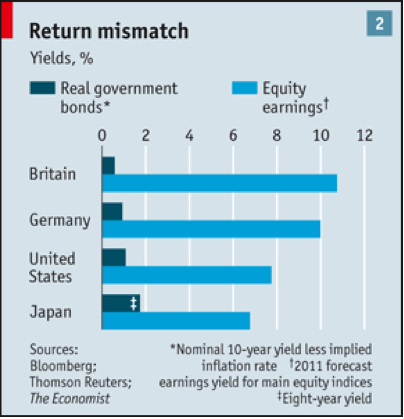
…..read more HERE
This won’t sit well with some people: Gold isn’t a commodity. There. I’ve said it.
But before you fire off an angry response, hear me out. The facts might change your view of gold’s role in a portfolio.
For a long time, we’ve all heard that gold is a commodity—no different, really, from silver or wheat or pork bellies. Its price ebbs and flows (supposedly) with inflation, which historically drives commodity prices.
Odd, then, that gold’s elevated price hasn’t fallen in response to tepid U.S. inflation numbers. The Consumer Price Index as of July pegged inflation at just 1.2% for the previous 12 months, not counting seasonal adjustments. Nor has gold reacted to what , Pimco’s chief executive, recently called “the road to deflation” on which he sees the U.S. traveling.
The conventional wisdom holds that neither of those scenarios—low inflation or deflation—should be good for gold. And yet it refuses to abandon record highs in the $1,200-an-ounce range. Something seems amiss.
I recently asked research firm Ibbotson Associates to run a correlation study to determine how closely inflation and gold-price movements track each other. You would expect gold, as a purported commodity, and inflation to move in tandem.
The data, going back to 1978 and capturing an inflationary spike, shows a correlation of, at most, 0.08.
That is low. Really low. Perfect correlation is 1; at minus-1, two assets move in perfect opposition. Near 0 implies gold and inflation barely acknowledge one another, and moves in unison are largely happenstance.
So if inflation doesn’t push and pull at gold prices, what might it be? If you believe correlation studies, the answer is the U.S. dollar.
Going back to 1973—a period that defines the modern, non-gold-backed dollar—the greenback’s movements closely track gold’s direction. The correlation between month-end gold prices and the Major Currencies Dollar Index, as reported by the Federal Reserve, is minus-0.45.
That clearly is a stronger correlation than you find with inflation. But let’s take this a bit further. Let’s shorten the time frame to the period from gold’s 1980 peak to today.
The result: Over the past 30 years, the correlation between the dollar and gold is minus-0.65—a high negative correlation. It means the dollar and gold are effectively on opposite ends of a seesaw. When the dollar is in favor, gold retreats. When it is under pressure, gold prices swell.
Look at the nearby chart. It is like a photo of a mountain scene reflected in a tranquil lake. The rises and falls and horizontal meanderings of gold are nearly the negative of the dollar’s.
The implication is that gold isn’t a commodity—at least not one that hews to the definition of something that people and industry consume.
Instead, “gold is a currency” whose daily price is a gauge of the market’s concern about the “potential diminishment” of the purchasing power of the dollar and other paper currencies, says , a principal at New York’s QB Asset Management.

If he is correct, it is the potential longer-term weakening of the dollar that is the real issue for the gold market, not inflation or deflation.
Some will note rightly that gold’s record spike came amid the last great inflation surge. Those folks might be misreading the tea leaves.
Gold’s four-year rally beginning in summer 1976 happened amid a four-year dollar decline. When the dollar bucked up at the end of 1980, gold prices retreated. Inflation was more of a sideshow than a driving force.
The question, with gold hanging around the $1,200 level, isn’t “Is gold in a bubble?” as so many are asking. It’s “What next for the dollar?”
Since its separation from gold, the dollar has been in a long downtrend, punctuated by periodic strength. The Fed’s Major Currencies Dollar Index is down 27% since 1973, and down 45% since the dollar’s peak in early 1985.
For investors convinced U.S. lawmakers and central bankers will successfully manage the budgetary woes and the massive unfunded liabilities of Social Security and Medicare, then gold is overvalued in the long term. Righting America’s national balance sheet would explicitly raise the dollar’s value as investors with money abroad move assets into a more-sound American economy. The selling of euro, yen and pounds would push the dollar higher—and gold lower.
If, however, you worry the U.S. balance sheet is irreparably damaged, then gold currently reflects the likelihood that a weak-dollar trend still has years to run as the U.S. struggles with its financial mess. Investors—and consumers—looking to preserve their purchasing power will gravitate toward gold, since its quantity isn’t easily manipulated.
Invest in gold, then, according your beliefs about the future of the greenback. Just don’t invest based on the idea that gold is a proxy for inflation. You are likely to be played for a fool.
Write to Jeff D. Opdyke at jeff.opdyke@wsj.com
….read the Wall Street Journal Article HERE
Quotable
“We live immersed in narrative, recounting and reassessing the meaning of our past actions, anticipating the outcome of our future projects, situating ourselves at the intersection of several stories not yet completed.” – Peter Brooks
FX Trading – Our negativity (scenario #1) in a nutshell, via feedback loops
Feedback Loops: Central to a full understanding of dissipative systems, and especially those in symbiotic relationships, is the concept of system feedback (Stear, 1987). Complex systems with feedback loops that allow for self-renewal are called autopoietic structures. One example of a simple, self-organizing system is a whirlpool. Another example is the red spot on the planet Jupiter. Other systems, such as the human body, can be extremely complex (Briggs and Peat, 1989).
Our rising dollar forecast is based on a very negative view of the future based on what we believe are logical feedback loops, which in turn could trigger a nasty downward self- reinforcing spiral:
1) US Consumer: Real, or perceived, threat of double-dip recession thanks to private deleveraging, thanks to lack of opportunities to create wealth in the private sector in large swaths of the world’s economy, because of government denying the market process, leading to wealth destruction, leading to private deleveraging…
2) China Disappointment: Self-reinforcing downward sentiment, from #1 above, pushing stocks lower (everywhere), thus endangering what remains of real collateral values in large degree dependent on Chinese growth which is in large part dependent upon US consumer leveraging; a tight and potentially nasty feedback loop that could pull in another self-reinforcing element—trade tensions (see Michael Pettis commentary in the Financial Times today).
3) German Disappointment: Rising systemic risk within the eurozone, driven by the realization Germany’s export game cannot continue on track without someone out there to take them, reinforces the negative impact of severe domestic adjustment across the PIIGS, which in turn likely triggers sovereign default and emerging market contagion, transmitted by the European banking system doing all it can by draining outstanding loan credit to shore up balance sheets.
4) Thus, private deleveraging globally completely overwhelms government so- called stimulus programs.
Evidence:
1) US consumer credit falling
2) Monetary velocity in the tank
3) Desperation of QE2
4) Yield spreads in the eurozone rising
5) Chinese growth slowing
6) Japan deflation worsening
Upshot:
1) Stocks break big
2) Dollar rallies big
3) Commodities get hit big
4) Gold rallies on risk
5) Bonds, incredibly to some analyst, move higher in price as yields sink further
This is not a pretty picture. Thank goodness we have proved in the past we can be very wrong. That is why scenario #2 is in our hip pocket.
Jack Crooks
Black Swan Capital LLC
www.blackswantrading.com
CONSENSUS PLAYING CATCH-UP (TO US!)
We’re not sure whether to be happy or sad over the fact that some of our long- standing views — once viewed as controversial — are now making the headlines in the popular press. Do we rejoice over the acceptance, or do we start to fade the trade?
Frugality has been a key theme of ours, and now we see How to Be Frugal and Still Be Asked on Dates on page B1 of the Saturday NYT.
Gold as a currency play as opposed to being strictly a commodity — have a look at Rethinking Gold: What If It Isn’t a Commodity After All on page B7 of the weekend WSJ.
Housing is now a ball and chain to the baby boomer population as opposed to a viable retirement asset has been a critical theme of ours for the past several years. Sure enough, what do we see on the front page of today’s NYT? A column supporting this view titled Your Home as Sure Nest Egg? That Era is Over, Analysts Say.
Finally, this deliberate asset-allocation shift out of equities and into bonds by the general public (as opposed to being a classic “contrarian” move) — see In Striking Shift, Investors Flee Stock Market on the front page of the Sunday NYT.
Also In this issue of Breakfast with Dave – read it all HERE
• While you were sleeping: sparse economic data releases today, but PMI indices in Euroland softened; there are now 118 failed banks in the U.S.
• It’s earnings estimates that matter most
• U.S. economy is contracting: the growth rate in the ECRI leading index has now been -10% or worst in the past five weeks
• Is it Japan all over again?
• In the U.S., demographics still matter
• No bubble in bonds
…..read it all HERE
-
I know Mike is a very solid investor and respect his opinions very much. So if he says pay attention to this or that - I will.
~ Dale G.
-
I've started managing my own investments so view Michael's site as a one-stop shop from which to get information and perspectives.
~ Dave E.
-
Michael offers easy reading, honest, common sense information that anyone can use in a practical manner.
~ der_al.
-
A sane voice in a scrambled investment world.
~ Ed R.
Inside Edge Pro Contributors

Greg Weldon

Josef Schachter

Tyler Bollhorn

Ryan Irvine

Paul Beattie

Martin Straith

Patrick Ceresna

Mark Leibovit

James Thorne

Victor Adair