
Daily Updates
(Ed Note: the 8 Rules are below)
Fund manager Stephen Jarislowsky is something of a conservative investor. So much so that the octogenarian is known in the markets as a Canadian Warren Buffett.
Still, while his strategy may look unadventurous – he’s still got shares tucked away that he bought as a student in the 1940s – few can quibble with his results: he has more than C$52bn (£25bn) under his management, is comfortably a billionaire in his own right and, within Canada, is a legend.
His book Investment Zoo– a mish-mash of autobiography, advice, and some frankly eccentric views on international policy – recently knocked The Da Vinci Code off the bestseller lists.
“Smart as Hell”
Together with partner Scott Fraser, he founded Montreal-based Jarislowsky Fraser. It didn’t take long for the firm to establish itself as “a Canadian investing legend”, says the National Post, with Jarislowsky soon renowned for being “aggressive and smart as hell” with his characteristic value-seeking style. That description stands today, says the Montreal Gazatte. But now it also comes with “feisty”, “irascible” and “caricature of a wealthy curmudgeon”.
Playing a long game
“If my kids hang on to the portfolio, and it doubles every seven, eight years, there’ll be more money than Warren Buffett has.
Stephen Jarislowsky’s eight rules of investing
1. Your best bet for building wealth over the long term is to build a portfolio of high-quality large-company stocks that have great management and a track record of doubling earnings every five to seven years – preferably in non-cyclical businesses.
2. Choose stocks over alternatives such as property (cyclical) and bonds (lower returns over the long haul) and be wary of alternative investments, such as gold and art.
3. Start as early as you can and select and hold these companies for the long term. Do not trade unless you have clearly made a mistake. Trading only adds dealing costs and possibly triggers a tax charge too. Be a long-term investor, not a gambler, and keep costs to a minimum.
4. Shares produce an average real return of 5% to 6% a year (after inflation). The earlier that you can start, the more miraculous will be the effects of compounding over a working life.
5. Put your plan in place and do not waver in the face of short-term market fluctuations. You do not own the market, only those companies in which you are invested.
6. Look at market bubbles as an occasional opportunity to take profits and market slumps as an opportunity to top up your holdings with cheap purchases.
7. Do not be swayed from your plan by smooth-talking financial advisers or stock brokers. Beware mutual funds (or their UK equivalent, unit trusts and Oeics) because of their high charges and often pedestrian performance.
8. Keep yourself informed on the companies in which you invest. Make a point of reading your companies’ reports and accounts.
What’s got the Pentagon so worried?
With more than 97% of the world’s rare earth metals produced in China, its recent announcement of a 72% reduction in exports could screw the US military…
The Pentagon is scrambling for alternatives, but they don’t really have time to scramble.
Rare earth resource demand must be met.
Without these metals, technological advancements are history. The world in which we have become accustomed to living in and the way in which we work, communicate, and progress will change drastically.
And not just for the military…
….read more HERE
Strategic Metals: An Introduction
What Are Strategic Metals?
Some time back in the last quarter of the 20th century, strategic metals came to be defined generally as metals vital to modern technology and industry, but that have sources susceptible to disruption. In other words, they are metals you really need, but someone else has.
Strategic metals are distinct from “precious” metals, like silver and gold, because most are not as vital to either technology and industry in the same way. Likewise, they differ from “base” metals, such as copper, lead, iron and zinc, in that those metals are relatively abundant in locations around the world.
While some strategic metals like chromium, manganese or tungsten are produced on a relatively large scale, many others are produced in extraordinarily small quantities. For example, only an estimated 140 tonnes of germanium was produced in 2010, while only an estimated 10 tonnes of thallium, a highly toxic element, was produced.
A large number of strategic metals are actually byproducts from base metal refining—some are even byproducts of byproducts!
Which Metals Are Strategic?
Sounding somewhat like the lyrics from Harvard mathematician Tom Lehrer’s song “The Elements,” the strategic metals are usually considered to include:

*Platinum group metals (PGM), a group that also includes platinum (Pt) and palladium (Pd).
‡Rare Earth Metals: Usually taken to include the so-called lanthanides, which include lanthanum (La), cerium (Ce), praseodymium (Pr), neodymium (Nd), promethium (Pm), samarium (Sm), europium, (Eu), gadolinium (Gd), terbium (Tb), dysprosium (Dy), holmium (Ho), erbium (Er), thulium (Tm), ytterbium (Yb) and lutetium (Lu), scandium (Sc) and yttrium (Y).

Source: http://www.periodni.com/ (For a larger view, please click on the image above.)
Some names may seem familiar, while others, not so much. Maybe you’ve only heard of, say, indium or selenium in the context of various “boiler room” scams run out of Canada, or even California, Nevada or Texas.
But don’t worry, you’re not alone! It appears that, despite their importance, even the U.S. Department of Defense doesn’t have a good handle on strategic metals either.
…..read page 2 HERE
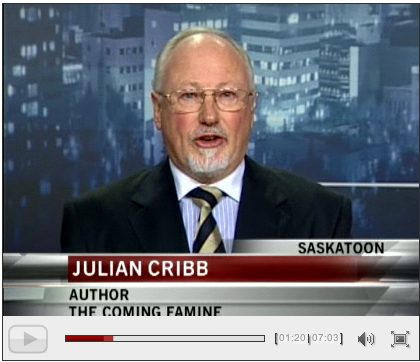
A look at the global food crisis with Julian Cribb, author, “The Coming Famine: The Global Food Crisis and What We Can Do To Avoid It.
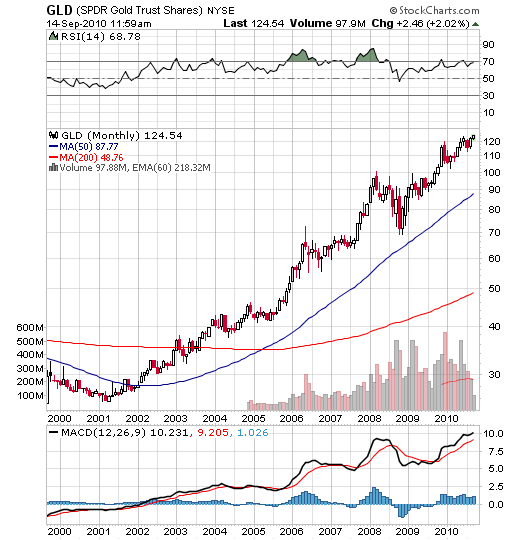
Gold, as I write, was at a new record high.
I show below a monthly chart of gold going back to 1999. What we see here is one of the greatest, least loved, and least recognized primary bull markets in history. Since 2001 I have been cajoling, pressuring, begging, insisting, that my subscribers take positions in gold. I have no idea how many of my beloved subscribers have taken my advice, but judging from that fact that I still have 10,000 subscribers (near my best) I’m guessing that I still have a load of loyal (or at least interested) subscribers. Comment by Richard Russell – Dow Theory Letters
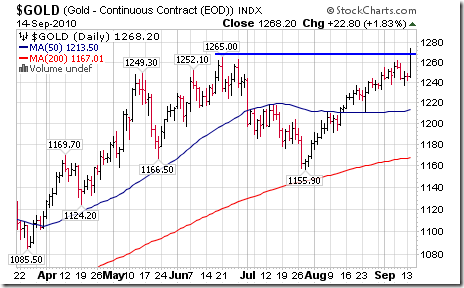
Following Charts and Comment by Don Vialoux of Timing the Market. Go HERE for full Report.
The move by gold to an all time high yesterday is drawing attention to possible takovers of small and medium sized producers by larger producers.
Anglogold Ashanti plans to raise $1.37 billion in order to eliminate its gold hedge position, another vote of confidence that gold is expected to move higher.
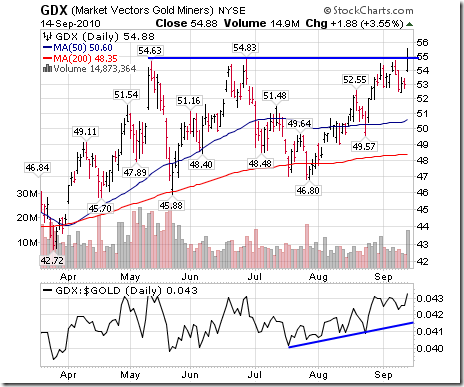
Gold broke to an all time high on a move above $1265.00. Upside potential for this move is to $1,384 U.S. per ounce.
Gold and silver stocks and related ETFs also broke to new highs. They continue to show positive strength relative to gold, a positive technical sign for both.
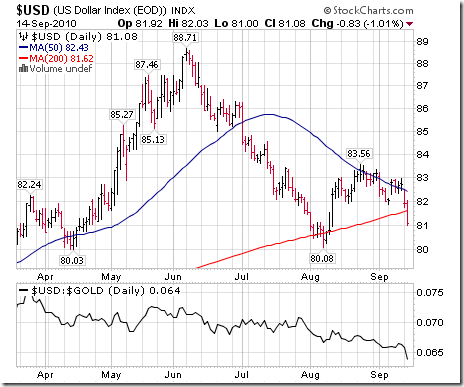
Weakness in the U.S. Dollar helped gold and gold stocks. The U.S. Dollar broke below its 200 day moving average yesterday, a level that previously offered support
Gold Market Update
15 September 2010 @ 03:07 am BST
Gold broke a new record yesterday as USD slumped amid speculations that the Fed will implement a more aggressive QE program by the end of the year. Comex futures of the yellow metal rallied to as high as 1276.5 before settling at 1271.1, up +1.97%. Others in the precious metal complex also jumped with silver, platinum and palladium gaining +1.39%, +2.87% and +3.29% respectively at close.
Speculations that the Fed will embark a new round of quantitative easing measures were rigorous after Goldman Sachs said that the central bank will purchase US Treasury securities cumulating to $1 trillion or more in late 2010 or early 2011. The investment bank believes an announcement in November is possible. Goldman however added that the impact on economy would be limited, probably boosting real GDP growth by a little under +0.5% per $1 trillion in purchases.
…..read more HERE
Stockscores.com Perspectives for the week ending September 11, 2010
One Liners
In this week’s issue:
Weekly Commentary
Strategy of the Week
Stocks That Meet The Featured Strategy

This may be a short commentary for the newsletter but I think it will have a lot of value for all traders. Print it out and read it often.
1. Buying a weak stock is like betting on a slow horse. It is foolish.
2. Stocks are only cheap if they are going higher after you buy them.
3. Never trust a person more than the market. People lie, the market does not.
4. Controlling losers is a must; let your winners run out of control.
5. Simplicity in trading demonstrates wisdom. Complexity is the sign of inexperience.
6. Have loyalty to your family, your dog, your team. Have no loyalty to your stocks.
7. Emotional traders want to give the disciplined their money.
8. Trends have counter trends to shake the weak hands out of the market.
9. The market is usually efficient and cannot be beat. Exploit inefficiencies.
10. To beat the market, you must have an edge.
11. Being wrong is a necessary part of trading profitably. Admit when you are wrong.
12. If you do what everyone is doing you will be average, so goes the definition.
13. Information is only valuable if no one knows about it.
(continued below)
- Get the StockSchool Pro Free

Open and Fund a brokerage account with DisnatDirect and receive the StockSchool Pro home study course free, including special Pro level access through the DisnatDirect client website. Offer only available to Canadian residents. For information, click HERE
14. Lower your risk till you sleep like a baby.
15. There is always a reason why stocks go up or down, we usually only learn the reason when it is too late.
16. Trades that make a lot of intellectual sense are likely to be losers.
17. You do not have to be right more than you are wrong to make money in the market.
18. Don’t worry about the trades that you miss, there will always be another.
19. Fear is more powerful than greed and so down trends are sharper than up trends.
20. Analyze the people, not the stock.
21. Trading is a dictators game; you cannot trade by committee.
22. The best traders are the ones who do not care about the money.
23. Do not think you are smarter than the market, you are not.
24. For most traders, profits are short term loans from the market.
25. The stock market cannot be predicted, we can only play the probabilities.
26. The farther price is from a linear trend, the more likely it is to correct.
27. Learn from your losses, you paid for them.
28. The market is cruel, it gives the test first and the lesson afterward.
29. Trading is simple but it is not easy.
30. The easiest time to make money is when there is a trend.

There are a lot of preset strategies built in to the Stockscores Market Scan tool that I use daily to find trading opportunities. Stockscores Simple, Bottom Fishing, Abnormal Activity Up and Abnormal Activity Down are my favorites for finding position trades. These are all included with an Advanced membership.
Here are a couple of stocks that I uncovered recently using some of the scans.

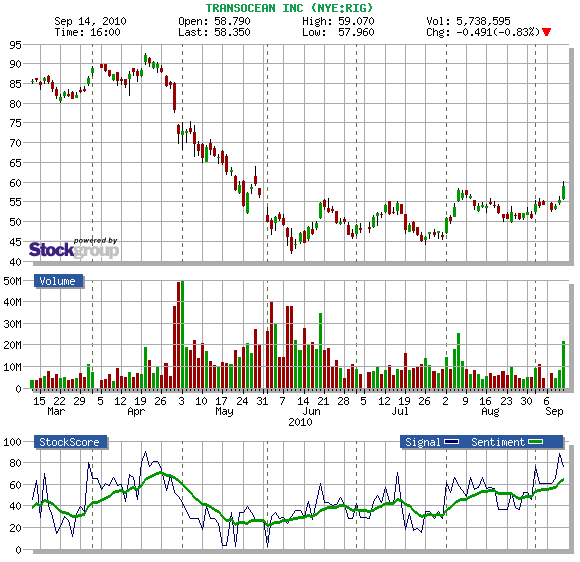
1. RIG
I found RIG using the Bottom Fishing Scan, it has been bottoming for three months and building rising bottoms, a sign of optimism. On Friday, the stock broke through resistance and the stock traded higher volume than normal. It looks like the stock may start to recover back some of its lost value from the BP oil spill. Support at $52.50.
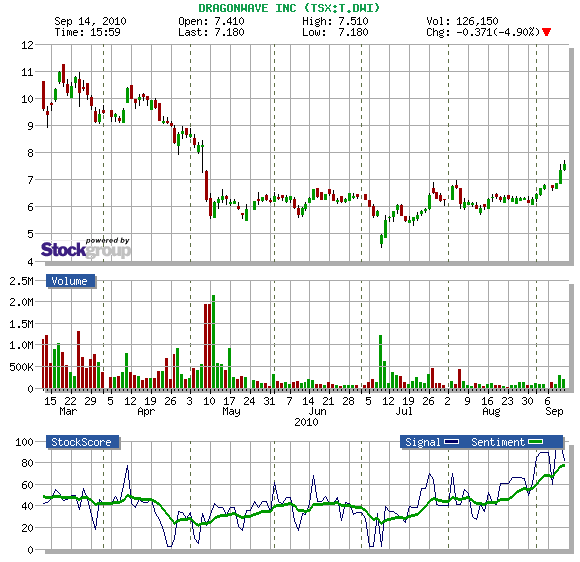
2. T.DWI
I featured this stock in the daily edition of the newsletter on Thursday at $7.19 with a real time alert. The stock has risen since but I think the chart still has enough potential to warrant consideration here. Support at $6.60. This stock also trades in the US with the symbol DRWI.
References
Get the Stockscore on any of over 20,000 North American stocks.
Background on the theories used by Stockscores.
Strategies that can help you find new opportunities.
Scan the market using extensive filter criteria.
Build a portfolio of stocks and view a slide show of their charts.
See which sectors are leading the market, and their components.
Click HERE for the Speaker Lineup and to Purchase the video if you want to learn from some of the worlds best traders including Tyler Bollhorn.

Tyler Bollhorn started trading the stock market with $3,000 in capital, some borrowed from his credit card, when he was just 19 years old. As he worked through the Business program at the University of Calgary, he constantly followed the market and traded stocks. Upon graduation, he could not shake his addiction to the market, and so he continued to trade and study the market by day, while working as a DJ at night. From his 600 square foot basement suite that he shared with his brother, Mr. Bollhorn pursued his dream of making his living buying and selling stocks.
Slowly, he began to learn how the market works, and more importantly, how to consistently make money from it. He realized that the stock market is not fair, and that a small group of people make most of the money while the general public suffers. Eventually, he found some of the key ingredients to success, and turned $30,000 in to half a million dollars in only 3 months. His career as a stock trader had finally flourished.
Much of Mr Bollhorn’s work was pioneering, so he had to create his own tools to identify opportunities. With a vision of making the research process simpler and more effective, he created the Stockscores Approach to trading, and partnered with Stockgroup in the creation of the Stockscores.com web site. He found that he enjoyed teaching others how the market works almost as much as trading it, and he has since taught hundreds of traders how to apply the Stockscores Approach to the market.
Disclaimer
This is not an investment advisory, and should not be used to make investment decisions. Information in Stockscores Perspectives is often opinionated and should be considered for information purposes only. No stock exchange anywhere has approved or disapproved of the information contained herein. There is no express or implied solicitation to buy or sell securities. The writers and editors of Perspectives may have positions in the stocks discussed above and may trade in the stocks mentioned. Don’t consider buying or selling any stock without conducting your own due diligence.
-
I know Mike is a very solid investor and respect his opinions very much. So if he says pay attention to this or that - I will.
~ Dale G.
-
I've started managing my own investments so view Michael's site as a one-stop shop from which to get information and perspectives.
~ Dave E.
-
Michael offers easy reading, honest, common sense information that anyone can use in a practical manner.
~ der_al.
-
A sane voice in a scrambled investment world.
~ Ed R.
Inside Edge Pro Contributors

Greg Weldon

Josef Schachter

Tyler Bollhorn

Ryan Irvine

Paul Beattie

Martin Straith

Patrick Ceresna

Mark Leibovit

James Thorne

Victor Adair