
Daily Updates
Sssooo much to talk about…(it’s reporting season)
First, the portfolio purchases. I have purchased token positions in two small juniors who are involved in the Canadian side of the Alberta Bakken play – 15,000 shares of Bowood Energy (BWD-TSXv) at 43 cents and 2000 shares of DeeThree (DTX-TSXv) at $3.70. I will now start to do research on these companies. I don’t know much about them, but in this very bullish and frothy market I sometimes shoot first and ask questions later. Primary will remain my largest position by far in this play – I just find I pay more attention to these stocks if I own them. All 3 of these stocks will be mentioned in Friday’s public blog story on the Alberta Bakken.
I also bought another 10,000 shares of Torquay (TOC.A-TSXv) on this $1.30 financing announced today. Management has been slow to tell the market what’s going on at Alma Lake, which tells me–not much. They are chasing the Bakken formation there. Most of their production is coming from their 1 section of Viewfield, the core area of the Canadian Bakken, which the two new gentlemen from Petrobakken sold them. But that is the most prudent way to build this company–build up production in an area that’s a “gimme”and then branch out into the more risky, but large upside area – Alma Lake, where they have about 53 net sections.
Truthfully, the reason I’m buying this financing is because Pat Ward’s Painted Pony (PPY.A-TSX), another OGIB portfolio stock, announced its first well at Flat Lake which is in the same area as Torquay’s Alma Lake down at the North Dakota border. The well tested 208 bopd for the 24 hours of Day 6 of a flow rate test. So that border area is prospective, productive, and I have the confidence in the new Petrobakken guys at at Torquay to figure out the completion puzzle. This means the oil is there in economic quantity, and they just need to figure out the best way to frack it to get it out. My suspicion is that this will remain a patient, illiquid story for several more months. But I see it as a quick take out by someone like nearby Enerplus if Alma Lake works out.
BTW, Painted Pony is one of my favourite NATURAL GAS stocks because of its Montney land position and the Buckinghorse Shale.
Energy service stocks are on fire – two reported great Q3 numbers yesterday, including OGIB portfolio stock Canadian Energy Services (CEU-TSX; $24.10 today). CEU’s primary business is selling technologically advanced drilling mud (please read the initial write up at the Members Centre; Bulletin #20 dated April 28 2010 – because this company is still a great investment IMHO). Revenue was up to $78 million vs 19.2 million in Q3 last year – a 308% increase! That was due to the two accretive acquisitions in the US this year and the fact that industry drilling has increased dramatically over 2009.
I try to keep my thinking on my investments very simple. This company is clearly growing quickly, and as long as gross margin is still there in the business, I’m happy. It was 29% this Q3 vs last year’s 32% – I’m not nervous until it’s under 25%. The US acquisitions were accretive to begin with, and management has indicated they have been able to leverage their product line across all these new customers. US market share jumped from under 2% to over 5%.
They increased their dividend for the second time since I originally bought the stock, and it’s now 10 cents a month vs 6 cents a month when I purchased it – a 66.66% increase in dividend!
GasFrac (GFS-TSX) reports its next set of financials at the market close today, with a conference call tomorrow morning. Unless I see something that I think will move the stock price, then I will wait until the call is over before issuing any of my thoughts. The stock has told me that management has grown the business very well, and is likely meeting their milestones.
As a side note, when I talk to management at the producing oil companies, they all say how tight the services sector is; lead times for a frac is now 4-6 months, and prices are moving up. So as much as these stocks have already run, they are going to keep running – especially those with a technological edge like the two I have.
Xcite Energy (XEL-TSXv) had a spike to $4 a share last week, and I sold 10,000 shares at $3.92 on Friday while I was at the Montreal Investment Conference. The good news behind the Friday share spike came out yesterday, Monday (ahem), as Xcite announced they had encountered the oil formation 18 feet higher than expected, which makes for a larger oil column, and they successfully directed the well along the top of the formation. The market has supported this team and stock beyond my wildest hopes. The fact the stock is today still holding the gains from its gap up tells me the stock could still go higher…but we will need a couple more days to confirm this. While none of this changes the timeline for production, it does mean that, potentially, the amount of oil that could be included in a P1 and P2 reserves could be more than anticipated.
This is where an independent reservoir engineering company goes in and says ok, given the characteristics of what I see from the well, and seismic, then our best guess as to how much oil is there (P1=90% likelihood; 2P=50%) is this many barrels of oil. And a very rough general rule of thumb is a $12-$18 valuation per barrel – or higher. I always have in the back of my mind that this junior exploration company now has a market cap of over $600 million with no production for a year possibly and we are now in a very juiced junior oil market courtesy of QE2, the American quantitative easing program.
Petrobakken (PBN-TSX) announced its Q3 results, with production of 40,000 bopd below street expectations and they also announced their first Cardium results – which were not bad–they were horrible – just over 100 bopd IP (Initial Production) for many of their Cardium wells. Yet the stock has not dropped off dramatically, which tells me management had guided the street’s expectations for these results.
Also dragging on the stock is the parent company’s (Petrobank; PBG-TSX) decision to sell off its position in Petrominerales (PMG-TSX, and a big win for OGIB subscribers – I bought at $11 and sold out the final half of my position at the very top, $33/share). They will likely do this with PBN now as well, so I see the stock staying low until there is some clarity from management on this issue.
Peyto Exploration (PEY.UN-TSX) also announced their Q3 numbers. Production per share up 41% year over year (YoY). Year end 2010 production (the ëxit rate”) guidance was raised to 30,000 boe/d. Lower royalties in Alberta allowed them to beat the street’s cash flow numbers at 48 cents a share for the quarter. The company lowered costs from $6.35 a boe (barrel of oil equivalent) to $5.90 and they still have the highest netback (profit per barrel) of any gas weighted producer I can find in Canada. The stock has been on a tear recently as natural gas prices have moved up. As the lowest cost intermediate producer on the TSX, I think it is the BEST call on rising natural gas prices.
On a final note, it’s easy to be a disciplined investor in a down or lacklustre market. You are just naturally attuned to looking for the best deal. In a market like this, where I get two emails a day asking me to participate in a new junior oil financing, it’s harder. You’re making money, every story sounds good…but this is where being diligent is key.
Subscribers, thank you for your support and keep the feedback coming!
Subscribe to Keith’s Service HERE
Hello, this is Keith Schaefer, editor and publisher of The Oil & Gas Investments Bulletin. I started my subscription service in mid-2009 because I could see there was no place where retail investors could go to easily find which oil and gas companies were creating huge shareholder wealth by using exciting new technologies, such as horizontal drilling, fracing and 3D seismic.
These companies are increasing cash flows – and stock prices – by finding ways to get more oil and gas out of the ground. And junior and intermediate producers – $2-$20 stocks – are leading the way.
I find the leaders in the new plays that are using these technologies. My research is finding higher and higher flow rates from new wells in old formations as management teams fine tune their use of these new technologies.
It’s amazing how technology is lowering operating costs – and increasing profits – for many publicly traded energy companies.
I find the ones who have the capital and the knowledge to be the fastest growing in their area – this usually means they have a large undeveloped land position in an area where either production costs are very low or production rates can be very high. They are covered by several research analysts, so there is research support and institutional money flow behind them.
And my subscribers and myself are making money from my research. I eat my own cooking and buy all the stocks I research for subscribers.
I read MANY research reports, and I do a lot of original research – call management teams, talking to my contacts in the oil patch, scour company financials – to find the companies with the best chance to provide investor profits.
But these reports also give me many great story ideas for the blog, that haven’t hit the mainstream media yet. That’s why you should sign up at the blog to get notified of new stories.
I write the blog and the subscription service so everyone can understand the story. I keep it simple.
Subscribers get a minimum 10 issues a year, and there is often more than one stock presented.
The Oil and Gas Investments Bulletin is a completely independent service, written to build subscriber loyalty. No company ever pays in any way to be profiled.
I am so confident you will find value in my service I offer a 60 day, money back guarantee, no questions asked, for annual subscription purchases. Please read the sample report I have posted on the website to get an idea of how I profile these fast growing stocks.
Email me with any questions at editor@oilandgas-investments.com
Keith Schaefer
Publisher
Record Gold & Silver Prices, Traffic and 3 Gold Stocks: Gold Resource, Timberline Resources and Nevada Sunrise Gold
Are we now entering the hyperinflationary stage? It is estimated that in 2011 alone, the TOP 15 developed countries (US, Japan, UK, Spain, Greece, etc) will need to raise some $10,200,000,000,000 ($10.2 trillion!) to finance their growing debts. That is 27% of their combined economic output. Not 2.7% but 27%! The consequences will be felt through further monetary devaluations. In essence a big part of the overhanging debt burden is being paid off through an inflation tax for paper currency holders. How much longer will $ or € holders go without having real monetary insurance and protection against this inflation?
Plus:
Gold Resource Corp. – Ultra Low Cost Producer, Soon to be the highest dividend paying gold stock?
Timberline (Gold) Resources Corp. – 2011 Gold Producer; Vertically Integrated Mining Company
Nevada Sunrise Gold Corp. – Nevada’s Next Big Gold Discovery? Drill Results Soon
….read ful story HERE
Hey… What’s wrong with the foreigners? They don’t seem to appreciate America’s magic tricks.
“US feels backlash over Fed initiative” says Friday’s Financial Times.
It may be our dollar…but it’s THEIR problem. The Fed’s new money doesn’t really do anything for the US economy. The banks take it. They hold it. If it goes anywhere at all it goes into the hedge funds and the banks’ own trading departments. Then, what are they going to do with it? US businesses don’t want to borrow. Consumers are reluctant to spend. Who wants to build a new shopping mall? Who wants to hire a new employee? The Fed is printing money like there was no tomorrow…who’s going to invest for the long term…when even tomorrow is in doubt?
The speculators borrow dollars at the lowest rates in three generations. What do they do with them? They invest them where they see growth – in the emerging markets.
Bloomberg explains:
Emerging-Market Stocks Advance on “Super-Goldilocks”
Nov. 5 (Bloomberg) – Emerging-market stocks climbed for a seventh day as Citigroup Inc. predicted a “super-Goldilocks” economy will send shares to record highs next year and investor Mark Mobius said the rally faces no risks any time soon.
The MSCI Emerging Markets Index will jump 30 percent to an all-time high in 2011, Citigroup strategist Geoffrey Dennis wrote in a Nov. 4 report. The Federal Reserve’s bond-purchase plan will fuel a global stock rally and emerging markets are the “bright spot,” Mobius, who oversees about $34 billion at Templeton Asset Management Ltd., said in an interview.
The MSCI emerging-markets index increased 0.5 percent to 1,156.32 at 8:50 a.m. in New York, bringing its gain this week to 4.6 percent. The 21-country benchmark gauge has advanced 17 percent this year, extending a record 75 percent rally in 2009.
This is not exactly good news. Consumer prices in these emerging economies go up…their currencies go up…their stock and other asset prices go up.
This has several effects that the emerging economies don’t like. It creates bubble-like conditions, raising their costs and making their products less competitive. Plus, it risks causing sell-offs and crashes when the foreign money leaves suddenly or over-capacity becomes a problem.
“China, Brazil and Germany criticized the Fed’s action,” reports the FT, “and a string of East Asian central banks said they were preparing measures to defend their economies…”
Then…in this morning’s Financial Times:
“Zoellick [head of the World Bank] seeks gold standard debate.”
It’s coming, dear reader…
Bill Bonner
for The Daily Reckoning
Since founding Agora Inc. in 1979, Bill Bonner has found success and garnered camaraderie in numerous communities and industries. A man of many talents, his entrepreneurial savvy, unique writings, philanthropic undertakings, and preservationist activities have all been recognized and awarded by some of America’s most respected authorities. Along with Addison Wiggin, his friend and colleague, Bill has written two New York Times best-selling books, Financial Reckoning Day and Empire of Debt. Both works have been critically acclaimed internationally. With political journalist Lila Rajiva, he wrote his third New York Times best-selling book, Mobs, Messiahs and Markets, which offers concrete advice on how to avoid the public spectacle of modern finance. Since 1999, Bill has been a daily contributor and the driving force behind The Daily Reckoning.
How President Obama Might Have Stoked a Currency War
President Obama faces a choice going into the G-20 meetings starting Thursday in Seoul: He can seek ways to avoid a currency and/or trade war with China…or he can purposely seek one out in a bid to stoke up anti-China fervor and boost his re-election chances.
He may be sincerely seeking the former…but this morning, he appears to be stumbling into the latter.
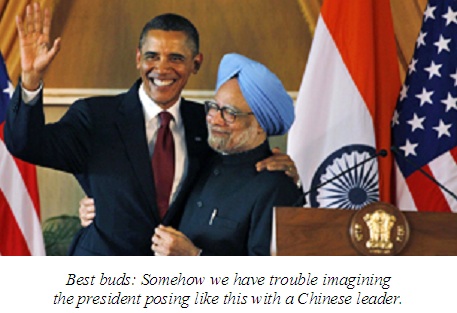
For starters, he stood next to India’s prime minister in New Delhi and declared he supports India getting permanent membership on the UN Security Council.
Of course, that’s guaranteed to anger Pakistan, India’s nuclear-armed archrival, whose support the president needs for his war in Afghanistan. But it’s also guaranteed to anger China – which has had a smoldering border dispute with India for some 50 years.
India has long been freaked out by China’s bases high up in Tibet, looming above India’s plains; decades ago, India’s leader Jawaharlal Nehru complained about it to Mao Zedong’s right-hand man, Chou Enlai.
“If I wanted to destroy India,” Chou was said to reply, “I would march 100 million Chinese to the edge of the Tibetan plateau and order them to piss downhill. We would wash you into the Indian Ocean.”
Old hatreds die hard; is anyone in the White House clued in to this?
Probably not, judging by other developments…
“We can’t continue situations,” declared the president, “where some countries maintain massive [trade] surpluses, other countries have massive deficits and never is there an adjustment with respect to currency that would lead to a more balanced growth pattern.”
So… That sounds as if Obama is going to make a full-court press at G-20 for Tim Geithner’s harebrained scheme to have everyone limit their trade surpluses and deficits to 4% of GDP – the scheme the Chinese dismissed last week as a relic of “planned economies.”
But even as the president spoke those words in New Delhi, Geithner was backing down in Tokyo. At a meeting of Asia-Pacific finance ministers, he said the concept is still sound, but “it’s not something that can reduce easily to a single number.”
Is it too much to ask that these guys get on the same page?
The president also went to bat for the Federal Reserve’s latest round of quantitative easing – in a roundabout way, since in theory the Fed and the White House operate independently. (Nixon-era Fed chief Arthur Burns gave away the game when he once said, “If we exerted our ‘independence,’ we’d certainly lose our independence.”)
“The Fed’s mandate, my mandate, is to grow our economy,” said Obama, “and that’s not just good for the US. That’s good for the world as a whole.”
The Chinese aren’t buying it. “[The US] does not recognize, as a country that issues one of the world’s major reserve currencies, its obligation to stabilize capital markets,” said vice finance minister Zhu Guangyao. Ouch.
Brazil’s president-elect Dilma Rousseff put it even more bluntly late last week: “The last time there was a competitive devaluation of currencies, it ended up where it did, in the second World War.”
Dave Gonigam
Treading a fine line between contrarian thinking and conspiracy theory, Dave Gonigam explores the nexus of finance, politics, and the media for Agora Financial’s 5 Minute Forecast. He joined kindred spirits at Agora Financial in 2007 after a 20-year career as an Emmy award-winning writer, producer, and manager in local TV newsrooms nationwide.
Revealed: You Could Build FIVE GENERATIONS of Wealth! The full power and promise of science’s next decade will create vast fortunes. Wealth opportunities are already piling up. Watch this urgent new presentation for full details on how to start your own wealth. Epic wealth revelations – Right Here
Three of four major events that could influence equity markets have passed and one more event is pending:
- Mid-term U.S. election results revealed on Tuesday evening concluded with a gridlocked Congress as generally expected. Initial reaction by equity markets was minimal.
- The FOMC announced plans for Quantitative Easing II on Wednesday that was slightly more than expected. The market was expecting a cash infusion of $500 billion through Fed purchase of short term Treasuries. Actual was $600 billion to be extended over an eight month period averaging $75 billion per month. Reaction (surprisingly) was minimal immediately after the announcement. U.S. equity indices on Wednesday afternoon recorded slight gains. The fireworks came overnight after the close on Wednesday and most notably on Thursday.
- The October employment report on Friday was better than expected thanks mainly to greater than expected hiring by the non-private sector. Reaction to the report was muted.
What happened on Thursday? Federal Reserve chairman Ben Bernanke’s highly unusual “Op-ed” comment in the Washington Post published Thursday morning was the trigger that caused a buying stampede into equity markets as well as short covering. The U.S. Dollar immediately broke support and commodities priced in U.S. Dollars immediately charged higher. The article defended a decision by the Fed to target asset prices as part of its monetary policy. The market quickly assumed that the Fed’s focus included prices of equities as well as commodity-like assets. U.S. equity and U.S. priced commodities virtually exploded on the upside on Thursday morning. In addition, major U.S. equity indices broke above mid April highs and attracted additional technical buying. Is this a one time event or is it an event that will have a lasting impact on equity markets, commodities and currencies in the weeks ahead? Part of the answer could come this week when the fourth market moving event occurs.
The fourth market moving event occurs this Wednesday when the G20 first ministers’ meeting is held. Focus of the meeting is currency. An attempt will be made to stabilize world currencies including a halt in the fall in the U.S. Dollar and a fairer value for China’s currency. G20 leaders have raised grave concerns about the currency war caused by the U.S. and China. Without an agreement, the possibility of a trade war is high. Recent weakness in the Baltic Dry Index already is an early warning signal and could be the “canary in the coal mine” during the next few weeks. Without an agreement, the U.S. Dollar will move lower and equity markets and commodity prices initially will move higher. However, their gains will quickly evaporate if a trade war is triggered. With an agreement, the U.S. Dollar will recover at least briefly and equity and commodity prices will come under profit taking pressures. However, intermediate and long term implications for equity markets and commodity prices are positive. Colour me skeptical! Look for a “comforting” statement following the meeting that will promise to take steps to stabilize currencies. However, the political will by major countries (notably the U.S. and China) to implement change is not strong. Let’s hope for the best and prepare for the worst.
Year end transactions for tax purposes in the U.S. remain on hold. Timing will depend on the political will by Congress to extend the Bush tax cuts for at least another year. Delays on the decision to extend the cuts will compress the time that investors will have to complete yearend transactions and will create significant volatility in equity markets as year end approaches. Obama mentioned over the weekend that he is willing to negotiate.
Large cash positions held by individuals and corporations remain on the sidelines and are likely to remain there until new policy directions are determined by the new Congress.
The recovery in China is significant and important for the recovery in world equity markets during the next 12 months.
Seasonal influences on world equity markets between now and next May are positive. The current quarter and the first two quarters of next year historically are the strongest three quarters in the U.S. Presidential cycle.
Short term momentum indicators for most markets that were overbought prior to last week became more overbought last week. In most cases, short term momentum indicators have yet to show signs of peaking after last week’s upside move.
The Bottom Line
Use weakness into November as an opportunity to acquire attractive equities and ETFs. Preferred selections are economically sensitive sectors such as China, technology, consumer discretionary, materials, Canadian financial services, lumber and industrials.
….don’t forget to look at Don’s 40+ Charts and analysis HERE
-
I know Mike is a very solid investor and respect his opinions very much. So if he says pay attention to this or that - I will.
~ Dale G.
-
I've started managing my own investments so view Michael's site as a one-stop shop from which to get information and perspectives.
~ Dave E.
-
Michael offers easy reading, honest, common sense information that anyone can use in a practical manner.
~ der_al.
-
A sane voice in a scrambled investment world.
~ Ed R.
Inside Edge Pro Contributors

Greg Weldon

Josef Schachter

Tyler Bollhorn

Ryan Irvine

Paul Beattie

Martin Straith

Patrick Ceresna

Mark Leibovit

James Thorne

Victor Adair