
Daily Updates
Homeowners know the bad news too well: residential real estate values have plummeted more than 25% nationally during the Great Recession, as much as 40-50% in some metro areas.
More from Kiplinger.com
- 10 U.S. Cities With the Lowest Cost of Living
- What $500K Buys You Now
- 10 Best Cities for the Next Decade
The good news? The depressed housing market looks more and more like a giant opportunity for young first-time buyers lucky enough to have stable jobs, investors in rental properties, even empty nesters with enough equity left in their existing homes to downsize.
Here are 10 nice homes for sale in solid urban and suburban neighborhoods with asking prices under $100,000. See if you are as surprised as we were at how far $75,000 goes in some parts of the country. The median home price nationally hovers around $240,000.
….view the startling homes HERE
News of promising drill intercepts, ownership certainty, and positive metallurgical results can each give a project upwards momentum, but Kiska Metals (KSK-V) is currently feeling the lift from all three as it advances its Whistler project in Alaska.
Uranium – Our “Trade of the Decade” Heats Up!
Profit Opportunities Continue
At the start of the year, your California editor dubbed uranium the “Trade of the Decade.”
Uranium may or may not be the Trade of the Decade, but it has been a pretty decent trade of the year. So far in 2010, the uranium price has soared 35% – triple the return of the S&P 500 Index.
The phrase, “Better lucky than good,” comes to mind…and your California editor never hesitates to give Lady Luck her due. But sometimes, good fortune germinates and blossoms from the seeds of timely analysis and insight.
Your financial market observers here at The Daily Reckoning did not simply toss their Trade of the Decade into the hat and walk away; they have continued to detail the bullish case for uranium – and for selected uranium mining companies – month after month.
Early in 2010, for example, Chris Mayer, the mind behind both Capital & Crisis and Mayer’s Special Situations, penned no less than five Daily Reckoning columns advocating investments in uranium. The last of these columns, “Cameco Corp. is a ‘Buy’”, extolled the virtues of North America’s largest uranium miner. The stock has soared to 53% since then.
Taking the baton from Chris in mid-summer, Byron King, editor of Outstanding Investments, sang uranium’s praises in two additional Daily Reckoning columns, while also suggesting specific ways to play the trend. All three of the stocks he recommended in his October 25 column, “More Nukes!”, have jumped spritely during the last two weeks.
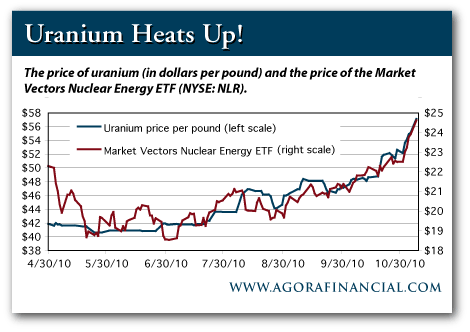
….read much much more and view charts HERE
It’s by far the most frequent question I field: “What should I buy?” In today’s special issue of Dividend Opportunities, I’ll take a look a two picks I like not just for today’s market… but forever.
The numbers have grown so large over the years, it’s hard for me to believe sometimes.
In total, more than 250,000 subscribers receive this Dividend Opportunities newsletter each week. I’m also the Director of Income Research for High-Yield Investing, which boasts over 30,000 readers. With nearly 300,000 investors reading my analysis, you can guess that I am always peppered with questions.
But one question is asked more than any other: “What should I buy?”
It can be a tough one to answer. After all, everyone has different goals for their portfolio. Some want the safest dividends possible. Others want the highest yields they can find. Still others are looking for a combination of growth and yield.
So when I answer, I make it simple on myself. I tell people to buy income stocks they’ll want to own forever.
In my mind, these “hold forever” gems are the safe, reliable securities that increase dividends year after year. The securities you hold forever should come courtesy of businesses so fundamental that demand never falters. For income stocks, this kind of unwavering demand drives reliable dividend growth. Year in and year out, regardless of circumstance, these stocks can power — and even raise — dividends.
This sort of steady demand isn’t a fairy tale. For example, StoneMor Partners LP (Nasdaq: STON) is the nation’s second-largest owner/operator of cemeteries. It operates more than 250 cemeteries and 60-plus funeral homes across the U.S. The company takes one of life’s certainties and channels it into consistent dividend growth.
Since going public six years ago, StoneMor has increased dividends eight times. The latest increase came just last month. StoneMor now pays $2.26 per share annually and yields a generous 7.9% at today’s $28.65 share price.
But along with steady growth, a “hold forever” gem must also have safe dividends. That means dividends are comfortably covered by cash flow. Last year StoneMor produced $35 million in distributable cash flow, but paid only $27 million in dividends. That leaves plenty of room for future dividend hikes.
Truth be told, the graying of our population is a great place to look for long-term holdings. It’s one trend that shows no sign of reversing for decades.
That’s why I am also a fan of Senior Housing Properties Trust (NYSE: SNH). Senior Housing Properties owns independent and assisted-living facilities that cater to seniors. It owns roughly 300 housing sites across the country.
Senior Housing began paying dividends in 2000 and has raised them steadily since then, a few pennies at a time. There has never been a dividend cut, even during the recent recession. The dividend was hiked twice in 2007, again in 2009, and again last month to a $1.48 per unit annualized rate. At this new rate, Senior Housing yields a steady 6.1%.
Distributions are safe since Senior Housing easily covers payments from its funds from operations (FFO). Senior Housing produces roughly $53.5 million in FFO each quarter, which covers $45.9 million paid out as distributions. Moreover, reliable cash flow is ensured by long-term leases on properties and growth comes from built-in rent increases.
Of course, there is no such thing as a perfect investment. Even with long-term holdings you have to be willing to overlook a few blemishes. For instance, Senior Housing Properties relies on one tenant — Five Star Quality Care — for nearly 60% of its income.
At this point, however, I think the benefits of steady demand and reliable dividends outweigh the risks, and it should be that way for a long time.
[Note: An amazing thing happens when you hold income stocks forever — the dividends add so much to your total return that it becomes hard to own a losing position. This is something many of the world’s most successful investors found out long ago. To get you started on the right track, we’ve created a short memo on the subject to supplement this article. Click here to start reading.]
Good Investing!
Carla Pasternak’s Dividend Opportunities
P.S. — Don’t miss a single issue! Add our address, Research@DividendOpportunities.com, to your Address Book or Safe List. For instructions, go here.
The chatter surrounding rare earth metals has reached fever pitch.
But with this once vanilla topic gaining notoriety so quickly, some of you are probably wondering what all the fuss is even about.
Here’s a quick list of things you need to know about the sector — including why it has investors and politicians so worked up.
1. Rare for a reason
First, a definition: Rare earths are a group of 17 elements with properties that make them attractive for use in a variety of modern electronics including cell phones, flat screen TVs, batteries, LEDs, wind turbines, solar panels, and even missile guidance systems.
But unlike coal, oil, and gas, which are produced by a variety of countries, rare earths are hard to find in amounts that are economically viable to extract.
Today, China mines about 95% of the rare earth metals used in industry. And since China is a major manufacturer of both electronics and green technology, it has reduced its export quotas in order to conserve resources for domestic use.
China temporarily cut exports of rare earths to Japan over a diplomatic dispute in September, and most argue it could hold the world hostage with rare earths much the way OPEC does with oil.
If China — which has a 95% lock on control — stops exporting, where will the world get the rare earths it needs to make its smart phones, Priuses, hi-def TVs, and laptops?
That’s exactly the question that has investors, politicians, and the price of rare earths in a tizzy.
2. The new oil?
With 95% of global production, the Chinese are to rare earths what the Saudis are to oil. And this is making some very powerful people and governments very worried.
Secretary of State Hillary Clinton, for example, is currently holding high-level talks with Australia about “China’s monopoly over minerals used in military systems.”
According to Bloomberg, Clinton said the prospect of a future slowdown “raised questions” in many nations about whether it is “wise to be dependent on a single source for elements that are critical to the most advanced civilian and military technology.”
There’s a witty “oil by any other name” quip in here somewhere.
3. New supply better than gold
Here’s the third point you need to know about rare earths: New supply could literally be worth its weight in gold — or better.
You see, there are only two rare earth mines outside of China: one in the United States and one in Australia.
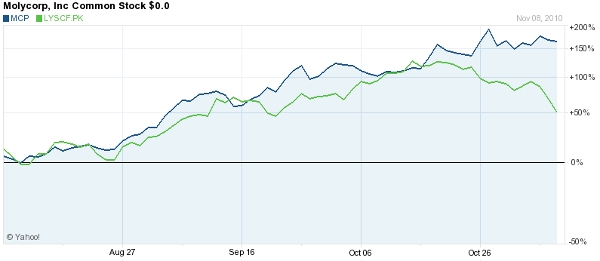
One is owned by Molycorp Minerals (NYSE: MCP), which IPOed earlier this year; the other by Lynas (PK: LYSCF).
So what do you think the only two rare earth mines outside of China are worth, now that China is limiting supply?
Well, it looks like anywhere from two to three times your money in just three months:
Now, with new rare earth supply so valuable, you can bet other companies are looking to start up production…
And we’ve found one with a lock on 500 square miles of some of the best rare earth mines outside of the Middle Kingdom.
Here’s the thing… Hardly anyone knows about the stock because production hasn’t yet begun.
Which means you can own the next rare earth runner before the masses know about it — before it starts to run like Molycorp and Lynas.
To learn more about rare earths — and this tiny company about to bring on valuable new supply — take a few minutes to watch our new investment presentation.
You’ll learn more about rare earths and why they’re in for a sustained bull run…
As well as how you can get in on a $1.50 company before it even brings an ounce of metal out of the ground.
Call it like you see it,

Nick
…subscribe Free to Energy & Capital (top right side) HERE
also:
Van Eck Launches Rare Earth/Strategic Metals ETF (REMX)
Van Eck Global )Van Eck Global has launched Market Vectors Rare Earth/Strategic
Metals ETF (NYSE Arca: REMX), the first U.S.-listed exchange traded fund (ETF) which seeks to give investors pure play exposure to the equities of companies primarily engaged in the producing, refining, and recycling rare earth/strategic metals, it was announced today.
Rare earth/strategic metals are industrial metals that are typically mined as by-products in operations focused on precious metals and base metals. Compared to base metals, they have more specialized uses and are often more difficult to extract. Currently, approximately 49 elements in the
periodic table are considered rare earth/strategic metals. They include such elements as cerium, manganese, titanium and tungsten. Strategic metals are used in a variety of technologies including jet engines, hybrid cars, steel alloys, wind turbines, flat screen televisions and cellular phones. Rare earth
metals, a subset of strategic metals, are a collection of 17 chemical elements that are essential in many of today’s most advanced technologies, with particular applications in electronics.
REMX seeks to replicate as closely as possible, before fees and expenses, the price and yield performance of the Market Vectors Rare Earth/Strategic Metals Index (ticker MVREMXTR), a rulesbased, modified-capitalization weighted, float adjusted index intended to give investors a means of tracking the overall performance of publicly traded companies primarily engaged in the producing, refining, and recycling of rare earth/strategic metals. To be included in the index, a company must have the capacity to generate more than 50 percent of its revenue from rare earth/strategic metals-focused efforts.
by ETF.com
-
I know Mike is a very solid investor and respect his opinions very much. So if he says pay attention to this or that - I will.
~ Dale G.
-
I've started managing my own investments so view Michael's site as a one-stop shop from which to get information and perspectives.
~ Dave E.
-
Michael offers easy reading, honest, common sense information that anyone can use in a practical manner.
~ der_al.
-
A sane voice in a scrambled investment world.
~ Ed R.
Inside Edge Pro Contributors

Greg Weldon

Josef Schachter

Tyler Bollhorn

Ryan Irvine

Paul Beattie

Martin Straith

Patrick Ceresna

Mark Leibovit

James Thorne

Victor Adair