
Daily Updates
“Open interest in silver on the Tokyo Commodity Exchange. I know I’ve been harping a lot about this, but the chart just keeps marching unbelievably upward.
Over the last two days, open interest jumped another 12%.”
“One possible explanation is increased trading in Japan from foreign players. TOCOM has been extending its night trading sessions and opening access for traders abroad in order to garner more international business.”
…look at the charts including the Declining NY open interest HERE
There Was a Fed Chairman Who Swallowed a Fly
While it’s true that history repeats itself, the patterns should always be separated by a generation or two to keep things respectable. Unfortunately, in today’s economic world, it seems the cycle can be counted in months.
On July 24, 2009, just as the Federal Reserve unleashed its first quantitative easing campaign (now called “QE1” – an echo of the reclassification of the Great War after still more destructive subsequent developments), Fed Chairman Ben Bernanke wrote an opinion piece in the Wall Street Journal to soothe growing concerns about excess liquidity. He assured the public that the Fed had an “exit strategy.”
In a response entitled “No Exit for Ben”, I called the Chairman’s bluff. I argued that the Fed had no exit strategy, and that Bernanke was trying to fool the market into believing that quantitative easing was not debt monetization.
Just 16 months later, Bernanke is at it again, penning another op-ed to defend his second round of QE. Except this time, instead of feigning an exit strategy, he just outlines a path to expand the program in perpetuity.
In recent months, Fed economists have taken great pains to tell us how much better off the economy is now than it was in the first half of 2009. Given this supposed good news, what prompted the current turnaround in policy? Could it be, perhaps, that perpetual easing was the policy all along?
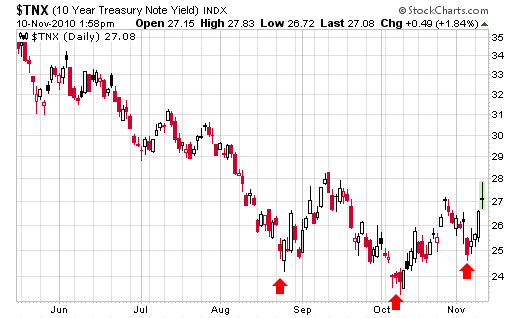
Danger: Rising interest rates. The chart below shows the interest on the bellwether 10 year T-note. I noted a head-and-shoulders bottom on this chart (check out the red arrows). – Richard Russell of Dow Theory Letters
Fed money-printing scheme triggering bond price meltdown!
Since talk of new money-printing first surfaced a few weeks ago, 30-year bond yields have jumped sharply higher — from 3.46% to 4.32%. That’s a 25% surge in borrowing costs!
It’s the biggest interest rate rise in a year — and it’s showing no signs of slowing. Yields surged yesterday after a lousy auction of 10-year Treasury Notes. Then they surged AGAIN today after the sale of $16 billion in 30-year Treasury bonds bombed.
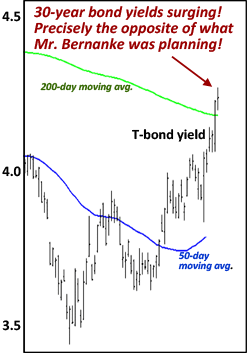
Ironically, this is exactly what Bernanke said would NOT happen:
In fact, the Fed chief’s main excuse for printing $600 billion over the next eight months was that the money was needed to buy up bonds and LOWER long-term interest rates!
But just as we warn in our online presentation, global investors in U.S. bonds are recoiling in horror — and for good reason:
They know that the Fed money-printing will drive the REAL value of their bonds down sharply!
No wonder they’re dumping U.S. bonds, driving the prices lower!
And no wonder they’re demanding higher yields, driving long-term interest rates higher!
Moreover, bonds are just ONE of the five asset classes directly impacted by the Fed’s new money-printing scheme. The others are:
* Currencies. As the Fed drives down the value of the dollar, it drives UP the value of major foreign currencies. Meanwhile, right now — TODAY — the Fed’s money printing plans are wreaking havoc at the G-20 meetings in Seoul, South Korea.
The main problem: Foreign nations are concerned that this massive supply of newly-created dollars will flood into their economies and drive their currencies through the roof!
* Precious metals. Despite a correction that began last night, gold and silver are still in massive, long-term bull markets.
* Agricultural commodities. Since QE2 talk began, commodities have been on a tear. They’re rising even faster than bonds are falling.
* Stocks. QE2 has mixed impacts on the U.S. economy and stocks. But for emerging markets, the combination of strong domestic growth and a rapid influx of U.S. dollars has been extremely positive.
Lots of opportunity!
Best wishes,
Mike Larson
Go to our online presentation how to trade & invest in this environment. This investment news is brought to you by Uncommon Wisdom. Uncommon Wisdom is a free daily investment newsletter from Weiss Research analysts offering the latest investing news and financial insights for the stock market, precious metals, natural resources, Asian and South American markets. From time to time, the authors of Uncommon Wisdom also cover other topics they feel can contribute to making you healthy, wealthy and wise. To view archives or subscribe, visit http://www.uncommonwisdomdaily.com.
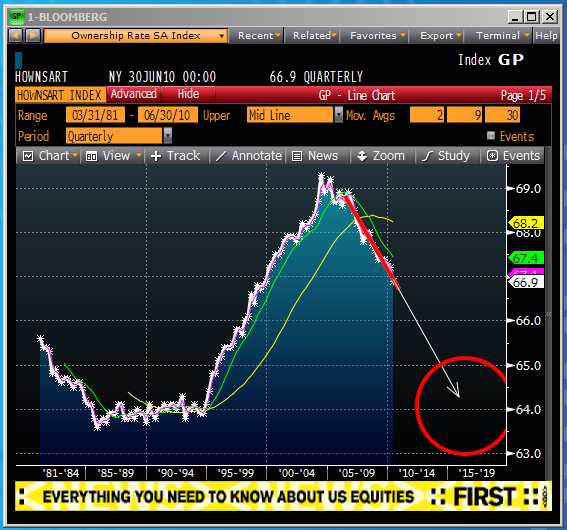
Facinating chart from Tom Keene’s blog, EconoChat, showing US Household ownership rates.
I have to disagree with Columbia University’s Ed McKelvey forecast for a 64% Home ownership rate.
In 1980, Home ownership was ~66%, it slid with the recession, bottoming under 64% in ’85. By 1995, as rates came down, advantageous tax changes were made, and (of course) vast wealth was being created by the stock market rally, the ownership rate moved higher.
By the end of the dotcom boom, it was up to 67%. Five years later it was over 69%.
Today, we are back under 67%. I would expect to see at least another 1-2% come off of this rate, as we have another 3-5 million foreclosures.
But down to 64%? Quite a few things need to go very very wrong for McKelvey forecast of 64% Home Ownership rate to come true . . .
John Embry: Die Was Cast Before Elections
Regardless of who’s controlling the U.S. Congress, Sprott Asset Management Chief Investment Strategist John Embry holds out little hope for economic happiness in the short run. As he tells The Gold Report in this exclusive interview, “It’s consequence time” and “any opportunity to have a pleasant outcome. . .in the relatively near term is long gone.” John’s view of equity markets is equally dim as he foresees the U.S. plowing deeper into quantitative easing to postpone—and maybe even exacerbate—the inevitable. An exception, at least for the time being, may be in senior gold stocks, which he says, “have seldom been cheaper in relation to the price of gold.”
The Gold Report: The last time we spoke, you said you’d gone long on precious metals and short on housing, banking etc., as you’d become more certain of your viewpoint. You said, “Everybody is being told things are fine and that the economy will return to normal and growth will continue”—an underlying assumption you called “dead wrong.” If that assumption is dead wrong, why are equities markets generally increasing and what should we expect from equities and gold markets going forward?
John Embry: I think the equity markets are reflecting the enormous amount of liquidity being injected into the market, particularly in the U.S. There’s no question that POMO (permanent open market operations) are going on continuously—to the extent that Goldman Sachs has identified the days they’re happening and recommending people buy equities those days—and they’re having an outsized impact on the market. This does not reflect the underlying economics whatsoever.
We’re very concerned about what might happen to equities because we continue to believe our view on the economy is playing out and that the U.S. economy has no real forward thrust. I don’t think equities are all that interesting now, particularly at the level to which they’ve been elevated due to these various market interventions.
The authorities wanted to make things look better going into the November elections. Maybe now, there will be less pressure to inflate things to such an extent and they will focus more on reality than elections. Now that we’re through the elections, it’s almost like the roadrunner off the cliff. The feet are going fast, but look out below.
TGR: Do you anticipate poor economic data will be released after the elections?
JE: I think the spin will be less positive. I am a great believer in John Williams’ ShadowStats. His numbers are much closer to reality, but those the public sees don’t look as bad as they really are. I think that perception will change. More people will start paying attention, see that things aren’t as good as they think and realize we could get into a reasonably unpleasant period.
TGR: How do you feel about gold?
JE: We continue to like gold very much. All this talk about bubbles and overbought is interesting in that sentiment is actually quite lousy. Interest in the market amongst the hoi polloi is very limited. I don’t see a lot of enthusiasm toward gold at this point, which is a precursor to better markets. So, we like gold; we don’t like equities so much.
TGR: Ultimately, will the U.S. economy be affected by either Republicans or Democrats controlling the Senate?
JE: In the long term, maybe; in the short-term, no. In the short run, I think the die is cast. They realize how serious the problem is, and that the Fed is in control and will likely continue down this path of quantitative easing (QE). That will be the defining thing in the short run.
In the long run, I think the conservatives on the Republican side—certainly the Tea Partiers—may have an impact along the lines of what’s going down in England now. What the Conservatives are doing in the UK is quite remarkable; really Draconian. It will be an interesting test case to see how this works out.
TGR: Wouldn’t you say they did the same thing in Greece?
JE: Yes; but so far, the English are putting up with it; the Greek, French, etc., are already starting to rebel. It will be fascinating to see how Americans will respond to that sort of activity.
TGR: Given the power of the American consumer, could something that drastic happen in the U.S. without tanking the economy?
JE: No. I am absolutely positive on that point. If the U.S. took a really hard stance on dealing with the budget deficit, the implications would be horrific for the economy. I think it would set off a depression that would make the ’30s look good.
TGR: When you say, “the die is cast,” are you referring to QE as the proposed solution to counter that?
JE: Unquestionably. The government is going to take the path of least resistance in the short run. Do I believe this is a solution in the long run? No. It just postpones the inevitable and, conceivably, makes it worse. But that doesn’t mean the Fed won’t opt for QE in the short run; it’s certainly indicated it will go that direction.
TGR: The Draconian cuts would push the U.S. into a greater depression; and, at the other extreme with QE, we don’t know quite the magnitude. Is there no middle ground?
JE: No. This is where I differ from many analysts and pundits; I think the middle ground was lost years ago. Any opportunity for a pleasant near-term outcome is long gone. Americans can take the pain now or something verging on hyperinflation and greater pain later. So, pick your poison. If I were emperor, I’d take the pain now.
TGR: Is it a foregone conclusion that inflation or hyperinflation would lead back into a depression? Will we end up in the same place regardless?
JE: I think we do end up in the same place. There’s no example in history that unbridled money creation works to solve any problems; in fact, it usually exacerbates them. I’m not sure it’s going to be any different this time because I believe today’s financial structure is probably more vulnerable than it’s ever been in history. I don’t want to get into derivatives and all these various collateralized debt vehicles, but the fact is we’ve never seen anything like this before. If you try to deflate, that would come to the fore immediately; if you inflate, that just creates a bigger problem later.
So, I’m kind of stuck; I can’t see a more positive outcome. I am a great believer in the Austrian School of Economics, and with a hugely excessive debt buildup in the economic system, there’s no escaping the consequences. We’ve had the biggest debt buildup in history, and here we are in consequence time.
TGR: I think everybody agrees about consequence time; it’s a matter of the degree of pain.
JE: If you went the tough route initially, you’d go through a lot of pain but you’d probably come out the other end sooner and save your currency. Now, if you go the unlimited QE route—or, as my friend Jim Sinclair puts it, “quantitative easing to infinity”—the currency will be destroyed. When that happens, you unleash an immense amount of inflation in your system; and, in that situation, people lose all their rudders. There’s nothing to hang onto when your money’s value is destroyed. I worry about social unrest; but in the end, you’ve got to clean the system out anyway.
TGR: That’s why you’re bullish on gold.
JE: That’s why I am extraordinarily bullish on gold. Either way, gold will be all right because it’s a tangible asset—a hard asset that’s existed through centuries. The hardest point to get across is that gold isn’t what’s changing. Gold is gold. It’s been around for thousands of years, recognized as money by most societies. What’s changing is the current paper-money experiment.
Without exception, paper money is always devalued in the end and always ends up worthless. We’ve got a long way to go, but we’re definitely en route to that ultimate conclusion. So, it’s not gold that’s changing; it’s the value of the paper money in which gold is valued; that’s why the price of gold is going up.
TGR: When you say, “we have a long way to go,” what kind of timeframe are you thinking about?
JE: It’s hard to put an exact timeframe on it, but I think the direction will become more evident in the next year and a lot more people will become acutely aware of the extent of the problem. Only a small minority of people realize the risk at this point. But once it starts, I use Weimar Germany after WWI as a guidepost. That experience lasted about three to three and a half years from beginning to end. We’re now at the beginning, so I think it will take at least that long.
TGR: But that was one country. If the world’s reserve currency loses all value, it will impact many more countries.
JE: Yes, that’s why the G20 finance ministers and central bank governors got together in South Korea on October 23 in advance of the G20 Summit there, which I think will solve absolutely nothing. Many other countries are extremely unhappy with the route the U.S. is taking and they’d probably share my opinion and say, “Get your house in order now rather than taking the rest of us down with you.”
TGR: But you say the die is cast and that this currency, the U.S. dollar will go down.
JE: It appears inevitable to me and that feeling is reinforced by the Fed’s statements that it will indulge in some form of QE. Goldman Sachs Chief Economist Jan Hatzius said it needs $4 trillion worth of asset purchases to get this thing turned. That number is astounding—and he knows more about it than I do.
QE to infinity is a flawed concept because the more the Fed does it, the less interest other countries will have in buying U.S. paper. As a result, it’ll need more QE. Once you get on the slippery slope, it moves quickly. That’s why I think it’s a horrible policy; but every indication tells us this is the route the Fed has chosen.
TGR: Countries that hold large amounts of U.S. currency are putting on the pressure against QE. Will they have any influence on this policy? If so, what will happen?
JE: There are only two outcomes possible: 1.) Debase the money to the extent that it lessens the impact of existing debt so it can be maintained; or 2.) Default on some portion of it (i.e., the Argentine route).
TGR: Your hedge fund focuses on a fair amount of precious metals assets as one way of protecting yourself regardless of which scenario plays out.
JE: Yes, we have a considerable amount in both gold and silver bullion, plus shares in both commodities.
TGR: Everyone agrees that gold is money but opinions on silver vary, including the idea that it’s an industrial metal and monetary asset. What makes you want to invest in silver?
JE: Quite frankly, silver is a better story than gold—and I love gold. We’ll see evidence of the expression, “silver is poor man’s gold,” come into effect shortly. More people are looking at silver as a store of value, and not buying it just to convert into jewelry or for medical and industrial uses. More people are starting to hoard silver bars and coins.
The silver market differs from the gold market in two ways: 1.) Central banks still have a fair amount of gold in their vaults, though not as much as they’d have you believe (and there isn’t a lot of silver inventory because the central banks have accumulated none to speak of); and 2.) Silver differs from gold in that the vast majority of newly mined silver is being consumed for medical and industrial uses, jewelry, etc., and not much is left over for investment demand. There’s been a deficit for many years. As far as we can determine, aboveground inventories are being reduced down to almost nothing. So if people want to invest in both gold and silver, it’s going to have an outsized impact on the silver price.
TGR: Are you saying the price of silver will outpace that of gold?
JE: Without question. If I’m right about an ongoing bull market in PMs, I virtually guarantee the silver price, on a percentage basis, will outperform the gold price by a considerable amount. That’s not to denigrate gold at all, because I think it will outperform virtually everything else.
TGR: What does outsized silver demand mean to the underlying equities? Will silver-focused mines outpace those focused on gold?
….read John’s recommendations HERE (scroll down to the copy with the links roughly 1/2 way down the page highlighted in blue)
-
I know Mike is a very solid investor and respect his opinions very much. So if he says pay attention to this or that - I will.
~ Dale G.
-
I've started managing my own investments so view Michael's site as a one-stop shop from which to get information and perspectives.
~ Dave E.
-
Michael offers easy reading, honest, common sense information that anyone can use in a practical manner.
~ der_al.
-
A sane voice in a scrambled investment world.
~ Ed R.
Inside Edge Pro Contributors

Greg Weldon

Josef Schachter

Tyler Bollhorn

Ryan Irvine

Paul Beattie

Martin Straith

Patrick Ceresna

Mark Leibovit

James Thorne

Victor Adair