
Daily Updates
Today’s Notes:
1. Gold and the Currency System
2. Names Only in Montreal
1. Gold and The Currency System
Sunday Robert Zoellick, President of the World Bank, called for a new Bretton Woods, the third such agreement, to replace the current Bretton Woods II floating exchange rate system. In July 1944 a fixed exchange rate currency regime was created with gold backing in Bretton Woods, New
Hampshire with the US dollar at its center as the world reserve currency. It was subsequently
disassembled by the Nixon administration in 1971 after the United States unilaterally decoupled
the dollar from gold. By 1971 when France and other countries realized the inherent vulnerabilities
of the dollar-based system and French president Charles de Gaulle begin to exchange US dollars for
gold.
Zoellick, a former US Treasury official in the 1980s, recommended a new Bretton Woods
agreement to replace the current system which is inherently inflexible and prone to what I have
termed “a currency race to the bottom.” I believe we are now witnessing the beginnings of this
phenomenon. As the US depreciates its currency other countries purposefully depreciate their
currencies in response to inflate their prodigious debt loads away or simply to protect their
economies. In the view of most observers US currency depreciation appears to be the only
effective option the United States now has other than a sovereign debt default which cannot
occur. Last week’s $600 billion quantitative easing decision by the Federal Reserve is indicative of
this tendency to depreciate the dollar. Competitive currency devaluations or currency controls
might now escalate worldwide resulting in a trade war. Associated problems such as trade wars,
capital controls, hot money flows due to carry traders are endemic to such a situation. One must
not forget that in the 20th century World War two, one of the most devastating wars mankind has
ever witnessed, resulted from such deflationary/ inflationary dynamics. Mr. Zoellick said,
“The system should also consider employing gold as an international reference point of market
expectations about inflation, deflation and future currency values. Although textbooks may view
gold as the old money, markets are using gold as an alternative monetary asset today.”
Mr. Zoellick makes five major points in his recommendations in the November 7th issue of the
Financial Times, The G20 Must Look beyond Bretton Woods. He refers to the work done by James
Baker, then president Reagan’s Treasury Secretary, who avoided a global protectionist system with
the launch of the WTO and eventually North American free-trade. Mr. Zoellick’s five points are:
1. The US and China must agree on specific, mutual steps to boost growth. China must
agree on appreciation of the renminbi. The US, in turn, must desist from punitive, tit-
for-tat trade actions. Open-market agreements are critical.
2. Other major economies, starting with the G7 and not including all G 20 initially, must
agree to forgo currency intervention. This is the cause of what we called the global
currency race to the bottom. These situations tend to end badly for all participants.
Gold and The Currency System
Today’s Notes:
1. Gold and the Currency System
2. Names Only in Montreal
1. Gold and The Currency System
Sunday Robert Zoellick, President of the World Bank, called for a new Bretton Woods, the third such agreement, to replace the current Bretton Woods II floating exchange rate system. In July 1944 a fixed exchange rate currency regime was created with gold backing in Bretton Woods, New Hampshire with the US dollar at its center as the world reserve currency. It was subsequently disassembled by the Nixon administration in 1971 after the United States unilaterally decoupled the dollar from gold. By 1971 when France and other countries realized the inherent vulnerabilities of the dollar-based system and French president Charles de Gaulle begin to exchange US dollars for gold.
Zoellick, a former US Treasury official in the 1980s, recommended a new Bretton Woods agreement to replace the current system which is inherently inflexible and prone to what I have termed “a currency race to the bottom.” I believe we are now witnessing the beginnings of this phenomenon. As the US depreciates its currency other countries purposefully depreciate their currencies in response to inflate their prodigious debt loads away or simply to protect their economies. In the view of most observers US currency depreciation appears to be the only effective option the United States now has other than a sovereign debt default which cannot occur. Last week’s $600 billion quantitative easing decision by the Federal Reserve is indicative of this tendency to depreciate the dollar. Competitive currency devaluations or currency controls might now escalate worldwide resulting in a trade war. Associated problems such as trade wars, capital controls, hot money flows due to carry traders are endemic to such a situation. One must not forget that in the 20th century World War two, one of the most devastating wars mankind has ever witnessed, resulted from such deflationary/ inflationary dynamics. Mr. Zoellick said,
“The system should also consider employing gold as an international reference point of market expectations about inflation, deflation and future currency values. Although textbooks may view gold as the old money, markets are using gold as an alternative monetary asset today.”
Mr. Zoellick makes five major points in his recommendations in the November 7th issue of the Financial Times, The G20 Must Look beyond Bretton Woods. He refers to the work done by James Baker, then president Reagan’s Treasury Secretary, who avoided a global protectionist system with the launch of the WTO and eventually North American free-trade. Mr. Zoellick’s five points are:
- The US and China must agree on specific, mutual steps to boost growth. China must agree on appreciation of the renminbi. The US, in turn, must desist from punitive, tit-for-tat trade actions. Open-market agreements are critical.
- Other major economies, starting with the G7 and not including all G 20 initially, must agree to forgo currency intervention. This is the cause of what we called the global currency race to the bottom. These situations tend to end badly for all participantsEmerging economies should have access to tools to suppress hot money flows which occur frequently. They are the cause of asset bubbles and high rates of inflation which derail developing economies.
- The supply‐side picture is critical. The developing countries in the G 20 make up half the world’s demand. Supply‐side bottlenecks are developing in many emerging countries. Import demand is rising worldwide. There is a need in these economies for the development of skilled labor forces, agriculture and infrastructure.
- Whatever currency system is finally agreed upon it must reflect the growth and needs of emerging world. Such a system will involve a basket of currencies including not only the dollar but also the euro, yen and the renminbi. In the future other currencies will be included in this group. In effect this reflects the emergence of a new reserve currency “portfolio” and a new reserve currency system. Such a system is already beginning to develop. It must move toward internationalization and open capital accounts.
Mr. Zoellick does not suggest that currencies must be redeemable in gold. Simply that gold should be used as a reference point for determining and combating inflationary and deflationary tendencies in the future currency system. This is disappointing but a first important step towards recognizing gold and silver as the ultimate money and the backstop for any new agreed‐upon currency system.
The development and acceptance of this system will take time and will require much soul‐ searching and give‐and‐take on the part of the haves and have‐nots. But it is patently clear that we need new approach. We also need a new cadre of economists and economic thinking to cope with the serious problems that we now face. In spite of the meeting of the G 20 in Korea this week one cannot escape from the issue that debtor nations around the world have a most serious problem on their hands and that emerging countries have a different kind of problem, no less serious. We hope this is simply a first step in the evolution of a new system that will restore order and fiscal
balances in the world.
It is the United States that has been the owner of the world’s reserve currency since 1945, the issuer of unlimited debt because of this status. She now must pay the piper. Neither the US nor Western Europe can continue to run their huge welfare schemes without inflating their currencies to pay for the debt that must be undertaken. It will now be interesting to see if the G20 can reach an agreement on a system designed to cure the ills and the imbalances of the world today.
Perhaps the most controversial part of Mr. Zoellick’s plan is his recommendation of gold as reference point. The FT this morning says “While there are occasional calls for return gold as an anchor for currency values most policymakers and economists regard the idea as liable to lead to overly tight monetary policy with growth and unemployment taking the brunt of economic shocks.”
Most economists still seem to regard gold the barbarous relic. Yet the Bernanke printing press is not working. Isn’t gold exactly the sort of constraint that we need to have on the political system. Perhaps a basket of commodities, not only gold, priced globally would lead to less tight monetary policy with subsequent unemployment problems. As it is now Keynesian monetary prescriptions have failed. Monetarist prescriptions are failing to provide adequate growth and lower levels of unemployment.
We think the current price of gold and the proclivity of leaders of China and South Korea to suggest that more of their foreignexchange reserves should be invested in gold indicates the reality of the situation. As we mentioned in the previous morning notes, if China is to maintain its 1.7% weighting in gold she will have to buy 1,500 tons in the next five years. At present Korea only has a .2 percentage weighting in gold indicating should she decide to buy gold a significant open‐market purchase is in the offing. It is hard to understand how gold can be rejected in a in a monetary system when central bankers around the world are now beginning to purchase and horde gold and silver.
In the meantime discovery investors have the opportunity to protect themselves through homemade leverage by owning gold and silver and if they so choose, the equities or the ETF investment vehicles that offer exposure to those precious metals.
On Friday at the Cambridge House Investment Symposium in Montréal I had the pleasure of listening to a speech by Mr. Eric Sprott a famous Canadian investor. It was a speech in which he forcefully outlined the role of silver in our future. It was one of the most convincing speeches I have ever heard on the rationale for silver to make its price appreciation as gold has. I am therefore re‐emphasizing this morning that investors seriously consider devoting an appropriate allocation to gold and silver. Mr. Sprott noted the first resistance level for silver is $50 per ounce.
He also noted that huge margin calls had been made in the silver market in the past week or two. Precious metals seem to be ascending the system as we write this morning note today.
2. Names from the Montreal Cambridge House Symposium
Here are a few of the interesting names we researched and met with in Montreal over the weekend. I will not review them here, simply leave it to you to do your homework if you choose ‐ might be a good way to exercise the Discovery Investing 10 point grid. More on these later as we accumulate information. They are:
1. Sama Resources (nickel, copper polymetallics)
2. Quest Rare Minerals Limited
3. Amazon Mining (potash)
4. Matamec (rare earths)
5. Osisko and Clifton Star (gold)
6. Lithium Americas Corp.
7. Commerce Resources
8. Primary Petroleum
Today we meet with Geologix Explorations Inc. (GIX.v) in New York City to assess the progress on the Tepal deposit in Mexico. We are looking forward to meeting the management.
….to sigh up for Michael Berry’s FREE market Letter go HERE
Triple threat? Bernanke clueless about finance, currencies, and economics, says Jim Rogers
Federal Reserve Chairman Ben S. Bernanke’s decision to pump a further $600 billion into the economy shows his grasp of economics is weak, said investor Jim Rogers, chairman of Rogers Holdings.
“Dr. Bernanke unfortunately does not understand economics, he does not understand currencies, he does not understand finance,” Rogers, 68, said in a lecture at Oxford University’s Balliol College yesterday. “All he understands is printing money.”
“His whole intellectual career has been based on the study of printing money,” said Rogers, who predicted the start of the global commodities rally in 1999. “Give the guy a printing press, he’s going to run it as fast as he can.”
The Fed said on Nov. 3 it will buy an additional $600 billion of Treasuries through June, in a bid to reduce unemployment and avert deflation. While Bernanke’s near-zero rates and $1.7 trillion in asset purchases helped end the recession, the Fed said progress has been “disappointingly slow” in bringing down joblessness that is close to a 26-year high.
“Debasing your currency has never worked,” Rogers said.
David W. Skidmore, a spokesman for the central bank in Washington, didn’t respond to a message seeking comment.
Bernanke’s View
Bernanke, 56, a former Princeton University economics professor who was appointed as Fed chairman by President George Bush in 2005, is a long-term scholar of the Great Depression. He has argued that the central bank’s blunders helped worsen the financial crisis that began in 1929.
He has responded with the most-aggressive expansion of the Fed’s power in its history, cutting interest rates, making Federal Reserve loans available to investment firms for the first time since the 1930s and lowering the rates at which banks can borrow from the Fed.
Rogers said the Fed was “throwing petrol on the fire” of surging commodity prices, which rose to a two-year high today. He urged students to scrap career plans for Wall Street or the City, London’s financial district, and to study agriculture and mining instead.
“The power is shifting again from the financial centers to the producers of real goods,” he said. “The place to be is in commodities, raw materials, natural resources.”
“Don’t go to Harvard Business School,” he said. “If you want to make fortunes and come back and donate large sums of money to Balliol you’re not going to do it if you get an MBA.”
‘Horrible Disaster’
He declined to comment on the performance of his own investments in commodities.
Rogers, who described the U.S. as the most indebted country in history, said quantitative easing had been a “horrible disaster.”
“It didn’t work the first time, it’s not going to work the second time,” he said in an interview with Bloomberg News. “It’s adding up staggering amounts of debt, staggering amounts of debased currencies. It’s going to cause more distortions, and we’re going to have more currency turmoil.”
The U.S. and U.K. governments’ taxpayer-sponsored bailouts of troubled banks were “unbelievable economics” and “terrible morality,” he said.
Rogers studied at Balliol in the 1960s and coxed Oxford to victory in the 1966 boat race against Cambridge University. Balliol, founded 747 years ago, educated British prime ministers including Harold Macmillan and writers such as Graham Greene.
“I’m here to sell books,” said Rogers, who lives in Singapore. “My little girls need royalties,” he added, referring to his two daughters, who are both younger than eight and were in the audience.
Rogers traveled the world by motorcycle and car in the 1990s researching investment ideas for his books, which include “Adventure Capitalist” (Random House/Wiley) and “Investment Biker.”
China’s Leg Up in the Rare Earths Market
Basically, rare earths are exotic elements that are critical to the future of high tech, clean energy, Big Science and – oh by the way – national defense. The list includes 17 elements like terbium, ytterbium, and yttrium.
Back in chemistry class you may have heard of the “Lanthanide Series” of elements, which includes 15 of the 17 elements. Also back in chemistry class, somebody doubtless raised their hand and asked the teacher what you needed to know about the Lanthanides. If your chemistry class was like most chemistry classes, the teacher probably said, “Don’t worry, they’re not on the test.”
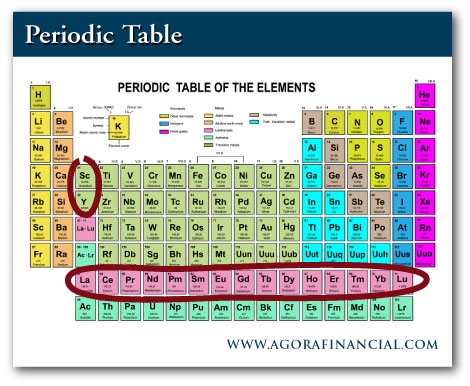
Well, these elements are on the test now. Why? Because the Chinese control 97% of world output of rare earths, and have tight control over much else as well in the realm of technology metals. Recently the news is that the Chinese have been restricting exports of rare earths, and apparently some other metals. That’s a problem.
All of the rare earth elements have one or more excellent atomic properties. These include incomparable chemical, electrical, magnetic and/or optical properties. For example, neodymium (Nd) makes strong magnets even stronger. Europium (Eu) is necessary for television screens to show color images. Lanthanum (La) is useful in high energy-density batteries, as well as being critical in petroleum refining.
Now think about all the rhetoric you’ve heard about how “we” are going to transition to a high tech/clean tech future of solar panels, windmills, electric cars, smart grid, wired-world. Oh yeah? Problem is, most of these technologies simply WILL NOT WORK without large amounts of rare earths.
That is, the electric cars, wind turbines, solar panels, miniature electronics, smart grid, etc. will not get built in the US (or Canada, Japan, Europe, Australia, etc., for that matter) if industries cannot secure long-term supplies of rare earth minerals. And, oh by the way, that goes double for advanced defense technologies. For example, EVERY missile in the US arsenal uses some quantity of rare earths – every single one!
What’s the problem? In the past 15 years or so, the West closed down essentially all of its rare earths refining capability. The entire market (well, 97% of it) was conceded to the Chinese, for a lot of reasons – economic, wages, resource-base, environmental and much more. Now that the West wants to build out a different energy and technology future, the Chinese control critical substances from ore bodies through to final oxides and metals.
It’s as if somebody (the West) wants to set up a fancy, Napa Valley-style winery (new, clean, high tech), but doesn’t have any grapes (rare earths). This vintner-wannabe will have to buy the grapes from a producer in China. Do you really think that the Chinese will sell the guy the best grapes, and help him create a world-class brand of wine?
What do the Chinese say? They say that they’re just acting rationally. They’re closing down unsafe mines and controlling past environmental pollution. They’re consolidating the industry, as most other industries consolidate over time.
The Chinese say that they’re just encountering natural issues of depletion, from mining their ore bodies over the years. They say that they just don’t have “more” rare earths to export, because of natural economic and market forces.
Of course, the Chinese also say that if you move your factory to China, they’ll put you on an allocation for rare earths. You’ll have enough to operate. That is, you’ll have enough raw materials as long as you set up a joint venture with a Chinese firm and share all your technology. Of course.
Byron King
for The Daily Reckoning
Byron King
Byron received his Juris Doctor from the University of Pittsburgh School of Law, was a cum laude graduate of Harvard University, served on the staff of the Chief of Naval Operations and as a field historian with the Navy. Our resident energy and oil expert, Byron is the editor of Outstanding Investments and Energy and Scarcity Investor. Byron has made frequent appearances in mainstream media such as The Washington Post, MSN Money, Marketwatch.com, Fox Business News, CNBC’s Squawk Box, Larry Kudlow, Glenn Beck and PBS Newshour. He also had a feature article written in the Financial Times, and has appeared on both CNN and Marketplace radio broadcasts. Byron has also been quoted in various international publications such as The Guardian and De Volkskrant, and has been a guest on Canada’s CBC television broadcast.
Strategies for Junior Mining Investors: The Whites of Their Eyes
“Don’t fire until you see the whites of their eyes.”
Most Americans were taught in school that William Prescott, commander of the colonial forces on Bunker Hill, gave this order to his men on the morning of June 17, 1775, just before the British attacked them.
Some may even remember that while the British took the hills, they did so at such great cost, it wasn’t much of a victory. The American forces repelled the British twice and were finally overwhelmed when they ran out of ammunition – an outcome that obviously concerned Prescott and provoked his order to conserve ammunition. It was vital to use each shot as effectively as possible.
I think of this often when contemplating investing, because I sometimes feel an urge to get all of my investment cash deployed NOW. I might miss the next big uptick! And even if not, modest double-digit gains are still better than money sitting in the bank. This urge gets strong when the market gets hot, as it has been over the past months – look at all the gains I missed!
But the best speculations, as Doug Casey likes to remind us, are when the perfect pitch comes sailing across home plate, cheap and with great upside. There are no called strikes, so it only makes sense to wait and swing only when it’d be hard to miss, hard to get hurt, and there’s clear out-of-the-ballpark potential.
- Key Point: Missing out on a winning pick may wound pride, but it doesn’t cost any cash. Placing hasty bets can cost dearly on both accounts.
Or, as Doug also likes to say, you can’t kiss all the girls. Nor should you try; the consequences in real life of attempting to kiss every girl you meet would be… nasty, brutish, and short.
Returning to my original metaphor, I don’t want to pull the trigger on a deal until I see the whites of their eyes – i.e., until everything is lined up for maximum effectiveness. Or, as I’ve put it before: “Buy Low, Sell High” is a much better strategy than “Buy High, Sell Higher.”
Strategy vs. Tactics for Speculators
Speaking of military metaphors, I frequently refer to strategy and tactics in my writing. Last June, I gave a talk on strategy vs. tactics at the Cambridge House conference in Vancouver, explaining in greater detail how these concepts can be useful to speculators. With gold recently reaching almost $1,400, making the blood pound heavily in so many speculators’ veins, I think it’s a good time to spell those thoughts out, lest any of us get carried away and suffer a lapse of discipline.
First, it helps to understand that these terms are not interchangeable. The U.S. military defines strategy as being:
The art and science of employing the armed forces of a nation to secure the objectives of national policy by the application of force or the threat of force.
Tactics, on the other hand, are defined along these lines:
The military science that deals with securing objectives set by strategy, especially the technique of deploying and directing troops, ships, and aircraft in effective maneuvers against an enemy.
My way of summarizing these ideas:
- Strategy: What you want to do. This might be “divide and conquer” or “overwhelm with vastly superior force” in a military context. For investors, it might be “preserve wealth” or “raise max cash ASAP.”
- Tactics: How you do it. This could be something like, “build a giant wooden rabbit and use it to sneak troops inside the castle walls” in a military context. For investors, it could be something like “pick only safe, undervalued investments” or “speculate on the stocks with the highest upside potential available.”
Why you do it, of course, is your goal. That might be conquest or freedom, for armed forces, and financial independence or “drop dead money” for investors.
- Key Point: Know Thyself. This is one of the things I’ve learned through thousands of interactions with investors over the years: your strategy and tactics – the “what” and “how” of your plan – should be based on what you are actually capable of doing.
For example:
….read more HERE
-
I know Mike is a very solid investor and respect his opinions very much. So if he says pay attention to this or that - I will.
~ Dale G.
-
I've started managing my own investments so view Michael's site as a one-stop shop from which to get information and perspectives.
~ Dave E.
-
Michael offers easy reading, honest, common sense information that anyone can use in a practical manner.
~ der_al.
-
A sane voice in a scrambled investment world.
~ Ed R.
Inside Edge Pro Contributors

Greg Weldon

Josef Schachter

Tyler Bollhorn

Ryan Irvine

Paul Beattie

Martin Straith

Patrick Ceresna

Mark Leibovit

James Thorne

Victor Adair