
Daily Updates
Following is an interesting comment on the intermediate and long term prospects for gold published over the weekend by Mark Leibovit in his weekly Gold Letter. The comment is entitled “Keep Your Pedal To The Metal”. by Don Vialoux Timing the Market
“I have no choice but to continue pounding the table on gold. Last week I presented to you ‘seasonality’ charges from the past ten years which clearly point to the fact a big rally is coming whether right away or after summer doldrums. Frankly, I would not wait. The contrarian in me suggests that if traders all have their finger on a trigger to buy gold on a pullback, that pullback may not come. Later, when gold surges to new highs and the non-believers jump in, perhaps then we see a correction.
Fear pervades the trading pits, the financial websites, and the financial media that the U.S. Dollar will suddenly explode putting the kibosh on gold. I don’t believe it in a New York minute. The U.S. Dollar is terminal. The vermin in Wall Street, at the financial institutions (the bankers), at the Federal Reserve, at the U.S. Treasury and in all branches of government are in part all to blame for the state of the Western World’s financial ills. Gold is telling you that it has become the new store of value – one of the only safe havens on earth. The train has left the station, so I suggest you quickly jump on board.
When gold reaches my new target of $3600 in the next few years that may turn out to be only a resting spot before we launch to even higher levels. Imagine what could be happening to silver in such an environment. Meanwhile, one important real question is WHEN will either QE3 or a step-child of QE3 begin? Do we need to see equity markets collapse a couple of thousand points first or will Bernanke secretly begin doing his magic behind the scenes? When China expresses interest in possibly helping bail-out Greece, we know the dynamics of the world have change and the West has lost its prowess. The U.S. Dollar will sink as China and the renminbi gain prominence. Ask yourself where are the Chinese putting their money? The answer: Primarily into natural resources including gold. They are preparing for the future. Where is the U.S. putting its resources? It is printing money, giving it to deviant bankers, foreign bankers, and other ‘friends’ at zero percent interest rates. In other words, it is going into their pockets. Keep your pedal to the metal, folks. The party is still very early.
Editor’s Note: Mark Liebovit has a remarkable history of making timely calls on gold, silver and precious metal equities. Tech Talk suggests that gold is approaching an important inflection point. Technicals for the seasonal trade are not there yet, but are getting close. A resumption of a downtrend in the U.S. Dollar is a likely trigger for start of the trade.
Mark offers a paid subscription service. His services are available at
http://www.vrtrader.com/login/index.asp
It’s yellow … it’s precious … but it’s not gold — it’s corn!
While many commodities have taken their lumpsin recent weeks, corn continues to hammer its way higher. Take a look at this chart of the Tuecrium Commodity Trust Corn Fund (CORN), which holds a basket of corn futures …
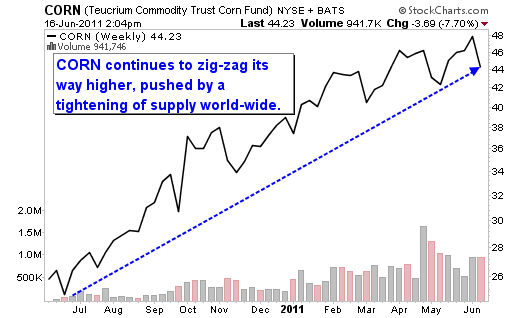
In the last six months alone, corn is up 24.7%. Compare that to the 3.7% rise in the S&P 500 over the same time period.
7 Things You Need to Know About Corn
Despite that fact that corn has already enjoyed a good run, I’m pretty bullish on corn going forward. Here are seven things you may not know about corn …
1) The USDA recently downgraded its estimate for this year’s corn harvest by 350 million bushels. Corn stockpiles before the start of the 2011 harvest may drop to 730 million bushels, the lowest level since 1996, and inventories will decline further the following year, to 695 million bushels, the USDA estimated on June 9.
2) As dismal as those projections are, the government estimates for the corn harvest are still too damned high, according to Goldman Sachs. The big bank says flooding along the Missouri and Mississippi rivers alone could drown 1 million acres of corn. Goldman says that the corn harvest will probably come in 70 million bushels below government estimates. The bank says that official forecasts for wheat and soybean harvests may also be too optimistic.
“We reflect the impact of delayed planting, poor weather and flooding in lower yield and higher abandonment projections,” Goldman Sachs analysts wrote in a note to clients.
3) Corn has doubled in price in the past year and recently went to a 3-year high after wet weather delayed U.S. planting and demand increased for ethanol and livestock feed. Corn futures for July delivery reached a record $7.9975 a bushel last week on the Chicago Board of Trade, and closed at a 40.5-cent premium to July wheat on June 9. That’s the most expensive spread between the two contracts in 15 years! This, in turn, should boost wheat demand, because wheat can be partially substituted for corn in animal feed.
4) Soaring prices for corn is a major reason why China’s food costs inflated in May by their largest jump in three years. China’s National Statistics bureau said on Tuesday that consumer prices rose 5.5% over a year earlier, driven by an 11.7% jump in food costs. That was up from April’s 5.3% rate. Severe drought and other weather disasters have taken their toll on China’s corn crop. Since corn is a major source of animal feed, this drives up meat prices, too!
5) China is the No. 2 corn producer behind the United States. It produced around 6.2 billion bushels, or 158 million metric tons of corn in 2010. But it’s not enough — despite seeing its corn harvest rise 8% last year, China switched from corn exporter to corn importer in 2010, when it bought 1.57 million metric tonnes, the most in 15 years. Almost all came from the United States. This year, China needs to import at least 2 million metric tonnes of corn, according to China’s Academy of State Administration of Grain.
Analysts are already scoffing at official Chinese predictions of a bumper corn crop this year.
6) The United States is the world’s largest producer and consumer of corn, and is China’s biggest agricultural supplier. America supplied 27% of China’s import market of food last year, reported the Global Trade Information Services. In other words, China needs our grain more than we need Saudi oil.
7) It’s not just China. The popular uprisings that roiled parts of the Middle East including Tunisia and Egypt were fueled by soaring food prices. Egypt in particular is a failed state, and the worsening crisis could impact Egypt’s own food production, increasing its demand for foreign imports to feed its 80 million people.
A Roller Coaster Loaded with Dynamite
Agriculture prices are among the most volatile in commodities. There will be downs as well as ups in corn prices.
There are forces that could drive corn prices lower. For example, the USDA recently raised its estimate of how much of the corn crop is in good to excellent condition, from 67% to 69%. That doesn’t sound like a lot, but in a market this volatile, it was enough to take some of the heat off this week.
And other countries like Argentina can also export large amounts of corn. But add in weather that is hammering farm belts around the planet, and corn has every shot at much higher prices.
How You Can Play This Trend
The CORN fund is already in the Crisis Profit Hunter portfolio, and subscribers should have nice open gains. Other ways to play higher corn prices include Archer Daniels Midland (ADM) and Corn Products International (CPO).
Whatever you do, do your own due diligence and make sure any investment is right for you before you buy it.
Yours for trading profits,
Sean
Sean Brodrick is a natural resources expert and editor of Crisis Profit Hunter, a monthly newsletter with a primary mission to help you profit from crisis situations and other dynamic forces affecting the global economy. Commodities and dividend-paying stocks are central to his approach, and he also delivers practical advice for uncertain economic times. For more information on Crisis Profit Hunter, click HERE.
Sean is also the editor of Red-Hot Global Resources, a weekly newsletter that aims to help you rack up profits with commodity-focused exchange-traded funds (ETFs) and natural resource-sensitive stocks that operate around the world. For more information on Red-Hot Global Resources, click HERE.
After a few years of a so-called recovery since 2008, the world is still in turmoil. The markets are still wavering.
Not long ago, buying Chinese stocks, or any stocks with the word Sino in it, was a great way to benefit from the world’s hottest emerging market. But in the last few weeks, all of that has taken a turn for the worst.
Chinese companies listed on the world’s most prominent exchanges have tumbled this month after a recent accusation by Muddy Waters’ Carson Block stating that Canadian-listed Sino-Forest (TSX: TRE) is involved in fraud by overstating both its sales and assets.
If you missed these recent events, the report caused a major ripple effect to worldwide Chinese companies causing shares of these companies to tumble.

Following the report by Muddy Waters, international bond markets have shut out many Chinese issuers. But this isn’t the first time it has happened.
In the past year, a string of foreign-listed Chinese companies have been accused of fraud, accounting discrepancies or other corporate governance failings. In the US, the shares of at least 20 Chinese companies have been suspended or kicked off New York stock exchanges in the past year following auditor resignations or accounting problems.
But does that mean we should run for the front door?
While accounting discrepancies and mistakes are found all over the world, everyone has their eyes set on the biggest emerging market of them all: China.
When you’re that big, you’re setting yourself up for a big target.
In the matter of Sino-Forest, I think short seller Muddy waters used it to their advantage to make a boat load of money. We still don’t know if any of the accusations are true. If it turns out to be false, you can bet we’ll see Sino-Forest shares surge and big time lawsuits in the coming months.
Think about it. Just a few short months ago, Sino-Forest was worth over $6.3 billion in market cap. At the time of this writing, it’s worth only $783 million losing nearly $5.5 billion in shareholder value.
Muddy Waters prime objective is selling stock short. By taking advantage of the markets’ nervousness surrounding Chinese companies, it released a negative report on Sino-Forest allowing them and their cohorts to short sell millions of dollars worth of stock and thus making millions of dollars off the losses from investors in the company.
Before the report was released, it was distributed to hedge funds around the world, so that more short sellers would join the party causing the stock to fall dramatically in share price.
Keep in mind that I am just assuming how much Muddy Waters and those involved are making from the short selling of Sino-Forest. It could be thousands. It could be millions. Heck, it could even be billions.
What I do know is that close to $5.5 billion worth of investors’ wealth was lost from one single report created by a firm with no real history of accuracy. A report created by notorious short seller Muddy Waters. Who is Carson Block anyway? Who is Muddy Waters?
I think that while Muddy Waters is doing research on these Chinese companies, somebody should do some research on them. The company has no listed address, and no real history. Carson Block, the man behind Muddy Waters, says that they don’t list an address because of death threats that he has received.
This is what I found on Muddy Water’s website in their “About Us” section:
“Muddy Waters Research sees through appearances to a Chinese company’s true worth. Our research director, Carson Block, is an entrepreneur who’s practiced law and pioneered an industry in China. Our team members are likewise veterans of China’s business trenches who similarly understand how business is really conducted in China. Through their successes and struggles, they’ve developed the knowledge and contacts to navigate China’s muddy waters.
Muddy Waters Research is available to work with institutional investors on an engagement basis.”
So who are the directors? Who is Carson Block? What background does he have in research? None of this is listed on their website.
The report said, “We are confident that [Orient Paper] is a fraud. Its purpose is to raise and misappropriate tens of millions of dollars.” On the front page of the report was a disclaimer that Muddy Waters had shorted the stock.
The report said the conclusion was not based on an analysis of Orient Paper’s books, but by talking to its customers, contacting suppliers of assets comparable to what Orient Paper said it had bought, having “experts” analyze photos of the company’s production equipment, and drawing conclusions from a visit to the Orient Paper factory in January 2010.
Since then, Orient Paper (AMEX: ONP) has refuted every single claim, while Deloitte & Touche (a real firm with real names), hired as independent auditors found Muddy Waters guilty of using false information.
At the end of the day, it doesn’t matter if information or research is real or fake. The market will always react first, and ask questions later.
I found it absolutely appalling that even some of the biggest media outlets and names, including Lou Dobbs, would (without their own research) go out on a limb and say that all of these Chinese companies are fraudulent. It’s absurd.
But that’s the stock market. It’s always sell or buy first and ask questions later. There are many groups and websites who issue negative reports on stocks they decide to short in order to profit. With a big enough following, these groups can wreak havoc on companies. I guess to them it’s no different than giving a buy recommendation to hike up the price of a stock they want to sell.
I feel bad for the investors involved in this recent debacle. At the same time, I can’t help but think how smart (or conniving) it was for Carson Block to take advantage of the insecurities of the market.
Do you think Sino-Forest is guilty? Or do you think Muddy Waters is?
Let me know by CLICKING HERE
(results will be posted next week)
Until next week,
Ivan Lo
Equedia Weekly
Questions?
Call Us Toll Free: 1-888-EQUEDIA (378-3342)
For the full interactive newsletter and report, please follow this link HERE
If you have not already subscribed to Equedia Weekly, you may sign up HERE
Forward-Looking Statements
This Newsletter and report contains certain forward-looking statements that may involve a number of risks and uncertainties. Actual events or results could differ materially from current expectations and projections. Except for statements of historical fact relating to the project, certain information contained herein constitutes “forward-looking statements”. Forward-looking statements are frequently characterized by words such as “plan”, “expect”, “project”, “intend”, “believe”, “anticipate” and other similar words, or statements that certain events or conditions “may” or “will” occur.
Except for the statements of historical fact, the information contained herein is of a forward-looking nature. Such forward-looking information involves known and unknown risks, uncertainties and other factors which may cause the actual results, performance or achievement of the Company to be materially different from any future results, performance or achievements expressed or implied by statements containing forward-looking information.
Although the Company has attempted to identify important factors that could cause actual results to differ materially, there may be other factors that cause results not to be as anticipated, estimated or intended. There can be no assurance that statements containing forward looking information will prove to be accurate as actual results and future events could differ materially from those anticipated in such statements. Accordingly, readers should not place undue reliance on statements containing forward looking information. Readers should review the risk factors set out in the Company’s prospectus and the documents incorporated by reference.
-
I know Mike is a very solid investor and respect his opinions very much. So if he says pay attention to this or that - I will.
~ Dale G.
-
I've started managing my own investments so view Michael's site as a one-stop shop from which to get information and perspectives.
~ Dave E.
-
Michael offers easy reading, honest, common sense information that anyone can use in a practical manner.
~ der_al.
-
A sane voice in a scrambled investment world.
~ Ed R.
Inside Edge Pro Contributors

Greg Weldon

Josef Schachter

Tyler Bollhorn

Ryan Irvine

Paul Beattie

Martin Straith

Patrick Ceresna

Mark Leibovit

James Thorne

Victor Adair