
Timing & trends
Where COVID-19 is Rising and Falling Around the World
It’s been just over two months since New York declared a state of emergency, and global stock markets were hammered as the fears of a full-blown crisis began to take hold.
Since then, we’ve seen detailed, daily coronavirus coverage in most of the major news outlets. With such a wealth of information available, it can be hard to keep track of the big picture of what’s happening around the world.
Today’s graphic, adapted from Information is Beautiful, is an efficient look at where the virus is fading away, and where new infection hotspots are emerging.
The Ebb and Flow of Coronavirus Cases
First, the good news: the number of new confirmed COVID-19 cases has started to level off on a global basis. This metric was rising rapidly until the beginning of April — but since then, it has plateaued and is holding steady (for now)…CLICK for complete article
With widespread layoffs and furloughs hitting post-World War II records and a global economy deep in the throes of a recession, the economic devastation wrought by the Covid-19 pandemic is only rivaled by the Great Depression. Yet, some businesses have been thriving during this upheaval, while others have had to reinvent themselves thanks to dramatic shifts in consumer behavior.
POET LLC, the world’s largest ethanol manufacturer producing about two billion gallons of the product per year, has made a pretty drastic business transition after retooling and pivoting into hand sanitizers instead. POET has re-engineered its systems to make pharmaceutical-grade hand sanitizers after ethanol prices cratered following weak gasoline demand.
Second Act POET runs more than two dozen ethanol plants in the U.S. but has been forced to close down three plants. It is running the remaining plants at half capacity and has laid off 10% of its workforce.
Pivoting into hand sanitizers is not as dramatic as, say, auto companies such as Ford, GM, and Tesla repurposing their car factories to make ventilators. Nevertheless, POET CEO Jeff Broin says the conversion from an ethanol manufacturer to one making hand sanitizers comes with some pretty significant costs….CLICK for complete article
In the early days of the COVID-19 panic—back in mid-March—articles began to appear pushing the idea of “flattening the curve” (the Washington Post ran an article called “Flatten the Curve” on March 14). This idea was premised on spreading out the total number of COVID-19 infections over time, so as to not overburden the healthcare infrastructure. A March 11 article for Statnews, summed it up:
“I think the whole notion of flattening the curve is to slow things down so that this doesn’t hit us like a brick wall,” said Michael Mina, associate medical director of clinical microbiology at Boston’s Brigham and Women’s Hospital. “It’s really all borne out of the risk of our health care infrastructure pulling apart at the seams if the virus spreads too quickly and too many people start showing up at the emergency room at any given time.”
In those days, it was still considered madness to suggest outlawing jobs for millions of Americans or “shutting down” entire national economies in an effort to “flatten the curve.” Thus, the article lists for more moderate mitigation strategies…CLICK for complete article
Greater Vancouver’s Detached Market Drops Over 100 Thousand dollars in April.
Sell in May and go away, an adage used primarily in the stock market, applies to Vancouver’s Real Estate in 2020. In all actuality one should have sold much sooner than May, but better late than never. Home values dropped over 100 Thousand dollars from March to April across Greater Vancouver. With more significant losses forecasted.
Many analysts and even the Greater Vancouver Real Estate Board had touted a significant price increase for the detached market in 2020. Reality has hit them all hard, along with their ardent followers. Prices are still up from the beginning of the year albeit only a measly 7 thousand dollars. From $1.590Mil in January to 1.597Mil in April. Signalling the peak of the 2020 detached prices has already come and gone.

Eitel insights had strongly suggested selling into that perceived strength, and advised to hold off on any potential purchases. The chart above demonstrates why. Prices for a majority of 2019 were near the 1.50Million threshold (Higher Orange) which held as a temporary bottom, and in turn stabilized the market enabling a rally up to 1.709Million to occur in March. We have seen this movie before of pricing threshold temporarily holding only to be broken on subsequent tests.
During 2017 – 2018 prices tested the 1.60Million threshold which temporarily held. However a pricing threshold is akin to a camel, one added straw will break this markets back too. 1.60Million broke early in 2019 much like 1.50Million will break in 2020. Leaving 1.40Million as the next threshold inevitably tested.
Now, we advise, Don’t try to catch this falling knife. Prices are down over $230,000 from the peak which is good. It will become even more attractive with time. As prices decline to 1.40Million that will exemplify a discount of $430,000 to the market from the peak.
There is no rush to enter this market, we suggest patience.
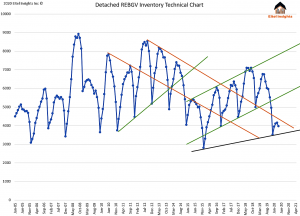
Inventory for the month of April waned as expected due to covid – 19, and the social distancing. The active listings are still above the staunch uptrend, finishing the month with just under 4000 properties for sale.
Once the social distancing relinquishes, the inventory will rapidly rise. A need for money has become a harsh circumstance for a majority of households. The stock markets have lost the equity gained over the previous two years. There isn’t even a possibility to work extra hours, as most work places have been closed, some never to reopen.
With few options remaining, selling real estate will become an unfortunate necessity. Which will inevitably lead to foreclosures coming to the market as well. None of which puts pressure on the buyers. If selling, take the hit early before the knockout punch is landed.

The housing market just experienced the lowest sales in April on record. For some perspective during the 08 -09 recent recession the sales for April were at 1298 and 1188 respectively. Sales numbers plummeted to only 393 home sales in April. Sub 400 sales have only occasionally occurred during the winter months, never in the spring markets. Sounds bad but there is an additional kicker.
As we have been pointing out for the past few articles, sales data is from land titles, meaning, the upcoming months will see likely even lower numbers reported.
The number of accepted offers so far this year, beginning with January, was over 500. February saw nearly 800, and March realized just under 700. Meaning the sales data from land titles of 393 sales came from completions on those previously accepted offers.
The kicker, April’s accepted offers were just over 200… the worst is yet to come.
One of my favourite quotes is as follows which will lead into my final thoughts. “While the individual man is an insoluble puzzle, in the aggregate he becomes a mathematical certainty. You can, for example, never foretell what one many will do, but you can say with precision what an average number will be up to. Individuals vary, but percentages remain constant. So says the statistician.” – William Winwood Reade
Eitel Insights’ forecast of 1.40 Million was offered by back in 2016 and published in 2017 (Western Investor). Not only were we the first to forecast the peak of 1.830 million, we forecasted the bottom at the same time. The housing markets are no longer guess work. Fundamental factors continually show up late to the game. By utilizing our actionable intelligence buying low and selling high is no longer based on a gut feel, it is technically predictable.
Not all markets in Greater Vancouver are created equal, some areas are closer to the bottom. While others still have significant percentage losses upcoming. Become an Eitel Insights client to find out which are which.
Dane Eitel, Eitel Insights
Watch Eitel Insights latest video:
In response to overwhelming demand, Michael Campbell will be conducting a series of interviews over the next month with keynote speakers from the World Outlook Conference and making them available to our Inside Edge Subscribers. In this week’s video James Thorne talks about what Central Bank support of the stock market means for your investments! Not yet an Inside Edge subscriber? This might be a great time to consider joining. Click for more info https://bit.ly/3bgj9aA
-
I know Mike is a very solid investor and respect his opinions very much. So if he says pay attention to this or that - I will.
~ Dale G.
-
I've started managing my own investments so view Michael's site as a one-stop shop from which to get information and perspectives.
~ Dave E.
-
Michael offers easy reading, honest, common sense information that anyone can use in a practical manner.
~ der_al.
-
A sane voice in a scrambled investment world.
~ Ed R.
Inside Edge Pro Contributors

Greg Weldon

Josef Schachter

Tyler Bollhorn

Ryan Irvine

Paul Beattie

Martin Straith

Patrick Ceresna

Mark Leibovit

James Thorne

Victor Adair