Bonds & Interest Rates

Peddle to the Metal to a Banking Crisis

The Sovereign Debt Crisis is leading to authoritarian governments all over the world. Because government have to pay the bondholders and are scared to death of what happens if they cannot, we must lose all our liberties. It is not just the USA. It is everyone.

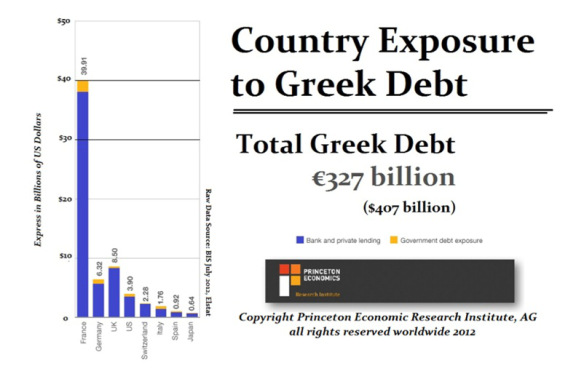
The Sovereign Debt Crisis is of profound importance. What is grossly being overlooked is both the exposure of banks to sovereign debt in Europe as well as Japan. In the case of the former, France is more or less ignoring the global trend and is putting peddle to the medal. As if they were driving straight off a cliff, they have simply sped up the process. On Wednesday the French government approved a measure that will lower the retirement age to 60 from 62 for a narrow group of workers, reversing the unpopular pension reforms made by former President Nicolas Sarkozy. They are also in Britain hunting down its citizens with new tax investigations. If the Greeks do not blow up the Euro, don’t worry, the French will.

greek-exposure

The French banks are in serious shape and now the Government will not back off of its insane socialistic policies. Just where is this money supposed to come from nobody knows.

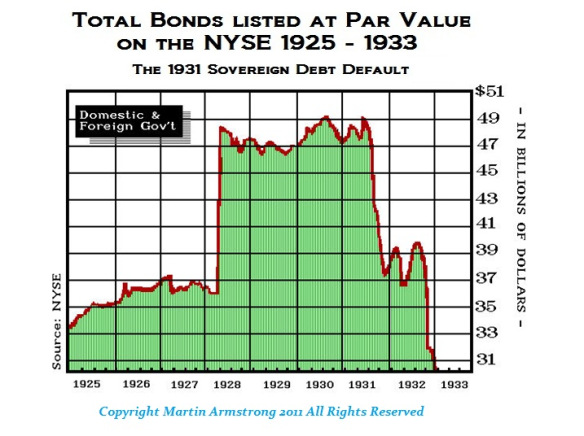
In Japan, the same problem exists. The Japanese debt is going to crash and burn in 2013. This will be the first opportunity for a major low in Japan. It will be 23 years down. Expect the JGBs to crash, the yen to decline, and the Nikkei to finally rally after it makes new record lows in 2013. The Japanese bank exposure to Japanese debt is monumental. The slightest uptick in interest rates in 2013 will wipe out bond investors like we saw in 1931. This will push the dollar higher as capital flees and parks in the dollar. Eventually that will flip and the dollar will drop with the Sovereign Debt Crisis eventually migrating to the USA.

As far as where to put your money, well that will be good solid equities. Gold of course will provide the underground economy. So those buying gold, make sure it is in coin form not in banks nor in bar form. Gold is not headed for nonsense of $30,000 and ounce. If that ever happened, the troops would be hunting down gold door to door in the USA.

The Sovereign Debt Crisis defines everything. Just remember what happened to bonds in 1931. Here is a vivid chart because this data is usually suppressed.

1931-sovdebtdefault

The government are all about self-interest. If you really think anything will change for the positive, think again.

About Martin Armstrong of Armstrong Economics

“Armstrong is the developer of the Armstrong Economic Confidence Model, best known for calling the crash of 1987 to the very day. The model pegged June 13-June 14, 2011 as the start of a long-term upward trend in the market; the market obliged by notching its first weekly rise since April 29.”. … Pi suggested some future turning points which Armstrong watched carefully as they approached. Among them was December, 1989, which marked the Nikkei’s peak before it crashed. This call earned him the New Yorker magazine’s Equity’s award as the top North American economist, and a big following in Japan, where the idea of cycles, a tenet of Eastern belief, did not seem so far-fetched. He presided over conferences in the ballroom of the Imperial Hotel in Tokyo and began investing  billions of dollars on behalf of Japanese clients. He boasted that the Japanese called him Mr. Yen. Another big pi date was July 20, 1998, which turned out to mark the high point in the S. & P. just before a Russian default broke the giant hedge fund Long Term Capital Management and nearly wrecked the financial system. Armstrong by now was running a couple of hedge funds, and the Magnum Hedge Fund Reporter named him Fund Manager of the Year.

“In Armstrong’s view of the world where boom-bust cycles occur like clockwork every 8.6 years, what matters is his record as a forecaster. … He called Russia’s financial collapse in 1998, using a model that also pointed to a peak just before the Japanese stock market crashed in 1989. These days, as the European sovereign-debt crisis roils markets worldwide, he reminds readers of his October 1997 prediction that the creation of the euro “will merely transform currency speculation into bond speculation,” leading to the system’s eventual collapse.”


Ominous Signs Housing’s Taking a Header

94aa52384933bffed241a3362858November was so bleak that housing sales were 30.3% below the 10-year average. On Sunday I told you to expect a 30% cratering of house sales in Vancouver when the realtors made their big reveal a day or two later. I was wrong. It was 29%. But Anyway you cut it, this is substantial news. Even the financial guys now know it.

Says BMO Nesbitt Burns: “Vancouver’s market is on the down slope of its historical roller-coaster ride.” When bankers start talking macho like that, you know what’s ahead. Minimum-wage hairdressers in East Van will have a nasty time getting million-dollar mortgages. It’s just so unfair.

Of course Vancouver housing is a proxy for real estate across the country. They just don’t know that yet in Calgary. The declines will not likely be as severe as they’ll end up being in The City that Mold Loves, but lower prices and sagging sales will be universal. And all the way down, real estate boards will probably lie to you.

Says veteran agent (and Van bad boy realtor) Sam Wyatt: “Anyway that you look at the pricing for detached Westside houses, they are falling… the lowest figures seen in nearly 2 years. 

…..read more and view chart HERE

Danger or Opportunity: Gold & Silver Smashed Again

stock-photo-5628852-gold-coins-falling-backgroundGold, Silver Dive Off Fiscal Cliff, breaking below key price support levels. 

The Dollar was Weak, despite Gold prices and the dollar usually trading opposite each other. Both gold and silver prices plunged sharply Tuesday along wih the dollar  — as lawmakers failed to make progress over resolving the fiscal cliff. Spot gold prices fell $25 and  SPDR Gold Shares (GLD), gapped down 1.10% to a four-week low, in heavy volume. GLD failed to break above its key 50-day line, which is very bearish. The next level of price support lies at the 200-day moving average, 2% below current levels.

Peter Grandich in his last interview of 2012 said before yesterday’s plunge that we shouldn’t be surprised if we see one last smack down for good measure. Further he also said that  it could very well continue until after the Presidential inauguration for Political reasons. in an Peter’s great audio interview can be listened to HERE 

On monday before the slump Mark Leibovit also said HERE “My ‘gut’ feeling is that another big ‘smackdown’ is being orchestrated, so personally I’m keeping my power dry just in case”. Mark, like Peter Grandich, is long term bullish.  As Mark always says “anytime is a good time to buy Gold & Silver. Dollar-cost-average”! The expression goes: ‘Don’t wait to buy gold – buy gold and wait’!

“This correction isn’t over,” Tom O’Brian, CEO of TFNN, an investment education firm, and editor of “The Gold Report” in Clearwater, Fla., wrote in a client note Tuesday. “Both, the physical metal, and the silver and gold equities, are now making a run to their November swing lows.”

Harry Dent, founder of HS Dent, an economic research firm in Tampa, Fla., attributed the sell-off to traders taking profits ahead of the fiscal cliff at year’s end. He remains bullish on gold on the expectation that China, Europe and the Federal Reserve will undergo more economic stimulus. He is looking to buy gold if it falls to $1,660 an ounce.

Gold hasn’t behaved as expected for Rich Winer, president of Winer Wealth Management in Woodland Hills, Calif., with $20 million in assets under management.

“I had thought that gold would do well as a result of central banks keeping interest rates low and implementing stimulative policies,” he wrote in an email. “However, since my initial prediction, the dollar has strengthened and gold has not done as well.”

PowerShares DB U.S. Dollar Index Bullish (UUP), also fell to 21.77, a six-week low. Gold prices and the dollar usually trade opposite each other. A weakening dollar normally increases prices of dollar-denominated commodities. UUP is trading below both is 50- and 200-day lines, which indicates a very strong downtrend.

Market Vectors Gold Miners ETF (GDX) fell as much as 2.6% at the opening before regaining all of its losses. It’s trading below both its 50-day and 200-day moving average, which indicates a strong downtrend.

The Federal Reserve’s quantitative easing programs haven’t generated the inflation that the gold bugs expect. Although the Fed has significantly increased the money supply, it’s not being circulated as intended.

…….read page 2 HERE

Gold Guns & Gas

Porter calls it “the best business in the world.”

It’s the only business in the world that routinely enjoys a positive cost of capital. In every other business, companies must pay for capital. They borrow through loans. They raise equity (and most pay dividends). They pay depositors. Everywhere else you look, in every other sector, in every other type of business, the cost of capital is one of the primary business considerations.

But a well-run business in Porter’s favorite sector will routinely not only get all the capital it needs for free, it will actually be paid to accept it.

* We’re talking about insurance… And the best insurance companies make sure the premiums they charge are greater than the risks they accept by extending insurance. These companies make a profit on underwriting. That’s why Warren Buffett loves insurance so much and used it as the building block for his $217 billion holding company, Berkshire Hathaway.

In his 2011 letter to investors, Buffett wrote:

Insurers receive premiums upfront and pay claims later. In extreme cases, such as those arising from certain workers’ compensation accidents, payments can stretch over decades. This collect-now, pay-later model leaves us holding large sums – money we call “float” – that will eventually go to others.

Meanwhile, we get to invest this float for Berkshire’s benefit… If our premiums exceed the total of our expenses and eventual losses, we register an underwriting profit that adds to the investment income our float produces. When such a profit occurs, we enjoy the use of free money – and, better yet, get paid for holding it.

—————–

Gold


Hedge-fund manager John Paulson now holds more gold than Brazil, Bolivia, or Bulgaria…

Paulson, who became a billionaire with his bet against sub-prime housing in 2007, now holds 21.8 million shares (around $3.67 billion) in the SPDR Gold Trust (GLD) – the biggest gold-backed exchange-traded fund. According to the most recent regulatory filing available, that makes him the biggest shareholder, with 4.9% of the fund. His holding represents about 66 tons of gold… meaning he controls more gold bullion than countries like Brazil, Bulgaria, and Bolivia hold in their reserves. Paulson also owns $1 billion of AngloGold Ashanti stock, in addition to smaller stakes in many other gold-mining stocks.

Paulson has been bullish on gold for years… He even has a fund that’s denominated in the precious metal. And he understands the correct way to view gold…

“We view gold as a currency, not a commodity,” Paulson told Bloomberg in June. “Its importance as a currency will continue to increase as the major central banks around the world continue to print money.”

* Legendary investor George Soros’ Soros Fund Management also upped its gold holdings by 49%. The fund now holds 1.3 million shares of GLD.

Paulson and Soros aren’t the only ones who think gold is a good idea right now.

Michael Mullaney, a chief investment officer at Boston’s Fiduciary Trust – which manages $9.5 billion in assets – said, We see gold as a hedge against the follies of politicians. It’s a good time to garner some protection in portfolios by having some real assets like gold.”

And Alan Gayle, a senior strategist at Ridgeworth Capital Management in Virginia – which has $47 billion in assets under management – said, “It looks as though global monetary stimulus is likely to continue, particularly in the wake of growing fiscal austerity. That puts pressure on the monetary authorities to stimulate the economy and that will debase the currencies and put a bid under gold.”

Screen Shot 2012-12-04 at 4.11.17 PM

—————–

Other than the U.S. becoming the dominant player in the global energy market, one of the major benefits of the U.S. shale boom is a resurgence in domestic manufacturing.

Natural gas is a major cost for manufacturers (from steel to chemicals). And as a result of oversupply, low natural gas prices will attract manufacturers to the U.S. My colleague Dan Ferris calls this phenomenon the “American Industrial Renaissance.” He wrote about it in today’s DailyWealth.

The American Industrial Renaissance is a simple-but-powerful wealth-building trend…

Thanks to new drilling technologies, we are unlocking vast new supplies of natural gas in underground shale formations across the country. The increased supply has pushed prices lower. And lower natural gas prices improve the profitability and competitive edge of many American industries – including chemicals, plastics, cement making, steel, power generation, and transportation.

Cheap natural gas produced from the U.S. shale revolution has transformed America into “the low-cost industrialized country for energy,” according to the Wall Street Journal. Savings on input costs can increase profits… which gives U.S.-based manufacturers a huge competitive advantage.

Natural Gas vs Oil infographic

—————

Record Guns Sales

sc

Shopping malls weren’t the only places receiving an influx of shoppers on Black Friday: According to the FBI, the day after Thanksgiving saw record gun sales, with 154,873 checks conducted, a 20 percent increase from last year. 

Over the three days from Nov. 23 to Nov. 25, there were a total of 283,423 NICS checks, compared with 215,192 last year.

Store owner Nesby said that sales at his store had been busy all week, noting that, following the presidential election, gun owners are concerned about new regulations. Nesby also cited a 15 percent increase in sales among women seeking guns for personal protection..”

“People are worried about gun control restrictions,” Nesby said.


CDN Real Estate: Bang Crash

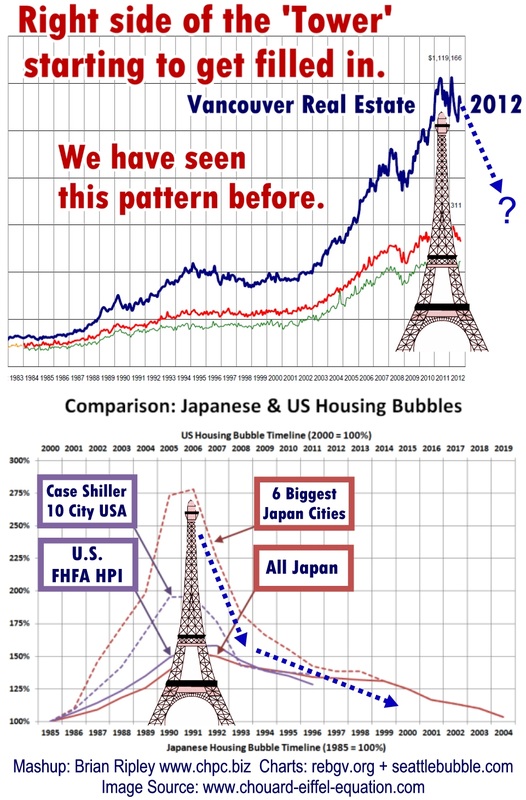
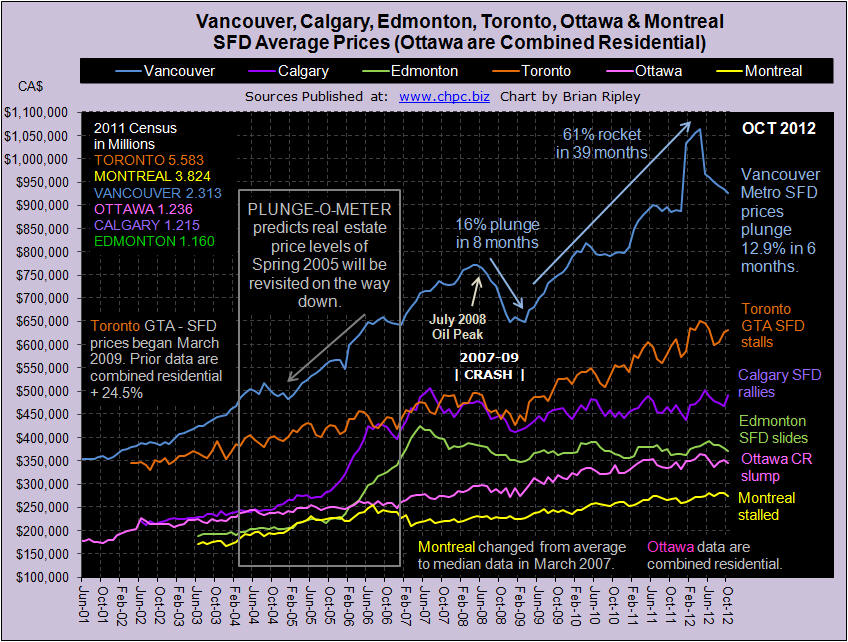
When prices go exponential, Chartists who track price series love to use the elegance of the Eiffel Tower as a metaphor. In short Vancouver Eiffelizes while Calgary Zooms.

The left side of the tower is exciting and for those who can time the ultimate exhaustion and exit point. They are rewarded… well exponentially. Vancouver average single family detached prices in October 2012 dropped again for a six month plunge of 12.9% and a loss of of $137,300 which is greater by 12% than the 2007-09 crash amount and the current plunge is a 77% retracement of the $177,329 gain since the beginning of the year (Vancouver Chart).

7496040 orig

But the right side of the tower is where exponential decay occurs and the trip down often has the right leg breaking well below the trend that was in place prior to the exponential move up. 

When it comes to real estate (a slow asset), the right leg can stretch out much further over time as evidenced by the Japanese experience.

As the downside trip gathers momentum, the market participants lower their expectations. We already hear real estate agents advising their client sellers to list their properties for sale below the last recorded comparable sale price to insure action and increase the probability of a successful transaction. 

The fear of missing out in Vancouver is being replaced with the fear of getting stuck.

3167201 orig

….read all the rest of Canadian City Pricing HERE 


test-php-789