Personal Finance

Reminder: This Is Going To Be A Huge Week For The Global Economy

We wrote about this yesterday, but if you’re just tuning in now, here’s a reminder that it’s going to be a huge week for the economy.

There’s been a lot of talk about how the economy is mending. Now it’s time for the data to do the talking.

Here’s what we got:

Monday: Durable Goods Orders, analysts expect 1.6% growth.

Tuesday:  Case-Shiller Home Price Index, analyst expect a 5.2% growth. Consumer Confidence.

Wednesday: ADP Jobs Report, GDP advance reading.

Thursday: Challenger Job Cuts, Initial Jobless Claims, Personal Income and Spending, Chicago PMI

FRIDAY: This is the big day. Starting in Asia its PMI day, when countries all around the world reveal the health of their manufacturing activity. That starts with China and Korea, and then goes through Asia, ending up in the US Friday morning. This will give us a great read on how things have gone in January for the entire globe.

In addition to PMI day that day, we’ll get Non-Farm Payrolls (analysts expect 180K), the unemployment rate (expected to stay flat at 7.7%), Construction Spending and Car and Truck Sales.

Recommended For You

7 Signs You Might Be Living Beyond Your Means

marie-antoinette-movieWhether you consider yourself to be financially responsible, or you always seem to come up short on cash, there are a few key indicators that may indicate you are living beyond your mean.
 

And being aware of them can save you loads of money woes in times of a cash emergency.


Be ready to pull the trigger

“Gold is on the verge of another failure, dangerously close to another leg Down not UP” – Larry Edelson

Unlimited money-printing from the Federal Reserve. Unlimited euro-printing from the European Central Bank. Unlimited yen-printing from the Bank of Japan …

North Korea about to stage a rocket test directed at striking the U.S. North Korea now threatening war with South Korea. Terrorist actions in Algiers. In Mali.

Bankrupt Spain. Greece. Italy. France going down the tubes. Britain on the edge of its third recession since 2008, with its fourth-quarter 2012 GDP contracting more than expected.

Unemployment in Spain’s 16-to-24 age group just hit 55% and overall unemployment, 26.6%, the worst in Spain’s history.

Washington in debt past its eyeballs, and desperate. So much so, it’s acting as though the debt doesn’t exist at all — once again kicking the issue down the road, this time to May 18. And more.
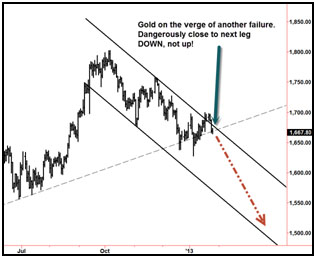
012813-img-01And gold is now nearly $257 below its all-time record high. It can barely rally.

Every time it does, the rally fades away and now, the price of gold is dangerously near an important weekly sell signal on my systems, which stands at $1,657.

I would love nothing more than to tell you that gold has finally embarked on its next leg up to $5,000-plus.

But the fact of the matter is that there is no evidence that it has. Period.

In fact, gold is telling you exactly the opposite: That there isn’t even record demand for gold right now. That instead, demand is actually slumping.

That more debts are about to be liquidated than the central banks can offset with money-printing.

And that inflation has not yet broken out to the upside.

That’s why I’m sticking to what my models say: The next phase of gold’s bull market (and all commodities for that matter) — is not yet here.

Which is precisely why I’m still not ready to stick my head out and load up on more gold. Nor should you.

My forecast — despite all the hate mail and pressure I get to change it — has also not changed: Based on my systems and models, I will not turn bullish again on gold until either …

A. Spot gold has closed above $1,823 an ounce on a weekly and monthly basis. Or …

B. Gold cracks the $1,527 level and plunges to the $1,400 level, and even a tad lower.

I know that’s not what you want to hear. I know that you are as eager as I am to see the next leg of gold’s bull market begin.

I know that you want to buy more gold, load up on it and ride it to glory over the next few years. So do I.

But when a market as sensitive as gold is to geopolitical events … as sensitive as gold is to money-printing and bankrupt governments … doesn’t do what logic says it should be doing, then something else must be going on. Markets are never wrong.

So what is gold really telling us? With all the money-printing going on, why hasn’t gold broken out yet?

With busted governments in Europe, why isn’t gold rallying?

With new war threats coming in from North Korea and from terrorists, why isn’t gold flying to the upside?

Why, in the face of all that, is gold instead dangerously close to issuing another weekly sell signal on my systems, and threatening to plunge anew?

To those of you looking for a fundamental explanation, the reasons are simple:

I see two major forces at work right now that are overpowering all the others …

First, money-printing — even when virtually all major central banks are doing it — means nothing when most of the money being printed is merely ending up sitting in the banks. I’ve said that before and it’s still largely the case.

It means consumers aren’t interested in adding to debt by increasing their borrowings and credit lines … and the velocity of money, or its turnover, is virtually non-existent.

Ditto for corporations that are conserving cash and largely paying down or refinancing debt rather than taking on new debt. Or choosing to buy back their own shares.

Second, fears of North Korea’s recent threats or renewed terrorist uprisings are — at this time — also actually suppressing gold. It’s causing just enough geopolitical uncertainty to put savvy investors in a “cash mode” of thinking … and not quite enough uncertainty to drive them directly into gold.

Both of the above forces will — down the road — become bullish forces for gold. But as those who recently attended the Weiss Wealth Summit in Florida already know from my presentation at the event, none of the above forces will become bullish until it’s time for them to do so.

And based on my work, that’s not likely until later this year. And from much lower prices in gold.

I know that’s difficult to understand. But do listen to the markets and what they are telling you. The markets, I repeat, are never wrong. Only the interpretations and expectations are.

So stay the course. Build up your stash of cash ammo so that when it does come time to pull the trigger on gold again and back up the truck, you will be able to.

Ditto for silver and other natural-resource and tangible-asset investments. While their time to shine is not here yet, it will come again, I assure you that.

You want to be fully ready and able to capitalize on these forces. If you listen to the pundits who proclaim the next bull market is here every time gold rallies $5 or $10 … or even $25, you won’t be ready. You’ll be far more likely to suffer massive losses. Ditto for silver.

Stay the course, build up your ammo, and be ready to pull the trigger when I issue a headline like “Back Up the Truck, NOW!”

Best wishes,

Larry

Larry Edelson has over 34 years of investing experience with a focus in the precious metals and natural resources markets. His Real Wealth Report (a monthly publication) and Power Portfolio provide a continuing education on natural resource investments, with recommendations aiming for both profit and risk management.

For more information on Real Wealth Reportclick here.
For more information on Power Portfolioclick here.


The Bottom Line: Historical Outperformance

The continuing short term stock market spurt triggered by better than expected fourth quarter results has provided an opportunity to take profits on strength on a wide variety of seasonal trades (e.g. agriculture, technology, semiconductors, biotech) and to rotate into other sectors that have a history of outperformance during the January to April period (e.g. energy, platinum, copper).

Economic focus this week is on two events: the FOMC decision to be released on Wednesday and the employment report on Friday. Both are expected to have a neutral impact on equity markets.

Short and intermediate technical indicators for most equity markets and sectors are overbought, but have yet to show significant signs of peaking.

February has been the second worst performing month for U.S. equity markets during the 1950-2012 periods.

History shows that U.S. equity markets in the year after a Presidential election move higher into January in conjunction with the fourth quarter earnings report season, weaken in February and March (when tough policies are enacted) , move higher into May and close the year at a high. History is repeating in 2013.

Cash and cash equivalents continue to pile up at the corporate level, but corporations are reluctant to commit to capital expansions due to political uncertainties related to the Sequester, U.S. budget, tax reform and the debt ceiling.

From a seasonal perspective, during post-presidential election years the market has shown losses on average once earnings season concludes into the start of February.   Losses top 2% between the end of the first week of February through to the last couple of days of the month.   From there, the market typically bottoms between the end of February and into March, rebounding higher in April and May.   Given the extent to which equity markets are overbought, some sort of pullback seems likely into February once the earnings season catalyst comes to an end.   This seasonal weakness during post-election years results from the president implementing much of the tough decisions according to his campaigned-upon mandate.   With deficit reduction talks continuing over the months ahead and the two key political parties remaining firm on varying degrees of balance between revenues and spending, politics could once again influence the market according to the average tendency during equivalent years. – via EquityClock.com HERE

clip image044 thumb3

The S&P 500 Index added 16.98 points (1.14%) last week. Intermediate trend is up. The Index closed at a five year high. The Index remains above its 20, 50 and 200 day moving averages. Short term momentum indicators remain overbought.

image thumb 14

The TSX Composite added another 90.34 points (0.71%) last week. Intermediate trend is up. The Index remains above its 20, 50 and 200 day moving averages. Strength relative to the TSX Composite Index remains neutral. Short term momentum indicators are overbought.

image thumb 16

The TSE Index has a history of positive relative performance between now and the first week in March.

image thumb 17

The S&P Energy Index gained 10.19 points (1.81%) last week. Intermediate trend is up. The Index remains above its 20, 50 and 200 day moving averages. Strength relative to the S&P 500 Index remains positive. Short term momentum indicators are overbought.

clip image028 thumb3

Gold eased $31.40 per ounce (1.97%) last week. Intermediate trend is neutral. The Index remains below its 50 day moving average and fell below its 20 and 200 day moving averages. Support is at 1,626.00. Gold fell back after an unsuccessful attempt to break above $1,700. Strength relative to the S&P 500 Index remains negative. Short term momentum indicators are rolling over from overbought levels.

clip image030 thumb3

Platinum gained $18.00 per ounce (1.08%) last week. Intermediate trend is up. Strength relative to gold remains positive.

clip image033 thumb3

……go HERE for Interest Rate, The TSX Metals & Mining Index, Commodities, Copper and many other Charts & Analysis on Don’s Brilliant Monday Report HERE


The Market Has Changed – Time To Sell The World

robot-evolution3The advent of computers and the internet have brought much change to the industry. Brokers are no longer required to trade stock; anyone can trade stock for less than $10 a trade. Algo-machines now represent probably well over 30% of daily volume on any exchange in a given day. These trading software platforms place and make trades in nanoseconds and often hold stocks for no more than 16 seconds. Just ask the guys at Tradebot
 

When I wrote last year that the S&P would hit 1500, most experts thought I was nuts. The fundamentals weren’t there to justify it, and to some degree they were right. But the market has changed. So much in fact that technicals, and a lot of what experts have studied throughout their careers, are no longer relevant – at least not entirely. 

Those who used to study technical charting patterns have never studied the effects of these machines. It’s a different world now. 

On the Canadian front, the big institutions are also benefitting from the little guys. They make trades for little cost and even get a kick back from the exchange based on the amount of trades they make. When everyone is scraping for pennies, you can bet the big guys are taking advantage of every retail trader they can by short selling and manipulating the markets any which way that benefits them. This isn’t hard to do given the liquidity issues in the Canadian market which makes it really difficult for companies to thrive. 

Market Expectations

Congress has pushed the debt ceiling deadline out to mid-May to give both sides more time to pound out a budget agreement, so there are strong reasons to expect a favorable seasonal rally to continue.

There still remains a tremendous amount of cash on the sidelines earning next to nothing in savings accounts and bond funds to fuel a further rally. And as I mentioned in my letter, “Time to Sell the World,” there is evidence that previously bearish investors who took money out of the stock market after 2008 are pouring back in. I also said that once the S&P pops passed 1500, we should all be much more careful as, “we have more downside than up at these levels.

The key to investing is to buy low and sell high; not buy high and sell higher. It may not necessarily happen this month, but I feel we’re closing in on a near-term top. I started this letter saying this is the best January for the Dow Industrials since 1994. What I didn’t tell you is that the best January in 1994 for the Dow Industrials was followed by a nasty decline of 10% the month after. 

I know investors remain bullish and sentiment has been pushed higher, but it’s time to start peddling back a little and let your money breathe. Even if just a little.

The market has been up 11 of the last 12 days…

Time to Sell the World?

I believe the markets have topped in many countries around the world, including Germany, France, and the UK. That means it’s probably time to sell Europe; the U.S. is getting very close. A rise above 1475 in the S&P next week could lead us to 1490. I predicted we would peak at 1500 last year within a twelve-month time frame, and we’re awfully close to that number. 

I am not saying it’s the end, but I we have more downside than up at these levels – especially in the short-term.

Next week may not be pretty for European markets. But then again, fundamentals haven’t mattered in years, why should technicals?

(Btw, Greek unemployment data was just released and it wasn’t good.  The broad unemployment rate for October has been revised to a new record high of 26.8%. The youth (15-24 age group) unemployment also rose to a new all-time high of 56.6%. The ratio of those employed (3.68MM) to unemployed (1.34MM) has now dropped to a record low 2.75x. What’s even more staggering is that the total number of inactive workers (3.34MM) could soon surpass all those who are working. Inactive are those persons who are neither classified as employed nor as unemployed.)

Inflationary Dragons

Bill Gross, the world’s largest bond fund manager and one of the smartest in the business, has been very bold in his statements regarding worldwide monetary and fiscal policy, and gold. 

In his most recent monthly investment outlook:

“Investors should be alert to the long-term inflationary thrust of such check writing. While they are not likely to breathe fire in 2013, the inflationary dragons lurk in the “out” years towards which long-term bond yields are measured. You should avoid them and confine your maturities and bond durations to short/intermediate targets supported by Fed policies. 

In addition, be aware of PIMCO’s continued concerns about the increasing ineffectiveness of quantitative easing with regards to the real economy. Zero-bound interest rates, QE maneuvering, and “essentially costless” check writing destroy financial business models and stunt investment decisions which offer increasingly lower ROIs and ROEs. 

Purchases of “paper” shares as opposed to investments in tangible productive investment assets become the likely preferred corporate choice. Those purchases may be initially supportive of stock prices but ultimately constraining of true wealth creation and real economic growth. 

At some future point, risk assets – stocks, corporate and high yield bonds – must recognize the difference. Bernanke’s dreams of economic revival, which would then lead to the day that investors can earn higher returns, may be an unattainable theoretical hope, in contrast to a future reality. Japan we are not, nor is Euroland or the U.K. – just yet. But “costless” check writing does indeed have a cost and checks cannot perpetually be written for free.“

Gross said that subject to the debt ceiling, the Fed is buying everything that Treasury can issue. He warns that we have this “conglomeration of monetary and fiscal policy” as not just the US is doing this but Japan and the Eurozone is doing this also.

Gross is a bond king, not a gold investor. But even he cannot stay away from the lustre of the shiny metal. 

On December 30, Gross tweeted:

“2013 Fearless Forecasts: 1) Stocks & bonds return less than 5%. 2) Unemployment stays at 7.5% or higher 3) Gold goes up……”

Gross may not always be right, and his timing not always be spot on, but he is certainly more right than wrong. And in the investment world, that makes him a superstar. 

Gold bears may want to rethink their strategy…

Ivan Lo

Equedia Weekly  

Questions?

Call Us Toll Free: 1-888-EQUEDIA (378-3342) 

The Hottest Place to Live Rich in Canada

The global Convergence of lifestyle – the addition of 6 billion people will ultimately impact the food chain. Saskatchewan has a unique place in this social dynamic. 

Add in the impact of a global population of 8 or 9 billion in the rest of the world by 2030 – 18 short years away.

This will be the longest commodity super cycle once the current credit cycle is fixed. The increase in QOL is unstoppable. Prices have risen only modestly relative to other super cycles.

Saskatchewan Has It All

Saskatchewan with 1 million people has it all. Get ready “Riders” the world is coming. 

Screen Shot 2013-01-25 at 10.25.28 AM

…..read the whole document HERE


test-php-789