
Stocks & Equities
A few weeks into the New Year, investors seem to be in a carefree mood. The traditional measures of volatility remain at extremely low levels. After all, the European economic crisis has calmed, budget negotiations in Washington aren’t front page news at the moment, and earnings season is unfurling without much drama (except for Apple’s (AAPL) sobering near-term outlook).
How little volatility is there in the market? The Volatility Index (VIX), which uses options trading activity as a gauge of investor fear, is at its lowest level in two years:

….read more HERE

Interest Rates will shoot higher and spike in 2013 said George Soros, the financier famous making over US$1 billion short selling the British Pound in 1992.
“It may already have begun,” Soros said of the move in rates. “I think it’s most likely to happen this year. Once you’re past the uncertainty about the budget and investment decisions are made I think you’ll see it.”
You have to respect Soros for his skill, timing and acumen. This former humble porter from Communist Hungary became a Billionaire Investor by developing his own theory of markets called ‘reflexivity’. He has laid out his theory in his recent books THE ALCHEMY OF FINANCE and THE CREDIT CRISIS OF 2008 AND WHAT IT MEANS. He also virtually invented Hedge Funds in 1973 by setting up the Quantum Fund, through which he accumulated a vast fortune (even before the British Pound Short).
…….more on Soros thoughs on Rising Rates and the Euro in this Peter Grandich suggested article HERE.
…… more again in this Soros article on Rising Rates, Europe, Japan and the US deficit HERE
Are we about to see a GREAT BOND MARKET MASSACRE like we did in 1994. By total surprise the Fed slammed on the brakes and caught the bond market completely off guard as Fed Chairman Alan Greenspan tried to ‘get ahead of the curve’.
The Question. Can you, or Western Governments handle a short term rate jump of 4% right now? As happened in 1994 as you can see in this Bank of Canada chart below. Mortgage rate jump of 3-5%? What happens if it goes even higher, like to the 15%-16% rates of the early 80’s? Some of the numbers below the chart certainly suggest it could be much worse than 1994.

There are stunning similarities and some dangerously different aspects between 1994 and 2013:
In January 1994 before the crash began bond yields were historically low with a 30-year Treasury yield of 6.2% .
In January 2013 before any crash starts bond yields are historically low with the 30-year Treasury yield at 3.19% now
In 1994 the economy was in the 34th month of economic expansion and Governments worldwide were no where near as in debt as a percentage of GDP as they are now.
In 2013 the Western Economies have been sketchy at best and the US is more Broke than ever in History. France is Bankrupt and Britain is losing its Triple A Debt Rating.
In the year before January 1994 the inflation rate averaged 2.96 %
In the year before January 2013 the inflation rate averaged 2.07 %
No wonder the Bank of America issued this warning some days ago:
Bank of America issues `bond crash’ alert on Fed tightening fears
The return of confidence and healthy growth in the US risks setting off a “bond crash” comparable to 1994 and triggering a string of upsets across the world, Bank of America has warned.
…..the whole warning HERE
Your Money Talks Editor put this together – You can Email HERE

Bob takes on the STOCK MARKET, CURRENCIES, COMMODITIES, PRECIOUS METALS, and the FED
PERSPECTIVE
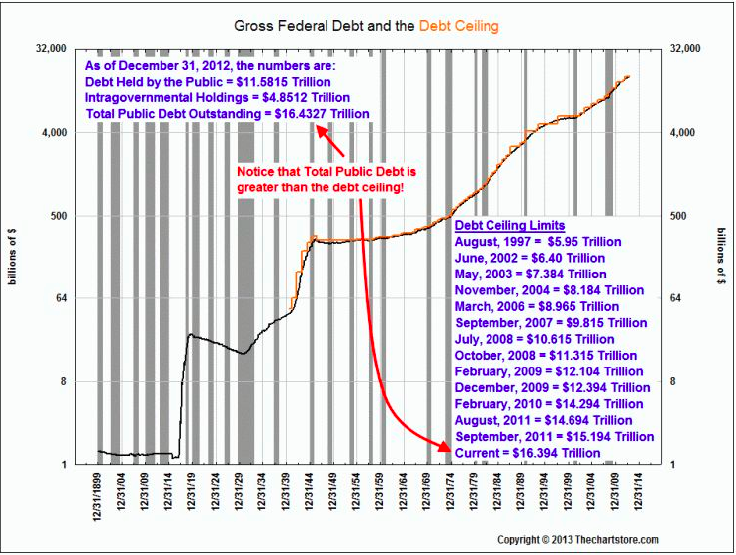
Well, the debt ceiling number has always been there, but it is often changed, when it is expedient. Never down and always up, and lately, with some drama. However, it does provide a chance for a voice of sobriety. The attached chart by Ron Griess shows that the debt level already exceeds the “limit”.
The political drama could more specifically be called “Theatre of the Absurd”. Only popular with the participants; the public and the markets could soon say “Enough!”.
While we can hardly restrain our anticipation of such a revulsion, it would be prudent to watch the charts.
…..go HERE for the entire article including:
After spending more than 50 years in foreign hands, Germany’s gold is finally going home.
In a recent watershed decision the Bundesbank, Germany’s central bank, has decided at least half of its gold should be held in its own vaults.
Since the Bundesbank is the second-largest gold holder in the world, that’s going to mean moving 54,000 bars of the shiny metal.

According to Der Spiegel:
“Finally, in 2007, “following numerous enquiries,” Bundesbank staff members were allowed to see the facility, but they reportedly only made it to the anteroom of the German reserves.
So why would the Federal Reserve deny the Bundesbank a full inspection and audit?
That question has been rich feed for the rumor mills ever since the news broke.
It shouldn’t take until 2020 for it to make its way back home. Seven months — maybe. Seven years means something else is up.
So let’s have a closer look at the surrounding facts…
….whole article HERE

“Money is not the only answer, but it makes a difference” – President Obama
Here’s the article reference: Senior Obama Official: “We Are Going To Kill The Dollar”. Youtube 1:13 video of the original interview HERE
Has the first currency crisis begun?
by Toby Connor
I expect the eventual endgame to this whole Keynesian monetary experiment that has been going on ever since World War II to finally terminate in a global currency crisis. I’m starting to wonder if we aren’t seeing the first domino start to topple.
I’m talking about the Japanese yen of course.
I think everyone just naturally assumes that the yen is dropping in response to Prime Minister Abe’s intent to imitate U.S. policy and print its way out of its troubles. The problem with this strategy is, of course, eventually Japan will break its currency. Japan is in a particularly tenuous situation in that their debt-to-GDP dwarfs most of the rest of the world. The only hope they have of servicing this debt is for interest rates to stay basically at zero.
Any move by interest rates above this artificially low level and Japan’s debt becomes unserviceable, without resorting to a greater and greater debasement of the currency. Unfortunately that will also result in an acceleration of the collapse of the currency, which would just cause Japanese bonds to be sold even more aggressively — a nasty catch-22 situation.
At this point there is no way out for Japan. The only question is when the endgame will arrive? Japanese bond bears have been asking themselves this question for almost two decades.
The recent move in the yen has started me wondering if that end game hasn’t now begun.
In the chart below I have marked the successive yearly cycle lows with blue arrows. As you can see this major cycle bottom tends to arrive between March and May most years. If the 2013 yearly cycle low arrives in the normal timing band, then there may be a big problem developing with the Japanese currency. The reason I say that is because the Japanese yen is basically already in free fall and we may still have another one-three months to go before a final bottom.

…..read & view 2 more charts on page 2 HERE

-
I know Mike is a very solid investor and respect his opinions very much. So if he says pay attention to this or that - I will.
~ Dale G.
-
I've started managing my own investments so view Michael's site as a one-stop shop from which to get information and perspectives.
~ Dave E.
-
Michael offers easy reading, honest, common sense information that anyone can use in a practical manner.
~ der_al.
-
A sane voice in a scrambled investment world.
~ Ed R.
Inside Edge Pro Contributors

Greg Weldon

Josef Schachter

Tyler Bollhorn

Ryan Irvine

Paul Beattie

Martin Straith

Patrick Ceresna

Mark Leibovit

James Thorne

Victor Adair