
Stocks & Equities
Rolls-Royce, Ferrari, Bentley, Lamborghini, Porsche, Aston-Martin, Maserati, BMW, Jaguar, Audi, Alfa Romeo
When I was a teenager, I dreamed about owning a Porsche or Ferrari. Of course, that was when I had no cash and even less in the way of brains.
Alas, I will forever be the son of a frugal farmer. So, a Ford or Chevy pickup will do just fine for me, thank you.
But hey, a lot of people feel very differently. Wherever I go in the United States, I see a lot of BMWs, Mercedes, Range Rovers, and other expensive luxury/sports cars.
What amazes me, however, is the number of luxury cars I see in Asia.
The streets of Tokyo, Taipei, Singapore, Kuala Lumpur, Bangkok, Shanghai, and Beijing have just as many — if not more — of those high-priced luxury/sports cars as any city in the United States.
That’s quite a change from 20 years ago when the primary mode of transportation in China was a bicycle. Those days are long gone, and a whole new era … and the whole new set of investing opportunities that come along with it … is upon us.
Today the streets of major Chinese cities, such as Beijing and Shanghai, are so clogged with cars that it can take hours to travel just a couple of miles.
In fact, China is now the largest auto market in the world, and car-makers from all over the world are tripping over each other to get into China.
Those carmakers gathered at the 2013 Shanghai Auto Show, the largest event of the year for the automobile industry.
Yup, you read that right — with 1,300 cars showcased this year, including the debut of more than 100 new models, it’s even bigger than the Detroit Auto Show!
The World’s Top Auto Market
Aims to Keep Ruling the Road
China has been the leading auto market in the world since 2009. But consulting firm McKinsey & Co. predicts it is going to get even-bigger.
Some 200 million Chinese have driver’s licenses, and McKinsey expects auto sales there will grow by an average of 8% a year between now and 2020.
But even though the typical car buyer is about a decade younger than his or her U.S. counterpart, as the CEO of Jaguar Land Rover told CNBC last week, they’re not intent on buying old beaters or simple models to get them from Point A to B.
Instead, they want something that screams “status car,” to reflect their growing incomes and the place in society they’re increasingly occupying.
That’s why China’s luxury-vehicle market is where the big bucks are being made. And that’s a market you can easily tap into without putting a single mile on your own car!
Big Price Tags,
Bigger Potential Profits
Every carmaker in the world — including Rolls-Royce, Porsche, Ferrari, Bentley and Lamborghini — from 20 countries flocks to Shanghai for good reason: to get in front of China’s growing pool of potential buyers.
McKinsey expects luxury cars sales to grow by an impressive 12% a year over the same period.
This leaves the potential for them to go even-higher because “Demand outstrips supply for our vehicles,” said Klaus Maier, the president of the China Mercedes-Benz division, as he recently told Bloomberg.
If you want to tap into the luxury auto boom, there are several ways to do so. Here are four “options” that could pick up some serious momentum …
Option #1: BMW (BAMXY.PK). BMW are extremely popular in China. Last year, sales there soared by an amazing 40% to 326,000 vehicles.
BMW, by the way, also owns the Rolls-Royce and Mini brands.
Option #2: Porsche (POAHY.PK). The younger Chinese millionaires prefer speed over comfort, and Porsche is making a killing in China.
Not surprisingly, Porsche just announced that it enjoyed its best March EVER in company history.
The company sold 37,009 cars in the first quarter, a 21% increase, but a big chunk of that gain came from China. There, Porsche sold 8,844 cars in the first quarter, a 25% bump from the same period last year.
Plus, Porsche has a nice kicker in that it owns 18% of Volkswagen, so you get both VW and Audi exposure when you buy Porsche stock.

Even though these higher-end vehicles may cost a pretty penny, that doesn’t mean they won’t require some serious upkeep over the years.
And so, you may want to look toward a pair of Chinese auto parts stocks that are traded in the United States on the Nasdaq that could benefit from China’s car-buying boom:
Option #3: Chinese Automotive Systems (CAAS), a leading supplier of power-steering components and systems for Chinese passenger automobiles and commercial vehicles.
Option #4: SORL Auto Parts (SORL) is a leading supplier of automotive brake systems and other key safety-related auto parts to automotive original equipment manufacturers, or OEMs.
Of course, as we discussed earlier this week, China’s economy “only” grew by 7.7% in the first quarter. So all the doomsayers are keeping a close eye on whether consumers are saving or spending their money.
But when it comes to luxury items like cars that many newly affluent citizens crave, I expect any potential shift in sales figures to be a mere pothole on the way to higher stock prices.
In fact, my Asian Century subscribers recently closed out a 100%-plus gain in just about eight weeks in an Asia-based car-maker. And just this week, I recommended another name that caters to a wide variety of Chinese and other global car buyers.
This stock is already in positive territory, and my research tells me it’s on the right track to zoom higher!
As always, if you’re doing this on your own, you need to do your homework and decide whether any of these securities are appropriate for your personal situation.
But as you know, timing is everything when it comes to investing. And there’s still time to get in on this new position in my trading service, The Asian Century. Click here now to claim your risk-free trial membership today!
Best wishes,
Tony
 Related: Supercars.net & The 2013 Shanghai Auto Show, the largest event of the year for the automobile industry.
P.S. To get all the names of my favorite stocks — what’s working today AND what to buy as Asia’s growth continues to explode — get on board with all the profit opportunities The Asian Century offers today. Click here to get started right away!

“Gold futures & the Gold Bug’s Index (HUI), have turned higher”
Our friend Chuck Cohen, a gold timer with a proven gift for knowing when to bet against the crowd, phoned the other day with urgent advice. Almost no one sees it coming, he said, but bullion is getting ready to explode. “It’s time to jump in head-first!”
Chuck has been wrong before, and we’d all but tuned him out for the last eight months or so, since his bullish drumbeat went against the asphyxiating weight of bullion charts that have shouted “lower” since last October. Now, he says, the winning bet is to be short stocks and long gold and silver. Will he be right? From a technical standpoint, it’s still too early to tell. To be sure, some key vehicles, including gold futures and the Gold Bug’s Index (HUI), have turned higher from levels that coincide with Hidden Pivot correction targets of our own. But the bounce so far, especially in Comex quotes, seems tentative at best. Moreover, this is occurring at a time when the juggernaut of deflation is threatening to overwhelm the central banks’ desperate efforts to thwart the collapse of a quadrillion dollar financial-asset bubble.
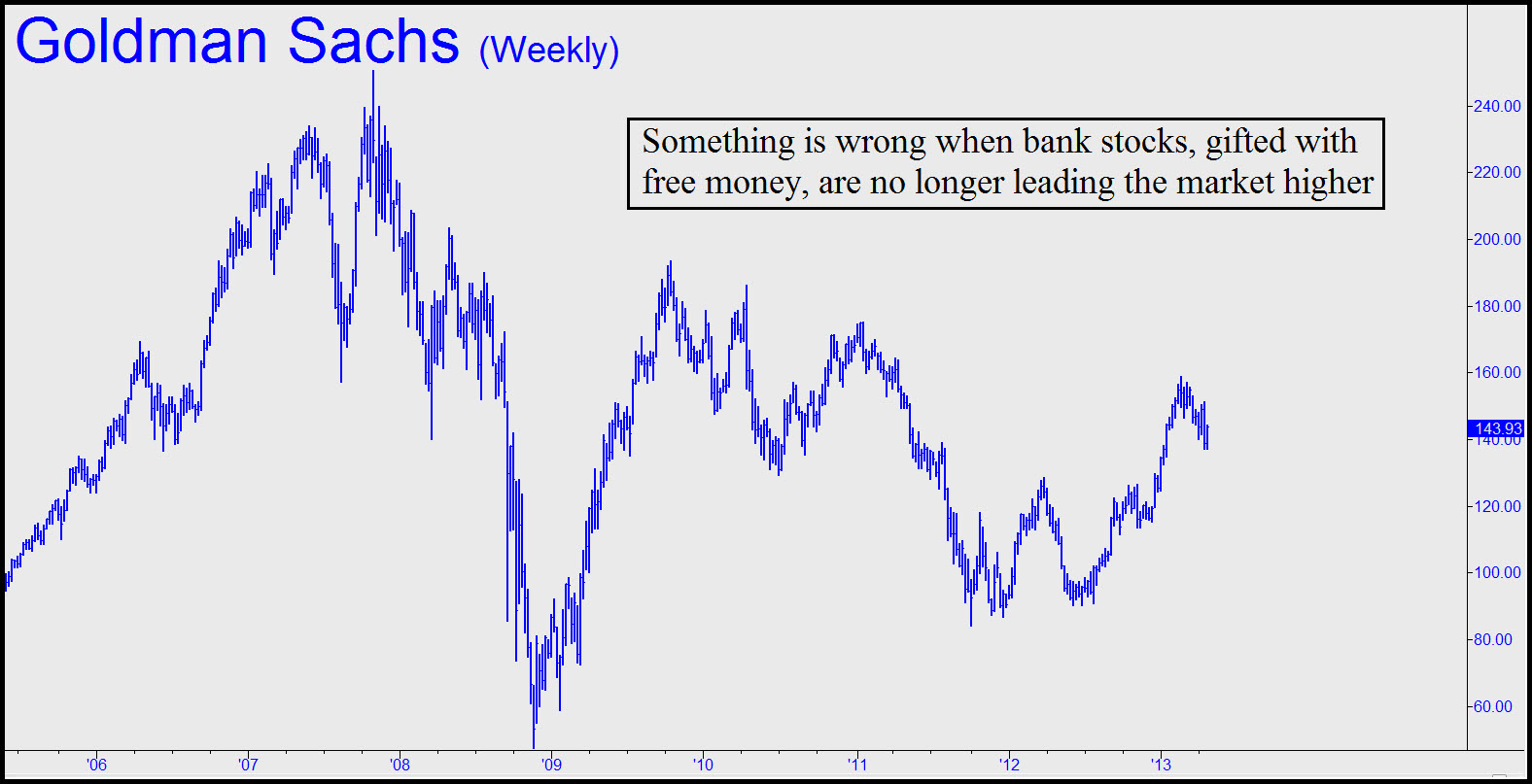
All things considered, we’re inclined to give Chuck the benefit of the doubt right now. Here are some persuasive points that he makes:
- Sentiment indicators suggest that gold is the leper of the investment world, with Rydex bulls currently at an astounding 2%.
- Shares of mining companies with real gold and silver in the ground, juniors in particular, have collapsed beyond the point of despair.
- As the price of paper gold has fallen in recent weeks, physical supplies have tightened sharply.
- Mining-share options are trading at giveaway volatilities.
IN ADDITION, CHUCK NOTES SOME TROUBLING SIGNS ON WALL STREET:
- Bull-mania has been brazenly flouting weaker corporate earnings, stagnant incomes and fizzling retail sales.
- With the Dow in record territory, institutional buyers have turned defensive, focusing on health care, big pharma and consumer staples.
- Ominously, the banking sector has turned weak even though it is by far the biggest beneficiary of a global money blowout.
- With respect to seasonality, the month of May has typically been anything but merry.
- Europe’s deepening recession has become intractable.
- China’s economy is turning down as well.
A MAJOR TURNING POINT?
All of these factors suggest that stocks, bullion and financial assets could be at a major turning point. If this proves to be the case, and it leads to the epiphany that quantitative easing isn’t working, a stepped-up response by the central banks could be the signal that bullion markets have long awaited.
In the meantime, we’ve been recommending bottom-fishing in gold futures, GDXJ, HUI and some other popular bullion vehicles, since we know how difficult it will be, psychologically speaking, to buy these erstwhile dogs after they’ve exploded for 15%-20% gains in mere days. That is how great bull markets often begin, and the only way to avoid being shut out is to be aboard before they begin. This is the lesson we learned when stocks took off in August of 1982 with a burst of ebullience and power such as we had never before witnessed. It’s going to happen in bullion sooner or later; but even if not now, with shares and T-bonds wafting ever higher on a sea of brazen lies, our gut instinct is telling us that this is no time for bullion bulls to throw in the towel.

 About six months ago everyone on TV and across the web was pretty much saying Apple’s stock would never go down. They said $1,000 for Apple shares was a foregone conclusion. And Apple shares certainly wouldn’t go down under $400 a share, that would be absurd to even consider. Well, yes, Apple shares most certainly have gone lower than $400 a share, and Apple shares are still hanging around $400 even after increasing their share buyback plan to $60 billion and raising their dividend.
And The Goofy Goes To:
Jim Cramer: “Thinking of Apple as a $1,000 stock is not “irrationally exuberant” as some have claimed, but likely a foregone conclusion.”
Andy Zaky: “Apple will reach $1,000 in late December or early January 2014″; His Apple hedge fund – yes he only bought Apple shares for his fund – lost millions.
James Altucher: “Apple is definitely undervalued. It could easily find its way to $1,000.”
Gene Munster: “Now Munster is upping the ante, calling for Apple to reach $1,000 a share by 2014 and become the first U.S. company worth $1 trillion.”
Steve Wozniak: “People talk about $1000 stock price. At first you want to doubt it, but I actually believe that, and I don’t follow stock markets. Apple has that much growth left.”
Shebly Seyrafi of FBN Securities: “AAPL continues to be a strong new product story,” the analyst writes. “It has the iPhone 5 shipping soon, it is expected to have a new iPad mini shipping in FY Q1, China Mobile is a large opportunity for AAPL starting next year and the iTV is generally expected to be launched over the next year or so
Brian White of Topeka Capital: “Driven by an ever expanding portfolio of innovative products, a growing integrated digital grid, unmatched aesthetics and a brand that is able to touch the soul of consumers of all backgrounds, Apple fever is spreading like a wildfire around the world and we see no end in sight to this trend.”

LONDON—The bond markets and the economies of Europe’s troubled countries tell two very different stories this year: The one is rallying, the other sinking.
In July 2012, Italian 10-year bonds yielded more than 6%; this week they fell below 4%. Falling yields mean rising prices. The Italian economy, meanwhile, has been ugly. Gross-domestic product in the fourth quarter of 2012 slid 2.8% from the same period in 2011, the sharpest quarterly fall since 2009. Italian unemployment was 11.6% in February, up from 10.6% in July. The tale is similar in Spain.
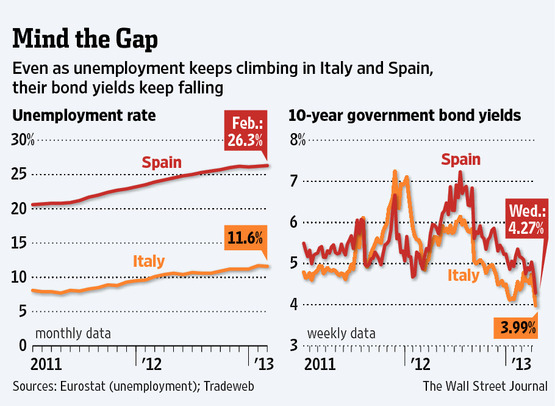
The bond-market rally has broad implications for the euro zone. At a basic level, access to financing is the measure of the crisis. Greece, Ireland, Portugal and Cyprus ultimately needed bailouts because they couldn’t persuade investors to lend them money. Spain and Italy can avoid similar fates so long as investors are buying bonds.
Right now, demand seems robust:
…..read more HERE
….and we are not seeing the Economic Growth story being supported in the Commodities Market
“There are some people now calling for DHIA 18,000 or 20,000 by year end,” “The S&P could then easily drop by 40%. the market needed the correction” starting in February or March, it did not correct, pull back, just dipped and buyers bought the dips into record territory.I thought maybe we were in a year like 1987, where the market goes up strongly between 1 Jan and 25 Aug. 25,. The market went up by 40% and then it crashed by 40% in 2 months’- Mr. Faber said in a recent TV interview.
Marc Faber – Gold Won’t Be Enough To Save You
Marc Faber : Gold is as Oversold as we were during the Crash in 1987
Marc Faber : The Government just fattens the pigs before they lead them to slaughter


-
I know Mike is a very solid investor and respect his opinions very much. So if he says pay attention to this or that - I will.
~ Dale G.
-
I've started managing my own investments so view Michael's site as a one-stop shop from which to get information and perspectives.
~ Dave E.
-
Michael offers easy reading, honest, common sense information that anyone can use in a practical manner.
~ der_al.
-
A sane voice in a scrambled investment world.
~ Ed R.
Inside Edge Pro Contributors

Greg Weldon

Josef Schachter

Tyler Bollhorn

Ryan Irvine

Paul Beattie

Martin Straith

Patrick Ceresna

Mark Leibovit

James Thorne

Victor Adair