
Bonds & Interest Rates
“No one can remotely think the Fed’s, or Obama’s, policies are a success, here’s just a few facts”
As a general rule, the most successful man in life is the man who has the best information
Alan Greenspan was chairman of the Federal Reserve from 1987 to early 2006. Greenspan used monetary policy to ignite one of the longest economic booms in history. Of course booms can soon turn to bust and nowhere was the boom more evident than in the housing industry – the sub-prime crisis collapsed the housing boom just after Greenspan left the Fed.
Sub-Prime Crisis
“The banking problems of the ’80s and ’90s came primarily, but not exclusively, from unsound real estate lending.” L. William Seidman, former chairman of both the Federal Deposit Insurance Corporation (FDIC) and the Resolution Trust Corporation
Between 1997 and 2005 mortgage fraud increased by 1,411 percent. In 2001 the US Federal Reserve lowered the Federal funds rate eleven times, from 6.5 percent to 1.75 percent. Mortgage denial rates were 28 percent in 1997, in 2002 – 2003 they were 14 percent for conventional home purchase loans. “Fog the mirror loans” were common, if you breathed you got a loan.
In June 2002 President George W. Bush set out to increase minority home ownership by 5.5 million. Bush’s lofty goals would be accomplished by tax credits, subsidies and Fannie Mae committing $440 billion to establish Neighbor Works America.
In June 2003 Federal Reserve Chair Alan Greenspan lowered the federal reserve’s key interest rate to one percent – the lowest rate in 45 years.
Throughout 2003 Fannie Mae and Freddie Mac bought $81 billion in subprime securities. President Bush signed the American Dream Down payment Act – the Act provided a maximum down payment assistance grant of either $10,000 or six percent of the purchase price of the home, whichever was greater.
U.S. homeownership rate peaked to an all time high of 69.2 percent in 2004.
From 2004 to 2006 Fannie Mae and Freddie Mac purchased $434 billion in securities backed by subprime loans.
In late 2004 the Securities Exchange Commission (SEC) suspended net capital rule for five firms – Goldman Sachs, Merrill Lynch, Lehman Brothers, Bear Stearns and Morgan Stanley. Free from government imposed limits on the amount of debt they could assume, they all levered up, as much as 40 to 1.
The United States housing market bubble burst in the fall of 2005. By year-end a total of 846,982 properties were in some stage of foreclosure. From the fourth quarter of 2005 to the first quarter of 2006, median prices nationwide dropped off 3.3 percent.
The U.S. Home Construction Index was down over 40 percent as of August 2006. A total of 1,259,118 foreclosures were filed in 2006, up 42 percent from 2005. Homeowners were going underwater (they owed more than the house was worth) and many had had questionable credit to start with.
In 2007, lenders started foreclosure proceedings on nearly 1.3 million properties, a 79 percent increase over 2006.
Foreclosure proceedings increased to 2.3 million in 2008, an 81 percent increase over 2007 and increased by another half million in 2009 to 2.8 million. By January 2008, the mortgage delinquency rate had risen to 21 percent and by May 2008 it was 25 percent.
By August 2008, 9.2 percent of all U.S. mortgages outstanding were either delinquent or in foreclosure. By September 2009, this had risen to 14.4 percent.
From September 2008 to September 2012, there were approximately 3.9 million completed foreclosures in the U.S. As of September 2012, approximately 1.4 million homes, or 3.3 Percent of all homes with a mortgage were in some stage of foreclosure compared to 1.5 million, or 3.5 percent, in September 2011.
Causes
The Great Recession started in December of 2007 and took a sharp downward turn in September 2008. It was started by the U.S. sub-prime crisis which burst the housing bubble. Businesses failed, consumers lost wealth estimated in the trillions of dollars and economic activity and international trade slowed.
So what caused the real estate crisis? Three things stand out:
Irrational exuberance – irrational exuberance was caused by a deliberate easy credit fueled boom.
“Most economists now believe that low, stable, and—most important—predictable inflation is good for an economy. If inflation is low and predictable, it is easier to capture it in price-adjustment contracts and interest rates, reducing its distortionary impact. Moreover, knowing that prices will be slightly higher in the future gives consumers an incentive to make purchases sooner, which boosts economic activity.” Ceyda Oner,Inflation: Prices on the Rise
In other words, economic growth – prosperity at the national level – can be driven by consumption. Saving is bad because money sitting in bank accounts will not stimulate the economy. The world’s central bankers believe inflation is necessary because it discourages the hoarding of money and encourages consumers to consume.
“In January of 1959, the personal savings rate in the United States was 8.3 percent – this means that, on average, Americans were able to save 8.3 percent of their disposable incomes. In the early 70s, the average savings rate started to spike, hitting a peak of 14.6% in May of 1975. The spike in personal savings rates from 1973 to 1975 coincided with the deep recession that was ravaging the country over the same period of time…The recession of the early ’80s was a particularly nasty mix of high inflation and weak economic activity, otherwise known as “stagflation”.
The average savings rate spiked to 12.2% in November of 1981, which was right when the national unemployment rate in the country really started to trend higher.
The average savings rate pulled back when the economy started to recover, spiked over 10% once again in 1984, and then really started to noticeably pull back in the mid ’80s. Consumer confidence was rapidly improving in the country, Ronald Reagan swept to victory on the back of a strengthening economy, and people were starting to spend their money once again. It was “morning in America”. There was another recession in the early ’90s, but no noticeable increase in the average savings rate. As a matter of fact, the savings rate of the average American held steady during the recession of the early ’90s, and then proceeded to fall like a stone throughout the rest of the decade.
By January 2000, the average savings rate was 3.5% – it would end up falling below 1.0% multiple times between 2000 and 2010.
Why the dramatic drop in the average rate of savings between 1990 and 2008?
The mindset of the average US consumer changed. There was greater access to credit and increasingly sophisticated marketing campaigns that had people cracking open their wallets or purses in droves.
Due to the surge of available credit, many people actually maintained negative savings rates. I’m sure that we all have known somebody who has spent more than what they made – this was all made possible through the explosion of available credit.
This access to credit made people want to spend, and marketers exploited this to the nth degree. People were flush with cash (and credit) in the post 9-11 economy. Interest rates were low, the real estate market was strong and many people were in a mood to spend. And spend they did.” Savings Rates In The United States Have Collapsed Since Mid ’80s, Manuel.com
The personal saving rate for Americans was a record low at the height of the housing bubble.
Moral hazard – in economic theory, a moral hazard is a situation where a party will have a tendency to take risks because the costs that could incur will not be felt by the party taking the risk. In other words, it is a tendency to be more willing to take a risk, knowing that the potential costs or burdens of taking such risk will be borne, in whole or in part, by others – Wikipedia.
Almost 100 international banking crises have occurred during the last 20 years, according to the World Bank all were resolved by bailouts at taxpayer expense.
“The risks inherent in mortgage lending became so widely dispersed that no one was forced to worry about the quality of any single loan. As shaky mortgages were combined, diluting any problems into a larger pool, the incentive for responsibility was undermined.” Mark Zandi, Moody’s Analytics
Forbearance – banks, mortgage underwriters and other lenders abandoned any pretense of having loan standards and having applicants meet any normal level of criteria such as:
- Employment history
- Income
- Down payment
- Credit rating
- Assets
Q: Who cared or asked about property loan-to-value ratio and debt-servicing abilities?
A: No one.
“Where the Fed really failed was as a regulator. It could have gone after the predatory lending in the subprime world, if it had wanted to. At least one Fed governor suggested doing so. Greenspan rebuffed him. Counter-factuals are always tricky, but if the Fed had clamped down on the endemic fraud in the mortgage market, it’s not difficult to imagine the run-up in housing prices being much more muted. After all, if the problem had been low interest rates, prices should have skyrocketed across the board. That prices only skyrocketed for housing tells us that something peculiar was going on there, namely an abdication of any regulatory oversight.” Matthew O’Brian, Happy Birthday, Alan Greenspan, the Atlantic.com
This was an overall decline in regulatory oversight known as forbearance.
“During a period of strong global growth, growing capital flows, and prolonged stability earlier this decade, market participants sought higher yields without an adequate appreciation of the risks and failed to exercise proper due diligence. At the same time, weak underwriting standards, unsound risk management practices, increasingly complex and opaque financial products, and consequent excessive leverage combined to create vulnerabilities in the system. Policy-makers, regulators and supervisors, in some advanced countries, did not adequately appreciate and address the risks building up in financial markets, keep pace with financial innovation, or take into account the systemic ramifications of domestic regulatory actions.” Declaration of the Summit on Financial Markets and the World Economy. dated 15 November 2008
The U.S. Financial Crisis Inquiry Commission, in January 2011, concluded “the crisis was avoidable and was caused by: Widespread failures in financial regulation, including the Federal Reserve’s failure to stem the tide of toxic mortgages; Dramatic breakdowns in corporate governance including too many financial firms acting recklessly and taking on too much risk; An explosive mix of excessive borrowing and risk by households and Wall Street that put the financial system on a collision course with crisis; Key policy makers ill prepared for the crisis, lacking a full understanding of the financial system they oversaw; and systemic breaches in accountability and ethics at all levels.”
The sub-prime mortgage crisis and collapsing housing industry threatened the U.S. economy, as the crisis started to spiral out of control and go global, the Fed had to act, and it did.
Economic Stimulus Goes Steroidal
After Fed chairman Greenspan left office, the Federal Reserve, under the stewardship of new chairman Ben Bernanke, started easing monetary policy aggressively. By December of 2008, the federal funds rate was between 0 and 1/4 percent. The Fed had used up its traditional stimulus, all the ‘Creature from Jekyll Island’ had left was the ability to print money so they started throwing cash at everything.
Additional stimulus was injected into the economy by:
The System Open Market Account (SOMA) purchased mortgage-backed securities guaranteed by Fannie Mae, Freddie Mac, and Ginnie Mae (agency MBS).
The Term Auction Facility was $40 billion in loans to rescue the banks. It wasn’t near enough, the Treasury department got authorization to spend $150 billion more to subsidize and eventually take over Fannie Mae and Freddie Mac, they also bailed out AIG.
Dollar Swap Lines exchanged dollars with foreign central banks for foreign currency to help address disruptions in dollar funding markets abroad.
The Term Securities Lending Facility auctioned loans of U.S. Treasury securities to primary dealers against eligible collateral.
The Primary Dealer Credit Facility provided overnight cash loans to primary dealers against eligible collateral.
The Asset-Backed Commercial Paper Money Market Mutual Fund Liquidity Facilityprovided loans to depository institutions and their affiliates to finance purchases of eligible asset-backed commercial paper from money market mutual funds.
The Commercial Paper Funding Facility provided loans to a special purpose vehicle to finance purchases of new issues of asset-backed commercial paper and unsecured commercial paper from eligible issuers.
The Term Asset-Backed Securities Loan Facility supported the issuance of asset-backed securities (ABS) collateralized by loans related to autos, credit cards, education, and small businesses. In March 2009, the Fed announced that it was expanding the scope of the TALF program to allow loans against additional types of collateral.
The Troubled Asset Recovery Program was proposed and $350 billion was approved by Congress – the money was used to buy bank and automotive stocks.
Late in 2008 there was a run on ultra safe money market accounts – according to AMG Data Services a record $140 billion was pulled out in one day.
In response to the continuing crisis and a stalling economy the US Federal Reserve initiated Quantitative Easing and Operation Twist.
Quantitative Easing
In September of 2008 the $1.7 trillion QE1 was started. The Fed purchased mostly mortgage backed securities and established a commercial paper lending facility.
In October of 2010 QE2 started. At $600 billion, QE2 was much smaller then QE1 and its buying was mostly confined to purchasing long term government bonds.
QE1 & QE2 failed to restart the economy and housing market.
Operation Twist
Operation Twist is the Fed’s initiative of buying longer-term Treasuries while simultaneously selling shorter-dated issues in order to bring down long-term interest rates.
By purchasing longer-term bonds, the Fed drives up prices which forces yields down – price and yield move in opposite directions. Selling shorter-term bonds causes their yields to go up because their prices fall. These two actions “twist” the shape of the yield curve, hence the name Operation Twist.
Quantitative Easing Three, QE3
On September 13, 2012, the Fed announced that it would buy $40 billion a month of mortgage-backed securities until the unemployment rate fell below 6.5 percent, or the expected inflation rate rose above 2.5 percent. In December the Fed added buying $45 billion/month of longer-term Treasury securities per month – QE3 is more than one trillion dollars a year.
In 1Q2013, which comprised the first three months of QE3, the Fed increased the size of its balance sheet by $285 billion, or 9.8 percent.
During the first 3 months of QE3, the Fed increased the monetary base by 10.83 percent.
Report Card
U.S. labor force participation is now down to where it was in 1979 – 63.3 percent. The unprecedented 2.5 percentage point decline in labor force participation under President Obama amounts to 6.2 million Americans being pushed out of the job market – 6,200,000 have stopped looking for work, these people have been forced to give up.

If labor force participation had remained at the 65.8 percent level it was at when Obama took over from Bush the unemployment rate for March would have been reported at 11.1 percent – that equates to a 3.1 percentage point rise during Obama’s presidency.
In the final quarter of 2012, the US economy expanded at an annual rate of 0.4 percent. The 0.4 percent growth rate for the gross domestic product (GDP) was the weakest quarterly performance in almost two years.
For all of 2012, the economy grew 2.2 percent, that’s after a 1.8 percent increase in 2011 and a 2.4 percent advance in 2010. Since the recession ended in the summer of 2009 the economy has been expanding at sub-par rates.
The Congressional Budget Office (CBO) has estimated that the combination of tax increases and spending cuts (the much talked about fiscal cliff) could trim economic growth this year by 1.5 percentage points leaving just 1.4 percentage points for growth in 2013. If the CBO’s estimates of just 1.4 percent real GDP growth this year prove true, America will have experienced its worst four consecutive growth years of GDP in the Bureau of Economic Analysis’ data going back to 1930.
There can’t be anyone even remotely thinking the Fed’s, or Obama’s, policies are a success, here’s just a few facts:
- Medium household income has declined
- Inflation is climbing much higher and faster than officially reported statistics
- Few Americans own any significant amount of financial wealth
- Housing has not recovered
- U.S. Employment rate is not recovering
- Consumer goods prices are not stable
- The number of Americans living in poverty has now reached a level not seen since the 1960s. There are 50 million poor people in America
- There are over 47 million Americans on food stamps
- U.S. national debt is $16+ trillion
- Adjusted for inflation markets are lower than they were in 2000
- Student debt totals over $1 trillion
- The Federal Reserve’s balance sheet is plus $3.2 trillion and the Fed is continuing to purchase assets at a rate of $85 billion a month
- Consumer sentiment is at crisis levels last seen in 2008
- The banking system backs $7.4 trillion in insured deposits with $32 billion, that’s just .43 percent – when the U.S. was on the gold standard your dollar was backed 40 percent with gold
- The largest city bankruptcy in US history was just announced for Stockton, California – population 300,000
Blue Collar Man
Give me a job, give me security
Give me a chance to survive
I’m just a poor soul in the unemployment line
My god, I’m hardly alive
Styx
Conclusion
Is it fair to say the Federal Reserve has failed America? I was watching TV the other night when an ad came on touting some drug. The disease could be cured by diet and exercise, of course most today would rather take a pill then responsibility. Anyway the announcer started reeling off all the side effects of this drug, it wasn’t long before I was staring up at the ceiling and the speakers voice had become Lucy’s teachers voice, yada yada yada blah blah blah, cancer, stroke, heart disease. I found myself thinking I’d rather have the disease then take the cure, it was fixable with some lifestyle tinkering.
The next thing I thought of was the Gold Standard was like the disease – not so bad compared to the drug. The Gold standard was fixable and amenable to today, it would work, and it’s certainly preferable to the cure, the pill represented by fiat currency, the Federal Reserve, stock market crash’s, banking and sovereign crises, yada yada yada.
I think we all need to ask ourselves if the U.S., and the world, were better off when the dollar was backed by gold, and politicians, along with their bankster brethren, had to operate under the burden of gold’s chains of fiscal discipline. Or are we all doing so well now, are things so great, has the Fed with its limited monetary policies worked out so well that we don’t need gold backed money?
Perhaps we don’t need the Federal Reserve, maybe what we need are gold’s chains of fiscal discipline. Perhaps the fiscal discipline of a gold standard needs to be imposed on our dear leaders. This question should be on all our radar screens. Is it on yours?
If not, it ought to be.
Richard (Rick) Mills
Richard is the owner of Aheadoftheherd.com and invests in the junior resource/bio-tech sectors. His articles have been published on over 400 websites, including:
WallStreetJournal, USAToday, NationalPost, Lewrockwell, MontrealGazette, VancouverSun, CBSnews, HuffingtonPost, Londonthenews, Wealthwire, CalgaryHerald, Forbes, Dallasnews, SGTreport, Vantagewire, Indiatimes, ninemsn, ibtimes, businessweek.com and the Association of Mining Analysts.
If you’re interested in learning more about the junior resource and bio-med sectors, and quality individual company’s within these sectors, please come and visit us atwww.aheadoftheherd.com
***
Legal Notice / Disclaimer
This document is not and should not be construed as an offer to sell or the solicitation of an offer to purchase or subscribe for any investment.
Richard Mills has based this document on information obtained from sources he believes to be reliable but which has not been independently verified.
Richard Mills makes no guarantee, representation or warranty and accepts no responsibility or liability as to its accuracy or completeness. Expressions of opinion are those of Richard Mills only and are subject to change without notice. Richard Mills assumes no warranty, liability or guarantee for the current relevance, correctness or completeness of any information provided within this Report and will not be held liable for the consequence of reliance upon any opinion or statement contained herein or any omission.
Furthermore, I, Richard Mills, assume no liability for any direct or indirect loss or damage or, in particular, for lost profit, which you may incur as a result of the use and existence of the information provided within this Report.

“While what happened looks disastrous, we don’t think that this means the end of the great, secular bull market in precious metals.”
What happened on Friday, April 12 and Monday, April 15 on gold and silver markets looked like a gigantic earthquake – a drop of about $200 (13%) for the yellow and almost $5 (18%) for the silver metal. There has been a lot of hyperbole going on. We even heard it said that a move of that scale would statistically only be expected “once every 4,776 years.” Going even further, John Kemp of Reuters calculates that, based on a normal distribution (by the way, market returns are not normally distributed), movements like this can be expected once in every 500 million trading days, or two million years. Sounds far-fetched?
There have been plenty of attempts to explain the cause of this enormous plunge. China’s economy grew “only” 7.7% in the first quarter, undershooting market expectations for an 8% expansion. China is the world’s second largest buyer of gold. There were concerns that the U.S. stimulus may be cut short since minutes of the Fed released just before the big decline in gold prices showed some officials were interested in ending the QE program this year. Another theory posits that since the new Japanese central bank governor promised to re-inflate the Japanese economy, Japanese government bonds (JGBs) have been on a wild ride. When investors in volatile assets are asked to put up wider margins they often sell assets they are holding. In this case, CME’s decision to raise margins for the entire precious metals sector is another bearish factor for the short term.
While what happened looks disastrous, we don’t think that this means the end of the great, secular bull market in precious metals. Bull markets have a parabolic stage when everyone is in a frenzy to get in and prices go up in a straight line. We have yet to see that spike.
Furthermore, we don’t see any changes in the fundamentals for gold and silver to make us think the bull market is over. There is still large unemployment, ballooning national debt, currency debasement and currency war, eurozone problems, QEs etc. etc. We like gold and silver for the same reasons we have liked them for the past decade.
The fundamentals are intact which ‘forces’ silver to rally in the long run but let us now turn to today’s technical portion to see whether recent events have marked the final bottom in the white metal or rather further declines are to be expected – we’ll start with silver’s long term chart (charts courtesy of http://stockcharts.com).
Click on the chart or HERE for a larger chart:

We don’t see the same corrective price action as we saw for gold – the yellow metal rallied for 7 out of last 8 days. Silver prices declined this week, except for a quite substantial move up on Thursday.
Overall, declines simply continue here (there was a small pullback within the 2008 decline as well); gold prices corrected quite a bit and silver did not. If this underperformance continues and gold prices move lower by $100 or so, the implication appears to be that silver will decline sharply to perhaps the $18 level or so. This price level is created by the July local bottom and the declining trend channel (parallel, green lines on the chart above), and the price level where the huge 2010 to 2011 rally began.
Let us now move on to the short-term timeframe.
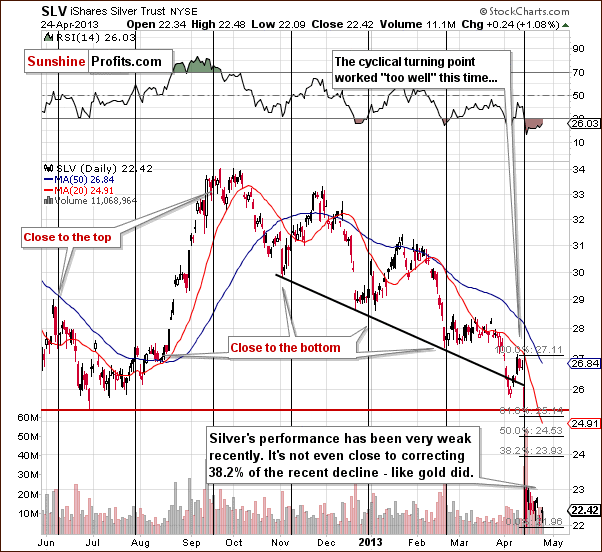
Here, in the short-term SLV ETF chart, the underperformance of silver is very clearly visible. While there has been some sideways trading, prices have declined overall, and the lack of any real pullback indicates the overall weakness of this market at the present time.
Given Thursday’s close in the SLV ETF at $23.49 (silver at $24.30), we still see no significant change in silver’s performance – its correction is still very small compared to the one seen in gold.
Since silver’s underperformance is such an important issue at this time, we decided to examine it particularly closely, using silver-to-gold ratio.
Click on the chart or HERE for larger chart:

In today’s silver to gold ratio chart, we present a somewhat new view of this ratio. We’ve discussed the underperformance of silver for some time now so we felt this graphic would be useful. We believe it’s best to plot the rate-of-change indicator (ROC) on this ratio as it does a very good job at measuring sharpness of given moves. The solid line in the chart is the ratio itself with gold’s daily price in the background and represented by the gold line.
The key point here is this: major bottoms used to be preceded by a sharp drop in the silver to gold ratio. We used to see either capitulation of silver investors or artificial sell-offs before the declines were over. Regardless of what the reasons were, it’s something that used to happen before the bottom was truly in. Recently, however, we saw silver’s price decline, but not as sharp as expected relative to gold if a major bottom was forming. In the recent days, we have seen steady underperformance rather than a very sharp drop in the ratio. It looks on the chart like the trend is accelerating, though, sort of like a reversing parabola.
Ideally, we’d like to see a lower rate-of-change indicator, say -10 or -15 at least before stating that the final bottom is in. This indicator barely moved when the precious metals declined heavily earlier this month. The declines seen in 2008 and in the first 2 months of 2010 provide a good example of what the indicator can do. At first, metals declined but silver not as significantly as gold. Only when gold formed a major bottom, did the ratio decline sharply. We would like to see this confirmation also in case of the current decline.
Summing up, silver has been underperforming recently but not as extremely as we would expect during a major bottom. It seems therefore that the final bottom is still ahead of us. Thursday’s move to $24.30 doesn’t invalidate the above.
To make sure that you are notified once the new features are implemented, and get immediate access to our free thoughts on the market, including information not available publicly, we urge you to sign up for our free gold newsletter. Sign up today and you’ll also get free, 7-day access to the Premium Sections on our website, including valuable tools and charts dedicated to serious Precious Metals Investors and Traders along with our 14 best gold investment practices. It’s free and you may unsubscribe at any time.
Thank you for reading. Have a great and profitable week!
Przemyslaw Radomski, CFA
Founder, Editor-in-chief
Gold Investment & Silver Investment Website – Sunshine Profits
* * * * *
About Sunshine Profits
Sunshine Profits enables anyone to forecast market changes with a level of accuracy that was once only available to closed-door institutions. It provides free trial access to its best investment tools (including lists of best gold mining stocks and silver mining stocks), proprietary gold & silver indicators, buy & sell signals, weekly newsletter, and more. Seeing is believing.
Disclaimer
All essays, research and information found above represent analyses and opinions of Przemyslaw Radomski, CFA and Sunshine Profits’ associates only. As such, it may prove wrong and be a subject to change without notice. Opinions and analyses were based on data available to authors of respective essays at the time of writing. Although the information provided above is based on careful research and sources that are believed to be accurate, Przemyslaw Radomski, CFA and his associates do not guarantee the accuracy or thoroughness of the data or information reported. The opinions published above are neither an offer nor a recommendation to purchase or sell any securities. Mr. Radomski is not a Registered Securities Advisor. By reading Przemyslaw Radomski’s, CFA reports you fully agree that he will not be held responsible or liable for any decisions you make regarding any information provided in these reports. Investing, trading and speculation in any financial markets may involve high risk of loss. Przemyslaw Radomski, CFA, Sunshine Profits’ employees and affiliates as well as members of their families may have a short or long position in any securities, including those mentioned in any of the reports or essays, and may make additional purchases and/or sales of those securities without notice.

 In the mid-1980s, a few years after I “decided to be rich,” I bought my dream house. It was a 4,000-square-foot chateau-styled, custom-built, five-bedroom home in a very nice gated neighborhood called Les Jardins in Boca Raton, Florida.
The cost of the house was about $600,000 – more than I ever imagined I could afford. But thanks to the success of a business I had started, I had socked away about $125,000. That was enough to cover the down payment and closing costs.
Telling the real estate agent “I’ll take it” gave me a great, memorable feeling of the power of wealth. I knew, even then, that this purchase would be a milestone in my life.
What I didn’t know was how many different lessons I would learn from it…
Deciding to buy my dream was euphoric. But signing the loan documents evoked a very different emotion: an ominous weight.
The title to this magnificent house was in my name. But I owned only one-fifth of it. The real owner was the bank.
I didn’t like the idea that if things went awry, I could lose “my” house to this corporation. So I decided to devote every extra dollar I made toward paying down the mortgage. I put no money away for my children’s education or my retirement. I didn’t even have an emergency fund. It all went toward my goal of really and truly owning my house.
What a great feeling it was when, only three years later, I handed that last payment to the bank. I would finally be rid of that burden, I thought. I would finally be master of my own domain.
But life had more lessons for me. Just a week or two after paying off the mortgage, I received my property tax assessment for the year. It was something like $22,000. “Holy cow,” I thought. “That’s more than K and I ever paid for rent. And I’ve got to pay this every year, without fail, as long as I own this house.”
The next week, I received a notice about the homeowner’s association fees: They would be going up to $4,000 per year. And then, the following week, I wrote checks to cover our monthly bills. These included about a half-dozen expenses that related directly to the house: electricity, gas, lawn maintenance, etc.
I realized that even after paying off a mortgage of $600,000, I was not in any way financially free. To possess and occupy that house was going to cost me more than $30,000 per year – for as long as I “owned” it.
I learned two important lessons from this experience:
- Holding title to something doesn’t mean you have absolute control over it.
- Having paid for something doesn’t mean it no longer costs you anything to use it.
Later, I realized that the same rules applied to buying a car. Getting title to one doesn’t mean you own it. And owning it doesn’t mean your car will be cost-free.
The same is true for boats and planes and beds and exercise equipment and machinery and so on. This rule applies to about everything you buy that cannot, like food or medicine, be consumed.
Thus, my happy delusion about ownership was shattered. But it wasn’t a bad thing. Not at all. It gave me a very useful insight into the cost of possessing things – an insight that has helped me make countless buying decisions since.
A New Way to Think About Ownership
Nowadays, when considering the purchase of a car or boat or a set of golf clubs, I don’t pretend that I will have them forever. I take a deep breath, calm down my greedy little heart, and make a realistic estimate about how many years I will actually use this desired object. I then calculate its total cost of ownership on a yearly basis.
In other words, rather than telling myself that this truck is going to cost me $25,000 (because that’s the sticker price), I do a full calculation of everything I’ll likely pay to own it for, say, 10 years, and arrive at what it will cost me, on an annual basis, to possess it.
I’m sure there are plenty of smart people who do the same thing. But I’ve never heard anyone say so. Nor have I read about it among the books on finance that I’ve read. So lacking a dictionary term for this idea, let’s create one. Let’s call it the cost of possession.
And to reiterate: The cost of possession is the full cost of using any non-consumable good, from a house to a car to a fountain pen, over a given period of time.
I said that understanding this idea has helped me become a better buyer of things. Let me give you an example – an issue that comes up all the time that you may have wondered about yourself.
An Old Debate: Own or Rent?
Many people believe that owning a house is always better than renting one. They point out that when you own a house, you get the benefit of price appreciation.
“Why should I fork over several thousand dollars per month in rent if, at the end of the day, I have nothing to show for it?”
The answer to this question becomes clear once you apply the principle we’ve just discussed – the cost of possession – to the decision at hand.
Today, for example, I’m shopping for an apartment in New York City. K and I are looking for a pied-à-terre in downtown Manhattan so we can be close to two of our sons who live in Brooklyn. I could afford to buy the apartments we are looking at, but because I now think in terms of the cost of possession, I’m pretty sure that would be a bad deal.
A little bit of arithmetic will demonstrate what I mean. The apartments we are looking at are in the $1.3 million-$1.7 million range. To make calculations simple, let’s assume I bought an apartment for $1.5 million and held it for 10 years. What would be the cost of possessing it on a yearly basis?
The first step is easy. We take the $1.5 million price and subtract it from the net price I think I’d be able to sell it for in 10 years. Assuming an annual appreciation of 4%, the apartment would be worth $2,220,000. I would stand to make a profit (a capital gain) of $660,000.
That’s an argument for ownership. But now I have to figure in the opportunity cost of plunking down $1.5 million in cash. The opportunity cost refers to the money I would have made by investing that same $1.5 million in another investment or group of investments. Assuming I could get a 4% yield on that $1.5 million, I’d turn that into $2,220,000, too. At the end of the 10 years, it is a wash.
OK, it’s tied at one-to-one.
Now let’s look at the other costs of possession…
First, when you own real estate, you have property taxes. From what I’ve seen so far, I’d be paying about 1.5% on the appraised value of the apartment. The appraised value would very likely be the price I paid for it. So that is a cost of $22,500 per year.
Then you have the association fees: The apartments I’m looking at average about $35,000 per year.
Then there is insurance, maintenance, and so on: I’m estimating that will run me $22,500 per year.
So the total cost of possessing that apartment on an ownership basis is $80,000 per year.
Now let’s look at renting…
You would think that if the rental market were “efficient,” the rental costs would amount to about the same thing: $80,000 per year. In fact, because of factors we don’t need to discuss here, it would cost me less than that to rent these apartments. My best guess is that it would cost me between $4,500 and $5,000 per month, including fees, to rent an apartment.
The bottom line: It would be about $20,000 per year cheaper to rent than to buy. Over a 10-year period, that’s a savings of $200,000.
So, in this case, renting is the better choice.
You can do the same analysis with cars. Rather than pretending that the sticker price of that Mustang you want is the cost of owning it, consider all the costs of possessing it, such as insurance, gas consumption, maintenance, and depreciation (i.e., cost versus resale value). Then make a realistic judgment about how many years you will keep it. And then you will have your annual cost of possession.
By approaching it this way, it will be very easy for you to compare leasing (renting) versus owning. You won’t make the mistake of thinking that either the sticker price or the monthly lease rate is your cost.
My housekeeper just found that out. She told the car dealer that she could afford to spend $300 per month and not a penny more. She further told him she could not afford a down payment. When he presented her with a car that met her expectations, she figured she had a good deal.
Two years later, when she discovered that she had already exceeded the mileage allocation for three years, she realized the truth. The car was going to cost her about $8,000 more over three years ($220 per month) than she had believed it would.
Understanding the cost of possession has saved me hundreds of thousands of dollars (if not millions) in these past 30-odd years. Discovering it was a big, big eye-opener. I hope this has had the same impact on you.
What I want you to take away from this essay is this: When making decisions about buying, renting, or leasing anything, always remember to include all of the costs involved. Then divide them by the number of years you expect to use the thing you are buying.
This will give you the real cost – the cost of possession. Once you get the knack for the arithmetic, it’s easy to do. You will make smarter decisions and have fewer regrets. And the salespeople you deal with will begrudgingly admire you!
Regards,
Mark Ford
Editor’s note: Mark recently formed a small group at The Palm Beach Letter where he shares step-by-step instructions to reaching a seven-figure net worth without stocks, options, or other risky investments. After just a few months, several subscribers have said they are on track to reaching their million-dollar goals. (One reader wrote in to say he made $60,000 in three weeks with one of Mark’s ideas. He expects to reach $1 million in just two years or less.)
Now, for a very limited time, Mark has opened this group to DailyWealth readers. Click here to learn more.
Despite the well-engineered ‘bear raid’ conducted by some U.S. banks together with some hedge funds –which knocked the gold price back on its heels down to $1,344—the demand for gold from all over the world remains unabated. The fall in the gold price caused the physical buying of gold to surge everywhere and the gold price has begun to recover.
 The dilemma facing most gold investors remains.
“Where does one hold their physical gold?”
More to the point, where does one hold one’s gold away from institutions and governments that may want to keep your gold. We’ve seen depositors funds confiscated from banks in Cyprus, so the prospect of gold being confiscated is now on the screens of gold investors. So where does one hold gold to avoid this probability? This is not just a vague fear but a real danger. It is insufficient to wait until the dollar collapses. That would be far too late!
This was emphasized by a recent report we saw implying that Switzerland was not allowing the redemption of gold. The report was baseless (see below).
Switzerland as a Financial “Haven”
Old money and new money from the world over, store their wealth in Switzerland, as they’ve done for the last three centuries in the face of many wars because Switzerland has remained neutral for all this time. You would think that such a small nation would not be able to resist an onslaught from its European neighbors. In fact there have been no attempts to assault the tiny nation. Not only is Switzerland a nation with an impossible terrain for armies, it has an army (mainly reserves) of over a million soldiers ready for action at any time in a well-trained state of readiness. Its complex of bridges and tunnels, which link it with all the different parts of Europe and allow its own people to travel through the nation, is mined with explosives that will make it impassable should it be invaded.
As a result its refuge for capital is 300 years old and its banking industry 5 times the size of its own GDP stretching all over the world. It has been tried and tested in war and in peace like no other nation. It’s this testing that is critical for investors. If they feel another country would be a better place to store wealth out of reach of their authorities, then they would have to question the robustness of its resolve against any other country’s attempts to dominate their sovereignty. Switzerland’s history on this has proved robust.
Of late, the multi-national companies in the financial industry in Switzerland and particularly private vaults have been rejecting U.S. taxpayers as clients. This is because the U.S. IRS alongside the new tax regimes and reporting requirements under FATCA and FBAR are invasive in attacking such taxpayers. The experience of UBS and the IRS brought a change in Switzerland that expanded their view of criminal wealth (which they don’t accept) to include Tax Evasion. But nothing else has changed there and the attempt to expose U.S. citizen’s bank accounts there brought the revealing of only 4,500 names out of the 45,000 U.S. citizens in UBS. This meant that 40,500 U.S. citizens were not guilty of Tax evasion and so their names were not revealed to the IRS. This showed the resolve of the Swiss government to retain Swiss secrecy in their financial affairs.
Swiss Banks Refusing to Redeem Gold?
The other day a report was issued by some respected members of the gold community that a Swiss Bank has refused to redeem/repatriate gold above 200,000 Swiss francs and the central bank had instructed them not to do it because it has to do with anti-terrorism and anti-money laundering precautions. We realized just how important such a possibility could be to gold investors so investigated its accuracy. It turns out that it was entirely false.
Reputable Vaults in Switzerland have informed us that they have not had any such instructions from the Swiss National Bank and that they continue to redeem/repatriate gold on client’s instructions.
Let’s be clear, if such a report was accurate it would have made headlines the world over. We are certain that the reputable vaults in Switzerland would inform the world, if the Swiss National Bank had issued such draconian regulations because of the deep impact of such news would have on the Swiss economy.
If a Swiss bank has told a client that he may not redeem/repatriate his gold, then the issue is between that bank and that client and nothing else outside these two.
We repeat that the Swiss National Bank has not issued such an instruction. Indeed we are of the opinion that Switzerland would be the last nation to introduce such Capital Controls, if ever.
But other nations are being recommended as a “Safe Haven” for investor’s gold such as Singapore, Canada and Hong Kong. The first point we would make about this is that none of these nations have a history of protecting clients’ assets. Such protection would be an unintended accident and would change, if government interests felt it should. Believing that their assets would be protected by government from foreign government pressures is an assumption that should not be made until tested.
But let’s look at Canada as a “Safe Haven” as this is perhaps the favorite of U.S. citizens.
Canada as a “Safe Haven” in Extreme Times
Before discussing the ways you can hold your gold in Canada, we feel it important to look at the nature of the country itself and particularly with regard to the U.S.
The first point that comes to mind is the dependence Canada has on the U.S. Canada could not survive independently of the U.S. in economic terms. There is a high degree of integration with the U.S. economy, so much so that should extreme times hit Canada, it will follow the direction of the U.S. We believe that it will not fight to hold off such pressures but willingly go along with U.S. interests. Certainly when it comes to financial policies, Canada will not walk a separate road to the U.S.
In extreme times we expect there to be a need to bring gold within the control of the central banks to support the existing monetary system. While Canada currently has very little gold having sold it off [3.2 tonnes] at 0.2% of its reserves, it is dependent on the U.S. dollar in its reserves. To us, this makes Canada a monetary satellite of the U.S. In turn, this makes it clear to us that Canada will make little to no efforts to ensure the U.S. does not interfere with U.S.-owned assets. History supplies evidence of how Canada has as recently as 1974 cooperated with the U.S. in attempting to return U.S. citizens gold back to the States. [http://personalliberty.com/2010/02/03/the-war-on-gold-a-personal-account/]
More importantly if the U.S. did decide to bring its citizens gold into government coffers, would Canada act any differently? We believe that if the U.S. felt the need to do this today, Canada would feel it too.
Canada has gold producers, so could easily buy the gold from these producers entirely and pay them market related prices to do so as is now the practice in Kazakhstan.
In addition, the institutions that held gold for clients would be targeted too. After all, this is where the largest holdings of physical gold are most accessible and so, primary targets. With banks being the Custodians of these institution’s gold, the government would simply instruct the custodian to hand over the gold it held on their behalf. The banks would comply immediately, as this would allow them to keep their banking license. The owning institutions would then be informed of the event.
Security and storage companies in Canada would also be targeted and would be happy to comply to keep other facets of their business. Swiss Vaults are rejecting U.S. Taxpayer clients for this very reason. They want to remove their vulnerability to government actions entirely. Sadly, similar Canadian companies would not be able to move their gold to another Jurisdiction and be forced to comply with U.S. and Canadian government demands.
As a result, for the many reasons given, Switzerland remains the only credible “Safe Haven” in extreme monetary times.
Hold your gold in such a way that governments and banks can’t seize it!
Enquire @ admin@StockbridgeMgMt.com
Get it First. Subscribe @ www.GoldForecaster.com, www.SilverForecaster.com
The rise in gold coin demand at the Australian Perth Mint and the US Mint as well as in Canada demonstrates the underlying long-term bull market should remain intact. It is coin rather than bullion you should stick to when you are talking about physical purchases.
Nevertheless, from a market perspective, the gold bounce is still not impressive. The first layer of technical resistance begins at 1475 up to 1545. However, we need to see a daily closing above 1592 just to relieve the broader selling pressure.
http://www.mining.com/web/gold-bears-suddenly-appear-more-emboldened-than-ever/?utm_source=digest-en-mining-130422&utm_medium=email&utm_campaign=digest

Ideally, the high in 2011 should be followed by a low in 2013 with a rally thereafter into 2017 that will not become a phase transition until AFTER the ECM turns in 2015.75. Keep in mind that as the pendulum swings back and forth, each time the momentum is building producing greater volatility. The weather is doing the same thing as we move into the peak of this NATURAL global warming cycle. This means when the ECM turns down again, this will produce even higher volatility than what we saw in 2007-2009 period. Also, that decline was focused in the real estate and banking. This turn will be governments. That is the entire purpose of gold – the hedge against government – not inflation.
The Market & Cycles – Why We Must Crash & Burn
One Response regarding this problem that we must crash and burn states that this “is somewhat of a paradox though, see some people, not so conflicted by their personal conscience (against obedience to authority / control ), but influenced by their uncertainty and/or lack of confidence. obviously, not all people are the same. Guess for the higher circumscribed step, to a world Government, should always pass through crash and burn stages, as history dictates, can never take the step smoothly:) ?
ANSWER: This is what makes cycles function. (1) there is the overall cycle of the economy such as the ECM, (2) then there are the cycles of individual markets that each has its own unique frequency like DNA, and finally (3) each of us has a personal cycle of life through which we pass, mature, and hopefully learn from our mistakes.
…..continue reading HERE


-
I know Mike is a very solid investor and respect his opinions very much. So if he says pay attention to this or that - I will.
~ Dale G.
-
I've started managing my own investments so view Michael's site as a one-stop shop from which to get information and perspectives.
~ Dave E.
-
Michael offers easy reading, honest, common sense information that anyone can use in a practical manner.
~ der_al.
-
A sane voice in a scrambled investment world.
~ Ed R.
Inside Edge Pro Contributors

Greg Weldon

Josef Schachter

Tyler Bollhorn

Ryan Irvine

Paul Beattie

Martin Straith

Patrick Ceresna

Mark Leibovit

James Thorne

Victor Adair