Gold & Precious Metals

The great gold redemption

imagesThe most puzzling part of the investment business is seeing how the vast and largely economically illiterate masses interpret any given piece of news. Take the recent gold selloff: Many large players were motivated to sell by news that Cyprus will have to liquidate its gold stockpiles to pay off acute debt obligations. But just a moment’s reflection shows this reaction to be knee-jerk.

The real story behind Cyprus’ deal has much more profound ramifications — and they are positive for gold.

The Right Lens

The reaction to Cyprus’ forced gold sale re-affirms my belief that most Western investors remain in a state of extreme anxiety. This leaves no room for the kind of nuanced analysis that leads to wise long-term investment decisions.

The important point is not that Cyprus has to sell €400 million worth of its gold reserves, but rather the circumstances of the sale and the potential buyers that will emerge.

Gold Demanded, Not Divested

After all, this isn’t a strategic investment decision by the Central Bank of Cyprus to divest itself of the yellow metal. In fact, local officials have gone on record saying any gold liquidation is a last resort. Cyprus wants to keep its gold — as has every nation in the West since the fiat money system started breaking down in the mid-2000s.

The only reason a gold sale is being proposed is that Cyprus finds itself at the height of its sovereign debt collapse. It has a long line of creditors but scant capital to pay them back. Gold is among the island nation’s only liquid assets available to be repossessed. This is, in fact, a ringing endorsement of the enduring value of gold when a banking system disintegrates.

Won’t Hit the Market

Still, some may be concerned about the price effects of gold sales by sovereigns. After all, Cyprus is just the tip of the iceberg. Lower down, the iceberg contains many European nations that are well-stocked with gold but that have debts orders of magnitude more hefty than Cyprus, e.g. Italy, France, Portugal and Spain.

Again, when viewed correctly, this reality is at worst neutral for gold investors.

When a sovereign is forced to sell its gold, the reason is to pay other sovereign creditors. With regard to the spot price and global marketplace for the metal, that sale is “off the books.” It merely cancels some IOUs, and the gold is shifted between central banks. It is not that this transaction has no market effects, but at the end of the day, the impact on gold’s trading price is minimal.

Redemption

While Cyprus’ payments to its European creditors is unlikely to change the fundamental landscape for gold, it represents a coming trend that will reshape everything we take for granted.

A legacy of its former wealth, the developed world is gold-rich and capital-poor. Emerging markets are in the opposite position. As I have long explained, we are undergoing a prolonged foreclosure by the emerging markets (centered on China) on the developed world (centered on the U.S.). Greece, Cyprus, Ireland, Iceland… these are the marginal cases that are the first movements in what will be a global realignment of the remaining Western capital to the East.

China and its cohorts have a pile of IOUs, and the Western nations have a pile of gold. As push comes to shove and the ongoing Eastern shift into hard assets translates into spiking interest rates and runaway asset prices in the West, the Western governments’ reserves will quickly become illiquid; in other words, they’ll be about as desirable as Greek government bonds are today. If history is any indicator, Eastern governments may continue to offer lifelines — but they will demand collateral that can’t be devalued. As Western governments inevitably continue their profligacy, the loans will be called and the gold stockpiles will board ships across the Pacific.

Renaissance

This entire process of breakdown and redemption will serve as a first-hand lesson in the enduring value of the yellow metal. And, at its conclusion, the nations with the capital will also be the ones with large gold stockpiles.

This bodes well for the price of gold. As bullion moves from weak hands to strong, the odds of Cypriot gold seeing the light of day again in our lifetimes are slim. Wealthy creditor nations have the resources to protect their gold. Bankrupt debtor nations do not.

It also bodes well for the re-monetization of the precious metals. Larger gold reserves will give Eastern nations the confidence they need to finally abandon the U.S. dollar-based reserve system and put their currencies on a sounder footing.

Cyprus, Greece, et al. might be foreign countries, but their problems are exactly the same as those facing the U.S. The key difference is that the U.S. is in a unique position to prolong and exacerbate its debt situation until it faces the largest sovereign debt collapse in human history. With the U.S. dollar at the center of the global money system, I expect that this will shake confidence in fiat currencies for generations to come.

The Long View

Fair-weather investors in gold jump at the first sign of turbulence because they do not have a clear concept of the monetary transformation that is taking place. They see other gold investors as greater fools who they must beat to the safety of U.S. dollars when the music stops. Fortunately for those who know better, these momentary panics allow us to buy their gold at steep discounts.

So the fools sell on news of Cyprus, while the rest of us see it as the kickoff of a historic Great Redemption of gold from West to East.


About the Author

Peter Schiff is CEO of Euro Pacific Precious Metal and an internationally recognized economist specializing in the foreign equity, currency and gold markets. Schiff made his name as president and chief global strategist of Euro Pacific Capital. He frequently delivers lectures at major economic and investment conferences, and is quoted often in the print media. His broadcast credits include regular guest appearances on CNBC, Fox Business, CNN, MSNBC, and Fox News Channel, as well as hosting his own weekly radio show, Wall Street Unspun. He is also the author of the bestselling books: “Crash Proof,” “The Little Book of Bull Moves in Bear Markets,” and the recently released: “Crash Proof 2.0: How to Profit from the Economic Collapse.” Peter Schiff

Real Estate beats Gold as #1 Investment & Euro Yen Recap

The Gallup Poll is out surveying the investment sentiment of American investors. Gold has held that top slot up until now. Gold has now fallen for the first time to the second position as investors return to the old historical investment sector – real estate. Even in Europe people are starting to move toward real estate as we should see a bounce into 2015. The surge in gold coin sales has not proven to be new investors, but those already in the market bargain hunting. Any surge bringing in new investors will need to wait for the next rally.

So far everything appears on track with volatility rising making counter trend reactions strong yet going nowhere as in the yen and euro. In the Euro for example, the Weekly Bullish is in the 13900 zone which is far from the recent low reflecting the amount of volatility within the system.

jy0501-d

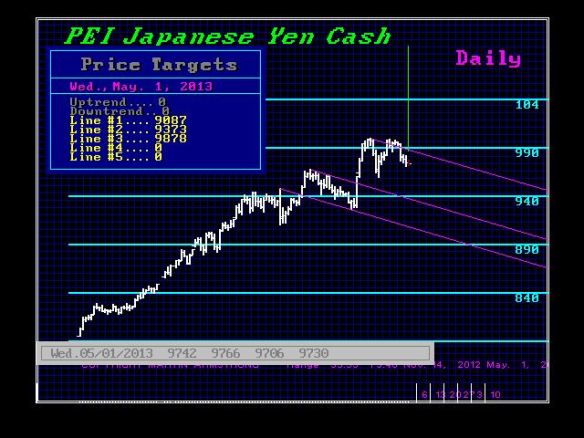
The Japanese yen declined and the dollar made an effective double top at the 99.93 level. This is a big psychological area being par 100. Japanese institutions took profits selling foreign assets since it was the first 20% profit they have seen in 23 years. Nonetheless, only a daily closing BELOW 92.75 would suggest some follow-through. Here we will see most likely a 3rd test of the 100 level, and it may be the 4th time that we plow through it. The highest monthly closing has been 97.40 on the cash. A monthly closing above 97.76 will signal we are starting to breakout, Technical support begins at mid 9300 area with the critical intraday support at the 9000 level. This double top formation is important for it will show the dollar rally that will put the most pressure on the entire global economic system and eventually force the US economy into recession starting 2015.75.

The best trading strategy under these conditions is to sell highs in the Euro according to time against reversals where the risk is the least. In the yen, buy the dollar against support below or on the breakout when that unfolds. Both the euro and the yen are reflecting that we are indeed in a bull market for volatility and when everything turns again with 2015.75 on the ECM, the volatility will be twice as high as what we experienced between 2007-2009. That is where we can see the next phase transition in gold. Don’t forget, gold has yet to test the 1980 high adjusted for inflation which standards at about $2300 level. So forget the hype. Gold has NOT broken out yet nor has it truly made new highs in REAL terms – only nominal.

http://www.mining.com/gold-on-top-no-longer-investors-have-a-new-darling-25556/?utm_source=digest-en-mining-130501&utm_medium=email&utm_campaign=digest


Faber: Gloom Boom Doom – Market Commentary – May 2013

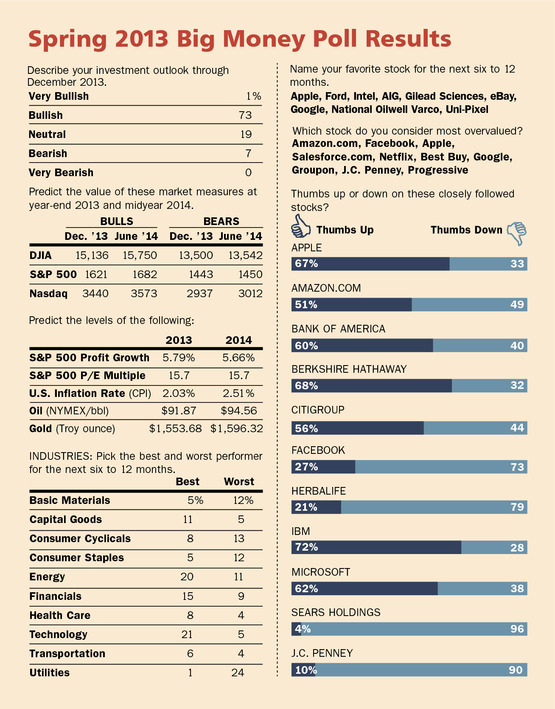
“74% of money managers are bullish on U.S. stocks, an all-time high by the magazine’s measurement. Only 7% were bearish..”

First, I am discussing capital flows and the general belief among some economists that trade and current account deficits do not matter because the money flows back in the form of investments in equities, bonds, real estate, direct investments, and corporate takeovers.

According to Barron’s Big Money Survey, “74% of large portfolio managers are bullish about stocks, which is the Highest Level Ever.” Time to be a contrarian?

I am reluctantly maintaining an approximately 25% weighting in equities (mostly in Asia and in Europe) and I have not yet shorted any stocks because I have learnt that a bubble can get bigger still and exceed my expectations – before it implodes violently.

I want to make clear that I own equities not because of the belief that they are inexpensive and that they will move up substantially but because I do not trust the banking system and, therefore, I do not wish to be overexposed to bank deposits.

Finally, has gold completed its correction and are we entering another major advance as the gold bugs tell us, or are we at the beginning of a major gold bear market as the bears want us to believe?

What the big money says about this market

According to a recent Barron’s poll, 74% of money managers are bullish on U.S. stocks, an all-time high by the magazine’s measurement. Only 7% were bearish.”

Uh oh.

“All-times highs in bullishness” is not something I generally like to hear. If these managers are talking their book — and we have to assume they are — then this means they are likely already invested aggressively and thus have little in the way of new buying to do.

BA-BB708G BigMo G 20130417150006

….whole commentary and details HERE

Cash & Government Bonds cannot Protect You

by Marc Faber

….read more HERE


What are you learning about yourself in this market environment?

Ruhland Andrew - compressed tie horzThe famous industrialist Bernard Baruch once quipped “If you don’t know who you are, the market is a very expensive place to find out.”

Two profound and timeless works of investing literature are helpful here: Mass Psychology by Jim Dines and The Seven Stages of Money Maturity by George Kinder both do an excellent job of exploring how Mass (market) Psychology interacts with our own emotional and psychological personalities around money. I highly recommend both of these books to anyone who is managing their own family’s portfolio, and to any investment professionals who happen to read this article.

If your deeply-held opinion is that investing is only ever about logical, left-brain mathematical phenomena such as economics, ratios and various other forms of analysis, or tweaking your process just a little bit, you may not have even read this far. You may be tempted to stop reading right now…after all, all that emotional stuff is for sissies, right?

Many people believe that buying low and selling high consistently is about how smart a person is, or how much information or technical education they have, or how much money they earn or have to invest. These factors are definitely relevant, but they’re only part of the picture. The scientific world has known for many years that decision-making happens in the right-brain, where emotions, values, feelings and intuition reside.

In my professional experience, many – if not most – of our saving and investing behaviours are deeply connected to the values, beliefs and understandings we hold around money, wealth and prosperity. The challenge for most of us is that we’ve never been asked to consider these right-brained, emotionally-based kinds of questions. For some people these may be painful questions to ponder so they avoid them, especially because a lot of this “emotional baggage” was handed to us in our childhood.

Even if we have contemplated these questions, we might not be able to articulate them. If we are aware of what they are, changing the self-limiting beliefs is another task altogether. Knowing “the problem that actually needs to be solved” is an important starting place. I’ll touch on some solutions in future articles.

As I’m writing this article, US equity markets are back near all-time nominal highs at the end of traditional seasonal strength, Japanese equity markets appear to have just started to transition to the (right-hand) downward side of a juicy parabolic pattern, and the (dead-cat?) bounce in Precious Metals seems to be hitting some resistance. So, what are you learning about yourself right here and now?

  • Are you hoping Precious Metals tank again because you sold higher or got stopped out with a moderate loss?
  • Are you holding all your Precious Metals positions because you are convinced that they cannot go any lower?
  • Are you determined to hold onto certain investments you made because you haven’t yet made “enough” on them?
  • Are you hoping that equity markets drop X or Y% because you were too scared to buy enough when prices were much lower, or perhaps because you believe that equity markets “shouldn’t” have gone up this much for this long and you’ve been waiting in cash for a long time?
  • Are you secretly hoping that this economic house of cards comes crashing down sooner than later so that your worldview will be vindicated and that you can “make a killing” in the next panic?
  • How do external stress factors affect the quality of the spending, saving and investment decisions that you and your family make?
  • Are you more focused on “being right” than “getting it right?”

The way you answer each of these questions can help you start to understand a little more about how your personal values, beliefs and understandings around money affect your investment decisions. And each of these questions is linked to a different cognitive and emotional bias that many people have. These flawed beliefs and biases show up at the most inconvenient times – decision times – and have a dramatic effect on investment results and your emotional well-being.

We explored these and other questions during a recent edition of Talk to the Experts on AM 770 here in Calgary. Click here to listen:

Cheers,

Andrew Ruhland, CFP, CPCA

www.integratedwealthmanagement.ca

What would end the Oil age?

My take is that oil is going to be replaced by something better at some point. It can’t be something like ethanol, where we end up using more water and increasing food costs. Ultimately, maybe we can shift to natural gas. From there we’ll have to look at some of the alternatives that right now are expensive, but in 20 years won’t be nearly as expensive. Politics always plays a role in energy policy.

Commodity Online
Whether the topic is peak oil, climate change or commodity bull markets, Jim Letourneau tends to take the contrarian position. He’s an unapologetic advocate of oil sands development and a shrewd analyst of the companies large and small that are active both in the Alberta oil sands and in the U.S. oil patch.

In this interview with The Energy Report, he shares his insights into one of Alberta’s largest oil sands players and one of its newest and smallest, as well as a well-positioned startup in the Texas Midland basin and northwestern Montana’s Williston basin. He also goes into new Technologies for Oil Extraction and other energy techologies

How was your presentation, “Is Peak Oil Dead?” received at the Calgary Energy and Resource Investment Conference on April 5?

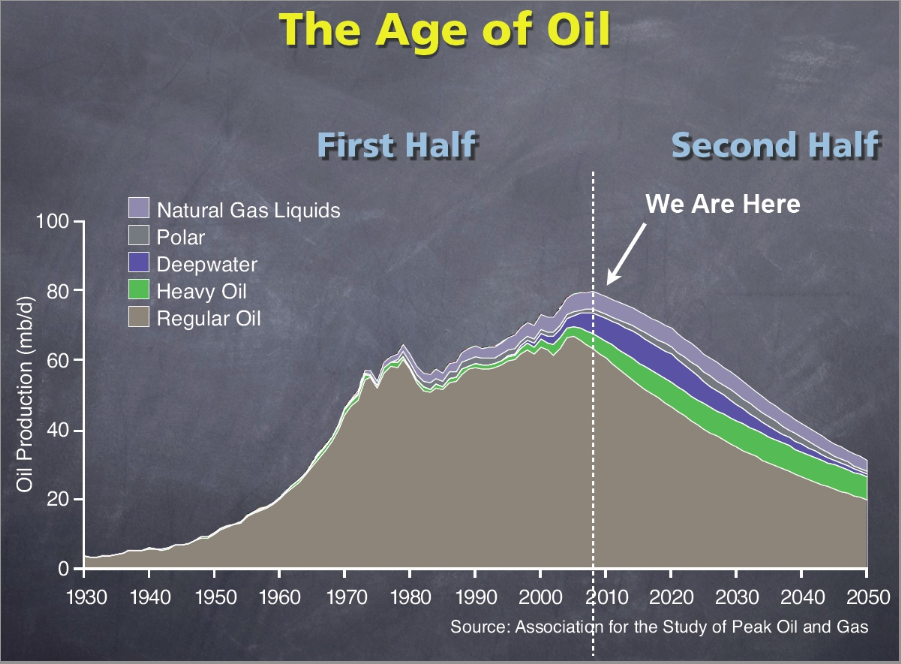
It went really well. There are a lot of professional engineers and geologists there who work in the oil business, and most of them were agreeing that technology is a big factor that pushes out when peak oil is going to occur. For each pool or technology, there is going to be a peak, so peak oil is really the average of hundreds of different peaks, but I think my big-picture point was well received.
Screen shot 2013-05-02 at 7.18.40 AM

Your point is that the theory behind peak oil fails to factor in technological breakthroughs that produce new drilling and stimulation technologies and tame hostile environments, thus leading to increases in production. If an oil shortage doesn’t end the oil age, could Government’s focus on climate change alone threaten oil’s dominance?

My take is that oil is going to be replaced by something better at some point. It can’t be something like ethanol, where we end up using more water and increasing food costs. Ultimately, maybe we can shift to natural gas. From there we’ll have to look at some of the alternatives that right now are expensive, but in 20 years won’t be nearly as expensive. Politics always plays a role in energy policy. We just went through a renewable energy stock bubble created by government loan guarantees. Meanwhile, oil companies have lost the PR battle. This gives governments the option to punitively tax and regulate the industry as they see fit.

If the future solution is natural gas, what companies do you see well positioned to meet that need?

Right now, because we’ve found so much natural gas, the companies that produce it are in a pickle. I think the range of prices is going to be lower for a long time. We’re not going to have an extended bull market. But the companies that use natural gas are pretty interesting. There are companies likeWestport Innovations Inc. (WPT:TSX; WPRT:NASDAQ) that build natural gas engines for big trucks and transport units. Another company is called Clean Energy Fuels Corp. (CLNE:NASDAQ). But the actual producers are in a tough spot. If the price does get a little higher, a lot of supply can come onstream very quickly.

You recently explained your new interest in biotech to The Life Sciences Report by saying, “The mining and energy sectors have reached a state of dysfunctional excess.” What do you mean by that expression?

What I mean is that there are just too many exploration companies out there and not enough expertise. When I started writing my newsletter 10 years ago, it was near the beginning of a commodity bull market, so there weren’t excesses in anything. The first bull market was in uranium, and only a handful of companies were trying to find uranium. Then the price started to move up and pretty soon there were well over 500 uranium companies worldwide. What could possibly be gained by having 500 companies instead of maybe 50?

I like to use the concept of a hype cycle, where a big wave of money coming into a sector builds up to a peak of inflated expectations before we move down to a trough of disillusionment. Another recent hype cycle was graphite. Look at the TSX Venture chart and you’ll see what I’m talking about. There’s going to be a hangover as a lot of those companies disappear.

Let’s shift gears and discuss some oil companies. Big Sky Petroleum Corp. (BSP:TSX.V) just retained an investor relations consultant, and part of the consultant’s fee is in options exercisable at $0.25. What does that say about that corporation’s expectations for growth in share value?

I think everyone is expecting the share value to grow, but today the share price is $0.13. Something has to change to get the share price higher, and maybe the investor relations consultant can help them with that.

A map of Big Sky’s West Texas assets shows that large- and mid-cap companies surround Big Sky’s new acreage. If the first well drilled is successful, do you think the larger companies are potential joint venture or takeover partners?

Definitely. The challenge for Big Sky is that it doesn’t have enough cash to pay for a single horizontal well. Almost all juniors right now have a big issue just keeping their production up. Big Sky doesn’t really have any production yet and it has just under $4 million ($4M) in cash. A horizontal well in the Wolfcamp is at least $5M and can be as high as $8M, and it’s in the same in the Bakken. If Big Sky drills one well each in the Bakken and the Wolfcamp, that’s $10M, so the company has to be pretty strategic about how it manages its opportunity. But the first step in any resource play is acreage capture, and Big Sky has done that. Hopefully, the company can find a partner and work out some kind of deal.

Sunshine Oilsands Ltd. (SUO:TSX; 2012:HKEX) is new and small. How much does its success depend on the permitting of the Keystone Pipeline?

Sunshine Oilsands has heavy oil production that averaged 625 barrels per day for the first nine months of 2012. Its first 10-thousand barrels-per-day West Ells project is close to being turned on, but it’s not built yet. If the Keystone Pipeline was approved, people would probably put a higher value on Sunshine, but its ultimate success is going to be based more on its leases and production.

Is Sunshine threatened by the rapid rise in domestic U.S. oil production?

To a degree. The rise in U.S. oil production has changed the level of supply urgency and it’s affecting policy. If there were a real shortage of oil in the U.S. and nothing on the horizon, that would be different. The amount of Canadian oil that’s been imported into the U.S. has doubled over the last decade or so. Now that the U.S. has more domestic sources, that urgency seems to have diminished. That is a threat. Canadians are aware of it. That’s why we’re working hard in Canada to get pipelines built to the west coast so we have two potential markets instead of just the United States.

Athabasca Oil Sands Corp. (ATH:TSX; ATI:FSE) set a goal to increase its oil production to between 200 and 260 thousand barrels of oil equivalent per day by 2020. Half of that would be in thermal production—in-situ production—and half from light oil, which it has no production at all in right now. It expects the first oil from thermal by 2014, so what is the key to that plan’s success?

Athabasca Oil has a very large land position in a light-oil play called the Duvernay, which is in central Alberta. The Duvernay was the source rock for the big Leduc fields that were found in Alberta and really kicked off Alberta’s oil industry. It’s a great source rock, but the wells are very deep and expensive. Athabasca had raised enough money that it can play around in that play. It’s an exciting new play. It could be very big for them.

The company is gearing up for thermal-assisted gravity drainage production. Has it achieved proof of concept for that?

Most companies are using some version of steam-assisted gravity drainage. There have been a few notable failures and there’s always some technical risk. The thing about resource plays has always been that the geological risk of the resource being there is very low. We know the oil sands there. We know where they are, but the technology to extract them requires specialized knowledge.

We’ve had a few examples where things haven’t worked out as planned. It’s always a bit nerve-racking until the projects are up and running and successful. Statistically, a company that’s got lots of land and lots of money can spread out that risk. I think Athabasca will be up and running pretty close to plan. Athabasca Oil has raised enough money to weather a lot of storms. It’s got lots of other projects that are ready to go.

Historically, the company was an open-pit oil sands miner. Is it prepared to succeed in light oil development?

Oh, definitely. Most people working in oil sands have a background in light oil. When it comes to shale oil, very few companies have tons of expertise because that’s only been around for maybe five years, but it’s to Athabasca’s credit that it’s diversified and captured a big opportunity.

As you intimated earlier, oil sands production gets bad press and protests both in Canada and in the U.S. for its alleged environmental damage. How much does that threaten Athabasca’s prospects, or Sunshine’s?

These projects are going to go ahead and they will get built and the oil will find a market. The environmental press has been negative, but in some ways, it’s a positive in that we will have the world’s best environmental monitoring because we keep measuring contamination with better and better equipment.

You had spoken in the past about the opportunities and challenges for uranium producers. Are any of them viable at a $40.75 uranium price or do you think that is going up?

The ones that are going into production are trying to lock in some longer-term pricing so that they have stability. For example, Ur-Energy Inc. (URE:TSX; URG:NYSE.MKT) just closed a $5.1 million transaction that provides them with upfront cash in return for the sale of future uranium deliveries. Smaller producers don’t want to be at the mercy of the spot price; $40/lb doesn’t leave them a ton of room, but they’re going to keep producing because if you produce, at least you’ll have some money coming in. I don’t think any of these projects are going to be shuttered. Right now it’s a tough game, but there are a lot of things on the table that will lead to higher uranium prices.

I think Japan may turn on some of their reactors again. Meanwhile, some of the biggest uranium producers are cutting back on production. All of the factors that kicked off the uranium bull market 10 years ago are still in play. Uranium producers based in the United States have an advantage because the U.S. wants energy security. These producers have come too far to stop. If the price moves up even $10 or $20, then they’ll be in an amazing position.

Courtesy: http://www.theenergyreport.com/

test-php-789