Gold & Precious Metals

Billionaire investor Warren Buffett, the chairman and chief executive officer of Berkshire Hathaway Inc., comments on the investment appeal of gold on May 2nd.
 
On whether he would buy gold after the recent slump, Buffett said: “No. Gold’s not reproduced or anything since I wrote about it a year or two ago. It just sits there, and you hope somebody pays you more for it.”
 
‘‘If gold went to $1,000 I wouldn’t be a buyer. If it went to $800, I wouldn’t be a buyer. It’s never interested me. If you go back to 1965, Berkshire was at $15 and gold was at $35, so you could’ve bought two shares of Berkshire for an ounce of gold, a little more than two shares. And so far, two shares of Berkshire’s been better.”
 
Buffett hasn’t always been averse to investing in metals. Berkshire made a pretax gain of almost $100 million by investing in silver in 1997. He said he made the wager because bullion inventories had fallen and he expected the price would climb.
 
Ed Note: Here is a more detailed view of how Warren Buffet and other Big Gun’s think written 5 days after the slump:
 

Investors including hedge-fund manager John Paulson faced losses this week as gold suffered its biggest rout in three decades. Warren Buffett told them there were better places to put their money.

The billionaire chairman of Berkshire Hathaway Inc. (BRK\A) cautioned against investing in the metal in February 2012, when an ounce sold for more than $1,700, because it’s not productive like a farm or company. Gold fell 14 percent to $1,348.21 in the two trading days through April 15, the biggest decline since 1983, and wiped out almost $1 billion in Paulson’s wealth. The price rebounded to $1,374.36 at 4:20 p.m. in New York today.

“What motivates most gold purchasers is their belief that the ranks of the fearful will grow,” Buffett wrote last year in a letter to shareholders. “During the past decade that belief has proved correct. Beyond that, the rising price has on its own generated additional buying enthusiasm, attracting purchasers who see the rise as validating an investment thesis. As ‘bandwagon’ investors join any party, they create their own truth — for a while.”

Buffett, 82, has said his preference is to build Omaha, Nebraska-based Berkshire by investing in companies, such as chemical maker Lubrizol Corp., which he bought in 2011. Since his comments about gold, his firm has struck a deal with Jorge Paulo Lemann’s 3G Capital to take HJ Heinz Co. private, acquired more than two dozen daily newspapers, bought retailer Oriental Trading and added to its $87.7 billion stock portfolio.

Happier Shareholders

“The shareholders are probably happier that he has Lubrizol and Heinz than gold,” Andrew Kilpatrick, a Buffett biographer, said in a phone interview. “He made a very cogent argument” for why the metal was an inferior investment.

Buffett is unlikely to invest in gold after the price declines, because it doesn’t fit his investing philosophy, said Luke Sims, co-portfolio manager of the Eagle Capital Growth Fund, which counts Berkshire among its largest holdings.

“If you put your money into gold or other non-income- producing assets that are dependent on what someone else values that in the future, you’re in speculation,” he said. “You’re not into investing.” Buffett didn’t respond to a request for comment sent to an assistant.

Paulson, whose firm earned $15 billion in 2007 betting against mortgage bonds, has said gold is the best hedge against inflation and currency debasement as central banks pump money into their economies to stimulate growth. Buffett said he shares concerns about paper money losing its purchasing power. Still, he wrote, investors could get more from productive assets.

Fondling Gold

To illustrate the point, he asked readers to picture the world’s entire gold stock melded together into a cube 68 feet (21 meters) on each side valued at $9.6 trillion at then- prevailing prices. For the same amount, an investor could have purchased all the farmland in the U.S., 16 replicas of Exxon Mobil Corp., and still have about $1 trillion of “walking- around money.”

A century later, the farmland will be producing valuable crops no matter the currency, and dividends from the companies would probably added up to trillions of dollars, Buffett wrote.

The 170,000 metric tons of gold “will be unchanged in size and still incapable of producing anything,” he wrote. “You can fondle the cube, but it will not respond.”

Buffett has spent his company’s cash on stocks. He’s added to Berkshire’s more than $16 billion holding in Wells Fargo & Co. and increased the funds overseen by his deputy investment managers, Todd Combs and Ted Weschler. The two have used that money to buy stakes in companies including DirecTV and DaVita HealthCare Partners Inc.

Buffett’s Deals

Berkshire has also been making deals. Managers at the company’s more than 80 operating businesses spent $2.3 billion for 26 acquisitions in 2012, Buffett wrote last month. In February, Berkshire agreed to spend about $12 billion on the Heinz deal. The agreement includes $8 billion of preferred shares in the condiment maker that pay a 9 percent dividend.

Capital spending at Berkshire is also set to rise, led by the energy unit and railroad, Burlington Northern Santa Fe. The company spent a record $9.8 billion on plant and equipment last year, Buffett wrote in a March 1 letter.

“We will keep our foot to the floor and will almost certainly set still another record for capital expenditures in 2013,” he said. “Opportunities abound in America.”

Berkshire’s Class A shares fell 2.1 percent to $157,700, trimming their gain this year to 18 percent. The Standard & Poor’s 500 Index has advanced about 8.8 percent since Dec. 31.

Buffett hasn’t always been averse to investing in metals. Berkshire made a pretax gain of almost $100 million by investing in silver in 1997. He said he made the wager because bullion inventories had fallen and he expected the price would climb. The bet wasn’t predicated on inflation expectations, he wrote.

To contact the reporter on this story: Noah Buhayar in New York at nbuhayar@bloomberg.net.

To contact the editor responsible for this story: Dan Kraut at dkraut2@bloomberg.net


CHINESE STOCKS SLUMP AS MANUFACTURING SLOWS

Chinese Stocks Slump Most in Three Weeks as Manufacturing Slows – Bloomberg Reports:

China’s stocks fell, dragging the benchmark index down the most in three weeks, as data showed the country’s manufacturing growing at a slower pace. 

The Shanghai Composite has slumped 9.7 percent from a Feb. 6 high, on concern slowing growth will hurt earnings. China’s economy expanded 7.7 percent in the first quarter, missing estimates, as industrial production and fixed-asset investments in March fell short of forecasts. Rising Chinese home prices may limit scope for stimulus as President Xi Jinping seeks to prevent a real-estate bubble. 

“This has been a very narrowly based recovery, predominantly driven by infrastructure investment, but now even infrastructure investment is also apparently slowing down,” said Tao Dong, head of Asia economics excluding Japan at Credit Suisse Group AG in Hong Kong.

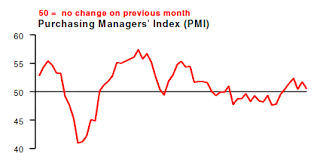
China Manufacturing PMI 2013-04-22CHINA PMI BARELY ABOVE CONTRACTION

As I have said on numerous occasions, China’s infrastructure build-out is both ridiculous and unsustainable. Yet that does not stop for one second the cheerleading. 

For example please consider the Markit report headline for China Manufacturing that shows Operating conditions improve marginally in April

It is really tough to spin that stagnation, assuming you even believe it (I don’t), into something positive. Hongbin Qu, Chief Economist, China & Co-Head of Asian Economic Research at HSBC managed to do just that.

Qu stated “The HSBC Flash China Manufacturing PMI came in at a two-month low, but still managed to expand modestly in April, albeit at a much slower pace. However, new export orders contracted after a temporary rebound in March, suggesting external demand for China’s exporters remains weak. Weaker overall demand has also started to weigh on employment in the manufacturing sector. Beijing is expected to respond strongly to sustain the economic recovery by increasing efforts to boost domestic investment and consumption in the coming months.”

Really?

50.5 is “modest expansion”?! Would 49.5 have been “modest contraction?”

Let’s at least be honest about this. At best China is stagnating and this is in spite of an unwarranted and unsustainable infrastructure build-out.

Mike “Mish” Shedlock
Subscribe Free top right at http://globaleconomicanalysis.blogspot.com

About Mike “Mish” Shedlock


Mike Shedlock / Mish is a registered investment advisor representative for SitkaPacific Capital Management. Sitka Pacific is an asset management firm whose goal is strong performance and low volatility, regardless of market direction.

Visit Sitka Pacific’s Investment Management Page to learn more about wealth management and capital preservation strategies of Sitka Pacific.

You are currently viewing my global economics blog which typically has commentary every day of the week. I am also a contributing “professor” on Minyanville, a community site focused on economic and financial education.

Mish Citations
 

New York TimesNYT 10th Annual Year in Ideas – #1 Idea of the Year ‘Do-It-Yourself Macroeconomics’

Time MagazineBest 25 Financial Blogs

BloombergFinancial Blogs: The Best of the Bunch

CNBCBest Alternative Financial Websites

Strategist NewsBest Business Blogs 2011


Real Estate Prices: 3 Major CDN Cities Turn Down in April 2013

3854346 orig

Toronto, Edmonton, and Calgary drop while Ottawa is the new real estate price breakout recipient.

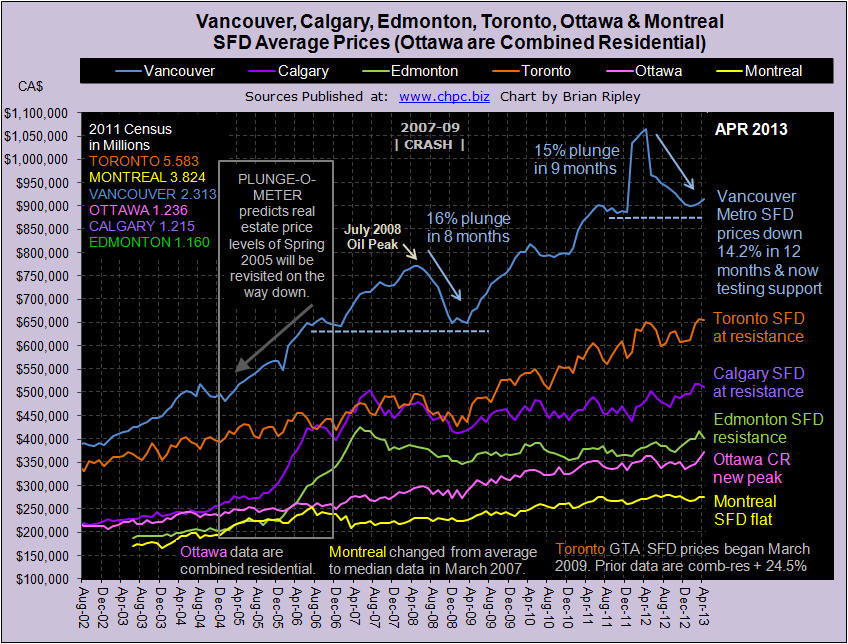
VANCOUVER average single family detached prices in April 2013 ticked up again but remain 14.2% ($150,800) below their peak set last April 2012 (Vancouver Chart). On the short term, price are up fractionally, but on an annual basis, Vancouver is on a sea of red (Scorecard) with combined residential sales down 6.2% Y/Y and prices down 12.6% Y/Y with price momentum solidly negative (-14.2%) and heading towards Extreme Fear on the 12 month change chart

Now that you have the April data, where do you think Vancouver SFD prices will be one year hence? VOTE HERE.
 
CALGARY average detached house, townhouse and condo prices in April 2013 have all turned down from their recent record highs, Calgary Chart). I have added the TSX Energy Index plot to the chart to see when correlations occur with housing prices. Real Estate and the energy index are labouring under multiple peaks and price momentum has taken a sharp turn down and threatens to go flat. 

The sentiment in Calgary is the least bearish of the 3 markets polled with only 24% of the survey thinking Calgary SFD prices will be 20% lower in 12 months. What do you think? VOTE HERE.

EDMONTON average detached house prices in April 2013 also turned down with Calgary (Canada Chart). The bright spot was townhouse prices popping 2.8% M/M but annually they are down 0.7%. Combined residential sales although up nearly 10% M/M are down 8% for the year (Scorecard). The record high SFD prices of May 2007 are still 5.6% out of reach (Plunge-O-Meter).
 
TORONTO average detached house prices for the GTA in April 2013 backed off the high set last month (Toronto Chart) and Y/Y sales numbers are down over 5% for detached, townhouse and condos (Scorecard). The weakening sales are driving the market momentum into the flat line. For anyone keeping score, the gap between Vancouver and Toronto housing prices (Vancouver vs Toronto) is narrowing, especially condos and marketers should note that HNWI has fallen in love with Toronto.

Despite recent record highs, sentiment continues to suggest that prices will be down another 20% in 12 months. What do you think? VOTE HERE.
 
OTTAWA average detached house prices are not available, instead the chart on this site reflects Ottawa’s average combined residential prices. OREB’s report is sparse and opaque and the CMHC, records for Ottawa inventory remain one month lagging. In April 2013 Ottawa combined residential prices zoomed 3.8% M/M for a new record price high on a solid 34.8% M/M sales surge (Scorecard). Ottawa real estate is trading 2.1% above the prior peak set one year ago breaking out from a well defined 2 year channel. Follow the money.

MONTREAL median (not average) detached house prices in March 2013 (I WILL UPDATE WITH APRIL DATA WHEN IT IS RELEASED) ticked up 1.9% M/M but remain in a narrow price channel 1.6% below the all time high price set in June 2012 (Canada Chart). Prices are floating on sales resistance (Scorecard) with combined residential sales 17.3% below last year. In the 2011 Census, Montreal added 6.4% more dwelling units while only adding 5.2% more people. There is no shortage of housing, but there is a shortage of earnings; the Province of Quebec ranks 7th in Canada’s 10 provinces for earnings and shares an unemployment rate with Ontario of 7.7% in March.


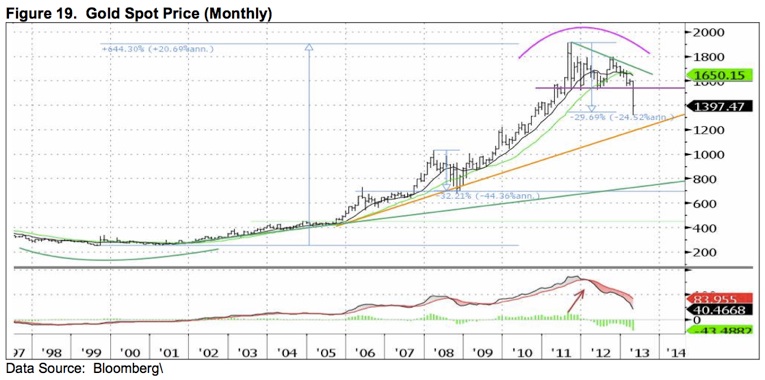
Yamada – 3 Absolutely Incredible Gold Charts & Commentary

With continued volatility in the gold and silver markets, today King World News is pleased to share a piece of legendary technical analyst Louise Yamada’s “Technical Perspectives” report.  Yamada is without question one of the greatest technical analysts Wall Street has ever seen.  This information is not available to the public and we are grateful to Louise for sharing her incredible work with KWN readers globally.

KWN Yamada I 5-1

…..read the commentary to this chart, the entire report and view more charts HERE

“Massive Changes” Afoot

mclogo

“Whether you care or not, there are massive changes going on in Government finances that are really devastating some people as we speak. that is already curtailing our freedom, confiscating our wealth” – Michael Campbell May 4th Money Talks Commentary

 Stocks bursting to Record Highs when the economy is so weak? Listen to Michael’s Important Commentary Below:

(Michael starts his commentary, using the left hand timer, at 1:10 and his commentary ends at 10:41. Just move the slider to the right to the 1:10 start)

{mp3}mtmay4thmccom3{/mp3}

test-php-789