
Personal Finance
 Super hedge fund manager Mohnish Pabrai has been lucky enough to have chances in person to tap into the wisdom of Charlie Munger and Warren Buffett.
From his conversations Pabrai learned five key things.
From Munger:
1. Follow other top notch investors; study what they are doing and why they are doing it.
2. Focus carefully on companies that are aggressively buying back their own stock.
3. Pay attention to spin-offs for opportunities.
From Buffett:
1. Patience.
2. Smart investors don’t need leverage, bad investors shouldn’t use it.
Enjoy the video!

Timing stock market tops and bottoms is risky business and we all know the more the more risk we take the more potential gain would could also make. Correctly timing a top or bottom for any investment is flat out exciting not to mention financially rewarding. But this high risk trading tactic does come with some major issues which you must FULLY understand so that you can protect your capital and self-confidence.
On May 13th I wrote a special report on how to spot market tops just before they happen and how to do it with a very high probability of success. I also explain the major pit falls to be aware of so you stay on the right side of the market.
I recommend you read this special report now: http://www.thegoldandoilguy.com/articles/how-to-spot-time-stock-market-tops/
That special report truly showed you what was going to happen a few weeks before it did. Much like how this report shows you what is likely to happen in June.
Looking at the market with my YOU ARE HERE type of using cycles, volume, price patterns and momentum to forecast what is likely to unfold in the coming weeks. Depending on the time frame used for my analysis I can figure out with a high probability where price will be in a few minutes, hours or days also.
MALL MARKET DIRECTORY – YOU ARE HERE
Stock market tops are tough to trade and time. That is because there are so many things happening in the media and emotions running wild that it’s tough to get a grasp on what you should really be focusing on to keep a level head trade around it.
Market tops are typically not an event but rather a progression that takes much longer than most individuals expect. I still find myself jumping the gun at times and I know this and have been through this process hundreds of times in various investments. The human brain is a powerful tool but emotions can force you to override your rules/strategy still.
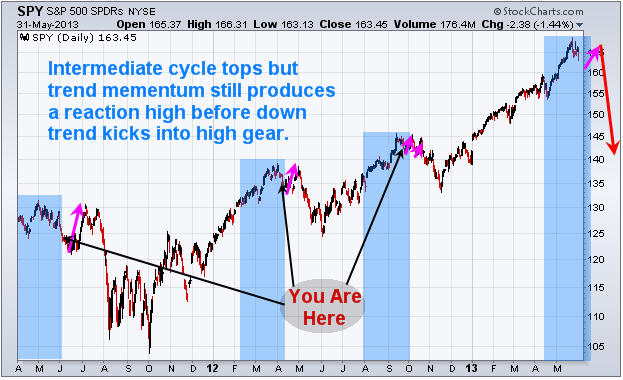
STOP FIGHTING! – BULLS & BEARS ARE BOTH CORRECT AT THIS STAGE
It does not matter where you go to get your stock market news and reports… Everyone is arguing their bullish or bearish case more than EVERY. There is a reason for this and it’s because the SP500, DJIA, RUT and NASDAQ appear to be entering a cycle top. What does this mean? It means the uptrend is almost over from a technical analyst point of view, and those who are have been bearish for a long time feel the market topping out more now than ever in their gut that this is the top.
Keeping it simple removing news, economic data, emotions and biases we are left with one thing which is technical analysis. This is based on price alone and that is important to remember because the only thing that pays you money for an investment is when price moves in your favor. Believe it or not price only has blips on the charts here and there which is based off news, economic data etc… In the big picture stock prices tend to lead economic data by several months and in some cases years.
So the big question is this… If price action is the only thing that pays you when trading why bother worrying about all the other opinions, news out there. That stuff only adds to the confusion and in most cases gets you on the wrong side of the market.
TIMING THE MARKET TOP CONCLUSION:
In short, from a technical point of view the SP500 remains in an uptrend. But according to technical analysis the upside momentum is starting to slow. If we get a few more down days then the trend will flip and be down but it has not yet happened.
When the trend does reverse down you must remember that 80% of the time price will bounce back up to test near the recent highs before truly rolling over and collapsing. Think of it like a zombie movie. Just when you think you killed one it comes back to life for one last scare before its dead.
Just to touch on stock market bottoms so you do not get confused. Stock market bottoms are little different than tops so they are traded differently. I will cover them when the time comes.
Trading the market is not easy during this type of condition, which is why members and myself got long SSO on the 23rd and two days later sold out for a 3.5% gain. I am now looking to reload this week for another bounce/rally play but only time will tell if we get another setup.
Know What the Market Will Do Next – JOIN NOW!
Chris Vermeulen

We examine the latest developments in commodity markets.
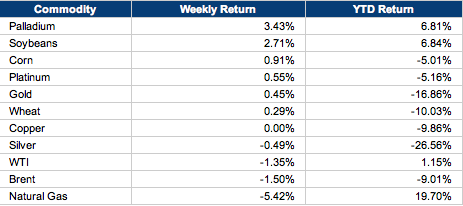
Commodities were mixed this week as palladium and soybeans outperformed, while energy underperformed. Gold ended the session fractionally higher, but remains volatile amid much uncertainty. Stocks, as measured by the S&P 500, ended the period close to unchanged, leaving the year-to-date gain near 16 percent.
Macroeconomic Highlights
The focus for traders this week was interest rate movements. In particular, a surge in the yield on the U.S. 10-year Treasury note has many worried for its potential dampening effect on housing and other segments of the economy. The yield reached as high as 2.23 percent—the highest level in over a year.
Bond traders have been selling Treasurys (sending yields higher) on speculation that the Federal Reserve could pare back or end its quantitative easing programs in the coming months.
Of course, the Fed said it would only end QE if the economy showed signs of a self-sustaining recovery. In that regard, this week’s data was mixed.
Housing remains a bright spot. S&P/Case-Shiller reported that its U.S. home price index rose by 1.12 percent in March, the 14th-straight monthly increase. On a year-over-year basis, home prices were up by 10.87 percent, the fastest pace of growth since 2006. Meanwhile, pending home sales in the U.S. in April were up 13.9 percent year-over-year and at the highest level in three years.
Data on income and spending were more disappointing. The Bureau of Economic Analysis said that personal income in the United States was unchanged in April, underperforming the 0.1 percent increase that was expected. Personal spending dipped by 0.2 percent, worse than the unchanged reading that was anticipated.
Finally, across the Atlantic in Europe, Eurostat reported that the unemployment rate in the eurozone ticked up from 12.1 to 12.2 percent—a euro-era record.
Commodity Wrap
…..read more HERE
Western Infrastructure Investment a Pocket of Strength
Please Note: KeyStone’s Senior Income/Dividend Stock Analyst, Aaron Dunn appeared on BNN today. Click on the image or HERE to view the interview or see below.
This Friday, mining and energy stocks led the way to a lower session on the Toronto stock market as demand concerns dented commodity prices. The S&P/TSX composite index fell 96.14 points to 12,650.42.
Statistics Canada reported that Canada’s economy rebounded strongly from a half-year of sub-par growth, posting an above-consensus 2.5% advance in the first three months of the year and setting the country on a stronger recovery path.
The report from Statistics Canada also revised the economy’s speed from 0.6 to 0.9% for the fourth quarter of 2012, and from 0.7 to 0.8% in the third quarter of last year. The first quarter was the best three-month gross domestic product performance since 2011, and the 0.2 per cent month-to-month advance for March — the last month of the quarter — provided a solid launch to the rest of the year.
Pundits were also not so quick to give Canada’s economy the thumbs up however, pointing out that much of the growth was based on an exceptionally strong exports performance, and in particular from natural resources. With declining commodity prices, the pace of gains in both total exports and output in the mining, oil and gas extraction sector are both not likely to be sustained.
Canada’s economy is in a difficult transition period, from one supported by a strong housing sector and consumer spending, to one that must rely on exports and business investment.
Stock Pickers Market – March’s Focus BUY jumps another 20% this week, up 70% in 2-months!
As such, it will remain a stock pickers market. With the S&P TSX trading at a 3 year average high of 19.1 times earnings, broader Canadian equities should not be considered cheap. We are keeping a keen eye on certain segments of the economy for near, mid and long-term growth opportunities as we believe only pockets of the Canadian economy are positioned for growth.
As such, index buying (or passive Canadian ETFs) in Canada in the near to mid-term does not appear overly attractive. Generally, the S&P/TSX Composite is flawed for index-tracking — it’s overweight in resource and financial stocks and leaves Canadian far too dependent on these sectors for investment returns.
One “pocket of strength” we have already benefitted from this year and expect to continue to see strong long-term potential in is infrastructure investment both made and planned for Northeastern BC and Northwestern Alberta. The most notable regions in these areas include the Horn River, Montney, and Peach River Arch areas, which are three of the fastest growing liquid rich natural gas basins in North America.
Active in these areas are some of the country’s largest energy infrastructure and production companies, including, Enbridge, TransCanada, AltaGas, Pembina Pipelines, Cenovus, Spectra, Nexen, Encana, and Penn West. With the recent exception of Nexen, all of these companies are publicly-traded and report both historic and planned capital investments.
The three major pipeline projects planned for the area include Enbridge’s $6.0 billion Northern Gateway Pipeline, TransCanada’s $5.0 billion Prince Rupert Gas Transmission line (expected to be in service 2018) and TransCanada’s $4.0 billion Coastal GasLink (expected to be in service by the end of the decade). Although the Northern Gateway pipeline has been highly contentious, we believe that TransCanada’s projects have a far higher likelihood of approval considering that gas infrastructure projects have not received the same public scrutiny as Oil Sands related projects.
This past week our March 2013 Top Focus BUY from this sector, jumped another 20% and has now generated our clients a return of almost 70% in only 2 months. Despite the rise, we just reiterated our BUY recommendation after they released outstanding Q1 2013 financial results. Not only does this stock trade at around 5 times earnings, but it remains well positioned to continue to benefit and grow from the resource and infrastructure development expected to occur in Northern BC over the next 5 years.
To find out more about this exciting company and several others, go to our website www.keystocks.com and become a client of KeyStone’s small-cap and dividend growth stock research.
We are currently evaluating another relatively cheap energy infrastructure service stock with exposure to this region which may be our next Top Focus BUY.
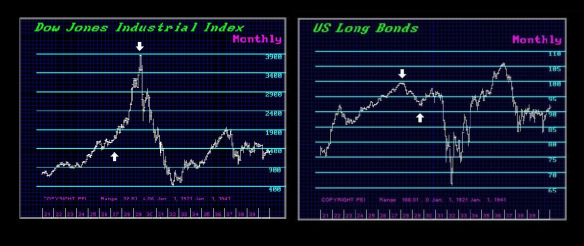
In the normal world of capital flows, bonds decline when stocks rise. The talking heads that claim lower interest rates are bullish for stocks once again try to reduce everything to a single cause and effect that applies to a single frame in a long movie. Here we can see that bonds declined when stocks rallied into 1929 as interest rates ROSE not declined!!!!!!! The explanations that the Dow is rising because of Fed Monetization and the bonds are rising because of a mismatch in quality, sorry, but that just does not cut it. It is capital inflows into the dollar both bonds and stocks as the dollar is being thrust into the single world currency thanks to the brain-dead decisions of Europe.
……read more HERE


-
I know Mike is a very solid investor and respect his opinions very much. So if he says pay attention to this or that - I will.
~ Dale G.
-
I've started managing my own investments so view Michael's site as a one-stop shop from which to get information and perspectives.
~ Dave E.
-
Michael offers easy reading, honest, common sense information that anyone can use in a practical manner.
~ der_al.
-
A sane voice in a scrambled investment world.
~ Ed R.
Inside Edge Pro Contributors

Greg Weldon

Josef Schachter

Tyler Bollhorn

Ryan Irvine

Paul Beattie

Martin Straith

Patrick Ceresna

Mark Leibovit

James Thorne

Victor Adair