
Bonds & Interest Rates
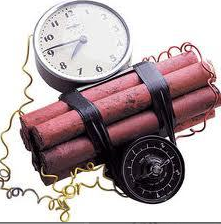 “The whole Financial System could blow up due to the huge amount of Derivatives still outstanding.”
“In my view, the European economy will not suddenly recover. It has too many structural problems. One way that the so-called “banking crisis” could be resolved, though, is to let inflation rates rise. Asset prices would then shoot up, and loan portfolios would be better covered. But I do not really think that inflation is the solution. The danger is that the whole financial system could blow up due to the huge amount of derivatives still outstanding. Once again, excessive speculation is being fueled by artificially low interest rates, and asset bubbles exist everywhere.”
“Basically, wev’e had since may 22nd, quite the sharp drop in markets around the world as in Turkey we are down 15% from the high. Japan also dropped from the recent high by 15%. in the u.s. many stocks have given up gains and they are no higher than in February. i think the market is rolling over. now very near-term we are a bit oversold and we may rally back to around 1660 on the s&p and 1670 and even on the back of the strength of Intel, Microsoft and IBM we could make a new high, but the new high would not be confirmed by the majority of shares so the market could be quite vulnerable.”

 The third-largest global economy is taking reckless steps to jump-start its languishing economy. Specifically, Japanese Prime Minister Shinzo Abe is taking unprecedented monetary action in an effort to reduce the value of the yen. The near-term effects may be positive for the weak Japanese economy. But the global econo

We take a look at the latest developments in the oil market, including charts of all the major inventory categories.
The Department of Energy reported this morning that in the week ending May 24, U.S. crude oil inventories increased by 3 million barrels, gasoline inventories decreased by 1.5 million barrels, distillate inventories increased by 1.9 million barrels and total petroleum inventories increased by 9.7 million barrels.

Crude oil sagged after the release of the latest inventory report. The EIA said that U.S. crude inventories climbed to the highest level since it began collecting data in 1978.
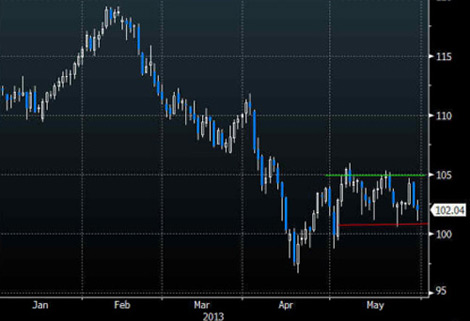
Brent has formed a narrow trading range between $101 and $105 as can be seen from the chart below. We expect that the range will resolve itself to the downside given weak supply and demand fundamentals and elevated inventory levels.
BRENT
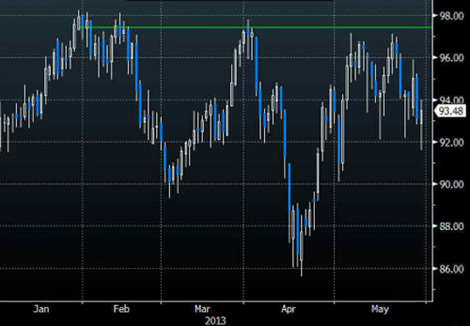
WTI
……read more HERE

……ILLUSTRATED BY THESE 51 REMARKABLE CHARTS:
Jeff Gundlach Answers what in the World is going on in this Fantastic New Presentation.
“Something happened in the middle of May,” said investing god Jeff Gundlach as he began his latest webcast on the state of the global markets and the economy.
He was referring to how global interest rates quietly rallied and how the Japanese stock market fell spectacularly.
He notes that the magnitude of the interest rate rally isn’t unusual. Having said that, Gundlach believes rates will stay low thanks to a “put” by the Federal Reserve. Should rates rise, Gundlach believes the Fed would actually expand quantitative easing. This is because high interest rates would put too much pressure on the economy, and it would cause Federal interest expenses to become too onerous.
“I certainly think the Fed is going to reduce quantitative easing,” he said. But he attributes the reduction to the shrinking Federal deficit.
“I’m starting to like long-term Treasuries,” said Gundlach as he predicted the 10-year Treasury yield would end the year at 1.7%.
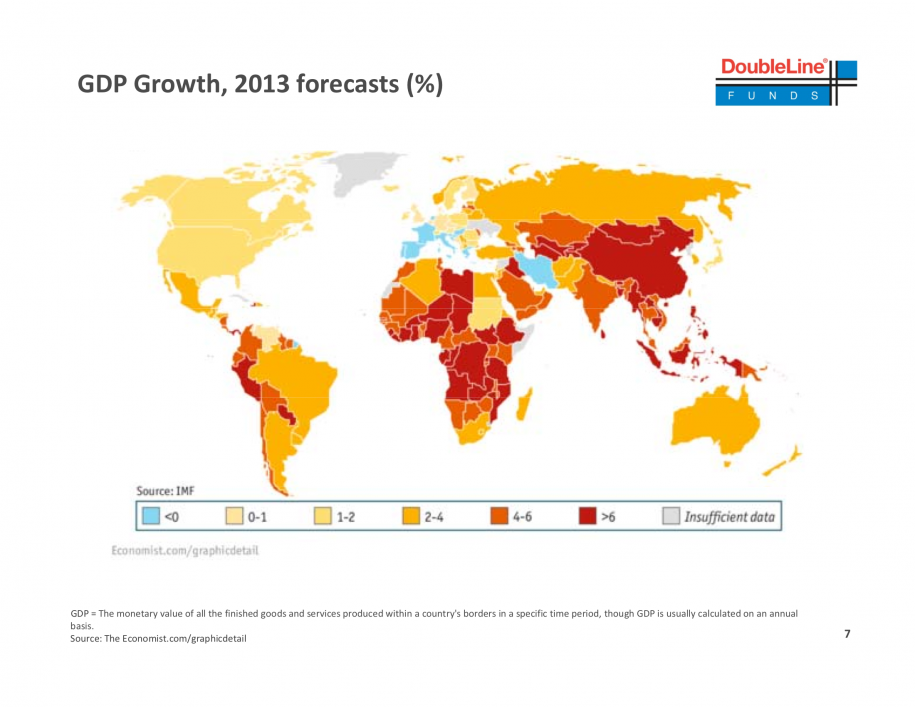
All of Gundlach’s theses are based on the fact that the global economy remains weak, GDP growth forecasts continue to come down, and unemployment remains high and lop-sided.
He communicates all of this in his eye-opening, hand-picked collection of charts on growth, employment, inflation, stocks, bonds, and other critical global macro indicators.
Anyone who is serious about investing must consider his charts. And for anyone who’s just curious, these charts will give you a peek into how Gundlach thinks.
…..click on the link below to view 50 more remarkable charts:
http://www.businessinsider.com/jeff-gundlach-june-webcast-presentation-2013-6#more-on-markets-51
Brooke discusses the overall health of the S&P 500 in the first 3 minute video. Despite the market not being “broken,” it is prone to a correction. After a short-term opportunity from the last few days in June to mid-July, the market enters into two months, August and September that can be a negative combination.
In 3 minute Video (2 below, ) Brooke discusses the following Sectors:
-PotashCorp
-Agrium
-Gold
-Energy
-Fixed Income
-Biotech

-
I know Mike is a very solid investor and respect his opinions very much. So if he says pay attention to this or that - I will.
~ Dale G.
-
I've started managing my own investments so view Michael's site as a one-stop shop from which to get information and perspectives.
~ Dave E.
-
Michael offers easy reading, honest, common sense information that anyone can use in a practical manner.
~ der_al.
-
A sane voice in a scrambled investment world.
~ Ed R.
Inside Edge Pro Contributors

Greg Weldon

Josef Schachter

Tyler Bollhorn

Ryan Irvine

Paul Beattie

Martin Straith

Patrick Ceresna

Mark Leibovit

James Thorne

Victor Adair