Stocks & Equities

Not Your Run of the Mill Sell-Off

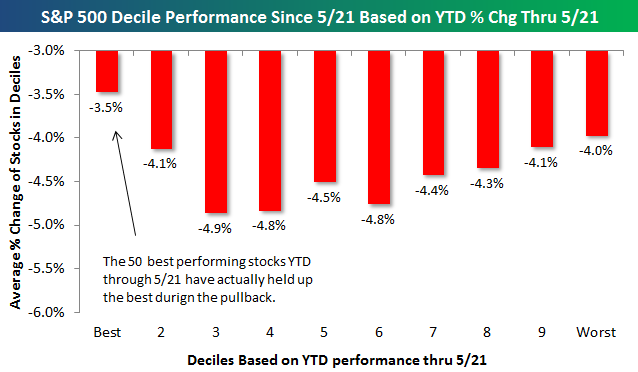
The average stock in the S&P 500 is down 4.34% since the index made an all-time closing high on May 21st.  Typically during market pullbacks, the stocks that went up the most during the preceding rally end up getting hit the hardest.  That hasn’t been the case during this pullback, however.  We broke the S&P 500 into deciles (10 groups of 50 stocks each) based on 2013 YTD stock performance through 5/21.  We then calculated the average performance of the stocks in each decile since the 5/21 market peak.  As shown in the chart below, the 50 stocks in decile 1, which is made up of the stocks that were up the most YTD through 5/21, are only down an average of 3.5% since then.  That makes it the best performing decile of the group during this pullback, so 2013’s big winners have not gotten hit as hard as other stocks in the index.

decile down

So if it’s not a “sell the winners” pullback, which stock characteristics are leading the market lower?  Over at Bespoke Premium, we just published a report answering this question. To view the full report, sign up for a 5-day free trial today!

Nikkei Nears Bear Market Territory

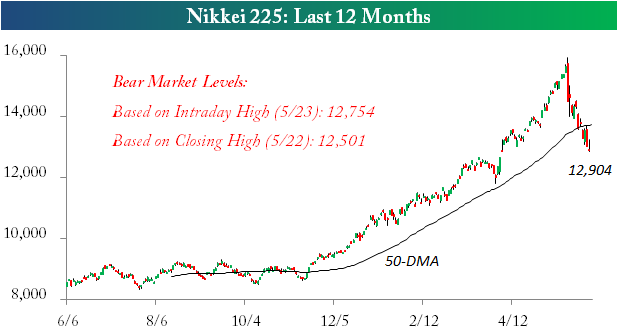
While it was the world’s best performing equity benchmark just over two weeks ago, Japan’s Nikkei 225 has quickly moved into the doghouse of investors.  In fact, with average daily moves of just under 3% since 5/23, the Nikkei is just one bad day away from moving into bear market territory.  

The chart below shows the levels the Nikkei would need to trade at in order to move officially into bear market territory.  Based on the intraday high from 5/23, the index is just 1.2% above the 12,754 bear market threshold.  Using closing prices (our preferred method), the Nikkei has more of a cushion.  In order to reach bear market territory based on closing prices, the Nikkei needs to drop 3.1% to 12,501.8.  Even here, though, all it will take is one bad day before the Nikkei closes out the week in bear market territory.

Nikkei225


Canada Slowdown & Even Odds of Recession Next Year

Most forecasters expect that growth in Canada will accelerate during the next few quarters. But a more sobering view comes from Montreal-based economist Peter Berezin at BCA Research.
Canadian-Dollar-RecessionA slowdown is on the way and there’s a 50-50 chance of recession in Canada by the middle of next year, argues Berezin, managing editor of the monthly newsletter The Bank Credit Analyst.

Growth is likely to falter as the housing bubble deflates and as investment spending slows, especially in the natural resource sector.

If that happens, the Bank of Canada would have limited recourse to stimulate the economy with easier monetary policy since interest rates are already near historic lows.

In these circumstances, the Canadian dollar is likely to weaken during the next year while Canadian stocks are likely to underperform.

Canada, he says, shares many of the same characteristics as other medium-sized resource economies such as Australia and Norway. All three have overvalued housing markets, high levels of household debt and overvalued currencies.

Canada may simply be at the leading edge of a broader story that will play out over the coming years, in which smaller economies begin to suffer the ill effects of global financial conditions that, from their perspective, have been too loose for too long. – Peter Berezin 

This would represent a sharp reversal of the trend in recent years in which Canada has outperformed many other economies. Our banking system was stronger after the financial crisis of 2008 and our governments were in better fiscal shape.

Most forecasters have continued to be reasonably optimistic about Canada in the short term, pegging growth at more than 2 per cent in 2014. The consensus view is that Canada will benefit from the recovery underway south of the border.

That’s wrong, argues Berezin. Canada has a 50 per cent chance of slipping into recession, even if U.S. growth does accelerate.

The main culprit will be a weakening housing market in this country, which until now has attracted new construction investment and helped to sustain consumer spending.

Recent declines in home sales are just the start of a likely slide in prices that could be painful. “Relative to disposable income, house prices stand nearly 40 per cent above their long-term average,” he notes.

And Canadians are dangerously exposed to household debt. By one estimate, 30 per cent of mortgage holders would encounter serious problems in making their monthly payments if rates were to rise by two percentage points.

A housing bust in Canada wouldn’t be as dramatic for our banking system as what we saw in the U.S., but it would have a severe impact on consumption, because of the willingness of Canadian households to take on more debt by using their homes as collateral.

So, if Canadian home prices were to decline by 20 per cent over three years, household wealth would take a $400-billion hit and leave Canadian consumers far less willing to spend.

Along with a slowdown in natural resource prices, Canada won’t benefit so much from a recovery in the U.S. One reason is that the Canadian economy is much less leveraged to the U.S. than it used to be.

In the past, U.S. and Canadian GDP have tended to move in lockstep, but now there are signs of decoupling. Canadian exports of manufactured goods to the U.S. have been on a downtrend for more than a decade.

In 2000, exports to the U.S. of manufactured goods, machinery and transportation equipment accounted for nearly 20 per cent of Canada’s GDP, but today, that has slipped to 8 per cent.

If you want more proof, consider that employment in Canada’s auto industry — usually a bellwether for trade to the U.S. — has shrunk by 30 per cent since 2000.

“In any case,” says Berezin, “it is not clear that Canadian manufacturing firms could easily increase production, even if they wanted to.” Manufacturing capacity has declined during the past decade in line with falling output.

And there will be no manufacturing renaissance north of the border until this country does something to reverse its long slide in competitiveness.

Source: BCA Research

About BCA

BCA Research is a world leader in the provision of macro investment research. Since 1949, the firm has provided its clients with leading-edge analysis and forecasts of the major financial markets, with clear and focused investment strategy recommendations and backed by countless proprietary models and leading indicators. BCA provides its services to financial professionals in more than 90 countries through a wide range of products, services, and meetings.


This article reprinted from the Montreal Gazette. Youi can read the article HERE at The Montreal Gazette

 

Gold, Silver & Precious Metal Miners Signals

It has been a very long couple of years for the precious metal bugs. The price of gold, silver and their related mining stocks have bucked the broad market up trend and instead have been sinking to the bottom in terms of performance.

Earlier this week I posted a detailed report on the broad stock market and how it looks as though it’s uptrend will be coming to an end sooner than later. The good news is that precious metals have the exact flip side of that outlook. They appear to be bottoming as they churn at support zones.

While metals and miners remain in a down trend it is important to recognize and prepare for a reversal in the coming weeks or months. Let’s take a look at the charts for a visual of where price is currently trading along with my analysis overlaid.

WEEKLY PRICE OF GOLD FUTURES:

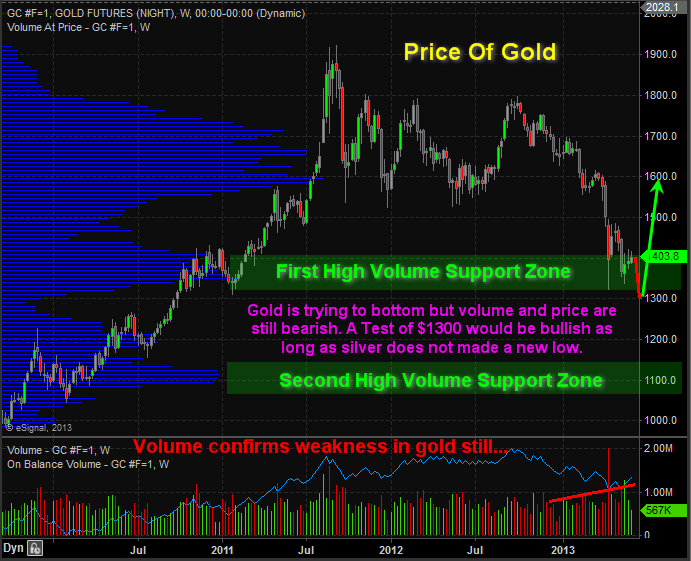
Gold has been under heavy selling pressure this year and it still may not be over. The technical patterns on the chart show continued weakness down to the $1300USD per once which would cleanse the market of remaining long positions before price rockets towards $1600+ per ounce.

There is a second major support zone drawn on the chart which is a worst case scenario. But this would likely on happen if US equities start another major leg higher and rally through the summer.

PriceOfGold

WEEKLY PRICE OF SILVER FUTURES:

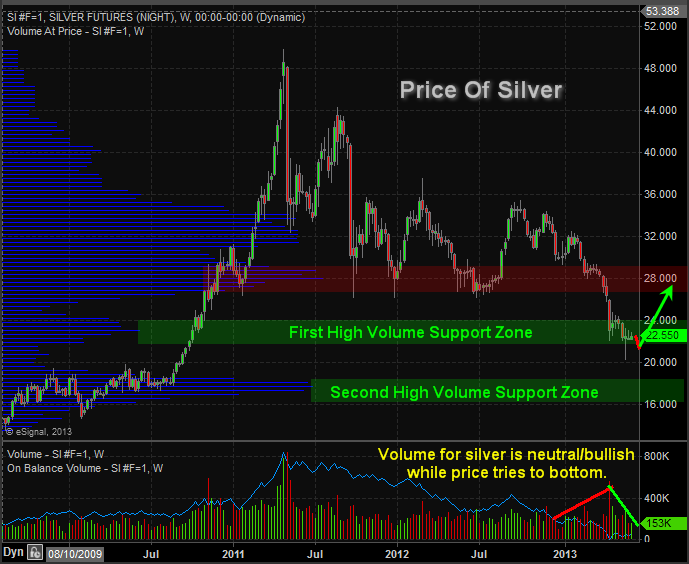
Silver is a little different than gold in terms of where it stands from a technical analysis point of view. The recent 10% dip in price which shows on the chart as a long lower candle stick wick took place on very light volume. This to me shows the majority of weak positions have been shaken out of silver. Gold has not done this yet and it typically happens before a bottom is put in.

While I figure gold will make one more minor new low, silver I feel will drift sideways to lower during until gold works the bugs out of the chart.

PriceOfSilver

SILVER MINING STOCK ETF – WEEKLY CHART:

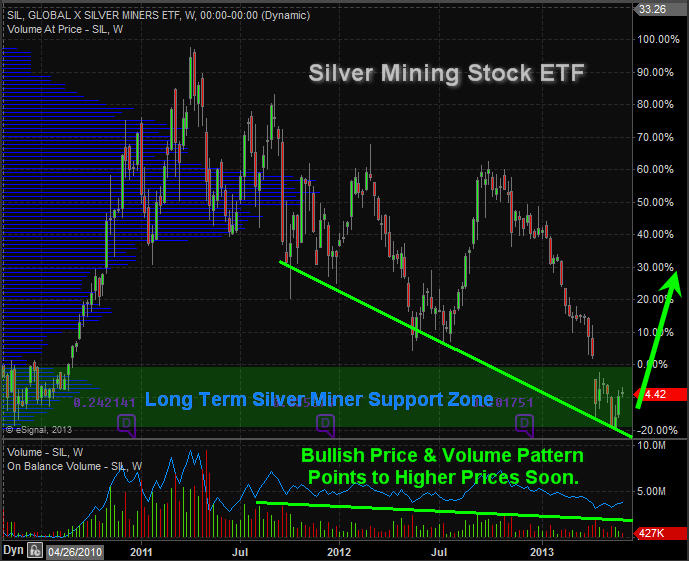
Silver miners are oversold and trading at both horizontal support and its down support trendline. Volume remains light meaning traders and investors are not that interested in them down where and it should just be a matter of time (weeks/months) before they build a basing pattern and start to rally.

SilverMiningStocksETF

GOLD MINING STOCK ETF – WEEKLY CHART:

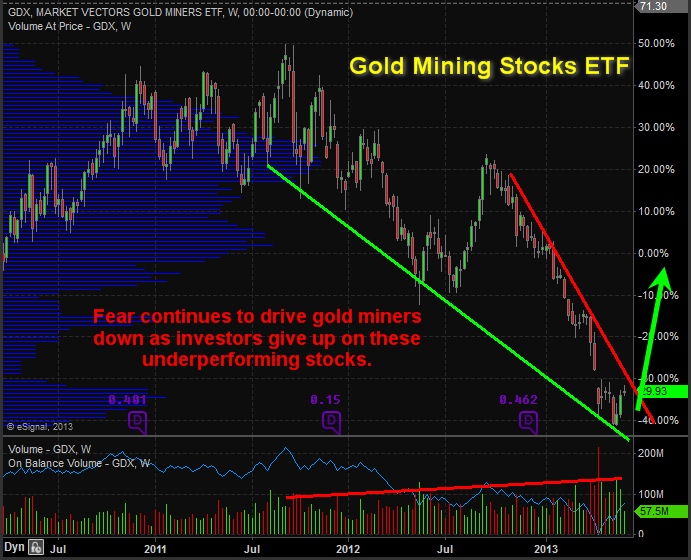
Gold mining stocks continue to be sold by investors with volume rising and price falls. Fear remains in control but that may not last much longer.

GOldMiningStocksETF

GOLD JUNIOR MINING STOCK ETF – WEEKLY CHART:

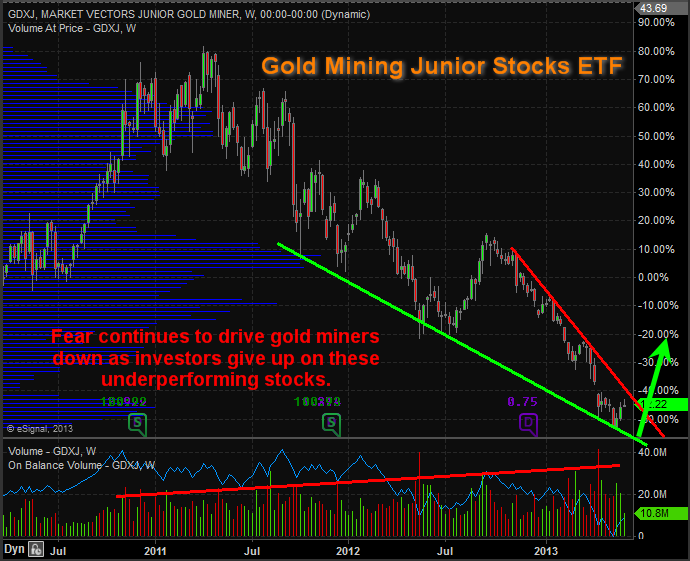
Gold junior miners are in the same boat with the big boys. Overall gold and gold miners are still being sold while silver and silver stocks are firming up.

GoldJuniorMiningStocksETF

PRECIOUS METALS TRADING CONCLUSION:

In the coming weeks we should see the broad stock market top out and for gold miners along with precious metals bottom. There are some decent gains to be had in this sector for the second half of the year but it will remain very dicey at best.

If selling in the broad market becomes intense and triggers a full blown bear market money will be pulled out of most investments as cash is king. Gold is likely to hold up the best in terms of percentage points but mining stocks will get sucked down along with all other stocks for a period of time. This scenario is not likely to be of any issue for a few months yet but it’s something to remember.

Get My Daily Precious Metals Report Each Morning And Profit!
www.TheGoldAndOilGuy.com
Chris Vermeulen

The five stages of the historical lessons of gold versus paper outlined in this interview with the author of: 

$10,000.00 Gold: Why Gold’s Inevitable Rise is the Investor’s Safe Haven.


$10,000 Gold & Worthy Reads

I normally find the calls for $5,000, $10,000 and higher gold mostly pipe dreams but this interview paints a very sound and reasonable case for $10,000. If he’s only a quarter right ($2,500), I won’t hold the rest against him-lol

Read

While I was away and spending most of my time on my knees praying and begging for forgiveness from my wife, family, friends and readers, I did see some worthy articles worth posting here:

And Eric Coffin encouraged me to offer my readers a free copy of a special report he issued. You can obtain it here

Ed Note: Peter’s book can be bought by clicking on the image:

Unknown


test-php-789