
Timing & trends
 “In the 19th century, America had a horrible Civil War. We had several depressions, very little rule of law, very few human rights. And yet we became a pretty successful country in the 20th century. So China is going to have plenty of problems. What I plan to do is, when I see serious problems in China again, I hope I’m smart enough to pick up the phone and buy more China.” – in Index Universe
Related ETFs: iShares FTSE/Xinhua China 25 Index (ETF) (NYSE:FXI)
….other thoughts by Jim Rogers. He was interviewed by Tekoa Da Silva this morning who said:
“It was an especially powerful interview, as Jim spoke towards the relentless downward pressure on gold, the upward explosion in interest rates, central bank money printing, and how to protect yourself ahead of the disastrous times he sees coming”
When asked if we’re seeing forced liquidation leading the smash down in gold this morning, Jim said, “We certainly are. There are a lot of leveraged players who are now being forced to sell. Usually when you have this kind of forced liquidation, you’re getting closer to a bottom, maybe not the final bottom, but certainly close to a bottom. I even bought a little bit [today].”
…..read more on Bonds, the Fed, the riots in Brazil HERE

 As we have noted, in the credit markets, the term “Disorderly” is a euphemism for “Crash”. And this is the condition afflicting most classes of bonds.
The key event has been the reversal from a speculative surge to a downtrend. This was expected in or around May.
Using the High-Yield Corporate Bond (HYG), the price soared to 95.80 on May 7th, which was followed by a dramatic Outside Reversal day. We reviewed this with Bond Markets – A Profound Change? on May 13th.
The main point was that the hot action was vulnerable to a seasonal reversal centered in May, and that market forces would overwhelm bond-buying programs by the ECB, BoJ and Fed. Mother Nature and Mister Market would preempt the “official” decision by senior central banks to end the program.
The test of the high reached 95.39 on May 22nd, and the breakdown was accomplished on May 23rd. Technically, the trend reversed to down in price and up in yield. The possibility of widening credit spreads has yet to work out. Treasury bond prices have fallen with lower-grade bond prices.
At some point spreads between treasuries and corporates will turn to serious widening.
The other part of the Great Bond Revulsion will be a serious increase in interest rates relative to the rate of CPI inflation. Rising real interest rates is one of the features of the post-bubble condition and will be reviewed in the next week or so.
The last disorderly market brewed up last summer and was mainly focused upon European Sovereign Debt. Using the Spanish Ten-Year as the proxy, the reversal from party-time was accomplished in early April 2012 when the yield rose above 5.50%.
The high in the panic was 7.50% set on July 24th.
The yield plunged to 4.0% on May 3rd, and the breakout at 4.43% was accomplished last week. Now it’s at 5.16% and rising quickly.
However, in looking at the leading disasters such as HYG and Emerging Debt (EMB) the plunge has been severe. Severe enough to drive the Weekly RSI on the HYG to 33, which is the lowest since the 2008 Crash.
On the EMB the RSI is down to 18. While not as low as with the 2008 Crash, it is extremely oversold.
The action in US corporates has been very bad but “Emerging” has been worse. The yield ratio between EMB/HYG soared to 1.36 last November and then HYG began to outperform.
The yield ratio declined to 1.24 in March and rallied to 1.29 in April. From 1.26 last week it has crashed to 1.14 earlier today. With this the Weekly RSI has plunged to 15 – the worst on a chart back to 2008.
Over the past week the calamity drove the DX from 80.5 to 82.8 earlier today.
Wrap
– Lower-grade bond markets are extremely oversold and can enjoy a brief rally. There could be even greater liquidity problems in the fall.
– With this, the US dollar can decline.
– A technical rebound for the precious metals is possible.
– For this to work out, gold stocks would begin to outperform gold and silver would begin to rise relative to gold.
FREE TRIAL SUBSCRIPTION
The term “Rational Fringe” has been used to distinguish our research from the mainstream convictions that financial history was random and could be managed by inspired manipulation of interest rates.
Our models are based upon a thorough review of the highly volatile conclusions of 5 previous new financial eras. This provides forecasts of significant trend changes with enough lead time to formulate strategy. See our notes on the Capitulation Model.
Our original observations were that key financial sectors such as the stock market or the yield curve each recorded similar behaviour patterns through each previous era of great financial booms.
The conclusion was that these patterns would provide a guide through our wild financial party and that the action would override orthodox financial research and policy making.
….read more about the service HERE

 “We know it has to happen. And when it does, we’ll get out.”
One of the speakers at a conference we attended in London last week, a professional money manager, talking about the most important bit of investment information you are likely to get in your lifetime.
He was probably speaking for thousands of his colleagues. All confident that they would be able to spot the turn in the bond market when it happens… and all leave the party in good order.
We’re still in the wee hours of a bear market in bonds that will probably last until the middle of the century. In fact, we’re so early that when the sun finally rises we may find we are not yet in a bear market after all. The action over the last two months – and especially the last two weeks – may be just another of Mr. Market’s famous fake-outs.
(We think Mr. Market is doing a great fake-out job in gold, by the way. More on that tomorrow…)
But in the bond market, it looks like the real thing. The Dow rose 100 points yesterday. Gold fell by a couple of bucks an ounce. And Treasury bonds continued their slide. And, since it has to happen sometime, we will suppose that the bond market has put in its top now. If we are too early… we’ll enjoy a leisurely cup of coffee while other investors are scrambling for the doorway.
Meanwhile, the New York Times reports that the exits are getting jammed:
Wall Street never thought it would be this bad. A bond sell-off has been anticipated for years, given the long run of popularity that corporate and government bonds have enjoyed. But most strategists expected that investors would slowly transfer out of bonds, allowing interest rates to slowly drift up.
Instead, since the Federal Reserve chairman, Ben S. Bernanke, recently suggested that the strength of the economic recovery might allow the Fed to slow down its bond-buying program, waves of selling have convulsed the markets.
The value of outstanding United States government 10-year notes has fallen 10% since a high in early May.
The selling has been most visible among retail investors, who have sold a record $48 billion worth of shares in bond mutual funds so far in June, according to the data company TrimTabs. But hedge funds and other big institutional investors have also been closing out positions or stepping back from the bond market.
“The feeling you are getting out there is that people are selling first and asking questions later,” said Hans Humes, chief executive of the hedge fund Greylock Capital Management.
That, by the way, is our advice. Get out now. You can ask all the questions you want later.
Everyone saw (or still sees) a turn in the bond market coming. Bonds have been going up for 33 years. They can’t go up forever. What can’t last forever has to stop sometime. This seems like as good a time as any.
But everyone cannot get out of their bond investments at the same time in a calm, orderly way. After three decades of bringing investors into the room, no trade is more crowded. When bond prices begin to go down… as they did the first week of May… the longer you wait to get out, the more you will lose.
So what do investors do? They head for the exits. All at once. And the bond market becomes an “owl market.” Everyone wants to sell. But “to who… to who?”
Owls are not trained in English grammar. They don’t know that the preposition “to” is followed by “whom,” not “who.” But they are good investors. And they know a developing disaster when they see one. Clever bond investors chose to stay at the party – even when they saw a little smoke rising in the corner. Now they have to decide what to do.
Some will hesitate… wait too long… and then, every bounce will encourage them to wait longer, hoping to recover their losses. Others will stumble and be crushed underfoot, selling their bonds at panic prices.
Is the panic happening already?
No. We’ve only smelled the first faint whiffs of fear. The 10-year T-note still yields only 2.58%. The really nasty odor will come later… when smoke fills the room… someone hits the fire alarm… and those clever investors find the exits blocked.
Regards,
Bill
About Bill Bonner
Bill Bonner founded Agora Inc. in 1978. It has grown into one of the largest independent newsletter publishing companies in the world. In 1999, along with Addison Wiggin, Bill founded The Daily Reckoning. Today, this daily e-letter reaches over 500,000 readers around the globe.
Bill has also co-written two New York Times bestselling books, Financial Reckoning Day and Empire of Debt. He has written or co-written other widely read books as well, and has penned a daily column at The Daily Reckoning for over 12 years. Recently, Bill decided to “retire” from his role at The Daily Reckoning and begin writing his Diary of a Rogue Economist.
Bill Bonner’s Diary of a Rogue Economist is your gateway to Bill’s decades of accrued knowledge about history, politics, society, finance and economics. Sometimes funny, sometimes frightening – but always entertaining and packed with useful insight, Diary of a Rogue Economist can help you make sense of the complex world we live in today.

 The A$ is Confirming Commodity Decline & Rise in US$ – Martin Armstrong
Martin’s view is that a rally in the US Dollar will be “a rally will be devastating on a global scale”.
…..full report HERE
Ed Note: This big report below confirms Martin’s technical point of view from a fundamental point of view in food commodities:
“Commodity prices are currently high by historical levels” .
” Most crop prices are projected to fall in response to a rebound in production”
“Higher production growth is expected from emerging economies which have invested in their agricultural sectors”
……there is a summary of bullet points starting on Page 9, and another outlook addressing the Medium Term on Page 13. The whole report is HERE

Last week was very disappointing for those who had previously been long precious metals and very profitable for precious metals bears. A lot happened after the FOMC meeting and the Federal Reserve Chairman’s statement on June 19, 2013.
As expected, the confirmation of the Fed’s intention to withdraw from QE3 clearly helped the American dollar. After about three weeks of the currency declines, last week brought the breakout and a start of a rally.
The strengthening of the U.S. dollar was a strong blow not only to the currencies, but also to commodity markets.
After Bernanke’s comments, pessimism transpired to the precious metals markets and we saw some of the biggest swings in this sector.
The sell-off in precious metals pushed gold and silver to lower levels and last week they hit new 2013 lows but haven’t found the bottom quite yet, as it seems. On Friday gold fell below its technical support around $1,285-1,308 per ounce. The decrease in the yellow metal triggered a plunge in silver. The white metal has been beaten in the recent months even worse than gold, and on Friday morning its price accordingly went down to the lowest level since September 2010.
Could these events trigger a more profound correction in mining stocks?
It’s said a picture is worth a thousand words. So let’s take a look at some charts below and try to come up with a thousand words to describe what we see (charts courtesy by http://stockcharts.com ).
(click HERE or on Chart for Larger View)

When you take a look at this chart you can ask a simple question: is the bottom already in? Several weeks ago we mentioned the silver-gold ratio as one of the key things to look at when making the call.
We have previously discussed how the final bottom for the white metal is often preceded by a big underperformance of silver to gold. This is yet to be seen, so lower prices are likely still in the cards for the white metal, and the rest of the sector as well.
There’s been no sharp drop so far, so the bottom is likely still ahead of us. If that’s the case and the entire precious metals sector is about to move lower, how low can mining stocks go?
Let’s take a look at two of the most followed commodity stock indices – the Philadelphia Gold/Silver XAU Index and the AMEX Gold Bugs HUI Index.
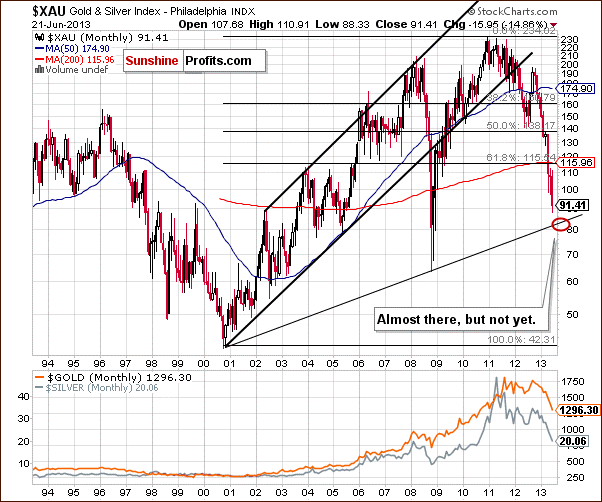
The XAU Index is above our initial target (84) for this decline (or at least it was at the moment of creating the above chart). As you know this target level was created from the rising support line based on the late 2000 and 2008 lows.
However, it seems that we could see a move even below that level and a local bottom will probably form slightly above 80. This is the range that likely needs to be reached before the declines in the mining stocks and the precious metals sector come to a close.
This might be a great buying opportunity or – more likely – there beginning thereof.
Now, let’s have a look at the HUI Index. The chart below expresses a simplicity that betrays potential information on where this market may ultimately be heading.
(Click HERE or on Chart for Larger View)

Last week gold mining stocks have continued their decline. Although investors have been selling their shares fear remains in control. However, this may not last much longer. As we mentioned above it seems that miners might move even below the initial target of 84 for the XAU Index.
In this case, it is the HUI Index that enables us to create a better price target.
There is a major support zone drawn on the chart which is a worst case scenario. The red ellipse on the above chart includes both important support levels – the 61.8% Fibonacci retracement level and the 2008 low. There’s one more thing that we didn’t mark on the chart and that is the price gap close to the 300 level (the gap was formed in April). Such a price gap sometimes indicates that at the time when its formed, the market is halfway done rallying or (in this case) declining. Taking this analogy provides us with a target in the marked area as well.
Our final chart today is the gold-stocks-to-gold ratio which is one of the more interesting ratios there are on the precious market.
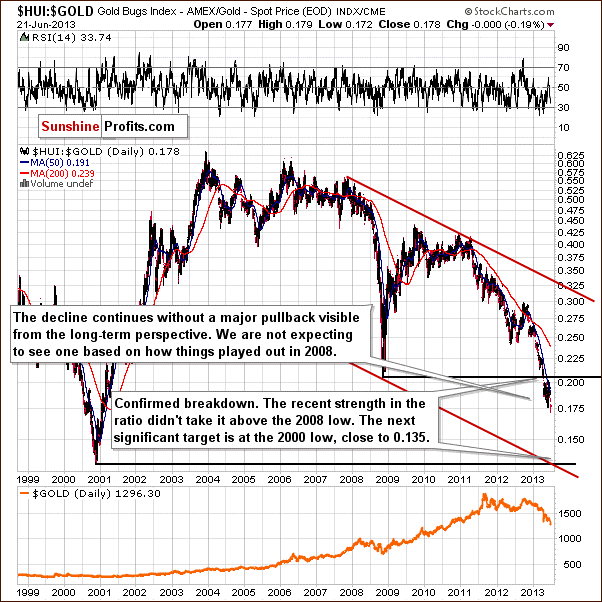
The above chart provides a very bearish picture. We see that the decline continues and that the ratio is quite far from its target – the 2000 low.
Please note that the trading channel and the next horizontal support intersect at a point much lower than where this ratio is today.
As we wrote over a month ago in our Premium Update on May 17, 2013:
The ratio has already broken below the previous late 2008 major low (…). This is a major breakdown and it was confirmed. The implication is that the trend is still down.
With the trend being down and accelerating and the recent breakdown being confirmed, there is a good possibility that the miners will decline significantly once again.
The ratio might move to its target level – the 2000 low – close to the 0.135 level, which is a quite clear forecast as far as direction of the next move is concerned.
Summing up, the outlook for mining stocks remains bearish and the correction is likely still not over. There may be many obvious, and not so obvious reasons for this recent underperformance of the precious metals sector, but the charts are quite clear. In our view it does not seem that the final bottom for mining stocks is already in at least not based on last week’s closing prices.
Thank you for reading. Have a great and profitable week!
Przemyslaw Radomski, CFA
Founder, Editor-in-chief
Gold Investment & Silver Investment Website – SunshineProfits.com
* * * * *
Disclaimer
All essays, research and information found above represent analyses and opinions of Przemyslaw Radomski, CFA and Sunshine Profits’ associates only. As such, it may prove wrong and be a subject to change without notice. Opinions and analyses were based on data available to authors of respective essays at the time of writing. Although the information provided above is based on careful research and sources that are believed to be accurate, Przemyslaw Radomski, CFA and his associates do not guarantee the accuracy or thoroughness of the data or information reported. The opinions published above are neither an offer nor a recommendation to purchase or sell any securities. Mr. Radomski is not a Registered Securities Advisor. By reading Przemyslaw Radomski’s, CFA reports you fully agree that he will not be held responsible or liable for any decisions you make regarding any information provided in these reports. Investing, trading and speculation in any financial markets may involve high risk of loss. Przemyslaw Radomski, CFA, Sunshine Profits’ employees and affiliates as well as members of their families may have a short or long position in any securities, including those mentioned in any of the reports or essays, and may make additional purchases and/or sales of those securities without notice.


-
I know Mike is a very solid investor and respect his opinions very much. So if he says pay attention to this or that - I will.
~ Dale G.
-
I've started managing my own investments so view Michael's site as a one-stop shop from which to get information and perspectives.
~ Dave E.
-
Michael offers easy reading, honest, common sense information that anyone can use in a practical manner.
~ der_al.
-
A sane voice in a scrambled investment world.
~ Ed R.
Inside Edge Pro Contributors

Greg Weldon

Josef Schachter

Tyler Bollhorn

Ryan Irvine

Paul Beattie

Martin Straith

Patrick Ceresna

Mark Leibovit

James Thorne

Victor Adair