
Timing & trends
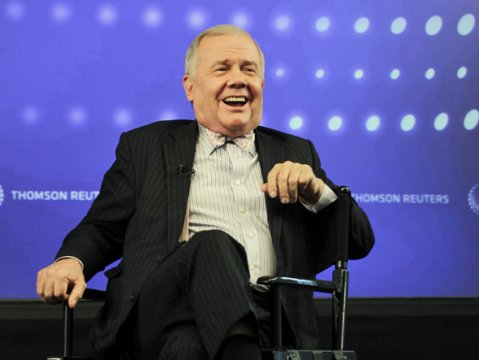 “Mark Twain said the definition of a gold mine is ‘a hole in the ground with a liar standing at the top of the hole’ because there’s just so many of them. Somebody once did a study and I think he determined that more money has been lost in gold mining shares than any other industry in America including airlines and railroads at one time.” – Jim Rogers 12:04 pm July 8th/2013
Here are Jim’s comments on Gold in the last 24hours:
Jim Rogers Destroys The Last Argument Of The Gold Bugs
Jim Rogers correctly predicted gold would fall to $1,200; now he thinks it could go as low as $900
Gold correction is over, suggests Deutsche Bank, but Jim Rogers disagrees
Gold Mining Stocks: Many Other Easy Ways For People To Buy Gold
Jim Rogers Warns “We’re All Going To Suffer From This Crazy, Crazy Money Printing”
“We’re getting to that point where either one of two things are going to happen; either central banks are going to stop all this [money printing], or the market is going to force them to stop it. It looks like we may be having a juncture of both… where the Fed is getting worried… and at the same time, the market is jumping in and saying, ‘Yes, it’s insane what you’re doing, and this has to end.’ And if it’s not ending now, it’s going to end sometime in the next year, because this cannot go on – it’s too insane.“
“There are a lot of leveraged players who are now being forced to sell [gold]. Usually when you have this kind of forced liquidation, you’re getting closer to a bottom, maybe not the final bottom, but certainly close to a bottom.”

Traders stampeded out of gold, emerging markets and bonds this month, setting record monthly outflows in June. Ever since the Federal Reserve hinted in May that signs of a stronger economy could allow for a slowdown of stimulus, markets have protested the news.
Gold has been hit hard by the tapering talk and resultant rising interest rates and liquidity drain, falling below $1,200 at the end of June for the first time since August 2010. We’re also seeing India, the world’s biggest gold buyer, trying to stifle gold demand. As the government seeks to reduce its record current account deficit, it has hiked import tariffs on gold to 8% and introduced new constraints on rural lending against gold jewelry and coins. Ross Norman, CEO of bullion broker Sharps Pixley, said, “It’s almost as if the finance ministry is waging war on the gold sector, which would suggest that they feel they have lost control of the economy to some extent. In that environment, you would want to own gold more than ever.”
Other factors fueling the liquidation were the raising of margin requirements on gold by the CME Group, the largest operator of futures exchanges in the U.S., and global liquidity concerns in the U.S. and China. When the country with the largest GDP in the world and the country with the largest population on Earth have liquidity concerns, traders run from stocks, bonds and gold and head to cash. Even though gold traders have pulled out of their financial investments, there has been a surge in physical gold buying and central bankers have maintained their positions.
We maintain that gold is in extremely oversold territory and mathematically due for a reversal toward the mean. Yet when gold prices plummet, fear takes over and some investors forget the fundamental reasons to own gold: Gold is a portfolio diversifier and a store of value. It is a finite resource with increasing global demand. I co-authored a book on gold five years ago based on a lifetime of experience with the metal. My advice hasn’t changed since then. When it comes to gold, moderation is key. Don’t try to get rich with gold, because the corresponding risk is simply too high. Limit your exposure to gold as an asset class to 10% of your portfolio — no more than 5% in bullion and 5% in equities. Rebalance each year to keep that level of exposure and use volatility to your advantage.
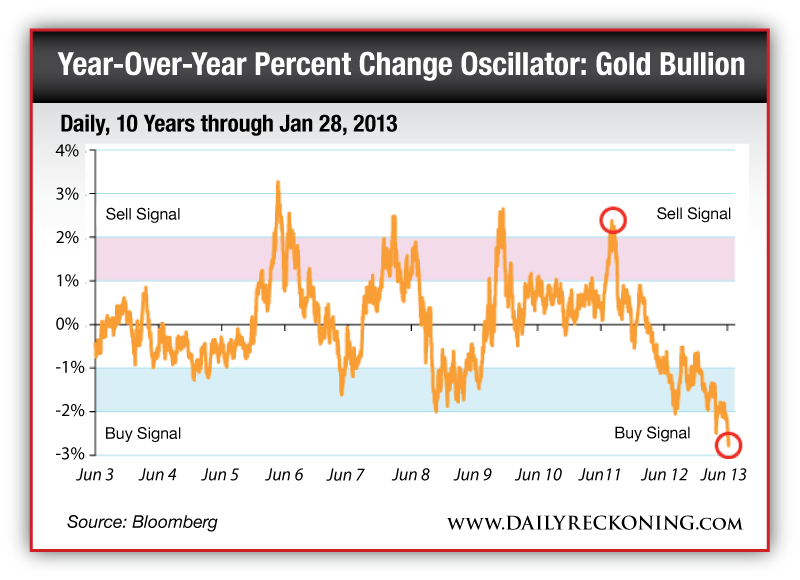
There seems to be an inherent emotional bias against gold by many in the financial media and among money managers, especially after gold corrects. Billions of dollars lost in gold make for sensational headlines, yet two darling technology stocks have also taken it on the chin. I find it interesting that the naysayers aren’t talking about the fact that Facebook and Apple have caused more destruction in market capitalization over the past year than the biggest gold ETF. The chart below puts the magnitude of decline in context.

Why is it that gold still struggles for acceptance as a permanent asset class? I, too, enjoy catching up with Facebook friends on my iPad, but I have more faith that millions of people in Asia and the Middle East will continue to adore the precious metal long after the novelty of Facebook and iPads wears off.
In many parts of the world, this deep cultural affinity for gold is expressed through the giving of gold coins and jewelry for momentous occasions. Gold will soon be entering its historical period of seasonal strength with Ramadan beginning in July, followed by the Indian Festival of Lights, wedding season and Christmas. We have often published on the impact of this powerful seasonal pattern.

In addition to spooking the gold market, the likelihood of the Fed ending its easing also had investors fleeing fixed income investments. Rising interest rates and falling prices led to June bond fund outflows shattering the previous record set in October 2008. Yet downward revisions of economic data suggested that while the economy may be steadily improving, there aren’t yet signs of spectacular growth. In response, bond yields retreated by the end of last week. We see the exodus as an entry point for investors who may have been nervous about getting into the bond market.
Fed fears reached far and wide as emerging market equities also experienced record outflows this month as the sell-off extended to Latin America, Europe and Asia. Renewed worries over Chinese growth and concerns with tightening financial conditions accelerated the flight from emerging markets. Money that had been made in recently hot markets was pulled out, further drying up liquidity. We continue to see opportunity in emerging markets, where we seek out undervalued dividend-paying companies with growth prospects.
From time to time, in bull and bear markets, prices and fundamentals disconnect. Prices can swing too far on fear and rise too fast on greed. We believe fundamentals remain solid and much of the short-term swings are much ado about nothing. In volatile markets, it is important to trust your investment processes and asset allocation disciplines.
Regards,
Frank Holmes
Ed. Note: As Frank Holmes points out, China loves the Midas metal. They’ve even got gold vending machines, for crying out loud!
But you can actually profit from China’s golden greed…
Our resident resource expert just relayed a shocking story that shows just how far China’s willing to go to get its hands on the yellow metal — and how you can make tons of money because of it. Click here to discover this incredible story and its strong implications for the future of your wealth.
About Frank Holmes
Frank Holmes is chief executive officer and chief investment officer of U.S. Global Investors Inc.

The Toronto stock market racked up a solid advance Monday amid rising metal prices, while traders looked to the kickoff of the second-quarter earnings season in the U.S. with results from resource giant Alcoa Inc.
The S&P/TSX composite index advanced 73.96 points to 12,208.87.
….for all action in markets today go HERE
The 30-second technical flash chart report on S&P 500
U.S. equities opened higher this morning and are setting up for a sharp pullback based on technical analysis using trends, cycles, momentum, volume, market breadth and key resistance zones.
Take a look at the charts below for a quick flash of what I think.
Barchart Market Momentum Index
This chart I look at daily. In short if its price is at 101 or higher I expect the broad market to pause or pullback within the next day. It tells me if stocks have moved too far in one direction on a daily basis and if so sellers (big money players) are likely to re-align stocks by taking profits or shorting during these times.
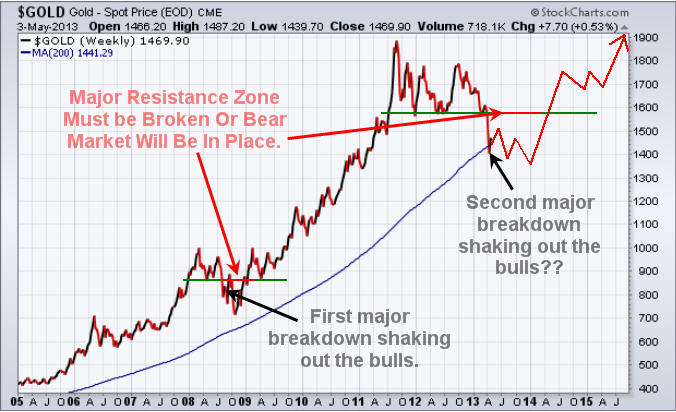
Stock Trading Above the 50-Day Moving Average
Here we can see that while the S&P 500 has been rising over the past six months, fewer stocks are trading above their 50-day moving average. This means a smaller group of stocks is holding the market up and it’s just a matter of time before those stocks burn out and roll over also.
Key Sectors That Move & Lead the Market
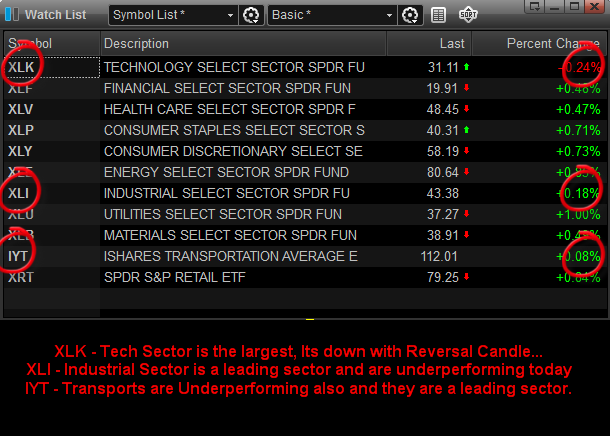
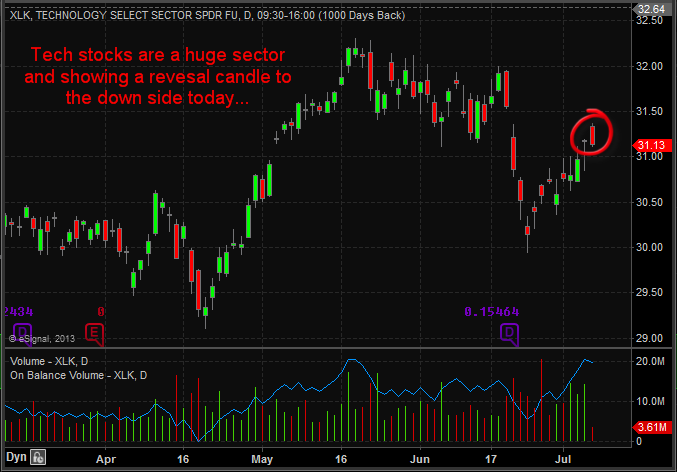
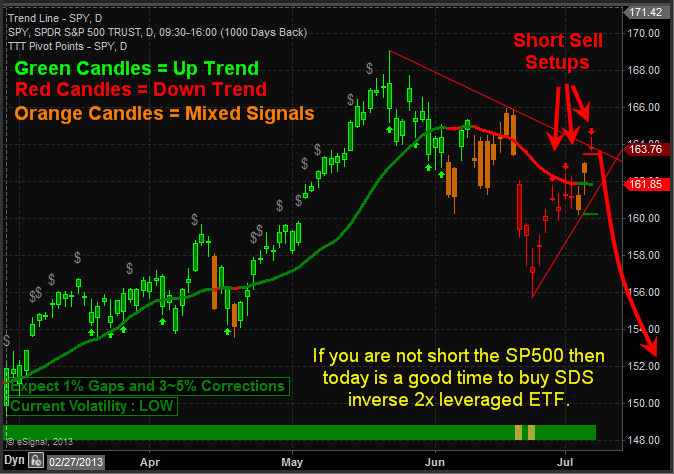
SPY Swing Trading Analysis – Daily Chart
With the S&P 500 breaking down from its trend channel and testing a short term resistance trend line, odds favor sellers should become more active and pull the market down as they unload any remaining long positions and possibly get short the market. Both of these actions will put pressure on U.S. Stocks.
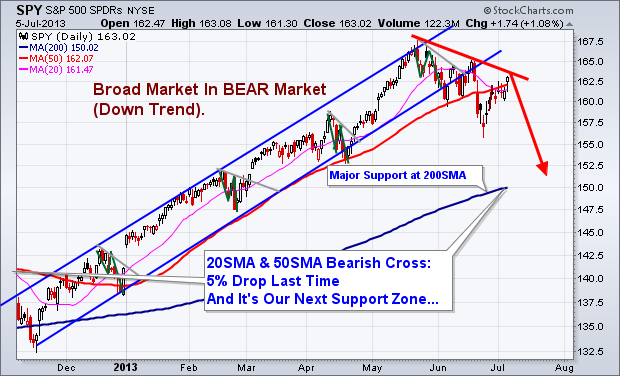
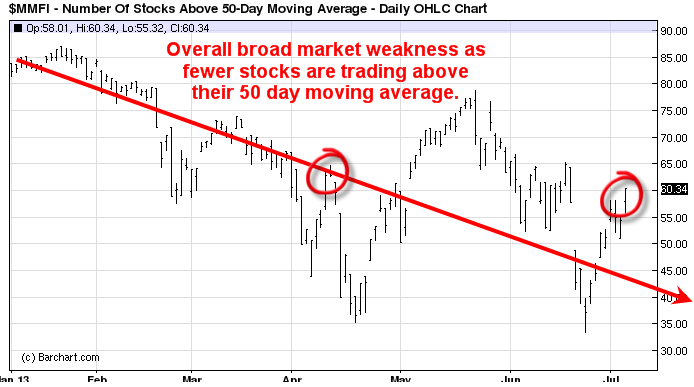
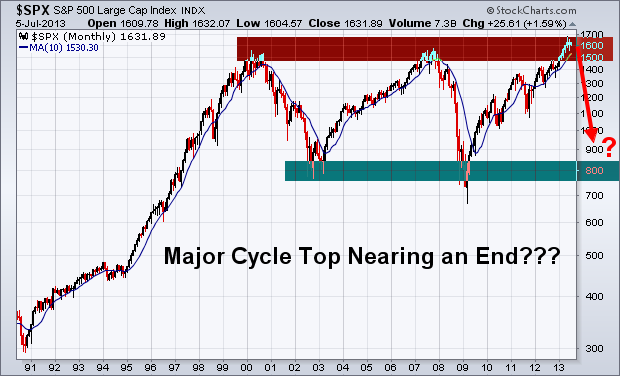
Big Picture Outlook – Don’t Get Me Wrong!
This chart is just to show you what is possible. I am not a perma-bear nor do I want another bear market like this to happen. But knowing what is possible still has to be known. Major market tops are a lengthy process and tends to take several months. If this is the case then it could be a wild and choppy market for the rest of 2013. Do not expect price to just collapse and free fall for 18 months… Dreams like that do not happen. Bear markets must be actively traded because they carry a lot of risk.
The Technical Analyst Conclusion:
This week is do or die for U.S. stocks. We need sellers to step in here and pull stocks down. With the S&P 500 trading at resistance, stocks being overbought on a short term basis and the holiday week behind us, which typically favors higher prices, it is now time for sellers to become active once again.
About the Author
Chris Vermeulen is a gold analyst and trader offering free weekly ETF reports and analysis at www.TheGoldAndOilGuy.com. He is founder ofTechnical Traders Ltd. and chief market analyst for TradersVideoPlaybook.com. Reach Chris at: Chris[at]TheTechnicalTraders.com .

WEEKLY COMMENTARY
Perspectives for the week ending July 8, 2013
Stockscores Market Minutes Video
This week’s Market Minutes video shows what a hot stock is and the critical element for finding them. Watch it on YouTube by clicking here.
This Week’s Trading Lesson
The start of July has been very slow for trading but the action should pick up this week as the market focuses on earnings announcements. Any recent action has been more concentrated in the US market over the Canadian but there is starting to be some interest in the Energy sector as Oil is back up over $100 a barrel. In the US, the Biotech and Solar sectors have been the strongest.
This week, I share some basic thoughts and rules on trading:
Don’t apply logic to the stock market.
So often I see people make decisions in the market on what makes sense to them. It makes sense to buy stocks when the company insiders are buying. It makes sense to buy stocks that are making positive announcements. It makes sense to listen to what the President has to say about the company’s prospects. However, all that matters is what the market thinks of the company and whether the buyers are more motivated than the sellers. So often, the market does things that do not make any sense until we later learn of what motivated the market to do what it did. Remember, the market is forward looking, most times, what makes sense is judged on what has happened in the past.
Never average down on a losing position
Buying more of a bad thing is not much different than continually betting on a losing horse. Winners win for a reason, and until your stock starts to show that it is a winner, don’t add more to a bad situation. If you like a company whose stock is losing you money, sell it. You can always buy it back later when the market starts to like it again.
Successful investing is not about being right, it is about making money
Most good traders are usually wrong. They will lose small amounts often and make big amounts occasionally. What matters is how much they make over a large number of trades. Don’t try to always be right, simply work to make money.
Resist doing what feels comfortable
We have a tendency to look for the market to prove our decision is a correct one before we make our move. The problem is that this often means we are too late to capitalize on the opportunity. We have to move before the crowd, and that often feels like a dangerous thing to do.
Anyone can get lucky in the short term, only good traders succeed in the long term
Don’t confuse making money in the stock market with knowing what you are doing. It is easy to get lucky on a stock or on a sector and enjoy gains that give credence to your analysis method. However, short term winners often give back all of their gains because they fail to recognize their success as luck.
Be patient with your winners, not with your losers
The natural tendency is to sell your winners too early and hold on to your losers, hoping for a turnaround. A simple, but not easy, thing to do is reverse this tendency. When the market proves you right, wait to sell on a signal that indicates the stock is likely to go lower. When the market proves you are wrong, let the trade go and take the loss.
Publicly available information is priced in to the stock, don’t rely on it to make decisions
Once information, no matter how good, is made public, it loses its usefulness to you.
Public information is priced in to the stock by the market of investors. Information only has value to you if the market has not priced it in.
Make sure your trading strategy has an edge
A trading strategy is only worth trading if it can be shown that it consistently makes money. Establish your trading rules and test them over a variety of market conditions so you know that it is effective. Time spent testing a strategy to prove it is a money maker can save you a lot of money in the market.
People lie, markets don’t
I have learned the hard way to never trust what people say, their actions say much more. Learn to read the market and understand it’s message. No matter how much insight a person may have, recognize that they have a bias based on their own emotional attachment to money.
It is easier to trade with the trend than against it
Understand the mood of the market and trade with it. Don’t chase euphoria, but seek to buy stocks that are in the control of the buyers. Don’t sell on fear, but seek to sell stocks that are under seller control.
STRATEGY OF THE WEEK
This past week was very quiet for the market because of the holidays but here is one stock that is worth considering.
STOCKS THAT MEET THE FEATURED STRATEGY
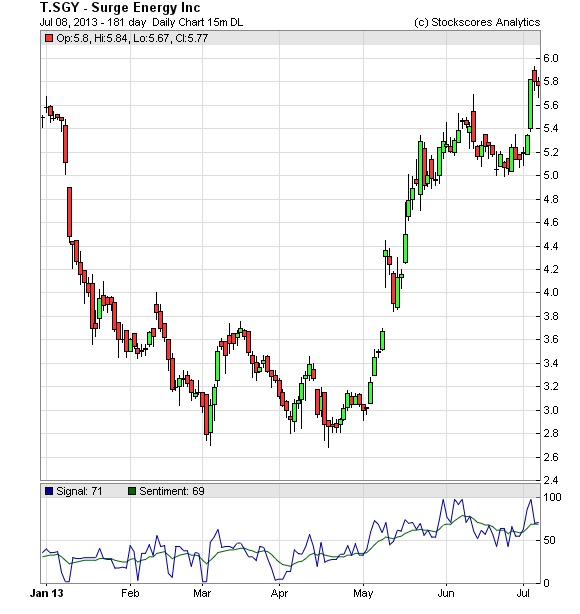
1. T.SGY
T.SGY made a good cup and handle break. The chart is good but I like the stock better on a pull back. The company recently did a financing at $5 which means there is some cheap stock out there that could be sold in to this strength. The longer term outlook for the chart is very good.
References
- Get the Stockscore on any of over 20,000 North American stocks.
- Background on the theories used by Stockscores.
- Strategies that can help you find new opportunities.
- Scan the market using extensive filter criteria.
- Build a portfolio of stocks and view a slide show of their charts.
- See which sectors are leading the market, and their components.
Disclaimer
This is not an investment advisory, and should not be used to make investment decisions. Information in Stockscores Perspectives is often opinionated and should be considered for information purposes only. No stock exchange anywhere has approved or disapproved of the information contained herein. There is no express or implied solicitation to buy or sell securities. The writers and editors of Perspectives may have positions in the stocks discussed above and may trade in the stocks mentioned. Don’t consider buying or selling any stock without conducting your own due diligence.
 The Fed’s EZ money policies will either succeed or fail. Either way, it will be a disaster.
If they succeed, interest rates will rise… and America’s debt-addicted economy will get the shakes.
If they fail, the Fed will double down with further acts of reckless improvisation – including bigger doses of credit – until the whole thing blows up.
On Friday, it looked as though the disaster might come from success. Gold took another solid right to the jaw – down $39 per ounce. The Dow rose another 147 points.
The proximate cause was the latest news from the jobs arena. Apparently, employers are once again reaching out and dragging able-bodied men and women into their shops.
“What does this mean?” investors asked themselves.
“The Fed can now taper,” said some. “Sell gold!”
“The economy is recovering,” said others. “Buy stocks!”
We noticed a few mean-spirited comments on the Internet, sniping at the figures. One website post told us that most of the new jobs are as waiters and bartenders. Another reminded us that people are still waiting more than 30 months before they find jobs… and that the workforce as a percentage of the population is at its lowest level since the 1970s.
But let’s give credit where it is due. These employment numbers speak a kind of success. In spite of the Fed’s policies, the economy is not only still alive… but also getting back on its feet.
If this is so, it is good news for the people who have finally found meaningful employment. As for the future of the US economy, it is a disaster.
Goodbye, Gentle World
What’s the most important thing that is happening in world markets?
C’mon… you know.
Treasury prices are going down; Treasury yields (and interest rates) are going up.
We are not sure if this will continue. But we guess it will. Like all guesses, it comes with a caveat lector: It ain’t necessarily so. Mr. Market is a fooler. And he could be fooling us now.
But a change of direction in the bond market is inevitable. And if the current fall in bond prices marks the start of a long-term secular bear market, it will be devastating.
But for whom, exactly? How? When?
A generation has come of age in a time of falling interest rates (which move in the opposite direction to bond prices).
When the last turn came, the boomers were just reaching maturity, setting up families, beginning their careers and starting to think about investing.
From 1981 until last month, they knew nothing else: Lending rates went down… down… down… from mortgage rates of over 10% to mortgages rates of under 4%. Stocks went up (with periodic dizzy spells). Bonds went up. The economy, too, seemed to grow without much effort.
A world of falling interest rates is a gentle, forgiving world. If you get into financial trouble, you refinance at lower interest rates. It’s hard to go broke when people make more and more credit available at lower and lower rates of interest. It’s hard not to make money, too, when people are spending money they have never earned.
When the Turn Comes
But it is a strange world too…
It is a world of make-believe, where people pretend they have income they don’t really have. Where retailers make believe they have customers who can pay their bills. Where the feds’ economists make believe they have things under control… and that Great Moderation is a feature of their own clever management.
It is also an unsustainable, unbalanced, rickety kind of world. A world that will fall over sooner or later.
Why?
Because people can’t spend money they don’t have forever. And when the turn comes, the world will not be so forgiving… not so easy… and not so readily manipulated by the feds’ clumsy economists.
First, the money ceases to flow from lender to borrower to retailer to stockholder. Instead, it begins to flow in the opposite direction. Stockholders, retailers, and borrowers all see their revenues decline.
Lenders begin to see their money come back to them. But alas, even they are disappointed. Because the loans they made at 3% seem paltry and stupid in a world of 5% yields. Their money went out full of youthful confidence… it’s coming back hunched over, worn out from too many late nights and too much partying.
If the rise in real interest rates were to begin now… as I believe it has… it sets the whole show running in reverse. Instead of EZ credit and smiling creditors, borrowers face grumpy loan officers and higher lending rates.
Borrowers (almost everybody, that is) also find they must cut back their spending to pay the higher rates… or go broke. And this time there is no one ready to catch them when they fall. There are no opportunities to refinance… not even at higher rates.
In a “normal” credit cycle, all of this happens with the usual crises and catastrophes. Some businesses go broke. But some increase market share. Some households file for bankruptcy. Others prosper. Some lenders take big losses. Others manage their risks more carefully. Nothing special, in other words.
But what happens when credit has been abnormally expanded?
The last bear market in bonds (accompanied by rising borrowing costs) began after World War II, with far less outstanding personal debt.
What happens when people have debt up the wazoo… and interest rates rise? What happens when the entire economy – from the federal budget to household finances – depends on unprecedented levels of debt at unsustainably low interest rates?
That is what we are going to find out. Because if the economy really is warming up, the unseasonably low interest rates of the Great Correction are bound to thaw out too.
Regards,

Bill

-
I know Mike is a very solid investor and respect his opinions very much. So if he says pay attention to this or that - I will.
~ Dale G.
-
I've started managing my own investments so view Michael's site as a one-stop shop from which to get information and perspectives.
~ Dave E.
-
Michael offers easy reading, honest, common sense information that anyone can use in a practical manner.
~ der_al.
-
A sane voice in a scrambled investment world.
~ Ed R.
Inside Edge Pro Contributors

Greg Weldon

Josef Schachter

Tyler Bollhorn

Ryan Irvine

Paul Beattie

Martin Straith

Patrick Ceresna

Mark Leibovit

James Thorne

Victor Adair