
Currency
…..in the last 12 to 18 months has been the US. So you have most markets in the world going down and the US going up. It is very likely that the US market has already peaked out at 1687 on May 22nd on the S&P and if the market makes a new high it would be only with a few stocks making new highs. The majority of stocks will not make new highs. (Ed Note: New S&P 500 High Today)

There wont be much Tapering
Central banks around the world will continue to pursue easy monetary policies and there will be very little tapering. But in the unlikely case, where the US economy were strong and showing strong growth, in half an year or year’s time, then they will reduce the purchases of assets.
But in a scenario where the economy stays weak and continues to disappoint, I do not think that they will taper much. In fact, Mr. Bernanke is most likely to retire and some other Fed members will try to make Mr. Bernanke look like a hawk and they have argued for unlimited QEs forever and that is likely to be the case.
There will be a Massive Deflation in Financial Assets
I feel deeply uncomfortable to hold cash in a bank and I think we are in an environment where financial assets are going to come under a lot of pressure at some point , Now will that some point be with Dow Jones at 20 000 , or 15 000 or 30 000 ? who knows ? but all I know is that the financial sector is disproportionately large to the global economy and that there will be a massive deflation in the financial assets
…… In Fox Business News interview : click here to watch the full interview >>>>>>>(Ed Note: 4:13 clip)
GOLD : we never know exactly which is the high and which is the low that’s why there are more poor people than rich people
Well he (Jim Rogers ) may know more than I do , and it is possible that (Gold) drops further , it is also possible that given the incredible bearish sentiment that exists about the outlook for gold price and given the fact that gold has already declined by almost 40 percent and also given the money printing , that we have around the world that gold is making lows right now , who knows ? my sense is that , we never know exactly which is the high and which is the low that’s why there are more poor people than rich people otherwise everybody will buy at the low and sell at the high the same day.
Click HERE to watch the full interview (Ed Note: Same 4:13 clip as above)

…….TAPERING From Interest Rates – OR – Economic Prestidigitation!
Bernanke Seeks to Divorce QE Tapering From Interest Rates – Bloomberg
Federal Reserve Chairman Ben S. Bernanke will have a chance to use testimony to Congress today to drive home his message that winding down asset purchases won’t presage an increase in the Fed’s benchmark interest rate.
Bernanke has said the Fed may start reducing $85 billion in monthly bond purchases later this year, assuming economic growth meets the Fed’s predictions. At the same time, policy makers’ forecasts have indicated the federal funds rate won’t rise until 2015, long after Bernanke’s second term ends Jan. 31.
… Treasury 10-year note yields were little changed at 2.53 percent as of 8:38 a.m. London time. They touched 2.51 percent yesterday, the lowest since July 5, in anticipation of Bernanke’s testimony, even as economic reports showed that U.S. industrial production rose by the most in four months in June and inflation picked up toward the Fed’s goal, supporting the case for a reduction in quantitative easing.
“He’ll say a slowing in the pace of asset purchases isn’t a tightening of policy, and it’s actually still an easing of policy just at a slower pace,” said Josh Feinman, the New York-based global chief economist for Deutsche Asset & Wealth Management, which oversees $400 billion, and a former Fed senior economist. “It doesn’t imply that they’re going to be tightening policy any time soon. They’re not.”
Global stocks and bonds retreated after Bernanke on June 19 outlined the conditions that would prompt the Federal Open Market Committee to reduce and eventually end asset purchases. His remarks pushed the yield on the benchmark 10-year Treasury to a 22-month high and erased $3 trillion in value from global equity market value over five days.
Technically, Bernanke can say that he can taper bond purchases without raising the Fed Benchmark interest rate, for he can. He is in complete control of said rate. Reality dictates something a little different though. The Fed benchmark interest rate doesn’t equal market rates. Ask Dr. Greenspan how difficult it is to get mother market rate to bend to your will by simply manipulating the Fed benchmark rate. He lost control (as if he ever had it) of market rates during his term as he tried to play economic god. Expect the same efforts and the same results from Bernanke.
I urge readers to keep in mind what I expoused in Apple Bonds Proven To Have A Nasty Taste wherein Apple bonds lose 9% in six weeks:
We Clearly & Obviously Ending A 3 Decade Bull Market, Likely At The Tail End Of The Largest Global ZIRP Experiment Ever!
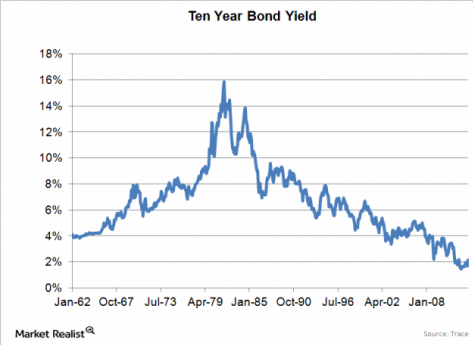
And this final aspect is the kicker. We are likely culminating the end of a three decade secular bull market in bonds. Why in the world would anyone want to buy debt now, in a good, bad or mediocore company? Reference a chart of ten year rates over time, and you will see that once you get this close to zero (and the applied end to excessive ZIRP), there’s no way to go but up. As excerpted from the Market Realist site:

What is our biggest fear? Embarrassment? Death? Public speaking? According to an Allianz Life Insurance poll, the greatest fear of older Americans is outlasting their savings. We fear living longer than our bank accounts by a margin of 22
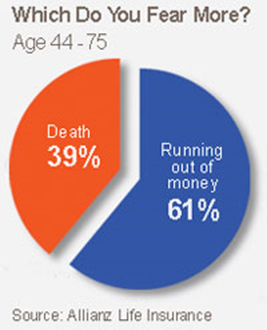
Death or Running out of money Stephen Pollan has an interesting solution to this problem. In his book Die Broke, he wrote something to the effect of: “The last check you should write should be to the undertaker, and it should bounce!” I wonder if people like that die because they know they are out of money.
Now, I can imagine a couple of ways to follow Pollan’s recommendation. One is to go skydiving, neglect to pull the parachute cord, and pay the skydiving company with a bad check. Or one could go on a massive spending spree, overdraw every account, and stay broke until death. In the latter case, one wouldn’t have to worry about running out of money in the least – you don’t have to worry about losing something you don’t have.
Not too long ago, I was quite pleased when my computer would ding and announce “You’ve got mail!” Now, after spending the day away from the computer, I am not surprised to return to 100 or so messages between the junk mail that makes it through the filters and the emails that actually require my attention.
Like most folks, I’ve developed a system for quickly scanning and prioritizing my inbox. Every day I get a few from my wife Jo (email from a spouse is a high priority for anyone interested in staying married), as she is forever on the lookout for things I might want to share with my readers. One headline Jo sent caught my eye: Running Out of Money Worse Than Death.
The short article published by AARP covered the results of the Allianz poll; while the poll of 3,257 people was taken about three years ago, my guess is the results would be similar today. Let’s take a look at a few of the highlights:
- Of people ages 44-75, more than three in five (61%) said they fear depleting their assets more than they fear dying.
- More than half (53%) of poll respondents said their net worth dropped significantly during the [2008] economic downturn. Of those, virtually all have cut back on entertaining and dining out, 47% have reduced their daily living expenses, and 11% have told their children to expect less financial support.
Honestly, this isn’t new news. Seniors and savers can no longer rely on Treasuries or FDIC-insured CDs to pay interest rates that will beat inflation, let alone make them any money. We are all having to put a greater portion of our nest eggs at risk to earn enough to supplement Social Security. But the headline still bothered me… a fear even greater than death?
Nevertheless, I started to pay attention to my closing thoughts at night, and I tried to recall what I dreamed about. I don’t remember ever dreaming about death or worrying about it late at night. On the other hand, I did find myself doing a lot of problem solving during the night, much of it financially related. Perhaps the survey was right; maybe I do worry more about running out of money than I do about dying.
I touched on this subject back in February, and since then two of my good friends have been diagnosed with medical problems for which there is currently no cure. I am amazed at how both friends quickly dealt with the news and set about reassuring their families that they were OK with the situation. One even went so far as to joke that his kids are being particularly nice, because they know he still has enough marbles to change his will if he wanted to. I admire both of these friends a great deal and hope that when my time comes I will handle my swan song with as much grace as they each have.
Then it hit me! And yes, it was actually in the middle of the night. My real problem with the Allianz survey is that I want to live until I die. I want to enjoy life while I’m here. I worked my tail off for many years to accumulate a nice nest egg. I’ve earned more than a few low-stress, worry-free golden years. Worry is for young folks with young families.
My kids roll their eyes when I remind them that in my 20s I worked three jobs and went to school at night… for a decade. The only thing I remember from my 20s was working to feed a young family; I had little time to worry about much else. When we reach our 60s, those stresses should be well in the past.
Nevertheless, just because certain worries should be in the past does not mean they are. Retirees need to figure out a way to not run out of money so they can stop worrying about it, sleep well at night, and enjoy the sort of retirement they imagined.
Retirement Success Is Possible
The fact is, the market has changed: investing is a lot more challenging than it was just a decade ago. If one has a nest egg but is worrying about making it last, he is well ahead of most folks. After all, he had the foresight and discipline to save while he was still in the workforce. Frankly, most of our readers fall into that boat.
As I wrote in my book Retirement Reboot, I was terrified in the fall of 2008. The banks had called in all of our CDs; I had a nest egg but was still in a panic regarding handling it. What should I do with it? Where could I find a good return? How do I know which investments are safe? What is a good allocation for a stock portfolio? I could have filled two pages with my list of fears at the time.
As I look back, the solution was really simple. I needed to learn – a lot. I needed to educate myself on investing and learn about issues I had not focused on during my business career. My goal was to invest my capital, earn good returns, not worry, and keep my fears under control. Most of all, I wanted to live life and enjoy the retirement Jo and I had dreamed about for a couple of decades.
A friend told me years ago that fear is a lack of knowledge. The more you learn and understand about a subject, the less fear you have surrounding it. I agree wholeheartedly. Financial fears will take a terrible toll on many of us if we are not careful. Fear not only affects us financially – often paralyzing us into indecision – it also eats away at our emotions and can even damage our physical health. I for one plan to have fun while I’m here and not worry myself to death.
Regards,
Dennis Miller
P.S. I’m sure we have all heard the old adage, “If you think education is expensive, try ignorance.” Most of our readers are like-minded folks who prefer to educate themselves rather than worry. If that sounds like you, I suggest taking a look at all of the educational resources Money Forever has to offer. Best of all, our 90-day trial subscription is 100% risk-free. Take it for a test drive, and if you find it’s not for you, just call or email within the first 90 days and we will refund 100% of the cost… no questions asked.
There’s no better way to start making sure you have enough money until you die. Click here to learn more about how Money Forever can help.
About Dennis Miller
Dennis Miller is the author of Miller’s Money Foreverand the free journal, Miller’s Money Weekly. Working with Casey Research analysts, Dennis advises subscribers on how to prepare a bulletproof retirement portfolio and ensure having their own money forever.

Is It Right Time to Buy Mining Stocks?
The most important Wednesday’s event was Ben Bernanke‘s testimony. The Fed Chairman said the U.S. central bank still expects to start scaling back bond purchases later in the year, but left open the option of changing that plan if needed.
We all know that every action has a reaction. Yesterday gold rallied and climbed to a three-week high at $1,300 per ounce after Bernanke’s remarks. This optimism didn’t last long. The yellow metal gave up the gains as the dollar remained strong and dropped slightly above $1,270 later in the day.
“Yesterday, gold was unable to convincingly break above $1,300 and some took this as a sign of weakness,” Commerzbank analyst Eugen Weinberg said. “We don’t expect any strong increase in the short time,” he added.
Does it mean that we see may further declines in the yellow metal? If gold moves lower, it may trigger a move down in mining stocks. How low can they go? Let’s examine the situation in the charts (charts courtesy by http://stockcharts.com.)
At the beginning let’s take a look at the gold stocks index – the HUI.
Click HERE or on chart for larger version:

In this week’s very long-term HUI index chart (a proxy for the gold stocks) we see that miners finally moved close to the upper border of the declining trend channel. Soon after that, they declined once again (it happened yesterday) and could be that the correction to the upside is already behind us.
The trend remains down, and another decline is likely before the final bottom is formed.
Where will it form? In our opinion, close to or slightly above the 2008 low as indicated in the above chart by the red ellipse (which also includes the 61.8% Fibonacci retracement level).
Once we know the current situation in the HUI index let’s take a look at the GDX ETF chart. Does it confirm the bearish outlook?
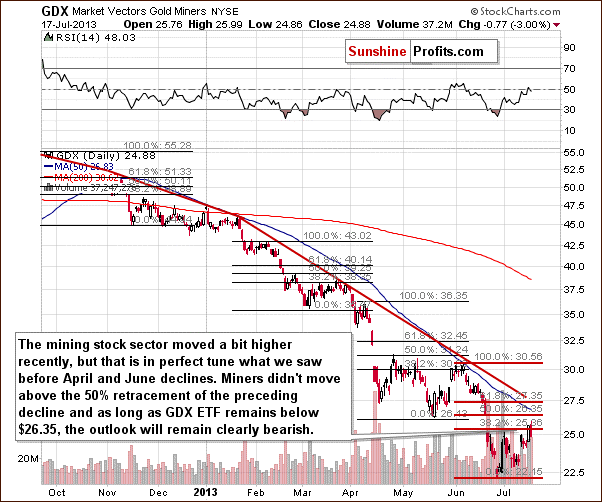
In this medium-term GDX ETF chart, we continue to see an analogy to the previous price patterns. The corrective ABC or zig-zag price pattern was previously followed by a period of declines. On each occasion, the GDX ETF did not move to the 50% Fibonacci retracement level. It declined after getting to or slightly above the 38.2% level. This same type of move was seen on Wednesday, and prices then declined. They seem ready to decline once again.
Furthermore, the volume levels on Wednesday being significant on a move to the downside suggest that it may be the start of bigger declines. The RSI level is close to 50, a level previously seen when the miners formed a local top.
In the past, sharp declines were not seen immediately after local tops. Moderate moves to the downside were seen initially and then – after a few days of moderate declines – we saw a period of accelerated declines.
Before we summarize, we would like to present you two interesting ratios: the gold-stocks-to-gold ratio and the ratio of the HUI Gold Bugs Index to the S&P 500.
Let’s start with the HUI-to-gold ratio. After all, gold stocks used to lead gold both higher and lower for years.
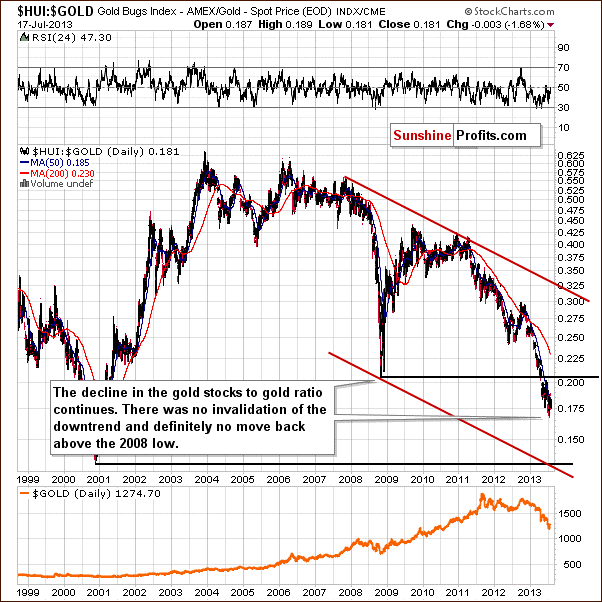
In the gold-stocks-to-gold ratio chart, we didn’t see a real improvement in the situation this week. Although the HUI-to-gold ratio moved higher on Tuesday, this move was barely visible from the long-term perspective. That was just a blip on the radar screen, just like when miners rallied relative to gold in the previous months.
Besides, when we look at the above chart, we clearly see that the HUI:gold ratio remains below the 50-day moving average, a level which has served as approximate resistance for the past month.
Therefore, in our view the downtrend is still valid and the implications remain bearish.
Now, let’s find out how the HUI is doing compared to the stock markets.
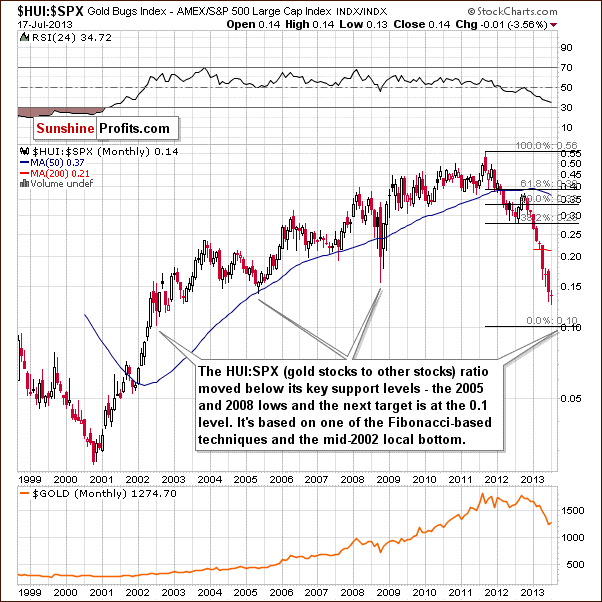
In this very long-term gold-stocks-to-other-stocks ratio we have seen a breakdown below the important support level created by the bottoms of 2005 and 2008. The ratio has been clearly below this level for several weeks now so the breakdown is confirmed.
The next support line is all the way down at the 0.1 level so it seems that further significant declines are likely before the final bottom is reached here. This target level is created by (applying Fibonacci techniques) extrapolating previous declines by the Fibonacci transformation of the Phi number (1.618) . It coincides with the local bottom seen in the middle of 2002.
This chart confirms what we’ve seen in other charts: the bottom is not in yet, another big drop is likely ahead, but the majority of the declines are probably behind us.
Summing up, the outlook for mining stocks remains bearish. Miners are still in a downtrend and it seems that the next move lower will probably be the one to take miners to their final bottom.
Thank you for reading. Have a great and profitable week!
Przemyslaw Radomski, CFA
Founder, Editor-in-chief
Gold Investment & Silver Investment Website – SunshineProfits.com
* * * * *
Disclaimer
All essays, research and information found above represent analyses and opinions of Przemyslaw Radomski, CFA and Sunshine Profits’ associates only. As such, it may prove wrong and be a subject to change without notice. Opinions and analyses were based on data available to authors of respective essays at the time of writing. Although the information provided above is based on careful research and sources that are believed to be accurate, Przemyslaw Radomski, CFA and his associates do not guarantee the accuracy or thoroughness of the data or information reported. The opinions published above are neither an offer nor a recommendation to purchase or sell any securities. Mr. Radomski is not a Registered Securities Advisor. By reading Przemyslaw Radomski’s, CFA reports you fully agree that he will not be held responsible or liable for any decisions you make regarding any information provided in these reports. Investing, trading and speculation in any financial markets may involve high risk of loss. Przemyslaw Radomski, CFA, Sunshine Profits’ employees and affiliates as well as members of their families may have a short or long position in any securities, including those mentioned in any of the reports or essays, and may make additional purchases and/or sales of those securities without notice.

 ‘Undervalued Relative to Gold’
The Powerful Case for Silver
I am a well-known “gold bug” because of my strongly voiced opinion that gold has been one of the best assets for protecting yourself from the US dollar’s prolonged decline.
Lately, the precious metals have taken a beating, and I’ve been called to defend gold’s future prospects in the media countless times. While I am confident that gold will rebound with a vengeance before long, I think investors are potentially missing an even greater opportunity in that other monetary metal: silver.
To address this oversight, I have compiled a special report called The Powerful Case for Silver, which is available at www.schiffsilver.com. This 14-page report report contains in-depth analysis of what I believe to be the strongest arguments for owning the white metal. What follows is a general overview of the key arguments I make in the report.
The People’s Money
After a couple generations of purely fiat currency in the United States, a lot of people have forgotten that money used to be backed by something of value – gold and silver. It wasn’t until 1965 that the US stopped making its dimes and quarters out of 90% silver, and the dollar was backed by gold internationally until 1971.
In spite of fiat money’s ubiquity, more and more people around the world are waking up to the dangers of paper currency and turning to gold and silver to protect their savings. Silver is particularly useful to everyday citizens around the world because of its smaller value-to-weight. A half-ounce of silver can buy you dinner. A half-ounce of gold can buy dinner for you and 60 of your closest friends. That’s why for centuries, gold has been considered the money of kings, while silver is known as the people’s money.
It’s not hard to see the growing importance of a stable medium of exchange worldwide – look to the Cypriot banking crisis or the barter markets evolving spontaneously in economically devastated countries like Argentina or Greece. Here are places where having an stash of silver versus a roll of banknotes can mean the difference between keeping your family well-fed and having to beg for assistance.
Developed nations are also waking up to this reality, translating into record silver sales at the US Mint and other major bullion producers despite the recent correction in global spot prices. This investment demand is providing a baseline of support to silver’s price and helping to re-establish silver as a universally recognized form of money.
Growing Industrial Demand
Silver conducts heat and electricity better than any other metal on Earth. It is also anti-bacterial. These amazing properties make silver indispensable in a vast array of modern industrial and technological applications.
This industrial demand has been shifting dramatically since the turn of the century, as defunct applications for silver like photographic film have been replaced by new technologies like photovoltaic power. The evolution of silver’s industrial applications continues unabated, with new uses being developed every year.
In spite of a recent dip in demand for industrial silver due to global economic volatility, the fundamentals of the industries consuming silver look promising. The Powerful Case for Silver delves deeper into the latest silver technologies like nanosilver and demonstrates why I believe industry will provide growing demand for silver over time.
Undervalued Relative to Gold
For the majority of human history, the prices of silver and gold have been closely tied to each other. There is estimated to be about 19 times as much silver as gold in the earth, and only 11.2 times more silver than gold has ever been mined. Today, the silver:gold price ratio on the markets is about 65:1. That is out of sync with the relative scarcity of the metals and with the long-standing historic bounds from 12:1 to 16:1.
To understand why silver is being undervalued by the market, it is important to trace the histories of the two precious metals. Over the last two centuries, as world markets were forcibly detached from their monetary backing, clumsy attempts at setting fixed exchange ratios at first cleared and then flooded Western markets with silver. Then, with both metals taken out of circulation, precious metals investment was confined to saving – a role more suited to gold.
As the fiat currency system collapses around us, I expect the precious metals to return to circulation, and silver to once again be valued for its advantages in this role. Though I expect both metals to appreciate significantly, silver may rise much faster in order to realign with its historical price ratio to gold.
Take The Time to Understand Your Investment
I’ve just brushed the surface of The Powerful Case for Silver. Inside the report, you’ll find more detail on all of these points, accompanied by helpful charts and graphs illustrating silver’s future prospects.
The Powerful Case for Silver also provides advice on which silver products are investment-grade and how to go about purchasing them safely.
For those who have been on the fence during this bull market, the recent correction is an excellent opportunity to learn about silver and build a position.
Click here to download The Powerful Case for Silver, a free in-depth report on the state of the silver market right now and investment prospects for the precious metal in the future.
Peter Schiff is Chairman of Euro Pacific Precious Metals, a gold and silver dealer selling reputable, well-known bullion coins and bars at competitive prices.
-
I know Mike is a very solid investor and respect his opinions very much. So if he says pay attention to this or that - I will.
~ Dale G.
-
I've started managing my own investments so view Michael's site as a one-stop shop from which to get information and perspectives.
~ Dave E.
-
Michael offers easy reading, honest, common sense information that anyone can use in a practical manner.
~ der_al.
-
A sane voice in a scrambled investment world.
~ Ed R.
Inside Edge Pro Contributors

Greg Weldon

Josef Schachter

Tyler Bollhorn

Ryan Irvine

Paul Beattie

Martin Straith

Patrick Ceresna

Mark Leibovit

James Thorne

Victor Adair