
Currency
“I know of only two men who really understand the value of gold,” Rothschild reputedly joked in the mid-19th century – “an obscure clerk in the basement vault of the Banque de France and one of the directors of the Bank of England.
Ben Bernanke vs. Rothschild’s Obscure Clerk
BEN BERNANKE, today’s most powerful banker, said this week that nobody really understands gold prices, including himself. Victorian Europe’s richest man, and bullion broker to the Bank of England, N.M.Rothschild at least took the trouble to check.
“I know of only two men who really understand the value of gold,”Rothschild reputedly joked in the mid-19th century – “an obscure clerk in the basement vault of the Banque de France and one of the directors of the Bank of England.
“Unfortunately, they disagree.”
The US Fed chairman in contrast shows only a cursory interest in gold. That’s despite being an economic historian (and 3,000 years of history say people buy gold as a store of value) as well as sitting on top of the world’s largest hoard (the New York Fed vaults some 6,700 tonnes for both the US and foreign governments. The United States’ own gold reserves total 8,133 tonnes – some 5% of all the gold ever mined).
Asked in Congress on Thursday, however, why 2013 gold prices have fallen 25%, Bernanke was in fact close to an answer. “People are less concerned about extreme outcomes,” he said, “and therefore they feel less need for whatever protection gold affords.”
This drop suggests “people have somewhat more confidence. [So] the gold price going down is not necessarily a bad thing.”
Rothschild’s obscure clerk might well agree, at least with regards to Western investors. People buy gold, and drive the price higher, when they fear bad things ahead. War, financial crisis and stockmarket crashes…such horrors make rare, indestructible gold appealing like nothing else. (The US government’s own hoard confirms that.) But five years after Lehmans collapsed, many investors are now bored with the crisis. That makes gold – proven crisis insurance – look boring as well.
Asian households, on the other hand, buy gold whenever they can. So their rising incomes mean India and China now account for one ounce of gold in every two sold worldwide. And not understanding gold prices today starts with ignoring Asia’s rapid ascent.
Ben Bernanke was also half-wrong to say people buy gold as an “inflation hedge”. Because he missed the equally big role played by interest rates – and that’s a telling blind spot. After all, the Fed chairman slashed the returns to cash to zero. More than four years later, he promises to hold rates at zero “for an extended period” in future as well.
This might not matter if inflation stayed “low” as he keeps claiming. But when inflation overtakes interest rates? Gold tends to rise in value when cash savings fall in real terms. That’s been as true under the free-floating prices of the last 42 years as it was under the 19th century’s classical Gold Standard.
Put another way, if inflation is rising faster than your savings are growing, your cost of living would be falling if you held that money as gold instead.

Since Richard Nixon cut the Dollar’s last formal ties to gold backing four decades ago, the official US cost of living index has outpaced US savings rates in 198 months. Gold prices have risen in 163 of them, gaining an average – in real terms and after accounting for today’s US capital gains tax – of 14.2% per year. That made the Consumer Price Index fall for gold-owning savers.
The reverse is true too (and again, in the main. We’re as tired of saying you can’t time real rates and gold as everyone else is of hearing it). In those 305 months when cash savings grew in real terms, gold lost value almost two-thirds of the time, dropping an average 4.0% from a year earlier and so making life more expensive for gold-owning savers.
Yes, the plunge in gold prices this year far outweighs the steadying cost of living for bank savers. But no one said fighting the Fed would be easy, or cheap. And the lesson for central bankers meantime?
Back in the 19th century, if people began exchanging their paper money for gold, central banks would raise interest rates, defending the value of cash and encouraging savers to stay in paper instead. With that convertibility long gone, however, central banks now have what Bernanke calls “flexibility” – the ability to keep rates below inflation, and even create more money at will. This bid to boost the economy comes at the expense of cash savers. So when people choose to buy gold in the 21st century they are signaling in fact the “success” of US Fed and other central-bank policies.
No doubt Ben Bernanke understands that more than he lets on. Savers would do well to understand his repeated desire for higher inflation. Never mind understanding the aims of his likely successors.
Adrian Ash
Gold price chart, no delay | Buy gold online at live prices
Adrian Ash is head of research at BullionVault – the secure, low-cost gold and silver market for private investors online, where you can buy physical gold and silver ready-vaulted in Zurich or Singapore for just 0.5% dealing fees.
(c) BullionVault 2013
Please Note: This article is to inform your thinking, not lead it. Only you can decide the best place for your money, and any decision you make will put your money at risk. Information or data included here may have already been overtaken by events – and must be verified elsewhere – should you choose to act on it.

“High oil prices tend to prick investment bubbles.”
 History does not necessarily repeat but it certainly rhymes. Think back five years to July 2008 and oil prices peaked at $147 before giving way to a slump to $33 by December as the global financial crisis struck.
This July WTI crude has jumped to $107 a barrel. That’s a tax on consumers and business. Surging oil prices are a proven recession indicator.
Gulf Wars
Think back to the First and Second Gulf War’s and the recessions that followed. High oil prices tend to prick investment bubbles.
Will it be different this time? Stock markets in advanced nations look very high with the global economy cooling down. House prices have also picked up courtesy of the Fed’s money printing and low interest rate regime.
These are the asset price bubbles that now look vulnerable. Gold and silver have already seen their big correction, and bonds prices have tumbled a huge 40 per cent in two months.
House prices are also now stalling after a hike in mortgage payments over the past couple of months. So why are stocks and oil still going up in price?
This is liquidity driven speculation of the sort that always ends in tears. Buying an asset class close to the top of its price cycle is always a bad idea. You have a lot of risk and little room for gain and much for pain.
Speculators always reckon they can close out their positions before markets reverse. But their track record is not good. Most get caught out in leveraged positions as markets head south and lose their shirts.
Yes the Middle East has geopolitical issues by the bucket load but there is nothing new and local civil wars and social and economic unrest are perhaps too much of a preoccupation for anything really exciting to happen.
Cash is king?
It would be far more sensible to liquidate and go into cash at this point and/or put money into assets that have already hit bottom, or must be very close to it like gold and silver.
We think high oil prices are an obvious red flag warning of trouble dead ahead for global financial markets.
Of course, $107 is lower than $147 in July but the global economy is in a much weaker condition that it was then and will therefore breakdown at lower oil prices than it did in 2008.
About Arabian Money
Arabianmoney.net is the first dedicated financial comment website to be published from Arabia, and provides lively and topical commentary on both local and global news. This is a free website that introduces the more detailed investment analysis and actionable investment ideas and tips available only in our paid-for subscription newsletter. Anybody seriously interested in Arabian investment should get this monthly publication (subscribe here).

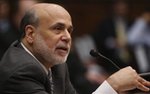 Federal Reserve Chairman Ben Bernanke Thursday said falling gold prices may reflect less concern among investors about “extreme outcomes” for the economy.
“Gold is an unusual asset. It’s an asset that people hold as a sort of disaster insurance,” Mr. Bernanke said in response to a question at a Senate Banking Committee hearing.
Gold prices have dropped near three-year lows in recent weeks as the economy shows signs of improving and the Fed has clarified its plans to eventually roll back its bond-buying program.
Mr. Bernanke said those lower prices may reflect greater confidence about the economy and less concern that Fed programs will cause inflation to spike.
Still, the Fed chairman said gold isn’t such a great hedge against inflation. “Movements of gold prices don’t predict inflation very well,” he said.
Mr. Bernanke also offered a major caveat to his assertions about gold: “Nobody really understands gold prices and I don’t pretend to understand them either,” he said.
Bernanke Explains How Fed Views Inflation
There’s long been a gulf between how people view inflation and how central bankers take account of price pressures.
For most people, food and energy costs are among the most important, and most volatile, prices they confront on a daily basis. If those prices rise, that means inflation is on the march, regardless of the readings on the wide range of price data ginned up by government agencies monthly.
…..read it all HERE
Financial analysts have opined that the United States is well on the road to recovery. They cite various data points to make the case that the multi-trillion dollar bailouts and stimulus have brought us back from the brink of a collapse so serious that Congressional leaders had been told that should the bailouts fail, there was a real possibility of martial law being declared.
We’re doing so well, in fact, that just a couple of years ago President Obama assured the nation of our progress, claiming that we “reversed the recession, avoided a depression, [and] got the economy moving again.”
But were one to take a step back from the rhetoric of talking heads, political leaders and so-called Wall Street experts, a completely different picture begins to emerge.
Just this week it was announced that not only are housing starts plummeting, but permit applications reported their “largest miss in history,” an indicator that the economy is not as healthy as it has been made out to be. And, while stock markets are hitting all-time record highs, what’s curious is that some of the world’s largest companies, including Intel, IBM, Google, Ebay and FedEx, are reporting significant consumer pull back and earnings below analyst expectations.
And if that hasn’t convinced you, then here is the reality of the situation directly from Federal Reserve Chairman Ben Bernanke, the architect of the most massive economic recovery “plan” ever devised in the history of the world.

What Helicopter Ben is saying, despite his pledge to start pulling back the monthly $85 billion (Over $1 Trillion yearly) in stimulus spending by mid-2014, is that if they stop injecting financial and bond markets with capital, the whole system is going to fall apart, just like it was going to in 2008.
There is no way out for Ben Bernanke’s policies. We’re toast either way. If we keep printing, we eventually hyperinflate our currency to oblivion, leaving our entire system of commerce at a standstill. If we stop printing the system “tanks,” as noted by the Chairman.
The end result, any way you slice it, is complete and total detonation of our financial, economic and monetary systems:

Following the 2008 crisis, former Treasury Secretary Henry Paulson was quoted as saying that the United States was on the brink of a total collapse, something his successor Tim Geithner echoed in an open letter to Congress.
This is happening, and our Federal Reserve Chairman just confirmed it.
Ignore it at your peril.

A Must Read, Thorough Article – Editor
The Existence Of Global Warming Is Inconsequential
It makes no difference whether or not human induced climate change is true. Governments across the world have already decided to take action and they’re serious about it; and yes, that includes China. Their reason behind this decision is quite simple: they are taking action “just in case” climate change is human induced. They are not willing to “roll the dice” when it comes to the survival of humankind. The ball has already started rolling; and that’s very unlikely to change.
 International Programs On Climate Change
- United Nations
- United Nations Framework Convention On Climate Change
- Intergovernmental Panel On Climate Change
- China Policies On Climate Change
- China National Development And Reform Commission
- Indian National Action Plan On Climate Change
- Australia Department Of Agriculture
- Australian Climate Change Adaptation Program
- WWF Russia Climate Change Program
- European Environment Agency
- Europa International Program For Climate Change
- DOE – United States Department of Energy
- NOAA – National Oceanic And Atmospheric Administration
- NASA – National Aeronautics And Space Administration
- EPA – Environmental Protection Agency
…..thorough article HERE

-
I know Mike is a very solid investor and respect his opinions very much. So if he says pay attention to this or that - I will.
~ Dale G.
-
I've started managing my own investments so view Michael's site as a one-stop shop from which to get information and perspectives.
~ Dave E.
-
Michael offers easy reading, honest, common sense information that anyone can use in a practical manner.
~ der_al.
-
A sane voice in a scrambled investment world.
~ Ed R.
Inside Edge Pro Contributors

Greg Weldon

Josef Schachter

Tyler Bollhorn

Ryan Irvine

Paul Beattie

Martin Straith

Patrick Ceresna

Mark Leibovit

James Thorne

Victor Adair