



Personal Finance

Still-smoldering protests from Egypt to Brazil have set off a race among scholars and journalists to identify the roots of this summer of discontent in the emerging world. Each major theory starts at the bottom, with the protesters on the street, and notes a common thread: young, Twitter-savvy members of a rising middle class. In this telling, the protests represent the perils of success, as growing wealth creates a class of people who have the time and financial wherewithal to demand from their leaders even more prosperity, and political freedom as well.

This is a plausible story, often well told. Yet it is a bit too familiar to be fully persuasive.

…..read more HERE

The Six Most Important Economic Data Points To Watch This Week


  • In the wake of our Note on the importance of PMI data, I thought it would be beneficial to point out what I think the six most important data points to be released this week and why 


MONDAY July 29th


With so much of American’s wealth tied up in their homes, today’s release of pending home sales (both month-over-month and year-over year) will be an important indicator of the relative health of the housing market in the US. 

Screen Shot 2013-07-29 at 6.39.55 AM

The fall in the monthly consensus number (-.1% from a previous monthly increase of 6.7%) is believed to be due to increasing mortgage rates in the US. Such a precipitous drop shows how sensitive consumers are to higher rates. The double digit gains on a YOY basis are due to the low rate environment manifested through the Federal Reserve’s near-zero interest rate policy and this is the number analysts are more focused on as it is more indicative of a trend.

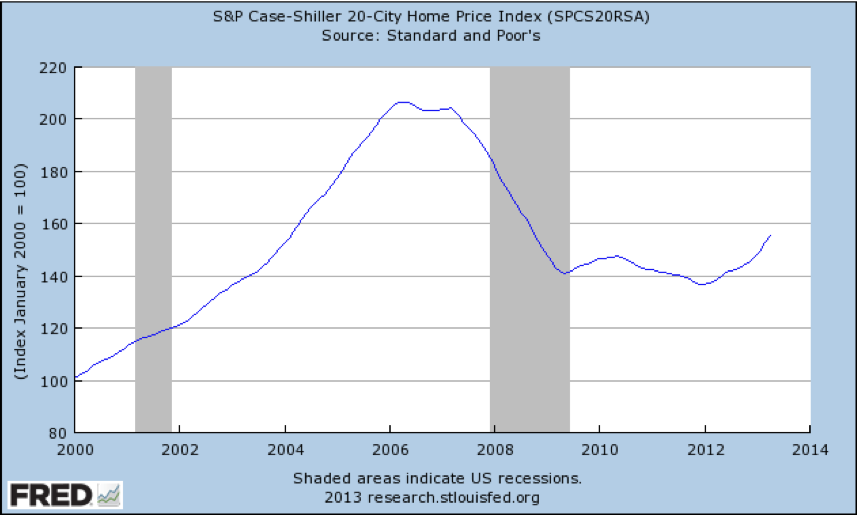
Though the housing market in the US has quite a hill to climb to regain its valuations pre-Great Recession (see chart below of the Case-Shiller 20 City Home Price Index), the recent strength in these (and other) housing market numbers has some cautiously optimistic. 

Screen Shot 2013-07-29 at 6.41.23 AM

TUESDAY July 30

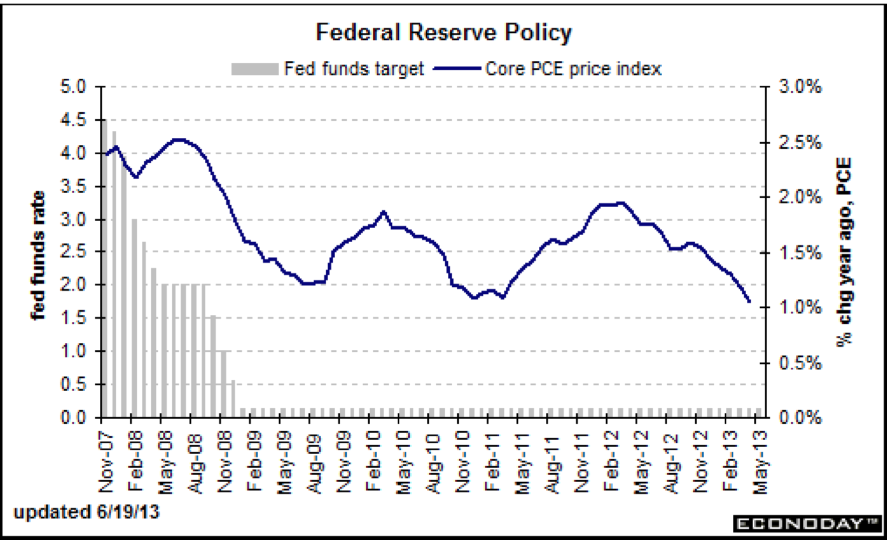
The Federal Open Market Committee (FOMC) begins its two day meeting today to debate the state of the US economy and hence, the direction of monetary policy, inflation, and prices. It’s no secret that the FOMC is split amongst the hawks who want to hasten an end to QE and raise rates and the doves, Chairman Bernanke among them, who want to keep rates in the US low for “an extended period”. The results of the two day meeting will be announced on Thursday. The chart below looks much more deflationary than inflationary and this is at the core of the debate at the FOMC. Short-term interest rates are expected to remain unchanged. 

Screen Shot 2013-07-29 at 6.43.49 AM


WEDNESDAY July 31


Two items of economic data of note today, specifically Q2 GDP and the June Chicago Purchasing Managers Index.

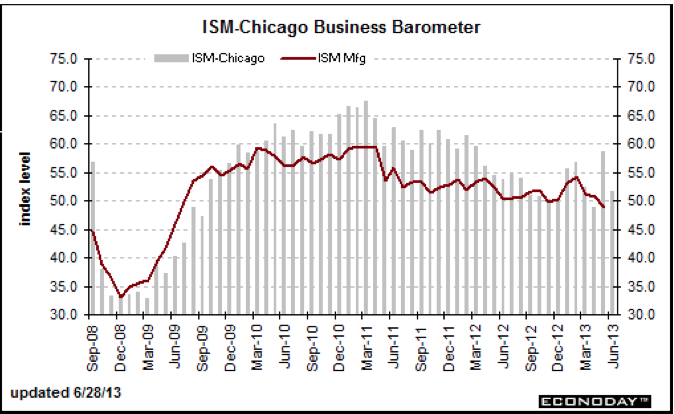
I discussed my affinity for PMI data in a Note last week, and with the US PMI data recently showing strength, the Chicago number will be watched to see if this trend can continue. 

Screen Shot 2013-07-29 at 9.31.54 AM

June’s number registered 51.6, down from the previous month, but still indicative of an expanding industrial base. The current forecast number is 54.

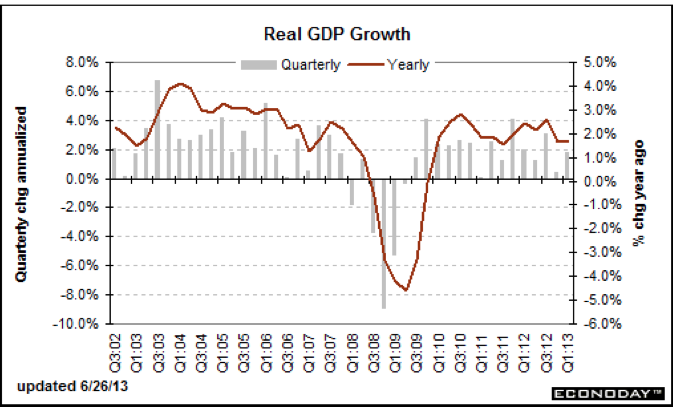
As for GDP, 

Screen Shot 2013-07-29 at 9.32.58 AM

the forecast looks somewhat less rosy as overall the US economy continues to “tread water”. The US economy grew at a rate of 1.8% in Q1 and the economy is forecast to grow by 1.2% in Q2 in the wake of recent downward revisions.

THURSDAY August 1


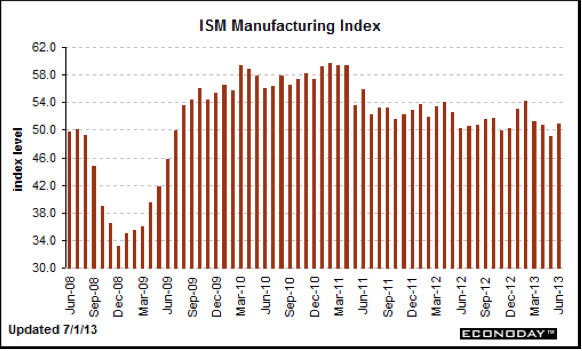
Today, the ISM Manufacturing Index is released and, like the PMI data before it, is forecast to show growth of 51.5 versus 50.9 in June. The ISM index is compiled by discussing a host of factors with purchasing managers from over 300 manufacturing firms in the US. According to Bloomberg, topics discussed include: the general direction of production, new orders, order backlogs, inventories, customer inventories, employment, supplier deliveries, exports, imports, and prices. 

Screen Shot 2013-07-29 at 9.34.56 AM

As a reminder, any reading above 50 is positive and a sign of increasing confidence within the manufacturing sector of the economy.

FRIDAY August 2nd


If the Rose Bowl is the “Grand Daddy” of College Football games, then today’s release of the monthly Initial Jobless Claims is the Grand Daddy of US economic data.

While I have reservations about this number and the unemployment rate in general including how the underemployed are accounted for and the “type”, or quality of job created, the impact that this number has on the financial markets cannot be ignored. I’ve said in the past I put more credence in past month’s claims numbers as they’ve been revised to portray a “truer” employment picture despite the flaws in how this number is calculated.

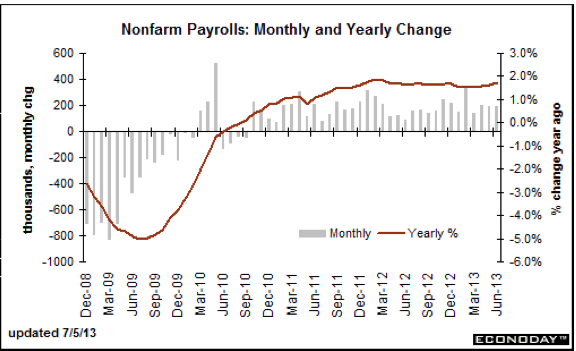
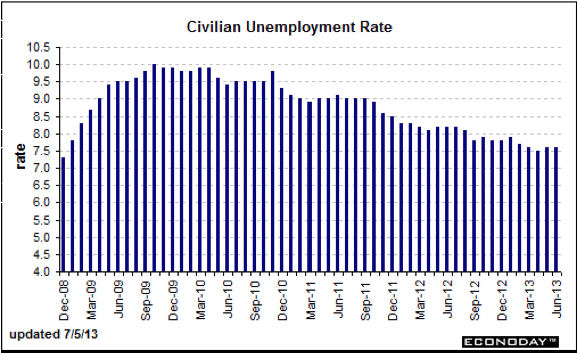
The unemployment rate is forecast at 7.5% down slightly from 7.6% and the non-farm payrolls are expected to increase by 175,000 down from 195,000 the previous month.

It is generally believed that a jobs number greater than 125,000 net new jobs per month is required to stay ahead of population growth and demographic changes in the US. This, however, is the subject of some debate. While the unemployment rate is still high by historic and structural standards, the job creation in the US economy, coupled with nascent strength in the housing market and manufacturing sector, have many believing in continued strength in the US in the second half of 2013 continuing into 2014.

The key will be the direction of interest rates and the health of the US consumer, as we have indicated before. 

Screen Shot 2013-07-29 at 9.36.25 AM


Screen Shot 2013-07-29 at 9.36.34 AM


The material herein is for informational purposes only and is not intended to and does not constitute the rendering of investment advice or the solicitation of an offer to buy securities. The foregoing discussion contains forward-looking statements within the meaning of the Private Securities Litigation Reform Act of 1995 (The Act). In particular when used in the preceding discussion the words “plan,” confident that, believe, scheduled, expect, or intend to, and similar conditional expressions are intended to identify forward-looking statements subject to the safe harbor created by the ACT. Such statements are subject to certain risks and uncertainties and actual resultscoulddiffermateriallyfromthoseexpressedinanyoftheforwardlookingstatements. Suchrisksanduncertaintiesinclude,butarenotlimitedtofutureevents and financial performance of the company which are inherently uncertain and actual events and / or results may differ materially. In addition we may review investments that are not registered in the U.S. We cannot attest to nor certify the correctness of any information in this note. Please consult your financial advisor and perform your own due diligence before considering any companies mentioned in this informational bulletin. We own no shares in any companies mentioned. 


MORNING NOTES 7/29/2013 


THE “MIRACLE MATERIAL” THAT WILL CHANGE THE WORLD

Graphene

A radical new material made from a single carbon atom will soon have a pervasive impact on the U.S. economy – and the entire human race.

200 times stronger than steel and lighter than a feather, this high-tech medium will shape virtually every part of our daily lives by the end of this decade.

The possible uses are almost limitless.

For instance…

  • Doctors will soon use it to create implants that will end brain disease…
  • Technologists will use it to take the power of 1,000 mainframe computers and hardwire it into your smartphone …
  • And biotechnologists will use this very same substance to work as “synthetic blood.”

No wonder the two scientists who discovered this substance won the Nobel Prize in physics last year. That alone should tell you something.

It often takes decades for scientific breakthroughs like this to bag the world’s biggest award. But these two Russians won it for a substance discovered just seven years ago!

We’re talking, of course, about graphene – a substance that is often referred to as the “Miracle Material” of the 21st century.

Make no mistake: This material is not something from science fiction.

It’s for real. And it has the power to revolutionize biotechnology… electronics… energy… computers…even more.

Best of all, it holds the promise of extraordinary new wealth for investors who know the secrets to playing this transformational breakthrough.

….find out what exactly Graphene is HERE

Why the Fed Will Keep QE Going

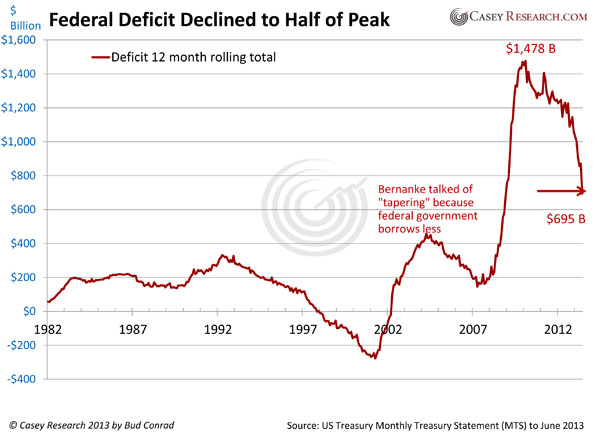
Despite Declining Deficit, Foreigners Aren’t Bailing Us Out, So the Fed Will Keep QE Going

The basic imbalance driving our economy is the government deficit, which spun out of control as a result of the Credit Crisis of 2008/9. But the sequester, improving tax base, lower interest rate, and elimination of stimulus spending have caused the big government deficit, while still extreme, to drop to half its previously nosebleed levels.

FederalDeficitDeclinedtoHalfofPeak


…..read & view more charts HERE

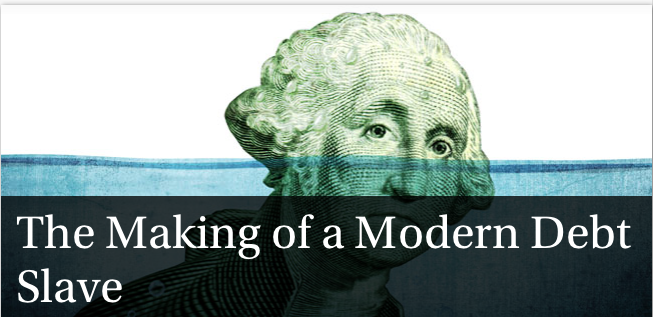
The Making of a Modern Debt Slave


Screen Shot 2013-07-29 at 2.18.05 AMIn the ancient world, when people got themselves into debt, they were often forced to sell their daughters into prostitution and their sons into slavery.

More about that in a minute…

First, a quick look at the financial markets. Looks like gold might have put in a bottom.

We figured it would be around $1,100 per ounce. It may have come closer to $1,200 per ounce.

We’ll have to wait to see. But gold is probably reacting to recent comments from the Fed. Turns out America’s central bank has no intention of tightening up on the credit markets anytime soon. The Fed will keep manning the stimulus pumps for as long as it takes to bring the economy back to “normal” growth… or until the whole thing blows up, whichever comes first.

But the recent rise in yields means credit markets are tightening. That has implications of a darker kind. It is one thing for the feds to correct their own policy mistakes… it is another for the market to force a correction upon them.

But let us return to the ancient world… and try to learn something about how a debt crisis can be resolved.

Sometimes, the weight of debt broke up families… Sometimes families fought back. Writes anthropologist David Graeber in his book Debt: The First 5,000 Years:

“For thousands of years, the struggle between rich and poor has largely taken the form of conflicts between creditors and debtors — of arguments about the rights and wrongs of interest payment, debt peonage, amnesty, repossession, restitution, the sequestering of sheep, the seizing of vineyards and selling of debtors’ children into slavery. By the same token, for the last 5,000 years, with remarkable regularity, popular insurrections have begun the same way: with ritual destruction of debt records — tablets, papyri, ledgers, whatever form they might have taken in any particular time and place.”

Pity the children. They often paid for their parents’ mistakes. Of course, the parents paid too. They suffered the dishonor and humiliation of having their children taken away and put to someone else’s service.

What has changed? Today, the U.S. lumbers into the future with total debt equal to about 350% of GDP. In Britain and Japan, the total is over 500%. Debt, remember, is the homage that the future pays to the past. It has to be carried, serviced… and paid. It has to be reckoned with… one way or another.

And the cost of carrying debt is going up! Over the last few weeks, interest rates have moved up by about 15% — an astounding increase for the sluggish debt market. How long will it be before long-term borrowing rates are back to “normal”?

At 5% interest, a debt that measures 3.5 times your revenue will cost about one-sixth of your income. Before taxes. After tax, you will have to work about one day a week to keep up with it (to say nothing of paying it off!).

That’s a heavy burden. It is especially disagreeable when someone else ran up the debt. Then you are a debt slave. That is the situation of young people today. They must face their parents’ debt. Even serfs in the Dark Ages had it better. They had to work only one day out of 10 for their lords and masters.

As it stands, young people in the U.S., Europe and Japan are expected to work their whole lives to pay for things their parents and grandparents consumed decades earlier.

But wait… it’s worse than that.

Because the unpaid burden of past consumption reduces the ability of the next generation to earn money. A friend sends this email message:

“Just watched an article on CNN regarding European youth unemployment.

“Unemployed between the ages of 16-25:

“Greece, 62%.

“Spain, 56%.

“Portugal, 50%.

“Britain, 24%.

“They are calling it a lost generation.

“This is the point I have been trying to make at our meetings. When you hear of the U.S. with 7.5% or 8%, it doesn’t sound horrible until you look into the numbers.

“In the U.S., the same youth category runs from 20% up to 50%, depending on education and ethnicity. Don’t know what it is in Brazil, but I’m sure it is a serious problem.

“Until this is righted with a multitude of fixes, it appears to me the youth will continue to revolt, and rightly so.

“Just imagine: four years of college, 23 years old, and a bleak future! Who wouldn’t be in a foul mood?”

Let’s see. Deny a young person work and you deny him a career. Deny him a career and you deny him a way to support a family. Deny him a family life and who knows what happens?

In the U.S. and Europe, marriage rates have never been lower. Huffington Post reports:

“We looked at how many adults are currently married — among people over 18, how many of them have a spouse — and we found that barely half of all adults now are married. That’s declined quite a bit from the past. In 2010, again it was barely half — 51% — and in 1960, it was 72%.”

Marriage, work, family — without them, a man thinks differently. Without the yoke of marriage or the traces of family, he runs amok. In China, the “bare branches” — young men who couldn’t find wives — started a revolution.

The Nien Rebellion, which took place between 1851-68, cost over 100,000 lives and almost toppled the Qing Dynasty.

Will today’s young people accept their lot… and remain in docile debt servitude their whole lives? Or will they rise up, as Mr. Graeber suggests, and burn T-bonds in public spaces… rampage down Wall Street… and perhaps hang Ben Bernanke in front of the New York Federal Reserve?

– Bill Bonner

Original article posted on Laissez Faire Today

BillBonnerSince founding Agora Inc. in 1979, Bill Bonner has found success and garnered camaraderie in numerous communities and industries. A man of many talents, his entrepreneurial savvy, unique writings, philanthropic undertakings, and preservationist activities have all been recognized and awarded by some of America’s most respected authorities. Along with Addison Wiggin, his friend and colleague, Bill has written two New York Times best-selling books, Financial Reckoning Day andEmpire of Debt. Both works have been critically acclaimed internationally. With political journalist Lila Rajiva, he wrote his third New York Times best-selling book, Mobs, Messiahs and Markets,which offers concrete advice on how to avoid the public spectacle of modern finance. Since 1999, Bill has been a daily contributor and the driving force behind The Daily ReckoningDice Have No Memory: Big Bets & Bad Economics from Paris to the Pampas, the newest book from Bill Bonner, is the definitive compendium of Bill’s daily reckonings from more than a decade: 1999-2010. 

 

test-php-789





