
Gold & Precious Metals

1. ECNS (English China Daily News) reports that “all may not be well”, in the Chinese gold market. When gold crashed in April, crowds of Chinese citizens were seen buying gold, but they may not have realized how much further prices have fallen since then.
2. “Small investors throughout China now find themselves stuck with depreciated gold assets as vendors tighten their purse strings, many of which are conducting trade-only deals. A woman surnamed Liu was shocked to discover that the gold beads she had purchased for 390 yuan ($63.61) a gram at a Hong Kong market back in April were now only worth 264 yuan a gram at Beijing’s Caishikou Department Store on July 24, reported the People’s Daily.” – ECNS News, August 6, 2013.
3. Small gold investors in China may not be as committed to holding their gold, as India’s citizens are, and they may be starting to worry about drawdowns of 30%, and more.
4. Small Chinese gold investors appear to be somewhat demoralized, and I wouldn’t count on them buying any more price declines in size, at least for now.
5. Regardless, my view is that Western gold investors need to focus on today more than tomorrow. The $1100 – $1200 zone seems to offer good support for gold, and the $1300 – $1400 area could be ideal for profit booking.
6. To fine tune this rough “range trade”, please click here now for larger chart

7. As gold rose to key HSR (horizontal support & resistance) in the $1320 area, my stokeillator soared to about 90. I warned bullish investors that gold needed to rest, and that’s exactly what has occurred.
8. As of this morning, the lead line of my stokeillator is down to the 55 area. It could approach the important 20 zone, within just a few days.That’s where minor trend price surges tend to originate from, and they typically last for 1 to 3 weeks.
 9. Technically, silver looks a bit stronger than gold right now. To view the current set-up, please click here now for larger chart.
10. The stokeillator (14,7,7 Stochastics series) lead line is at the 39 level. Rallies can start from here, but unless you have no silver at all, I would try to wait a few more days before buying.
11. Junior gold stocks are the favourite asset class of many investors in the gold community, and a major upside breakout appears to be “near, but not quite here”.
12. Please click here now . You are viewing the GDXJ daily chart. From a technical point of view, the more times that the price touches a downtrend line, the more important an upside breakout becomes.

13. On this chart, GDXJ has touched the downtrend line four times. Since GDXJ began declining from the $100 price area last fall, there have been minor trend rallies (one to three weeks in terms of time), but nothing more substantial has occurred.
14. Watch that red downtrend line very carefully. A breakout above it could trigger an intermediate trend move, favouring the bulls!
15. Going forwards, I think the senior gold stocks will lag the juniors, for both fundamental and technical reasons. The price of gold is less important to an exploration company than it is to a producer, at least in the short term.
16. Please click here now . That’s the GDX daily chart. A potential inverse head and shoulders bottom pattern began forming, but the rally from the head area has failed too quickly. The pattern is now a bit of a mess.

17. Also, note the position of my stokeillator. The lead line is still quite high, sitting at about 55. Patience is required. Bullish investors should hope that if GDX moves under $25, it forms a double bottom in the $23 area.
18. Since the current downtrend began almost a year ago, each GDX rally has failed to exceed the previous minor trend high. When that finally happens (hopefully on the next upside move!), the intermediate term downtrend will be defined, at least technically, as finished.
19. In the meantime, that day is not today. It’s very important not to get overly excited trying to call “the low”. The low will be defined by a trending pattern of higher highs and higher lows that comes after the low is reached.
20. My suggestion is to focus your “prediction energy” on predicting whether gold stocks appear to offer value, rather than when they could go “parabolic”.
21. Gold stocks do offer value, but parabolic moves usually happen only when massive short positions get force-liquidated by banks, brokers, and dealers.
22. Please click here now . You are looking at a Bloomberg/CFTC table of speculative positions in various commodity markets. Speculators clearly have huge net short positions in five commodities, but not in gold or silver.

23. Unless speculators build a large net short position in the gold and silver futures market, a parabolic move to the upside is not very likely, at least at this point in the economic cycle.
24. The significance of an upside penetration of the GDXJ downtrend line is probably underestimated, by most technicians. Many junior gold stock investors are probably demoralized, and focused on bullion as a “growth with safety” trade. I think this focus on bullion is a mistake. The coming upside penetration of the GDXJ trend line should be the key that opens the gold stocks gulag door, and sets all the prisoners free! The only question is, are you ready for a breakout?
Special Offer For Website Readers: Please send me an Email to freereports4@gracelandupdates.com and I’ll send you my free “Aussie Triple Play” report. Three great Australian gold stocks look ready to breakout to the upside, and begin a trending move of higher highs and higher lows. I’ll show you the tactics to use for each of them.
Thanks!
Cheers
St
Aug 6, 2013
Stewart Thomson
Graceland Updates
website: www.gracelandupdates.com
email for questions: stewart@gracelandupdates.com
email to request the free reports: freereports@gracelandupdates.com
Only $169. for 250 Informative Issues a Year!
2yr: $269 (over 500 issues)
Written between 4am-7am. 5-6 issues per week. Emailed at aprox 9am daily.
Plus:
6 Month Subscription + Pyramid Generator
Over 125 issues plus access to the pyramid generator – $99.
Graceland Updates Subscription Service: Note we are privacy oriented. We accept cheques. And credit cards thru PayPal only on our website. For your protection we don’t see your credit card information. Only PayPal does.
| Subscribe via major credit cards at Graceland Updates – or make checks payable to: “Stewart Thomson” Mail to: Stewart Thomson / 1276 Lakeview Drive / Oakville, Ontario L6H 2M8 / Canada |
Stewart Thomson is a retired Merrill Lynch broker. Stewart writes the Graceland Updates daily between 4am-7am. They are sent out around 8am. The newsletter is attractively priced and the format is a unique numbered point form; giving clarity to each point and saving valuable reading time.
Risks, Disclaimers, Legal
Stewart Thomson is no longer an investment advisor. The information provided by Stewart and Graceland Updates is for general information purposes only. Before taking any action on any investment, it is imperative that you consult with multiple properly licensed, experienced and qualifed investment advisors and get numerous opinions before taking any action. Your minimum risk on any investment in the world is 100% loss of all your money. You may be taking or preparing to take leveraged positions in investments and not know it, exposing yourself to unlimited risks. This is highly concerning if you are an invetor in any derivatives products. There is an approx $700 trillion OTC Derivatives Iceberg with a tiny portion written off officially. The bottom line:

Deflation looms as Beijing rebalances economy
Developed country equity and credit markets snapped back quickly after the Federal Reserve tapering wobble a few weeks ago. From the crow’s nest, markets have accepted that Fed policy normalisation will be gradual, become more confident about economic prospects, and put to one side earlier concerns about the risk of deflation. At the coalface, though, things look more nuanced, and suggest that Fed tapering is much less of a risk than rising concern over a ‘fin de siècle’ moment in emerging markets, especially China, which could spark new deflation fears.
In China, the GDP deflator (a measure of the level of prices of all new, domestically produced, goods and services in an economy) has already slumped to a reported annual rate of 0.5 per cent in the June quarter, from around 7 per cent just two years ago. The combination of overcapacity in several industries and weaker growth could generate further downward pressure on Chinese goods prices at home and abroad.
….read more HERE

Credit is the lifeblood of any economy.
by Bert Dohmen July 25, 2013.
When credit tightens, either because of intent by a central bank, or through market forces, the economy goes into recession…or worse.
China’s money supply (M2) growth in May was up 15.8% compared to one year ago. Some economists say that since there is plenty of money growth, the credit crunch will be just “temporary.” We must point out that the growth of the money supply does not determine whether or not there is a credit crunch. The availability of credit depends on confidence and the willingness of lenders to lend.
Take the case of the US at the start of the 2007-2008 Credit Crisis: credit markets became totally frozen. The Commercial Paper (90-day corporate I.O.U.s) market froze and even large companies like GE couldn’t roll their paper on expiration. We saw this immediately as a crisis scenario, but amazingly no one in the financial media rang the alarm bells. That was the start of global crisis.
And what was US money supply growth at the time? Like China, it too was in the double-digits, rising from a 12% to a 15% growth rate by the end of 2007. In spite of this, the credit crisis intensified culminating in an Armageddon scenario in 2008.
During the last six months China has injected nearly $1.6 trillion in new credit (21% of GDP) into the economy. If there can be a credit crunch even with that much credit being added to the system, then you know that the problems are big.
Currently, China has a serious credit crisis. No private borrowers can get a loan, regardless of creditworthiness.
Our advice at this time: BEWARE!
Will a China Credit Crisis infect the Global Markets?
By Bert Dohmen June 24, 2013
The week of June 17, 2013 had some very important clues for what is ahead for the markets. The Federal Reserve had a two day meeting. The statement of the Fed after the meeting, and the press conference of Fed chief Ben Bernanke were widely misinterpreted in our opinion. The markets tumbled. Does this create a buying opportunity or is it a warning sign?
Our June 21 issue of our CHINA BOOM-BUST ANALYST present the results of our work and our predictions. These will be very, very important for your investment portfolio. Here is an excerpt:
China’s Credit Crisis
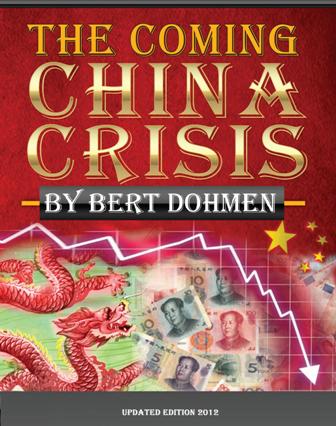
China has the largest credit bubble in the world. We have tracked the private sector credit in China for the past several years. It’s a parabolic curve, and as market observers know, parabolic moves eventually collapse. We discussed this in our e-book, THE COMING CHINA CRISIS (150 pages) one year ago. It was greeted with great disbelief, similar to our book written in 2007, PRELUDE TO MELTDOWN, which predicted that 2008 would see a potential meltdown in the US system. Very few people believed it and the financial media ignored it.
On June 20 the global markets were shaken by the big overnight surge in short-term interest rates in China. The SHIBOR rate (similar to the short-term LIBOR interest rate in the western world) soared to over 11% overnight. The overnight repo rate soared over 25%.
The markets are sending an important message. What is really behind the market turmoil of the week of June 17? You will get Bert Dohmen’s interpretation in the CHINA ANALYST as well as the other services we offer.
China is extremely important for all business leaders and investors, whether you ever intend to invest in China (which we don’t) or not. You may ask, “why should you spend your valuable time reading about China if you have no intention of trading or investing in the country?”
Because whatever happens to China will tremendously influence the world economy and your investments. Many large US and European companies depend on China for a significant portion of their sales and profits. These companies are household names. A crisis in China will have global repercussion.
 About Dohmen Capital Research
You can stay ahead of the crowd by being knowledgeable about what is happening in China, not what the media is telling you about China. Amazingly, 99% of all analysts still believe the fiction of 7.5% GDP growth in China. Knowing the truth, our subscribers have been able to adjust their portfolio accordingly.
Being prepared for what’s ahead will help your portfolio thrive during this age of turmoil. For less than $31/month you can stay ahead of the crowd. The CHINA BOOM-BUST ANALYST is the most authoritative China research publication you can find at such a low cost. Go to:http://www.dohmencapital.com/ordernow.htm
Bert Dohmen did an important interview about China on Dec. 22, 2012. Judge
yourself if it was on target.
Here is the link: http://www.marketoracle.co.uk/Article38147.html
The Special China E-Book “The Coming China Crisis” is only available as a PDF format. (150 pages) $25.00 Click HERE or on the image to read more.

-
I know Mike is a very solid investor and respect his opinions very much. So if he says pay attention to this or that - I will.
~ Dale G.
-
I've started managing my own investments so view Michael's site as a one-stop shop from which to get information and perspectives.
~ Dave E.
-
Michael offers easy reading, honest, common sense information that anyone can use in a practical manner.
~ der_al.
-
A sane voice in a scrambled investment world.
~ Ed R.
Inside Edge Pro Contributors

Greg Weldon

Josef Schachter

Tyler Bollhorn

Ryan Irvine

Paul Beattie

Martin Straith

Patrick Ceresna

Mark Leibovit

James Thorne

Victor Adair