
Timing & trends
The mantra that gold is the only inflationary hedge to use should have a closer look. Here is one – Ed.
My first article is based our just-released Market Overview (monthly reports). It focuses on gold as an anti-inflation hedge, and why it is precisely a hedge against something else. In the article below I will focus on John Paulson’s recent comments on gold by discussing the link between base money and gold. In short, significant increases in base money can be good reasons to be bullish, but not necessarily as bullish as Paulson argues.
John Paulson is betting in favor of gold based on his inflationary explanation of the current situation. He is consistent is his belief in the inflationary scenario when he states that the housing market is not far away from the bottom. He even goes so far to say that buying a home is one of the best investments one can make. (Let us not forget that Paulson correctly predicted the peak in the housing market and became a billionaire by short selling subprime mortgages in 2007). So where is the consistency? What does being bullish about gold have to do with being bullish about the real estate market? The answer is: if you believe in strong inflationary forces, you have to believe they should prevail macroeconomically, and you cannot separate various markets. If money printing should lead to inflation, you should see inflation everywhere, because it is a universal phenomenon; an upward march of prices. Of course, some markets are more affected than others. One price can increase by 10%, another by 25%, other by merely 4%. Nevertheless, once inflation takes a hold there are no doubts about it, since rising prices are noticeable virtually everywhere. Therefore, it would seem contradictory to argue on the one hand that high inflation is coming, and at the same time state that the housing market should still plummet. In other words, if you believe in hyperinflation, you should believe in a runaway boom, a flight into real assets, any assets useful to the public despite any possible debt shackles (since the real value of debt shrinks in the high inflation storm).
This of course does not imply that gold always has to move in the same direction as real estate. But, if the argument for buying gold is based on hyperinflationary conclusions, then one must accept the consequences and argue that other real markets also have to boom. That is the nature of high universal inflation: everything gets more expensive (except for money and past contracts, which lose their value). Therefore, if one posits that gold will rise because very high inflation is around the corner, one could just as well say that real assets are going to rise due to the upcoming inflation.
Actually the same goes with interest returns, including government bonds. If high inflation is on its way, one should see investors demanding inflationary compensation. In other words, interest returns on current investments should take into consideration the inflationary wave that is supposed to swipe the currency market. If you believe in hyperinflation, observe current interest returns and all commodity markets. If you do not see an upswing in both cases, nobody’s really expecting high inflation to happen. Therefore, you should not make the case for gold based on hyperinflation argument.
In the environment of very high levels of inflation (tens of percent) gold will rise as other real values. What is the case with single-digit inflationary scenario? Is gold really the inflation-hedge as it is touted? People believe so, and they are right when it comes to high inflation scenarios, but if we focus on smaller doses of inflation there is little correlation between the inflation rate and the gold price. Actually, as stated above gold is an anti-inflation instrument only when biginflation is on its way. Very big. The last 40 years tell us that gold has its own cycle, in fact unrelated to levels of inflation. Take a look at this graph:
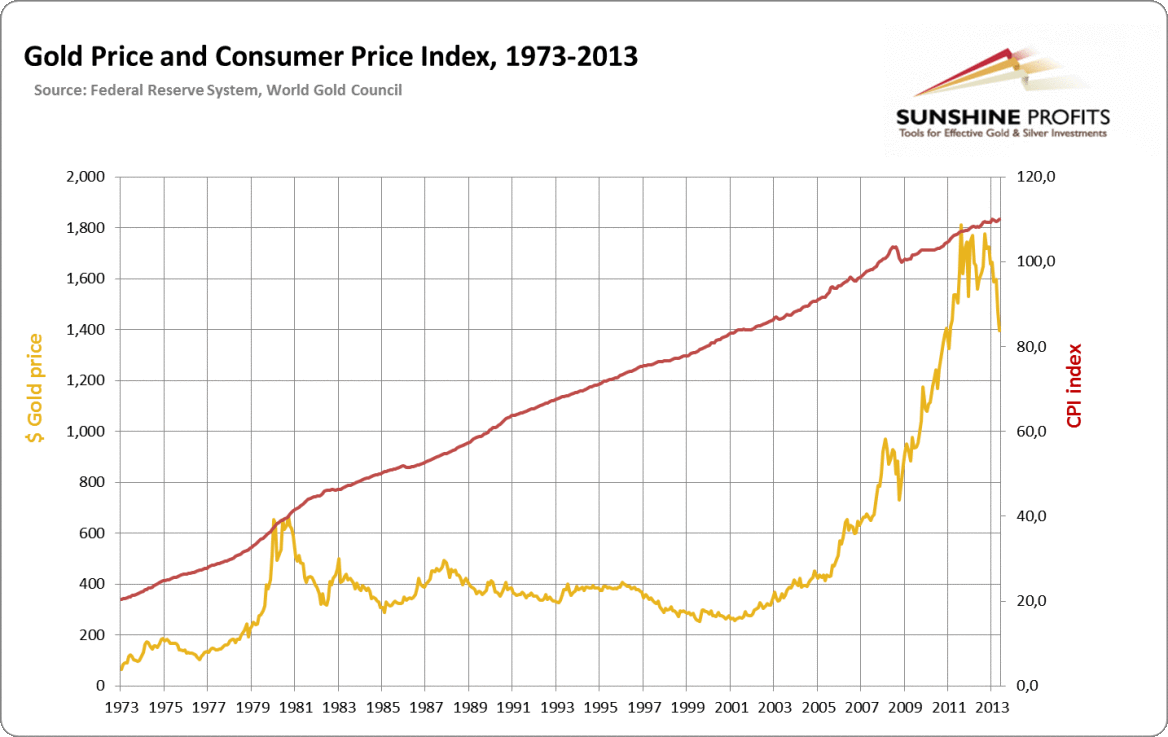
For the last 40 years the dollar was constantly losing its value (right scale) sometimes faster, sometimes slower. Yet gold appears to have its own way of reacting to this steady decline in the dollar’s purchasing power. Take as an example the case of the period between 1982 to 2002 when the dollar lost half of its value. During the same period gold did not gain 100% to compensate for inflation. It did not increase and did not even stay at the same level. In fact it lost its value. It was one of the worst inflation-hedges one could pick. It did not save your capital from inflationary policies. Worse, because it was inferior to the dollar putting your green paper currency in socks was a better choice than buying gold.
Two decades is not a short run. We do not take the highest gold price from the 1980s to prove the point. During those 20 years gold was losing its value faster than the dollar. Then things changed. For the next ten years the dollar lost its value, but there was a significant shift in the gold market. During that period of time, as we well know, gold gained tremendously. Even though the time period is not very long it can clearly confirm one thing: gold has its own separate market. Its value may be related to the inflation rate, but it is not a primary reason for major shifts in the value of gold. Simply put, there is more–much more. Historically gold is not a good inflation hedge (or precisely it can be in only certain circumstances).
The key to proper understanding of the gold market and more importantly – making a correct investment choice in the gold market – is getting rid of this popular notion about the yellow metals and admitting that gold will not necessarily save you from the inflation monster. Yet it can save you from something else: the endangered dollar system.
As mentioned earlier, the above is a part of the first Market Overview report that we have just published. The full version includes detailed discussion of the anti-inflationary investing vs. anti-system investing (when is gold exactly an inflation hedge?), physical gold production, mining costs, and more. We are generally fans of the try-before-you-buy policy, so we have already provided two parts of this month’s Market Overview this and last week. We are also posting this month’s Overview later than usually so that if you sign up for the monthly subscription, you’ll be able to read 2 monthly Market Overview reports in this period. The price for one month is $14.95, but we decided to lower it for the first month to $9.95. So, instead of one for $14.95 you get two for $9.95 – that’s a 67% discount for a premium publication. We’re not saying that you have to sign up but we highly recommend that you do and given the discount, it would be a waste not to take advantage of it. You can sign up here.
Thank you.
Matt Machaj, PhD
Sunshine Profits‘ Contributing Author
Sunshine Profits’ Gold & Silver Market Overview
He is a free market advocate, believes in personal liberty, responsibility, and believes that social power is a better alternative than government power. Personally he believes that intelligence is the most powerful thing in the universe and beyond. He is no fan of conspiracy theories, but likes to study conspiracy practices.
* * * * *
Disclaimer
All essays, research and information found above represent analyses and opinions of Matt Machaj, PhD and Sunshine Profits’ associates only. As such, it may prove wrong and be a subject to change without notice. Opinions and analyses were based on data available to authors of respective essays at the time of writing. Although the information provided above is based on careful research and sources that are believed to be accurate, Matt Machaj, PhD and his associates do not guarantee the accuracy or thoroughness of the data or information reported. The opinions published above are neither an offer nor a recommendation to purchase or sell any securities. Matt Machaj, PhD is not a Registered Securities Advisor. By reading Matt Machaj’s, PhD reports you fully agree that he will not be held responsible or liable for any decisions you make regarding any information provided in these reports. Investing, trading and speculation in any financial markets may involve high risk of loss. Matt Machaj, PhD, Sunshine Profits’ employees and affiliates as well as members of their families may have a short or long position in any securities, including those mentioned in any of the reports or essays, and may make additional purchases and/or sales of those securities without notice.

Miners Become Currency Traders
There’s been one bright point for miners lately: depreciating global currencies.
Reports this month suggest that Australian coal miners are benefiting from a recently-weaker Aussie dollar.
Management at Indonesian coal miner PT Adaro Energy said their company is facing stiffer competition from these re-invigorated Australian producers. With the A$ lower against the USD, such miners make a larger domestic profit selling their product abroad in American dollars.
But it’s not just Australia. Indonesia’s biggest coal miner PT Bukit Asam said it may also benefit from a weaker rupiah when it next reports earnings.
It seems the story is the same in many mining-focused economies. South African coal miner and synfuel-maker Sasol reported last week that its headline earnings for the year ended June 30 may jump as much as 30%. Management cited a 14% depreciation on the rand against the dollar as part of the reason for the surprising rise in profits.
Watch for the same story to unfold in Brazil. The real has dropped a staggering 13% against the dollar in just three months. This is bad news for Brazilian firms buying USD-priced imports. But it’s great news for miners and oil producers who sell their product in dollars, and mainly pay expenses in local currency.
We could see some earnings surprises here over the next quarter or two.
Here’s to foreign exchange,

“There was very good physical demand overnight out of Asia,” said Bill O’Neill, one of the principals with LOGIC Advisers. “That got things going, and it kind of built upon itself….We hit (buy) stops as the session wore on.”
September silver SIU3 +4.65% rose 92 cents, or 4.5%, to $21.32 an ounce. Silver hasn’t traded above $21 since mid-June, according to FactSet. The Global X Silver Miners ETF SIL +6.28% was up more than 5% in recent trade.
But other factors were at play as well, including a fresh news report about the robust demand from China so far this year. The China Gold Association said that the country’s gold consumption in the first half of 2013 rose 54% year-on-year to 706.36 metric tons.
“You still have China on a gold- and silver-buying binge,” Flynn said. “At a time when prices were falling, China continues to buy. That report today is a reminder that there is still a lot of physical demand for the metal.
Kevin Grady, president of Phoenix Futures and Options on the Comex floor, said gold futures are in slight backwardation, in which prices for the nearby contract are more expensive than for deferred contracts and seen as a sign of a tightening market. Normally, deferred contracts are more expensive due to costs such as storage. As of Friday’s close, August gold had a 70-cent premium to December.
“There is definitely buying in the physical market,” Grady said. “It’s coming out of Southeast Asia and it’s coming out of the Middle East, and it’s strong. There’s been buying the entire way down.”
….read more HERE
The US Is Weeks Away From A Confluence Of Risky Economic Events That’s Unlike Anything We Can Recall
Starting sometime in September, we can expect to see the following:
- A fight over the government’s budget, leading to a possible government shutdown.
- A fight over the debt ceiling.
- The beginning of Fed tapering (the reduction of large-scale asset purchases, known as Quantitative Easing)
- A nomination for a Fed Chair to replace Ben Bernanke.
Each one of these could be economically significant to varying degrees. Together they’re likely to be very exciting.
….some analysis HERE
Also: Why Wall Street Should Worry About the Next Fiscal Fight
Without a doubt, the recent weeks were tough for the U.S. currency. The U.S. dollar fell as investors weighed when the Federal Reserve would slow the pace of bond purchases that had contributed to weakening the greenback. It also dropped against all its major counterparts after a government report last week showed American employers hired fewer workers in July than economists had predicted. Another bearish factor which weakened the dollar was strong data from China that suggested economic optimism.
“The weakness in the dollar is causing some short-covering in gold,” said Ronald Leung at dealer and refiner Lee Cheong Gold Dealers in Hong Kong.
What has happened with gold in the recent weeks? After a rally to over $1,347 the yellow metal declined below $1,300 per ounce and then pulled back to $1,320. In the following days we saw a sharp drop to a three-week low and an equally strong move to the upside which took gold to over $1,316 per ounce. Some investors said it was a rollercoaster.
Yesterday, gold bounced higher and gained nearly 2 percent. Its recovery was helped by the dollar’s slide to a seven-week low. However, the improvement didn’t last long and today the shiny metal eased back below $1,310 an ounce as the dollar recovered.
This interesting relationship between the U.S. dollar and gold has encouraged us to examine the US Dollar Index and the gold chart from two other perspectives to see if there’s anything on the horizon that could drive gold prices higher or lower shortly. We’ll start with the USD Index very long-term chart to put the gold charts into perspective (charts courtesy by http://stockcharts.com.)
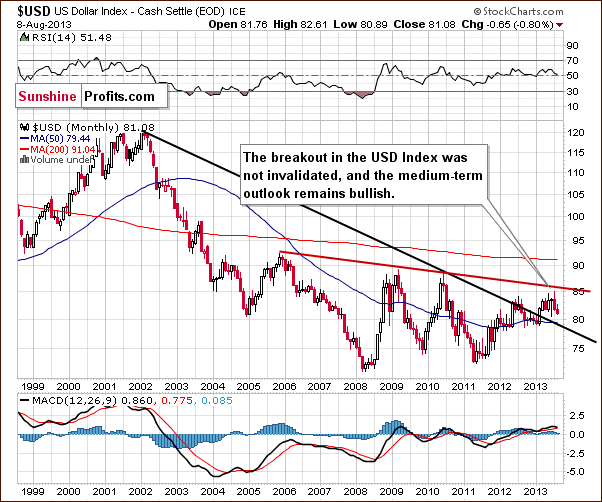
As we wrote in our essay on gold, stocks and the dollar on July 24, 2013:
The breakout above the declining support/resistance line (currently close to 79) was still not invalidated.
The above paragraph is up-to-date also today. From the long-term perspective, the situation remains bullish.
Now, let’s zoom in on our picture of the USD Index and see the medium-term chart.
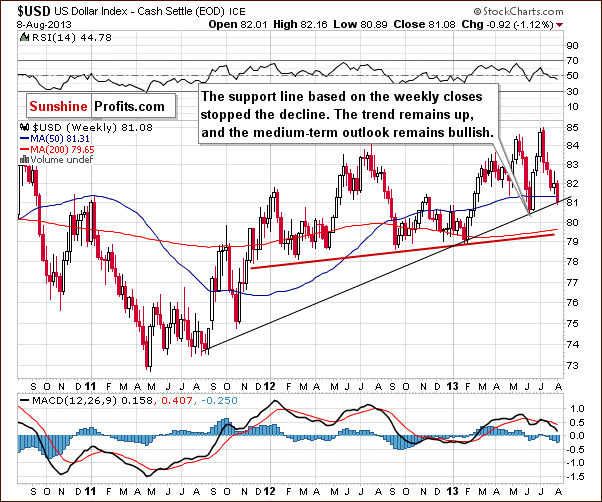
On the above weekly chart, we can see that in the past week, the USD Index declined once again. The recent declines took the index to the medium-term support line (currently close to the 81 level). Keep in mind that this strong support line stopped the decline in June (it was not even reached) and encouraged buyers to act, which resulted in a sharp rally in the following days. Taking this into account, we might see a similar situation in the coming days.
From this perspective, the medium-term uptrend is not threatened, and the situation remains bullish. Therefore we can expect the dollar to strengthen further in the coming weeks.
To make the U.S. dollar perspective complete, let’s see how the situation in the US currency may translate into the precious metals market. Let’s take a look at the Correlation Matrix (namely: gold correlations and silver correlations).
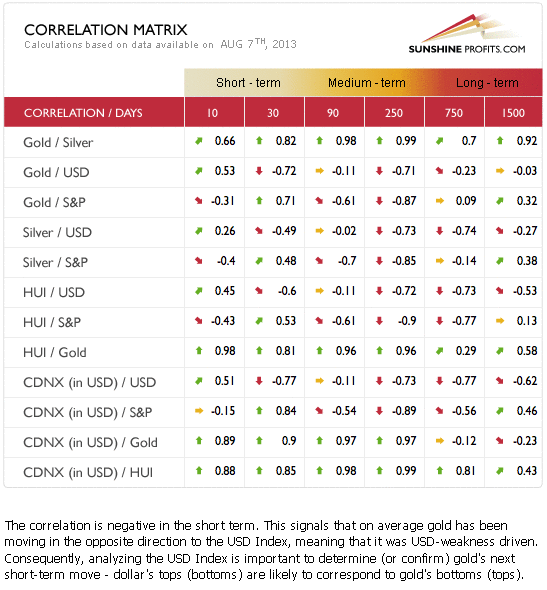
Basically, there have been changes in the values of coefficients since we commented on them previously in our essay on gold, stocks and the dollar on July 24:
We have seen negative correlation between the metals and the USD Index(…). Taking the short-term, bullish outlook for the USD Index into account, the implications for gold, silver, and the mining stocks are clearly bearish at this time.
At this point we would like to add that even though the USD Index declined by almost a full index point this week, gold didn’t rally – it moved lower by about $3. Gold’s underperformance remains in place – or at least Thursday’s rally is not enough to change it.
Once we know the current situation in the U.S currency and its implications for the precious metals sector, let’s find out what happened during the recent days and check the current situation in gold from the perspective of the Australian dollar. Does it provide any important clues as to further gold’s price movements?
Click HERE or on image for larger version

On the gold priced in Australian dollar chart, we see that the previous breakout was invalidated very quickly, and the price came back below this declining resistance line. However, buyers didn’t give up and triggered one more move to the upside. That increase resulted in the next breakout above the previously-broken resistance/support line.
Despite this growth, gold did not manage to break above the June top as the above-mentioned strong resistance level stopped the rally. The corrective move took the yellow metal below the previously-broken resistance/support line and reached the 50-day moving average.
Keep in mind that we saw similar price action in June. After an invalidation of a breakout above the above-mentioned declining support/resistance line, there was a pullback to this resistance line. The buyers, however, didn’t manage to push gold above it, resulting in strong declines. This time, the gold bulls were stronger and pushed the price a bit higher, but it doesn’t change the similarity between these two situations (still looks like a double-top pattern).
In June, the strong corrective move took gold‘s price all the way back down to the April bottom area. If we see similar price action here, gold priced in Australian dollars will likely decline heavily once again.
So, from this point of view, the recent price increase hasn’t changed the current outlook, and the implications remain bearish.
To finish off, let’s have a glance at a chart that synthesizes the “non-USD” perspective, as it features gold‘s price relative to an index of foreign currencies.
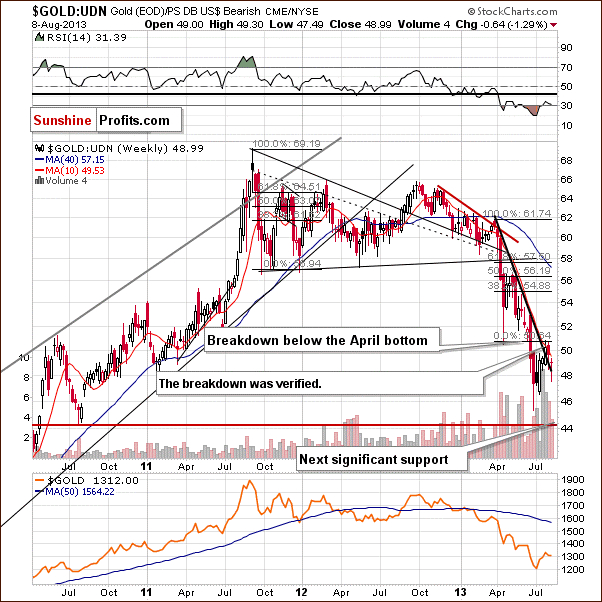
At the end of July we saw a move to the upside which took gold above the declining support/resistance level. However, the yellow metal didn’t manage to move back above the April bottom. This event brought negative consequences in the following days.
We clearly see that gold showed weakness in the past week as well as this one, and the breakdown below the April’s bottom was verified.
Gold has not broken below the declining support line so far. When it does, the decline will be likely to accelerate.
Summing up, the situation in gold remains bearish. Gold moved higher on Thursday, but overall it’s down $2.90 this week (taking Thursday’s closing price into account), while at the same time, the USD Index is down almost a full index point. Gold continues to underperform the dollar and a one-day rally on relatively low (compared to the size of the rally and volume accompanying previous days’ declines) volume doesn’t change that. The situation remains in tune with previous bearish price patterns.
Thank you for reading. Have a great and profitable week!
Przemyslaw Radomski, CFA
Founder, Editor-in-chief
Gold Investment & Silver Investment Website – SunshineProfits.com
* * * * *
Disclaimer
All essays, research and information found above represent analyses and opinions of Przemyslaw Radomski, CFA and Sunshine Profits’ associates only. As such, it may prove wrong and be a subject to change without notice. Opinions and analyses were based on data available to authors of respective essays at the time of writing. Although the information provided above is based on careful research and sources that are believed to be accurate, Przemyslaw Radomski, CFA and his associates do not guarantee the accuracy or thoroughness of the data or information reported. The opinions published above are neither an offer nor a recommendation to purchase or sell any securities. Mr. Radomski is not a Registered Securities Advisor. By reading Przemyslaw Radomski’s, CFA reports you fully agree that he will not be held responsible or liable for any decisions you make regarding any information provided in these reports. Investing, trading and speculation in any financial markets may involve high risk of loss. Przemyslaw Radomski, CFA, Sunshine Profits’ employees and affiliates as well as members of their families may have a short or long position in any securities, including those mentioned in any of the reports or essays, and may make additional purchases and/or sales of those securities without notice.

-
I know Mike is a very solid investor and respect his opinions very much. So if he says pay attention to this or that - I will.
~ Dale G.
-
I've started managing my own investments so view Michael's site as a one-stop shop from which to get information and perspectives.
~ Dave E.
-
Michael offers easy reading, honest, common sense information that anyone can use in a practical manner.
~ der_al.
-
A sane voice in a scrambled investment world.
~ Ed R.
Inside Edge Pro Contributors

Greg Weldon

Josef Schachter

Tyler Bollhorn

Ryan Irvine

Paul Beattie

Martin Straith

Patrick Ceresna

Mark Leibovit

James Thorne

Victor Adair