
Timing & trends
U.S. stocks fell, sending the Standard & Poor’s 500 Index lower for the sixth time in eight days, as speculation increased that the Federal Reserve will scale back stimulus this year amid signs the global economy is strengthening.
Macy’s Inc. fell 4.2 percent as the department-store chain cut its profit forecast after weaker-than-estimated quarterly sales. Homebuilders and utility stocks slumped amid rising bond yields. Cree Inc. tumbled 19 percent after forecasting lower first-quarter profit than analysts had anticipated. Apple Inc. climbed above $500 for the first time since January, extending a rally after billionaire investor Carl Icahn said yesterday he’s an Apple shareholder.
“The market is scope-locked on Fed tapering in September,”Douglas Cote, chief market strategist at ING U.S. Investment Management in New York, said in a telephone interview. His firm oversees $190 billion. “Quantitative easing is creating some excess in the financial system. The last thing Bernanke wants when he finishes his term is to be responsible for the next bubble.”
….read more HERE

And pointed to very little inflationary pressure in the economy, which could add to worries at the U.S. Federal Reserve that inflation is running too low.
The Labor Department said on Wednesday a drop in natural gas and gasoline costs held back its seasonally adjusted producer price index. Analysts polled by Reuters had expected a 0.3 percent increase.
But it was the weakness in the index outside of volatile energy and food components that will likely garner more attention at the Fed, which has recently flagged the risks posed to the economy by low inflation.
These so-called “core” prices, which are seen as indicators of trends in inflation, rose 0.1 percent during the month, below the 0.2 percent gain expected by analysts in a Reuters poll.
The report helped push yields lower on long-term U.S. government debt, suggesting investors saw it as a sign the Fed might keep a major economic stimulus program in place for longer.
….read more HERE

Paulson raises offer to $40/shr from $38
Offer values company at $512 million
Shares rise to $40.41 in premarket trading
Steinway says merger agreement does not provide for go-shop period
Aug 14 (Reuters) – Steinway Musical Instruments Inc, best known for its grand pianos, said it would be taken private by Paulson & Co Inc after the hedge fund firm raised its offer to $40 per share, valuing the 160-year old company at about $512 million.
Steinway’s shares rose to $40.41 in premarket trade, suggesting some investors expect a higher offer.
The company said on Monday it had received a bid of $38 per share from an unidentified asset manager that topped an offer of $35 per share from Kohlberg & Co. A source identified the new bidder as John Paulson’s hedge fund firm.
….read more HERE

“This is a no-brainer to go buy stock in a company that can go borrow” at a low rate, Mr. Icahn said in an interview. “Buy the company here and even without earnings growth, we think it ought to be worth $625,” he said, referring to the stock price, which closed Tuesday at $489.57, having risen 5% on the news of Mr. Icahn’s investment.
much more at Wall Street Journal HERE
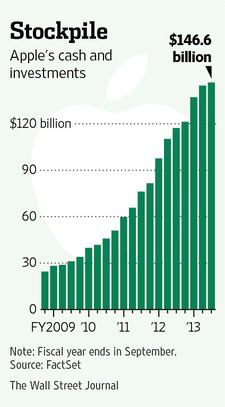
Apple’s Stockpile:
 Wa
Wa

“Oil is absolutely certain to become incredibly short in supply and very high priced. The imported oil is not your enemy, it’s your friend. Every barrel that you use up that comes from somebody else is a barrel of your precious oil which you’re going to need to feed your people and maintain your civilization. And what responsible people do with a Confucian ethos is suffer now to benefit themselves and their families and their countrymen later. The way to do that is to go very slow in producing domestic oil and not mind at all if we pay prices that look ruinous for foreign oil.
It’s going to get way worse later …
The oil in the ground that you’re not producing is a national treasure … It’s not at all clear that there’s any substitute [for hydrocarbons]. When the hydrocarbons are gone, I don’t think the chemists are going to be able to just mix up a vat and create more hydrocarbons. It’s conceivable that they could, I suppose, but it’s not the way to bet. We should spend no attention to these silly economists and these silly politicians that tell us to become energy independent.
Let me pose a question for you. It’s 1930. Oil in the United States is in glut. We have cartels to get the price up to $0.50 a barrel. Everywhere we drill we find more oil in our own country; everywhere we drill in Arabia we find even more.
What would the correct policy of the United States have been in that time? Well, the correct policy would have been to issue $150 billion of very long-term bonds and cart 150 billion barrels of Middle Eastern oil into the United States and throw it into our salt caverns and leave it there untouched until the current age.
It’s easy to see that in retrospect, but who do you see who ever points this out? Zero. We have a brain-block on this issue. We should behave now to do on purpose what we did on accident then.” – Charlie Munger
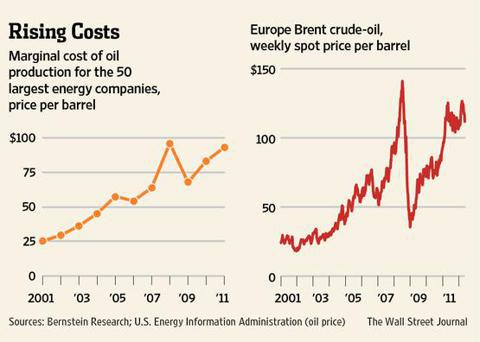
According to Bernstein Research, that marginal cost of production influenced by tight, deepwater and oil sands production, is now in excess of $90 per barrel.


-
I know Mike is a very solid investor and respect his opinions very much. So if he says pay attention to this or that - I will.
~ Dale G.
-
I've started managing my own investments so view Michael's site as a one-stop shop from which to get information and perspectives.
~ Dave E.
-
Michael offers easy reading, honest, common sense information that anyone can use in a practical manner.
~ der_al.
-
A sane voice in a scrambled investment world.
~ Ed R.
Inside Edge Pro Contributors

Greg Weldon

Josef Schachter

Tyler Bollhorn

Ryan Irvine

Paul Beattie

Martin Straith

Patrick Ceresna

Mark Leibovit

James Thorne

Victor Adair