
Mike's Content
 “A Primer on 3D Printing: How It Works” – Lisa Harouni
It is the dawn of the era of 3D printing. From artificial prosthetics to very real human kidneys to filigree skull sculptures – the number and variety of applications for this technology are growing, layer by printed layer. Combine this with the decreasing cost of owning a printer, as well as the cheaper cost of manufacturing in general, and it appears that 3D printers are here to stay.
….to read more Click HERE – and scroll down and click on the link “A Primer On 3D Printing” by Lisa Harouni or click directly here on “A Primer on 3D Printing” – Lisa Harouni
Check It Out
If you are already familiar with 3D printing scroll down further on the link above to David F Flanders’ excellent talk – “Why I have a 3D printer” or click directly here on “Why I have a 3D printer” – David F Flanders’


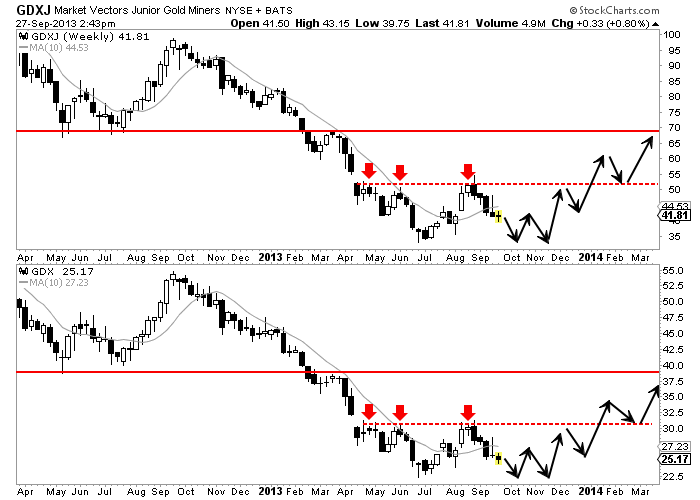
In our last editorial we pointed out how the gold stocks had veered off the recovery course. They fell well below the recovery template and fell below their 50-day moving averages. Furthermore, the positive “non-taper” news turned out to be the mother of all bull traps for traders. The market soared on presumably an epic amount of short covering. Yet that only served to be a selling opportunity for traders. That sequence of events only strengthened our view that the sector continues to be headed for a retest which could serve as the mother of all buying opportunities.
The weekly chart of GDXJ and GDX shows these markets sitting between strong support and strong resistance. At current prices, GDX has 12% downside to its daily closing low while GDXJ has 21% downside to its daily closing low. The silver stocks (SIL is not shown) also have 21% downside to their daily closing low. That is probably too much downside for a new low but it doesn’t rule out a retest.
The weekly charts for Gold and Silver show a similar picture. Gold rallied nearly $220 on a daily closing basis. However, it failed at $1400 which is now clear resistance. Similarly, Silver rallied from $18 to nearly $25. There is quite a bit of resistance at $24. We think its unlikely Gold and Silver break past $1400 and $25 anytime soon. We’d first anticipate a retest of the summer lows or at best weeks and weeks of back and forth of action.
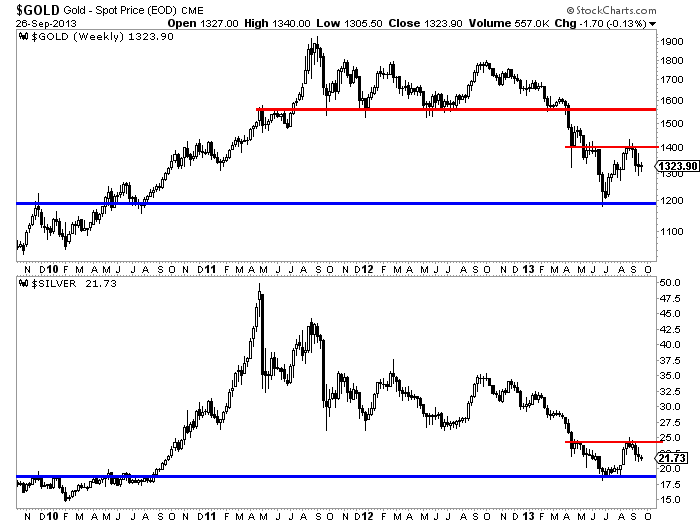
The good news for precious metals bulls is this market remains in a bottoming process which should produce a turning point that is on par with those seen in 2000 and 2008. The bad news is we are already five months into this bottoming process and it can continue for several more months. We don’t see widespread news in the sector but it is possible that GDX makes a new low but not GDXJ. It’s possible Gold makes a new low but not Silver. Major divergences are common at major bottoms.
The gold and silver stocks have been in a two and a half year bear market and have shed anywhere from 65% to 78%. Silver has been in a two and a half year bear market and at one point shed nearly 65%. Gold has been in a two-year bear market and has shed 36%. Huge cyclical rebounds aren’t an immediate reaction to the scope of these types of declines. These markets are telling us that the worst is just about over with yet more time is needed for a base that will launch the next phase of this secular bull market. If you don’t believe the next phase is worth waiting for then consider the following. Following these major bottoms the mining stocks have rallied on average 60%-70% within five months. In the two-month rally this summer, SIL rebounded 55% while GDXJ rebounded 63% (both on a daily closing basis). Once this bottoming process moves to its final stages, many stocks will be primed for spectacular rebounds that could occur in weeks and months. Readers are advised to watch closely and spot the companies which show the most strength during this retest. If you’d be interested in our analysis on the companies poised to lead this new bull market, we invite you to learn more about our service.
Jordan Roy-Byrne, CMT
About The Daily Gold
Jordan Roy-Byrne, CMT (Trendsman) is a Chartered Market Technician and member of the Market Technicians Association.. He is the publisher and editor of TheDailyGold Premium, a publication which emphasizes market timing and stock selection for the sophisticated investor.
From 2010-2012 The Daily Gold Premium Model Portfolio was up 131% compared to GDX (+5%) and GDXJ (-11%). In 2012, the Model Portfolio was up 32%, making it arguably one of the top-performing gold/silver stock newsletters. Jordan’s work has been featured in CNBC, Barrons, Financial Times Alphaville, Kitco and Yahoo Finance. He is quoted regularly in Barrons. Jordan has been a speaker at PDAC, Cambridge House and Hard Assets conferences. Jordan earned a degree in General Studies from the University of Washington with a concentration in International Economic Development. He also lived and worked in Southeast Asia for 3 years in order to study economic development from an emerging market perspective. In his spare time he enjoys spending time with Mrs. Trendsman.
Contact: Jordan @ TheDailyGold.com

 Live – Tomorrow at 10:15am Pacific
How to use ETFs in your portfolio

Technically, we now have something quite clear.
INSTITUTIONAL ADVISORS
FRIDAY, SEPTEMBER 27, 2013
BOB HOYE
PUBLISHED BY INSTITUTIONAL ADVISORS
The following is part of Pivotal Events that was
published for our subscribers September 19, 2013.
Overdose of Kool-Aid
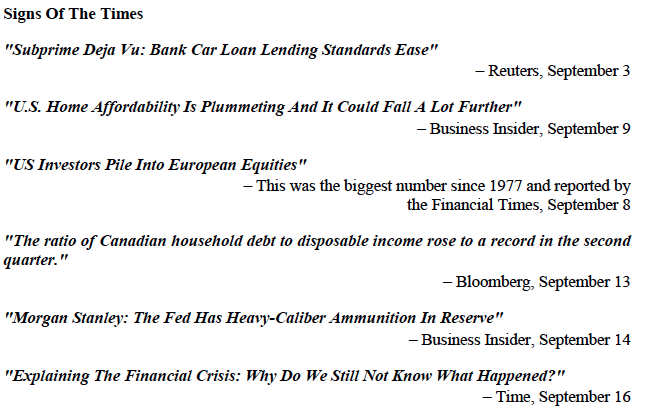
The last two quotes show the absurdity of intellectual theories bereft of market history. In 2007 the establishment boasted that with the “Dream Team” at the Fed nothing could go wrong. Now the same establishment that could have anticipated the bust claims not to understand it. And then there is this week’s tout that the Fed still has some “Heavy-Caliber Ammunition”.
If it wasn’t so pathetic it would be disgusting.
The ability of the Fed to get its portion of a credit expansion “out the door” depends upon a big speculative bid from the private sector. Until May the big play was in lower-grade bonds. This is no longer the case, but through the summer stocks and crude oil have been strong. Yesterday, Bernanke announced that the bond-buying program would continue until unemployment met some arbitrary number. In so many words, he renewed his vows to keep trying to depreciate the dollar.
Markets vigorously responded to the Fed in its role as a catalyst.
* * * * *
Stock Markets
Sunshine likely in September has continued with “Benny Bucks” Bernanke providing an almost universal catalyst.
As they saying goes, “When the Fed is the bartender everyone drinks until they fall down”. More than likely it is an overdose of Kool-Aid.
Technically, we now have something quite clear.
The rally from S&P 1627 in late August made it to 1705 on Tuesday. Yesterday’s news popped it to 1726. Overall this is a multi-index spike up with both the DJIA and S&P reaching a limiting level on the Daily RSI.
This year’s strength drove the Weekly RSI to a higher level for a longer time than accomplished going into the 2007 high. And now at 73 the Daily RSI has exceeded the 66 accomplished in October 2007.
The RSI provided negative divergence on that important peak. A loss of momentum now would accomplish just such a divergence.
What also caught our eye was the reversal in Broker Dealers (XBD). Although this is a volatile and at times precarious sector it has been virtually a “one-way-street” since turning around late last year.
This thing does big and long overboughts on the way up. And at the high in 2007 a couple of rallies reached 70 on the Daily RSI.
For this year, the weekly has accomplished the longest run of very overbought in years. It ran from February to May. Since August there has been two thrusts to 70 on the Daily RSI.
Yesterday, Broker-Dealers (XBD) sold off in the morning and jumped from 140.2 to 141.5 on “the news”. This was up on the day, but in only a few minutes it gave it up. At the end of the day it was down almost 1 percent, setting an Outside Reversal.
It is a warning.
And so is the huge volatility in the gold/silver ratio, which will be detailed below.
Currencies
The dollar index was also volatile as it slumped with Bernanke’s statement.
This drove the DX below support at the 81 level to support at the 80.5 level. This slumped the Daily RSI to 33, which compares to 30 reached with the June plunge.
The ETF is UUP and the RSI declined to 30 yesterday, which compares to 28 set with the low in June. Momentum is at 33 today suggesting a reversal, which in turn suggests a positive divergence.
Last Thursday’s ChartWorks updated the bigger picture on currencies and noted that the euro was showing distribution. This indicates dollar accumulation, which is constructive.
Of course with dollar depreciation considered as the best policy ever and at any time, a rising dollar would be the worst thing that could happen.
Get prepared for the “worst” to happen.
This along with the overbought stock market at this time of year, as well as the outstanding four-year bull market, suggests the financial markets are precarious.
A firming dollar next week would provide confirmation.
The Canadian dollar rallied from 95 in late August to 98 yesterday, which represents serious resistance. The Daily RSI jumped to 68, which ended the past two rallies.
The C$ is heading to support at the 94 level.
Credit Markets
The action in lower-grade bonds suffered a “mini-panic” following the expected reversal in May. The EMB crashed to 99.4 in late June, which was exceptionally oversold. The rebound run out in mid-July at 111.18 and the price declined to 104.60 two weeks ago. The rebound started then and the Bernanke pledge popped the Emerging Bonds to 111.15 yesterday.
Clearly, this is at significant resistance and the Daily RSI reached 72 yesterday. This has accomplished a huge swing from extremely oversold to enough of an overbought to end the move.
Much the same holds for JNK, HYG and MUB.
The reversal in the huge bond market in May ended one of the greatest speculations in lowergrade bonds – ever. Once the natural reversal was in, we expected some churning around through the summer. This would lead to a more severe hit later in the year.
This week’s zoom to an overbought condition seems a timely setup to disorderly markets.
Traders can return to playing the short side and investors should focus upon 3 to 4-year AAA corporates.
Considering the possibility of a firming dollar, this position should be attractive to off-shore investors.
North American bond markets have been corrupted by the US administration and world bond markets by all central bankers, particularly the Fed. Individual investors have been uniquely forced to reach for yield.
At some point spreads will reverse to widening.
Link to September 20, 2013 ‘Bob and Jim Show’ on TalkDigitalNetwork.com:
http://talkdigitalnetwork.com/2013/09/any-chance-of-a-black-october/
All One Bond Market
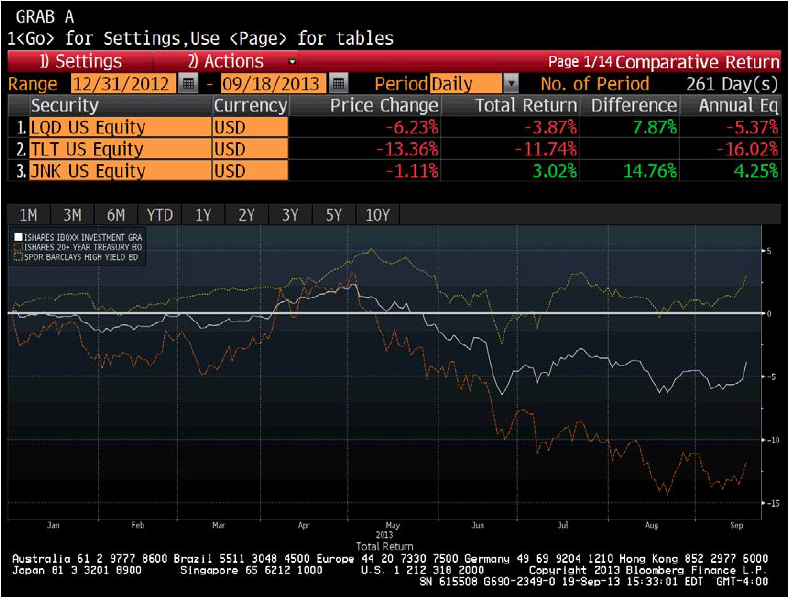
- Long-dated treasuries (TLT) zoomed up to a spectacular peak in July 2012.
- Despite considerable buying by the US Treasury the bear market prevailed.
- Investors could be concerned about US (or should we say Chicago?) credit worthiness.
- Although the important price-swings have been coordinated, treasuries have been a relative disaster.
- Earlier in the year, we discussed that part of a post-bubble contraction has been the Great Bond Revulsion, which occurs as the street realizes that all of the debt cannot be serviced.
- The next step in the “revulsion” could begin in a few weeks.
- Investors could find a haven and some return in 3 to 4-year Prime Corporates.
BOB HOYE, INSTITUTIONAL ADVISORS
E-MAIL bhoye.institutionaladvisors@telus.net
WEBSITE: www.institutionaladvisors.com


-
I know Mike is a very solid investor and respect his opinions very much. So if he says pay attention to this or that - I will.
~ Dale G.
-
I've started managing my own investments so view Michael's site as a one-stop shop from which to get information and perspectives.
~ Dave E.
-
Michael offers easy reading, honest, common sense information that anyone can use in a practical manner.
~ der_al.
-
A sane voice in a scrambled investment world.
~ Ed R.
Inside Edge Pro Contributors

Greg Weldon

Josef Schachter

Tyler Bollhorn

Ryan Irvine

Paul Beattie

Martin Straith

Patrick Ceresna

Mark Leibovit

James Thorne

Victor Adair