Bonds & Interest Rates

A Janet Yellen Primer

McIver Wealth Management Consulting Group / Richardson GMP Limited

President Obama announced today that he is nominating Janet Yellen, currently the Vice-Chairman of the Federal Reserve Board, to role of Chairman.

Yellen has been on my radar screen since the Clinton Administration when she served as Chairman on Clinton’s Council of Economic Advisers. She is a known entity.

In 2008, she spoke at the CFA (Chartered Financial Analyst) Institute’s Annual Conference which happened to be held in Vancouver that year. At the time she was serving as President of the Federal Reserve Bank of San Francisco (one of the 12 regional Federal Reserve Banks). During her presentation, she struck me as a potentially autocratic leader. Prior to listening to her in person, my sense was that she was might have been a more diminutive personality and a wide consensus builder.

In the Q&A session, she came across as extremely confident in what the Fed was doing and that it had done a great job during the decade during which she held on-and-off roles within the Federal Reserve System. This was about four months before the Lehman Brothers collapse which might tell you that there was some over-confidence present. However, during the Q&A she also exhibited some tone deafness as some extremely well qualified delegates had some great but serious questions. Her answers suggested that either she did not grasp the importance of some of the question topics, or dismissed them because they did not fit her perspective or beliefs.

My impression at the time was that she was especially concerned with maintaining economic growth at almost any cost. She appeared to be more concerned about Americans enjoying a high standard of living, even if it resulted from financial engineering. She didn’t seem especially focused on traditional central bank issues such as the general stability of the financial system and the things that could disrupt that. To be fair, Alan Greenspan and Ben Bernanke also fell into this category of central banker. Generally, these central bankers have pushed and pushed for wider powers and much more broad mandates. They see themselves more as general economic guardians as opposed to strictly central bankers.

Yellen will almost certainly be friendly to the current presidential administration and its ambitions for greater spending and bigger government. These ambitions are facilitated by low interest costs on the Federal debt and Yellen is just the person to fight for that.

That said, monetary has lost much of its potency over the last five years with respect to spurring employment and economic growth. If she maintains the rate of money-printing, or Quantitative Easing, well into next year, we could see a situation where the market not longer believes in the efficacy of the policy. It will be very interesting to see what she does in this case which would be an extremely challenging period for someone who sees themselves as an economic guardian.

The opinions expressed in this report are the opinions of the author and readers should not assume they reflect the opinions or recommendations of Richardson GMP Limited or its affiliates. Assumptions, opinions and estimates constitute the author’s judgment as of the date of this material and are subject to change without notice. We do not warrant the completeness or accuracy of this material, and it should not be relied upon as such. Before acting on any recommendation, you should consider whether it is suitable for your particular circumstances and, if necessary, seek professional advice. Past performance is not indicative of future results.  

Richardson GMP Limited, Member Canadian Investor Protection Fund.

Richardson is a trade-mark of James Richardson & Sons, Limited. GMP is a registered trade-mark of GMP Securities L.P. Both used under license by Richardson GMP Limited.

Goldman targets $1,050 – Yellen News Barely Affects Gold

 iStock 000017776797XSmall-resize-380x300Gold Rose 12% When Goldman Did Same In Nov 2007

Yellen Fed news fails to shake gold’s lethargy

The wholesale price of gold gave back this week’s 1.4% gains Wednesday morning in London, dropping below $1.310 per ounce as European shares recovered earlier losses.

Commodities ticked lower, as did non-U.S. government bonds, while silver followed gold lower, but retained a 1.0% gain for the week so far.

U.S. stock futures pointed higher despite Washington’s current impasse over the debt ceiling moving within eight days of a possible debt default.

The U.S. dollar meantime rose sharply after the New York Times reported that current Federal Reserve vice-chair Janet Yellen – a renowned “dove” on low interest rates and stronger quantitative easing – will today be confirmed as President Obama’s choice to succeed Ben Bernanke as the central bank’s chief.

“Sentiment has changed. People don’t seem to be flocking to gold, even in times of distress,” said Jim Iuorio, managing director of TJM Institutional Services in Chicago to CNBC on Tuesday.

“[Gold prices] continue to hang in limbo,” says a Singapore trading desk, “unable to rally yet does not want to give up $1,300 handle.”

“The closer the U.S. comes to reaching its debt ceiling,” say commodity analysts at Commerzbank in Germany, “and the more the risk of insolvency grows as a result, the more gold should be in demand as a safe haven in the west…which should be reflected in a climbing gold price.

“Perhaps gold will be shaken out of its lethargy when the Fed minutes are published this evening,” says the bank, asking if the delay in ‘QE tapering’ last month was due to the U.S. central bank’s fears over a drop in government spending.

But “once we get past this stalemate in Washington, precious metals are a slam dunk to sell,” reckoned investment bank Goldman Sach’s head of commodities research Jeffery Currie, speaking Tuesday at Commodities Week here in London.

Selling gold is his top raw materials trade for 2014, a view agreed Tuesday by Swiss investment and bullion bank Credit Suisse’s research chief Ric Deverell.

“You have to argue that with significant recovery in the U.S.,” said Currie, “tapering of QE should put downward pressure on gold.”

Economic growth in the U.K. is set to outstrip the U.S. in 2013, the International Monetary Fund said Tuesday, adding that it was “pleasantly surprised” by Britain’s ‘austerity’ policies failing to hurt growth as the IMF warned in April.

U.K. manufacturing and industrial output today showed a sharp drop for August, defying analyst forecasts of strong growth.

The Pound fell hard after the news, dropping to a 2-week low beneath $1.60. That buoyed gold for U.K. investors above £820 per ounce, some 0.8% below an earlier spike to one-week highs.

Gold priced in Euros also eased back, touching last week’s closing level at €967 per ounce as the single currency fell despite much stronger-than-expected German industrial output data for August.

Currie at Goldman Sachs now sees his target for year-end 2014 at $1,050 per ounce – a “key gold level” according to panellists speaking last week at the London Bullion Market Association’s conference in Rome.


 

About the Author

Adrian Ash runs the research desk at BullionVault. Formerly head of editorial at Fleet Street Publications – London’s top publisher of financial advice for private investors – he was City correspondent for The Daily Reckoning from 2003 to 2008, and is now a regular contributor to a number of investment websites.Adrian Ash


A U.S. Default Is NOT Automatic

McIver Wealth Management Consulting Group / Richardson GMP Limited

The news over the last two weeks has suggested that if U.S. lawmakers are unable to pass an increase to the federal debt ceiling, the U.S. will default on its Treasury bond obligations.

Not so fast.

There is no law that stipulates that there will be a halt on maturing bonds being redeemed and on interest paid to current bondholders.

Instead, the scenario would be more like this:

The U.S. Treasury Department has three agencies which make payments to cover the cost of running the government. This covers almost everything including the wages of government workers, wages of military personnel, civil and military procurement, and interest on the bonds that it issues. Since they have not had to prioritize in the past, there is no existing method of prioritization. Because the debt ceiling has been perpetually higher than the amount of outstanding debt in the past, all these payments have been on autopilot over the years.

So, in the event of hitting the debt ceiling, the U.S. Treasury will probably have to manually prioritize expenditures. Jack Lew, the Secretary of the Treasury, and his staff will have to carry out these decisions. Jack Lew’s boss is President Obama. Therein lies the source of Obama’s panic. Hitting the debt ceiling would be akin to a hot, flaming ball landing in his half of the court. He will be forced to decide whether to keep things like the National Parks open, or to pay interest to the bondholders. Considering that some of America’s largest trading partners are significant bondholders, and that the Treasury will have to roll-over $3 trillion in maturing bonds over the next twelve months, they certainly don’t want to upset those bondholders.

So, with that, what are the chances of a default? Low.

That does not mean that it cannot happen. Back in the late 1970s, the U.S. bumped into the debt ceiling for a short-period of time but the ceiling was quickly raised. However, there was a glitch with some word processing software that bungled the administration of the interest payments and those payments were delayed. The bond market got hit has investors became unnerved. And, it took a number of months before bond prices rose back to where they were before the problem.

Barring some similar glitch, a default will probably be avoided at all costs and bonds should sail relatively smoothly through this period.

The opinions expressed in this report are the opinions of the author and readers should not assume they reflect the opinions or recommendations of Richardson GMP Limited or its affiliates. Assumptions, opinions and estimates constitute the author’s judgment as of the date of this material and are subject to change without notice. We do not warrant the completeness or accuracy of this material, and it should not be relied upon as such. Before acting on any recommendation, you should consider whether it is suitable for your particular circumstances and, if necessary, seek professional advice. Past performance is not indicative of future results. 

Richardson GMP Limited, Member Canadian Investor Protection Fund.

Richardson is a trade-mark of James Richardson & Sons, Limited. GMP is a registered trade-mark of GMP Securities L.P. Both used under license by Richardson GMP Limited.

“THIS IS “CRITICALLY IMPORTANT”

T”he US dollar is poised right on the edge of a cliff.”  said the Godfather of newsletter writers. A lot below in this powerful commentary – Ed

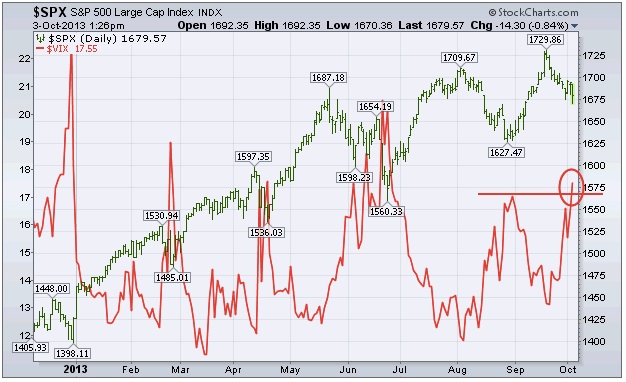
“The chart below shows the S&P Composite, and the red line is the VIX or volatility index.  As you can see, the VIX has risen to its highest level since July.  Thus, the VIX is sensing some volatility to come over the next few months.  As a rule, I usually ready myself for some market volatility when the VIX climbs from a dull period to over 20.  We’re not quite there yet.

KWN RR I 10-7

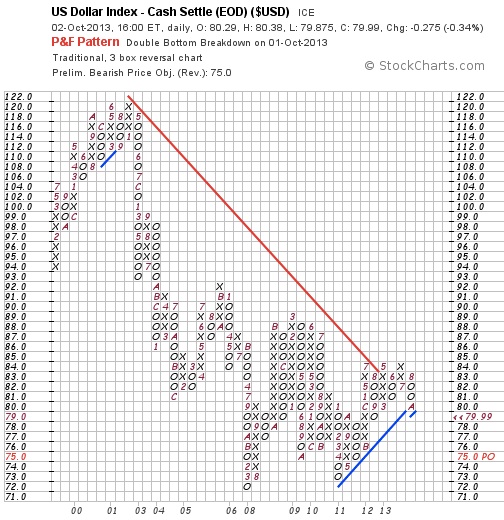
The chart below is the one that I believe is critically important — it’s the US dollar.  The US dollar has acted as a safe haven for money in the US and all over the world.  Thus, if we get a sell signal on the dollar it will have international implications.

sc

Because it is so important, I am also including this P&F chart of the US dollar.  The dollar appeared to be ready to break out on the upside, but a sudden reversal took the dollar down to the 80 box.  The dollar is poised right on the edge of the “cliff.”  A decline to 79 would look bad, and a further decline to 78 would result in a sell signal with the possibility that the dollar would then test its most recent low at (god forbid) 73.

KWN RR II 10-7

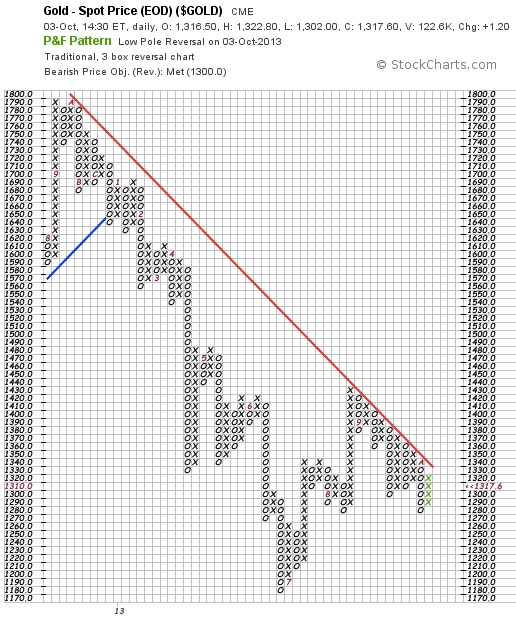
This chart of gold offers a portion of hope. We now have a four-box rally off the low of 1280.  If gold can hit the 1340 box we will have what every gold-bug is praying for — a reversal to the upside, taking gold above the bearish red trendline.  What are the odds that this will happen?  If I knew, I’d be richer than Warren Buffett.

KWN RR III 10-7

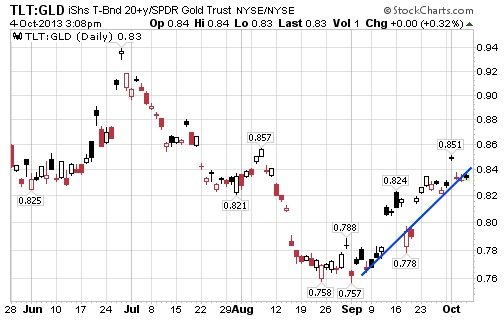
Below we see my inflation-or-deflation chart.  Here we see the bond/gold ratio.  When deflation is seen ahead, gold will tend to decline and bonds will tend to advance.  The chart shows the bond/gold ratio rising. Thus, the markets are saying that deflation lies ahead. 

KWN RR IV 10-7

This is very important since as I’ve noted before, Ben Bernanke will not tolerate deflation.  Thus, this chart is telling us that tapering is not in the cards.  As deflation becomes more visible, I expect the world’s central banks to battle against it with ever-greater portions of quantitative easing.  This, of course, will set off a bull market in gold and silver.”


To subscribe to Richard Russell’s Dow Theory Letters CLICK HERE. 

About Richard Russell

Russell began publishing Dow Theory Letters in 1958, and he has been writing the Letters ever since (never once having skipped a Letter). Dow Theory Letters is the oldest service continuously written by one person in the business.

Russell gained wide recognition via a series of over 30 Dow Theory and technical articles that he wrote for Barron’s during the late-’50s through the ’90s. Through Barron’s and via word of mouth, he gained a wide following. Russell was the first (in 1960) to recommend gold stocks. He called the top of the 1949-’66 bull market. And almost to the day he called the bottom of the great 1972-’74 bear market, and the beginning of the great bull market which started in December 1974.

Letters are published and mailed every three weeks. We offer a TRIAL (two consecutive up-to-date issues) for $1.00 (same price that was originally charged in 1958). Trials, please one time only. Mail your $1.00 check to: Dow Theory Letters, PO Box 1759, La Jolla, CA 92038 (annual cost of a subscription is $300, tax deductible if ordered through your business).


A Zombie Story From Motor City

UnknownAs you know, Detroit was recently flattened. 

Now, it’s being scrapped… 

It’s the largest municipal bankruptcy in US history. Detroit was once one of the richest… and most dynamic… cities in the world. And it was the center of the United States’ most profitable industry: automobiles.

German and Japanese automakers had the good fortune of being bombed in World War II. But Detroit grew bigger… more prosperous… and full of zombies.

Yes, dear reader, Detroit is another classic zombie story. Since 1971, almost all big stories have a zombie angle. Because the credit-based monetary system Richard Nixon put us in is a perfect habitat for zombies. The New York Times had the story:

Detroit, the cradle of America’s automobile industry and once the nation’s fourth-most-populous city, filed for bankruptcy on Thursday, the largest American city ever to take such a course. 

Not everyone agrees how much Detroit owes, but Kevyn D. Orr, the emergency manager, has said the debt is likely to be $18 billion and perhaps as much as $20 billion. 

For Detroit, the filing came as a painful reminder of a city’s rise and fall. 

“It’s sad, but you could see the writing on the wall,” said Terence Tyson, a city worker who learned of the bankruptcy as he left his job at Detroit’s municipal building on Thursday evening. Like many there, he seemed to react with muted resignation and uncertainty about what lies ahead, but not surprise. “This has been coming for ages.” 

Detroit expanded at a stunning rate in the first half of the 20th century with the arrival of the automobile industry, and then shrank away in recent decades at a similarly remarkable pace. A city of 1.8 million in 1950, it is now home to 700,000 people, as well as to tens of thousands of abandoned buildings, vacant lots and unlit streets.

Beware of Zombies

Yes, the handwriting has been on the wall for a long time. But what did it say?

We’ll answer that without hesitation. It said: “Beware of Zombies.”

And here we offer a simple test so dear readers can tell which side they’re on. 

Ask yourself: In the absence of government would people still willingly give you money to do what you do? If the answer is no, then you are probably a zombie.

Here’s how it works… 

When people realize they can use the police power of the government to get other peoples’ money, they rarely hesitate. In the case of Motor City, unionized workers found that they could use government to back their demands. Gradually, wages and benefits rose…

After World War II, Germany and Japan built new auto industries, with factory workers who were willing and able to turn out better cars at lower prices. 

Detroit, by contrast, let its machinery get old… and its workers get soft. Due to poor quality, out-of-date styles and high costs, the US auto businesses could barely make a go of it.

Light manufacturing was fleeing the country – to China, Southeast Asia and Mexico. 

The heavy industry – car making, steel, mining – was a sitting duck. It couldn’t protect itself from zombies. The zombies soon got control over the government…. and then preyed upon fixed industries.

The Jig Is Up

Only four years ago, the US federal government bailed out GM. Or rather, it bailed out its zombified labor unions – guaranteeing wages and benefits the company couldn’t afford to give. 

What was happening in the motor business in general was happening even faster in Motor City. 

As Detroit zombified, productive businesses and taxpayers moved out. Zombies were all that was left. People on welfare. People working for the government. People who were disabled. Crooks, malingerers, shysters – they were all there, getting money for nothing in the age-old zombie fashion.

Was there no way to turn Detroit around? 

Of course there was. It was obvious how to do it. But who wanted to do it? 

The more dysfunctional the city became, the more money the city’s sleaze-ball leaders got from the federal government. That’s how zombieism works: The worse things get, the better they are for the zombies…

Zombieism is like drug addiction. You rarely just “give it up.” Instead, you have to go all the way… and hit rock bottom. 

Detroit may be hitting rock bottom now.

And how long will it be before Baltimore and Chicago go broke too? 

It depends on how fast interest rates rise. The higher they go, the harder it is for these cities to keep up with their promises to the zombies. And since interest rates are probably embarking on a long-term secular rise… it is just a matter of time before they all go broke.

That is when the jig is up. Zombies fall. The credit-based money system collapses. 

…Gold rises.

Regards,

Bill

test-php-789