Currency

A Brilliant Summary Of Our Current Economic Situation

black swanA Road To Serfdom – We Are Traveling Quickly Down That Path


“Our freedom of choice in a competitive society rests on the fact that, if one person refuses to satisfy our wishes, we can turn to another. But if we face a monopolist we are at his absolute mercy. And an authority directing the whole economic system of the country would be the most powerful monopolist conceivable…it would have complete power to decide what we are to be given and on what terms. It would not only decide what commodities and services were to be available and in what quantities; it would be able to direct their distributions between persons to any degree it liked.”

                                                                                                 Friedrich A. von Hayek, The Road to Serfdom


Greetings!


Nick Ellis, one of the many intelligent and articulate readers of Currency Currents (and sincerely honored about that fact we are), recently sent us what I believe is a brilliant and succinct summary of our current economic/political morass. I have printed it in full below. I think Nick’s analysis is dead on the money and his reference to von Hayek’s book, The Road to Serfdom, is particularly apt.

Hi Jack,

The only way to avoid a major hit is to let the system cleanse itself on a constant basis (which our system does for the small players (Bankruptcy) but not the big players (Bailout)).  

Our Political Structure finds Big Money cleansing untenable and will continue to collude with Big Money to hit the average citizen with more taxation, redistribution and eventually inflation to solve a crisis. 

During a crisis, even if the assets pass to stronger hands at a reduced cost we are still experiencing deflation in the debt based monetary supply.

Big Government = Big Money = Big Labor

It is a vacuum of consolidation moving to the top.  Road to Serfdom in a nut shell.  We are moving down a slippery slope.

The average citizen will be robbed of their labor earnings through a weaker dollar, asset inflation, increased debt burden (entitlements) and no safe store of value. 

The Fed does not have a strong dollar policy.  What they have is a policy that attempts to devalue the dollar as slow as possible and a weak gold policy (attempts to keep it from gaining too fast).  

Worst of all, gold is not money and never should be.  The Federal Govt. should not have the right create debt on behalf of the citizen.  The Treasury should simply print debt free money as this is truly a Sovereign power or we should have competitive money.

Hayek on Milton Friedman’s Monetary Policy:  Select the CC captions for subtitles as it is easier to understand Hayek when he is talking.

http://www.youtube.com/watch?v=fXqc-yyoVKg

The FED and the Federal Govt. are so far away from the Will, Desires and Best Interest of the People… 

Nick Ellis

Thank you Nick!  Great stuff!   

Be sure to check out our new format for the Global Investor.  We have posted a sample issue at our homepage www.blackswantrading.com

Regards,

Jack Crooks

Black Swan Capital

www.blackswantrading.com

info@blackswantrading.com

.

Gold Stocks Continue Bottoming Pattern

A month ago we noted that the gold stocks were headed lower and to a potential double bottom that would create another great buying opportunity. After seven straight weeks of price declines, the gold stocks rebounded last week and are off to a good start this week. We can’t be sure if a double bottom or some complex head and shoulders pattern is developing. Regardless of the specific pattern, a bottom seems to be developing and another great buying opportunity could be at hand. 

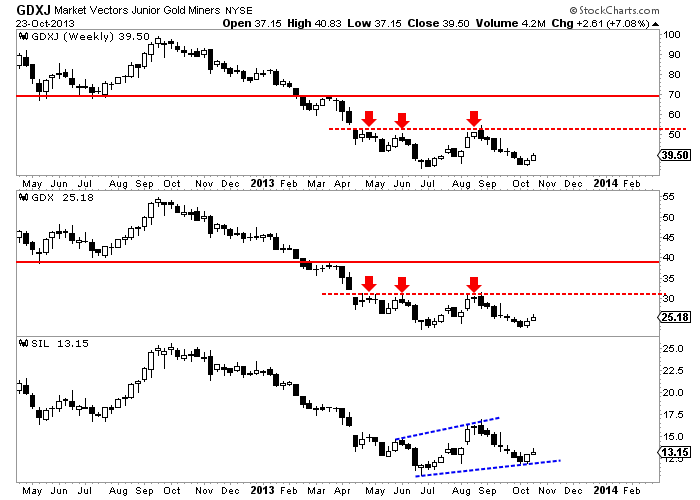
The weekly chart below shows GDX, GDXJ and SIL. We’ve already noted the clear resistance at GDXJ $51 and GDX $31. It appears these markets have at least a few more months of bottoming activity ahead before they can push through that resistance. However, there is near-term upside to be had if the market can rally to that resistance. Meanwhile, the silver stocks as represented by SIL continue to look the strongest. It had the strongest summer rally and it has made a true higher low already.

oct23edsectorlook

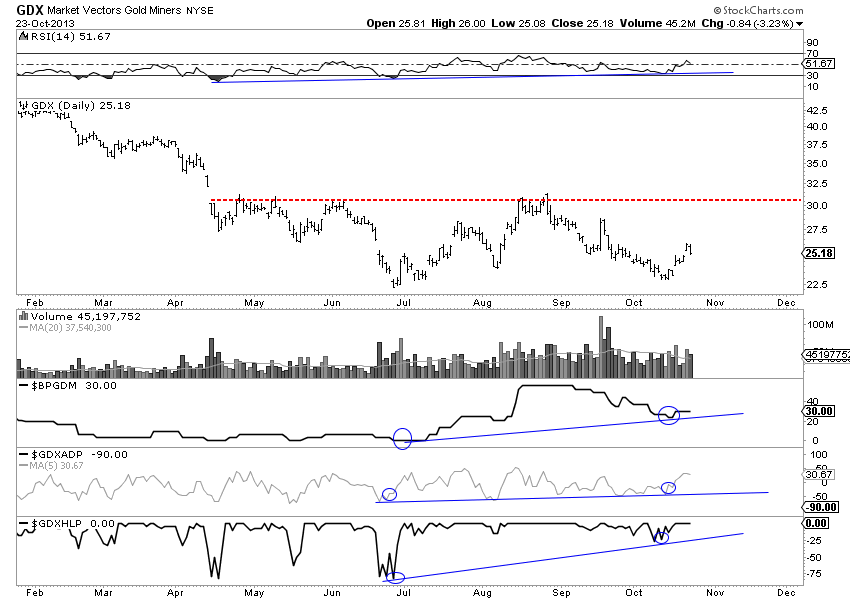
If we zoom in on GDX we see a few additional positives that bode well for the sector. The three indicators at the bottom are breadth indicators. Breadth can lead price at key turning points. The bullish percent index, smoothed advance decline line and new highs minus new lows indicators are all in a much stronger position compared to the summer bottom. This suggests internal strength is building.

oct23edgdx

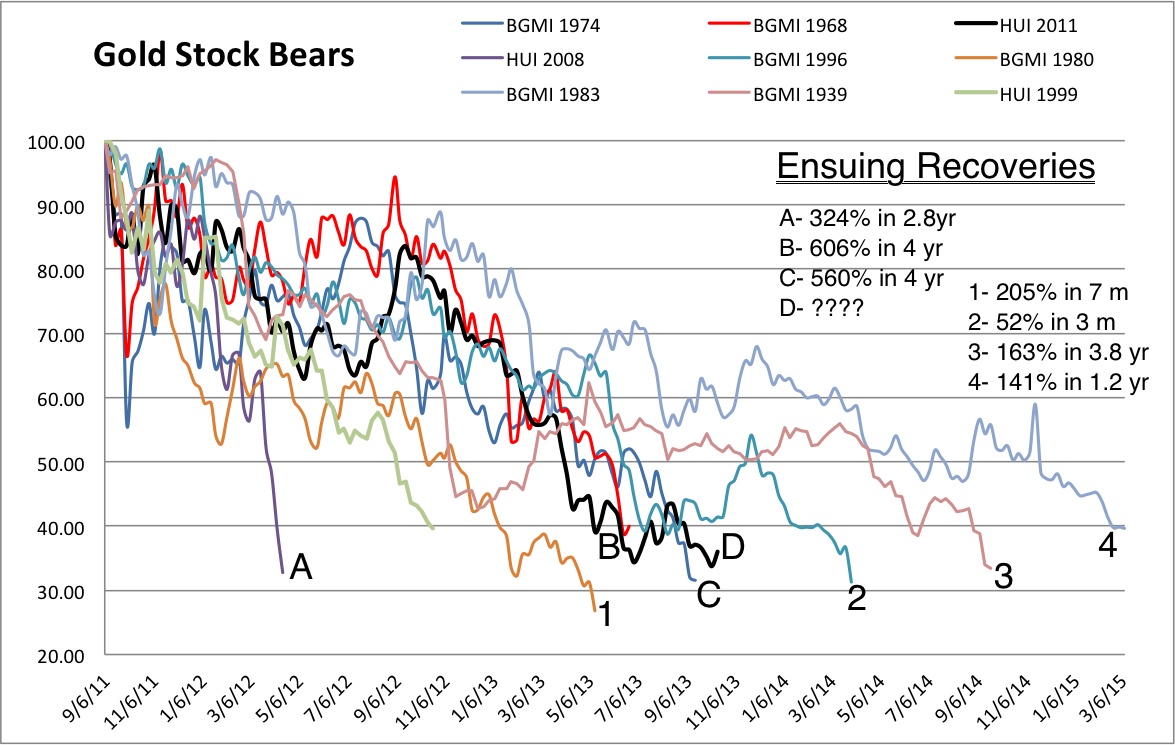
Furthermore, our favorite chart (of course) by itself makes a very strong case. The worst bear markets in gold stocks are 66%-68%. Only one (1980-1982) exceeded that. At the summer low, the gold stocks were down 67%. Furthermore, the three bears that lasted longer (2,3,4) were, at this point in the bear market less oversold than the current bear.

oct23edbgmibears

Getting back to the title question, I’m not sure if the gold shares are developing a double bottom or a complex inverse head and shoulders bottom. Double bottoms typically explode off the second bottom and we haven’t really seen that yet. However, that doesn’t invalidate that the market is tracing out some type of major bottom. The shares are six months into this bottoming pattern. If GDX and GDXJ reach resistance in December and breakout in January that amounts to nine months of bottoming. The longer the base is, the greater the eventual breakout. For example, GDXJ upon breaking past $51 would have a measured breakout target of ~$70. That is 77% upside from here.

As we’ve noted in the past, cyclical advances in a bull market average roughly 50% in the first four months and roughly 70% in the first seven months. I also looked at the rebounds from the 2000, 2005 and 2008 bottoms in the Tocqueville Gold Fund, one of the best gold stock funds in my opinion. Over those three periods it averaged a 158% rebound in the first 13 months. Past performance in any market is certainly no indication of future performance but it provides a guide to frame our expectations around. It also implies that patience will be rewarded. As this bottoming process in precious metals moves to its final stages, readers are advised to identify the companies with the best fundamentals and growth potential that are showing relative strength. Focus on the leaders and avoid the laggards. If you’d be interested in our analysis on the companies poised to lead this new bull market, we invite you to learn more about our service.


Good Luck!


Jordan Roy-Byrne, CMT

Jordan@TheDailyGold.com


Alan Greenspan’s Shock Revelation

We really can’t forecast all that well. We pretend that we can but we can’t. And markets do really weird things sometimes because they react to the way people behave, and sometimes people are a little screwy.

– Alan Greenspan, speaking this week on “The Daily Show”


“Jobs Report Leaves Fed in Doubt,” was a big headline yesterday morning.

Later in the day came this:

“Dow down 54 on jobs concern.” 

What is the Fed in doubt about? To taper, or not to taper, that is the question.

And why should a jobs report make any difference?

Oh, dear reader, where have you been? Don’t you know everyone now sits on the edge of his seat wondering when and how the Fed will back off from its massive QE program? And don’t you know the future of civilization hangs in the balance?

On that point, we have a position… a thought… a reaction. Civilization hangs in the balance, but not in the way you think.

Asking for Trouble

We have been trying to introduce a new way of looking at civilization. In short, we’ve tried to make it more civilized.

What is the difference between a civilized community and a barbaric one? We have introduced a simple test. The civilized community relies mostly on cooperation and consent. The uncivilized community depends heavily on force and violence.

A French historian first introduced the word “civilization” less than 300 years ago. Since then there has been much argument about what it means. We enter the fray gingerly, but sure of ourselves. It only makes sense on our terms. A civilized community is peaceful; a barbaric one is not.

“Okay, Bill,” you may be saying to yourself. “I’ll give you that one… I guess. But what the hell difference does it make? What has it got to do with the jobs report?”

Good questions. Glad you asked.

We know from bitter experience that trying to force economies to do what you want is a thankless task. Markets are fundamentally based on free exchange, cooperation, trust and trade. Force them in one direction or another and you are just asking for trouble. 

As Alan Greenspan described this week, in an interview with John Stewart on “The Daily Show,” people are a little “screwy” from time to time. Which means they don’t necessarily go along with your central planning, no matter how good you think it is.

But still economists insist that, if they are allowed to monkey around with it, they can make an economy better. This is occasionally true. Said occasion is usually when they have already messed it up. By withdrawing some of their planning and programs, they may allow it to recover.

Otherwise, there is no example in history where force has been successfully applied to economics.

Compounding Errors

But that doesn’t stop the PhDs from trying. The jobs report showed about 60,000 jobs missing – fewer jobs than economists had projected. 

Now, the erring economists will most likely compound their error by continuing to try to force the economy to do their bidding – force up the rate of consumer price increases and force down the number of Americans out of work.

If they really wanted to increase employment, that would be easy enough. They would encourage the feds to withdraw some of the laws that bully employers (health insurance… EEOC threats… overtime, etc.)… or some of the schemes that make it easy for potential employees to remain unemployed (disability… unemployment benefits… food stamps). As far as we know, those things are not on the table.

What is on the table is more QE. 

With regards to QE, the poles of possibility are as follows: 

  1. QE does nothing important. If this were so, there would be no reason to keep it.
  2. QE is essential to the economy. If this were so, they couldn’t get rid of it… no matter what the jobs report says.

Most likely, QE lies somewhere in between… perhaps lost in the horse latitudes. It probably has little effect on the real economy. That is why the jobs report is so disappointing. But it probably has a great effect on the financial economy. That’s why the Dow sets new record highs almost every session. 

The Fed is probably stuck with QE. Were it to stop, the stock market would likely tumble and the “wealth effect” the PhDs have been aiming for would quickly turn into a poverty effect. 

Janet Yellen couldn’t stand it. She believes the Fed should use all its available weapons to force the economy to do what she wants it to do. She won’t be able to stand by, dagger in hand, when the market turns its back on her. Instead, she will stab.

And the Fed, which has lived by the sword of QE, will probably die by it too.

Regards,
Bill-Bonner sig

Bill

Indian Imports & Temple Gold

We feel it important to raise this topic once more in this series because Societe Generale, the French bank has stated that if the Indian government does not handle this matter well there could be a run on the Indian Rupee.

Why? There’s no doubt that if the Indian gov’t could harness locally owned gold (total around 25,000 tonnes). The currency would then be the best backed currency in the world and shouldn’t suffer declines if its gold were used as collateral for its foreign currency needs. The trouble is the Indian people would be furious and the gov’t would most likely lose the next election (because of the feelings the Indian people have towards gold).

So, with elections due next year, they’re currently exploring ways to achieve this without creating uproar. Hence temple gold, where there are around 2,000 tonnes of gold held by them overall. Much of this is already stored in banks in the country, so technically represent unsecured loans to the banks. Again technically, as in the world of unallocated gold in the developed world, the banks/government can already access it (provided they can return it).

So the warning by Societe Generale is quite right. On the one hand, such moves could create uproar and on the other, the signal would go to the rest of the world that India was in deep financial trouble and could not reduce its Current Account Deficit paving the way for a major debt to reserves ration problem.

We think this is coming anyway.

Last month’s imported gold to India was 7 tonnes and the month before 3.5 tonnes, when these figures should be close to 100 tonnes and 70 tonnes respectively. The result is that the premium on an ounce of gold has jumped in a volatile manner from as low as 5% to current levels of around 140%. We believe that smuggled gold into India is rising fast and accounts for the overall volatility of these premiums. We expect a far greater figure than 250 tonnes to be smuggled in.

This raises several issues for gold and India’s global monetary situation:

1.   We believe the gov’t will adjust policies if they see those adversely affecting votes. This translates into a lowering of the import duty and current requirement to export 20% if imports of gold ahead of the elections.

2.   The Current Account Deficit has already created a Rupee/debt to reserves crisis which is expected to worsen. Expect an int’l credit crisis that will appear in time. The crisis has been slowed through the temporary use of swaps and gold import restrictions. There is no visible sign of effective action to halt the underlying crisis.

3.   With 25,000 tonnes of gold, India only needs to use a small portion of this to give it time to try to resolve the crisis fundamentally. We cannot see how they will resolve India’s economic/monetary crisis, but at least gold will give them time to try.

4.   The harnessing of locally-owned gold will happen; it is simply a matter of time and method. This will be a form of confiscation even if gov’t and its agencies continue to recognize the original owner with an eventual promise of returning it.

Summary of India’s Situation on the Gold Price:

– India could well be among the first countries to take citizen’s gold to support their currency, but certainly not the last. It will monetize its gold to some extent and provide a preview of what’s to come when the Chinese Yuan becomes a reserve currency.

– The absence of direct Indian demand is falsely holding down the U.S. dollar price of gold at the moment.

– It is also preventing global demand from overtaking global supplies, thus stopping the gold price from returning to record highs.

And in so doing, India will lead the way into what we see as a new monetary order with gold taking a pivotal position in that reformed system!

In the final part of this series we will look at the consequences that will inevitably come with management, manipulation and speculation and how China fits into this picture and discuss the demand and supply picture now developing that will change the gold price dramatically!


Challenging A Canadian Belief

Michael Mike Campbell image Michael rips the idea that Canadian Politicians and special interest groups are defenders of the poor. 

{mp3}mcbuscomoct24fp{/mp3}

test-php-789