
Mike's Content
 Michael focuses on the remark that former Central Banker Alan Greenspan made, and the implications that it has on your life.
{mp3}mcbuscomoct30fp{/mp3}

Stocks pushed higher on Tuesday as investors positioned portfolios ahead of the FOMC announcement on Wednesday. Investors overwhelmingly expect no change to present stimulus measures as a result of recent lacklustre employment reports that were less than expected. Despite the risk-on trading environment that would be implied by maintaining stimulus measures, consumer staples, a defensive sector, continues to dominate market performance. Sectors that have lagged the market activity as of recent, such as the consumer staples and energy, outperformed the market on Tuesday in what may be construed as month-end positioning; cyclical sectors that have led the markets higher over recent weeks, such as industrials and materials, underperformed broad market benchmarks during the session. The Russell 2000 Small Cap Index, the classic risk-on play, is also starting to show signs of lagging broad market performance. Stocks remain significantly overbought and some sort of consolidation appears to be in order to rejuvenate upside momentum.
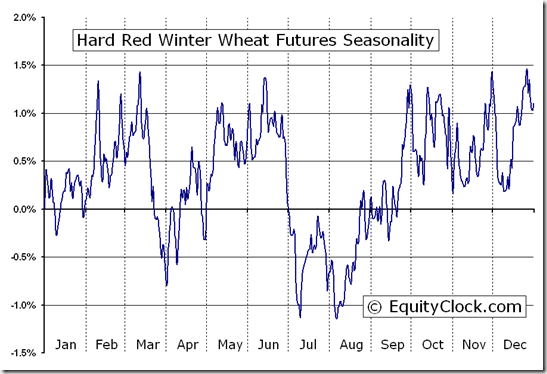
The gains on the session pushed the Dow Jones Industrial Average to a new closing high as the blue chip index attempts to join the other benchmarks in previously uncharted territory. The Dow is presently testing the upper limit of an over 6 month trading range. The Dow has significantly underperformed the S&P 500 since mid-April due to lagging performance in Exxon Mobil, IBM, and Caterpillar, each of which typically trend positive into the end of the year.
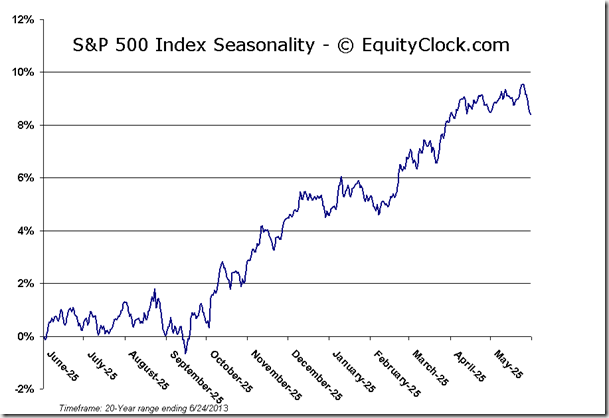
….read more from EquityClock HERE & the full daily report including Interesting Charts from Don Vialoux’s Timing the Market HERE

 And How to Invest in 4D Printing….
4D Printing Potential Makes Me Drool
After more than 30 years in the markets, I’ve seen all kinds of new technologies that are supposed to change the world. Most are pumped by little-known companies with overly hyped marketing, aggressive underwriters, and little more than vaporware. To say I’m jaded would be an understatement.
But I ran across something recently that positively made my mouth drop.
We already know about 3D printing. It’s all the rage right now, because you can buy a printer for a few thousand bucks and cook up whatever your computer can plot.
But 4D printing?
…..read all about it and the companies to invest in HERE
Ed Note: Here is the latest remarkable story about 3D printing (scroll down): Need a Hand? Boy Gets Prosthetic Hand Made by 3-D Printer (Cost $5 vs. $30,000 Medical Device)

 “This could turn into a very violent wake-up call for [screen-traded gold]. People talk about ‘fiat currencies’, but we also have ‘fiat gold.’ Volatility is too cheap right now.” — Gold refiner quoted by John Dizard in his Financial Times column this weekend
In the initial Reuters report on the London-Zurich-Hong Kong-Shanghai gold pipeline, Macquarie gold analyst Matthew Turner suggested that the 1016 metric tonne United Kingdom export (up from 85 tonnes the previous year) might have been shipped to Switzerland for refining into “smaller bars more attractive to Asian consumers or to be vaulted there instead.” Though vaulting cannot be ruled out, the recasting explanation makes considerably more sense given the times and the extraordinary amount of gold being imported by China – over 1500 tonnes so far this year according to research published by the Koos Jansen website. It is difficult to imagine a scenario in which China would be interested in vaulting gold in the West – particularly at a time when the West is experiencing difficult financial and economic circumstances.

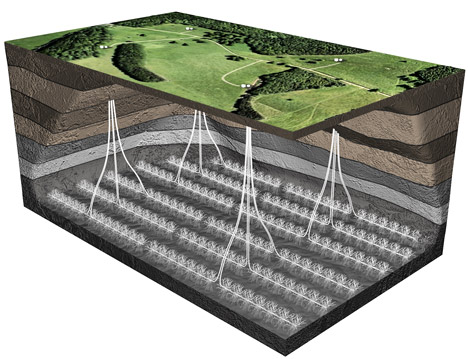 Its official — the U.S. government’s authoritative Energy Information Administration has confirmed that the world’s three leading shale gas producers are U.S., Canada and China, respectively.
In a 23 October report entitled “North America leads the world in production of shale gas” the EIA reports, “The United States and Canada are the only major producers of commercially viable natural gas from shale formations in the world, even though about a dozen other countries have conducted exploratory test wells” and that China is the only nation outside of North America that has registered commercially viable production of shale gas, although the volumes contribute less than 1 percent of the total natural gas production in that country. In comparison, shale gas as a share of total natural gas production in 2012 was 39 percent in the United States and 15 percent in Canada.
This is not the whole global story, however.
According to the “Technically Recoverable Shale Oil and Shale Gas Resources: An Assessment of 137 Shale Formations in 41 Countries Outside the United States” analysis prepared by Advanced Resources International for the EIA, in comparison with 2011 figures, 41 countries were now assessed to have recoverable shale gas reserves, up from 32 two years ago. The number of basins with recoverable shale reserves increased from 41 in 2011 to 48 in 2013, and the number of formations containing shale gas nearly doubled in the same time period, from 69 in 2011 to 137 in 2013. Worldwide, estimates of “technically recoverable resources” of shale gas also increased, from 6,622 trillion cubic feet in 2011 to 7,299 tcf two years later. Shale/”tight oil” estimates also rose, more than 1,000 percent, from 32 billion barrels in 2011 to an impressive 345 bb.
The report’s most arresting statistic is that in only two years, estimates of U.S. potential shale gas reserves soared by nearly 50 percent. “The shale gas resources assessed in this report, combined with EIA’s prior estimate of U.S. shale gas resources, add approximately 47 percent to the 15,583 trillion cubic feet of proved and unproven non-shale technically recoverable natural gas resources. Globally, 32 percent of the total estimated natural gas resources are in shale formations, while 10 percent of estimated oil resources are in shale or tight formations.”
[Hear More: Kurt Wulff: The Big News in the Shale Play – Eagle Ford, Bakken, and Permian]
Another fascinating statistic from the study is its ranking of the “Top 10 countries with technically recoverable shale oil resources.” While the U.S. is first in extraction, the report ranks the Russian Federation in reserves, with 75 billion barrels of technically recoverable shale oil. The U.S. is number two, with 58 bb. China is number 3, with 32 bb, Argentina number 4 with 27 bb, Libya number 5 with 26 bb, Australia number six with 18 bb, leaving Venezuela and Mexico tied for seventh with 13 bb apiece and Pakistan and Canada tied for eighth place, with 9 bb apiece.
A number of interesting conclusions flow from the above information.
First, five of the top shale gas reserves are in the Western Hemisphere – the U.S. Argentina, Venezuela, Mexico and Canada, but only two of them, the U.S. and Canada, have aggressively moved to exploit them.
Secondly, conspicuously absent are Middle Eastern countries Saudi Arabia and Iran, where hydrocarbon information is regarded as a state secret. Iraq is also absent. Energy poor Pakistan and energy power Libya have shale gas reserves, but neither the money nor the technology to exploit them.
In the Pacific, Australia is doing nicely from its coal exports, and is looking towards ramping up its liquefied natural gas exports.
Canada, while having relatively modest shale gas reserves, nevertheless is only trailing the U.S. in their exploitation.
…leaving as wild cards energy superpower Russia and energy starved China, both as yet minors players in the shale gas revolution.
Bottom line?
Given North America’s commanding lead in exploiting shale gas, vast potential opportunities exist, and U.S. and Canadian energy firms can expect profitable contracts from nations endowed with substantive shale gas reserves to come knocking at their doors for assistance in unlocking their subterranean treasures.
About Us
OilPrice.com is the fastest growing energy news site online. Our analysis focuses on Oil and Gas, Alternative Energy and Geopolitics. We have 3 in house writers and publish research from over 150 contributors.
OilPrice works with over 250 syndication partners who re-publish our analysis. Some of our partners are: Zerohedge, Business Insider, Forbes, 24/7 Wall St, Arab News, The Street, Rigzone, Mining.com, Mineweb, Minyanville, Stockhouse + many others…
OilPrice.com publishes more news than any other energy related site online.

-
I know Mike is a very solid investor and respect his opinions very much. So if he says pay attention to this or that - I will.
~ Dale G.
-
I've started managing my own investments so view Michael's site as a one-stop shop from which to get information and perspectives.
~ Dave E.
-
Michael offers easy reading, honest, common sense information that anyone can use in a practical manner.
~ der_al.
-
A sane voice in a scrambled investment world.
~ Ed R.
Inside Edge Pro Contributors

Greg Weldon

Josef Schachter

Tyler Bollhorn

Ryan Irvine

Paul Beattie

Martin Straith

Patrick Ceresna

Mark Leibovit

James Thorne

Victor Adair